Florian Rey1, 2*, Mohamed Nosair2, Hung Ly2
1Division of Cardiology, Department of Medical Specialties, Geneva University Hospitals, Geneva, Switzerland
2Interventional cardiology, Department of Medicine, Montreal Heart Institute, Canada
*Corresponding author: Florian Rey, Interventional cardiology, Department of Medicine,Montreal Heart Institute, 5000 Rue Bélanger, Montreal, QC H1T 1C8. Canada
Received: 19 January 2020; Accepted: 05 February 2020; Published: 25 February 2020
Right Heart Catheterization; Antecubital Vein
Case Report
Vascular access for RHC procedures is usually performed using proximal venous access sites such as the common femoral vein or the internal jugular vein. While these routes are at relatively low risk, significant complications can occur such as large hematomas, pseudoaneurysms, and arterio-venous fistula formation, especially in anticoagulated patients. Using the antecubital vein approach for RHC is an attractive alternative to decrease vascular complication and perform PH assessment during effort.
A 20-gauge peripheral venous catheter is inserted in the antecubital vein. It is exchanged for a slender 7F in 6F transradial introducer (Terumo, Japan). This introducer is inserted after a local anaesthesia over a hydrophilic 0.035” guidewire around the entry point. Subsequently over a 0.025” hydrophilic J-tipped wire (Terumo) advanced under fluoroscopic guidance, a 7-F Swan-Ganz catheter is introduced up to the pulmonary artery (Figure 1). Closure of the venous access is performed by a 10 minutes duration manual compression, and then it is done with a compressive dress.
RHC was first introduced in humans in 1929 by Werner Forssmann, who performed self-catheterization through antecubital venous access [1]. Then, the preferred access site has shifted from the antecubital veins to the proximal veins. However, with the increasing use of transradial arterial access for coronary angiography and left catheterization, antecubital venous access for RHC has reappeared in specialized centers in PH assessment [2-5]. When compared with femoral access, antecubital access was associated with shorter procedure duration and fluoroscopy time and a lower radiation dose [2-5]. It also appeared safer, with fewer access site hematomas [2-5].
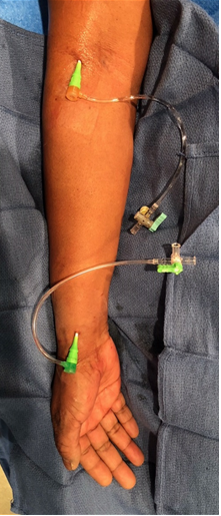
Figure 1: A Terumo Slender 7F in 6F introducer (the orange and green introducer) was inserted in the right antecubital vein. A Terumo 6F (the green introducer) was inserted in the right radial artery.
Conclusion
Using the antecubital vein allows a comprehensive hemodynamic evaluation together with a reduced time of procedure and an excellent safety
References
- Meyer JA. Werner Forssmann and catheterization of the heart, 1929. The Annals of thoracic surgery 49 (1990): 497-499.
- Hoeper MM, Lee SH, Voswinckel R, Palazzini M, Jais X, et al. Complications of right heart catheterization procedures in patients with pulmonary hypertension in experienced centers. Journal of the American College of Cardiology 48 (2006): 2546-2552.
- Shah S, Boyd G, Pyne CT, Bilazarian SD, Piemonte TC, Jeon C and Waxman S. Right heart catheterization using antecubital venous access: feasibility, safety and adoption rate in a tertiary center. Catheter Cardiovasc Interv 84 (2014): 70-74.
- Lo TS, Buch AN, Hall IR, Hildick-Smith DJ and Nolan J. Percutaneous left and right heart catheterization in fully anticoagulated patients utilizing the radial artery and forearm vein: a two-center experience. Journal of interventional cardiology 19 (2006): 258-263.
- Roule V, Ailem S, Legallois D, Dahdouh Z, Lognone T, Bergot E, Grollier G, Milliez P, Sabatier R and Beygui F. Antecubital vs Femoral Venous Access for Right Heart Catheterization: Benefits of a Flashback. Can J Cardiol 31 (2015): 1497e1-6.