Willem Pype1*, Elodie Melsens1, Pieter Van Aelst1, Astrid Rycx1, Dorien Haesen2, Bruno Dillemans1
1Department of General surgery; AZ Sint-Jan Hospital AV, Ruddershove 10, 8000 Brugge, Belgium
2Archer Research CRO, Agoralaan Building A bis, 3590 Diepenbeek, Belgium
*Corresponding Author: Willem Pype, Department of General surgery; AZ Sint-Jan Hospital AV, Ruddershove 10, 8000 Brugge, Belgium
Received: 09 July 2026; Accepted: 20 July 2026; Published: 18 September 2026
Background: Laparoscopic Roux-en-Y gastric bypass (RYGB) has evolved into a leading treatment for obesity. The aim of this study was to assess the safety and the performance of the easyEndoTM Universal Linear Cutting Stapler and Reloads (EziSurg Medical CO., LTD, Shanghai, China) in laparoscopic RYGB surgery.
Methods: This prospective, non-randomized, registry recruited patients who underwent laparoscopic RYGB with the easyEndoTM Universal Linear Cutting Stapler. The primary endpoint was to evaluate the occurrence of peri- and post-operative anastomotic leaks and intraluminal/intraperitoneal bleeding. Patient’s weight loss, primary technical success of the procedure, device performance, complications and frequency of re-interventions were evaluated as secondary outcomes.
Results: 150 patients (102 women and 48 men) underwent laparoscopic RYGB. The mean weight before RYGB was 116.26±19.50 kg, the body mass index (BMI) was 40.54±3.64 kg/m2 and the mean excess weight 44.77±13.70 kg. The operation could be successfully completed in all cases using the easyEndoTM Universal Linear Cutting Stapler. In 3.3% of cases (5/150) a pulsatile bleeding occurred that could be clipped and a staple line disruption occurred in 1.3% of cases (2/150) that was oversewn. No conversions to open laparotomy occurred. Primary technical success was 90.7%. Regarding the primary endpoint, 1 post-operative bleeding occurred on the gastrojejunostomy created by a circular stapler. Postoperative melaena occurred in 3 patients. Twenty-four months after RYGB, the average BMI dropped to 25.91±4.07 kg/m2, with a percentage excess weight loss (%EWL) of 95.74±26.59% and percentage total weight
loss (%TWL) of 35.59±9.53%. A total of 19 post-operative complications occurred in 15 patients (10.0%), mainly internal herniation and small bowel obstruction. Re-interventions were needed in 11 patients (7.3%).
Conclusions: The 24-months follow-up data show that RYGB using the easyEndoTM Universal Linear Cutting Stapler and Reloads is safe and effective with significant weight loss and comparable complication rates according to the literature.
Bariatric surgery, Obesity, Laparoscopy, Roux-en-Y gastric bypass, Linear stapler, Weight loss
Bariatric surgery articles; Obesity articles; Laparoscopy articles; Roux-en-Y gastric bypass articles; Linear stapler articles; Weight loss articles
Introduction
Obesity is a severe condition of global concern and occurs in 13% of the adult population in Western societies [1]. This chronic disease is a risk factor for diabetes, cancer, and cardiovascular, musculoskeletal, and gynecological diseases [2-10]. Today, bariatric surgery combined with lifestyle modifications is considered the best treatment to achieve successful long-term weight loss in individuals with a body mass index (BMI) ≥ 35 kg/m2 with comorbidities or a BMI ≥ 40 kg/m2. Bariatric surgery has been shown to decrease the overall, cardiovascular- and diabetes-related mortality, and leads to greater improvements in quality of life compared to non-surgical alternatives [11-14]. With a steady increase in morbid obesity and further improvements in the already proven efficient surgical techniques, a rapidly increasing demand for bariatric surgery has been noted worldwide [15,16]. Laparoscopic Roux-en-Y gastric bypass (RYGB) is one of the most frequently used bariatric procedures. During RYGB, the stomach is surgically reshaped to create a small gastric pouch distal of the gastroesophageal junction and attached to the jejunum called the ‘Roux Limb’. The Roux limb is then subsequently attached to the biliary limb and thus bypassing the remnant stomach, duodenum and proximal jejunum. This procedure induces a combination of restriction in food intake and some degree of malabsorption. In addition, positive outcomes are attributed to expected changes in cell function, tissue-specific insulin sensitivity, bile acid concentration and gut microbiota, and altered connections between the gastrointestinal system and the brain [17].
It is now possible to complete a laparoscopic RYGB procedure using only stapling devices without suturing. Laparoscopic stapling devices are designed to facilitate the division of tissues, while at the same time ensuring that the divided ends are sealed, and thus creating anastomoses. Staple line/anastomotic reinforcement by suturing, surgical glue or buttress materials may be applied to reduce the risk of staple line leaks and bleedings [18]. Both linear cutting staplers and circular staplers are used in bariatric surgery. The use of stapling devices allows for standardized RYGB procedures, resulting in very low mortality and low morbidity rates [19].
We present the 24-months follow-up data of 150 patients who underwent laparoscopic RYGB with the easyEndoTM Universal Linear Cutting Stapler and Reloads (EziSurg Medical).
Materials and Methods
Study design
The current registry was a monocenter, prospective, single-arm, investigational device registry of patients undergoing laparoscopic RYGB with the easyEndoTM Universal Linear Cutting Stapler and Reloads (EziSurg Medical). Pregnant patients, patients with a history of bariatric surgery and patients who were suspected to be unable to comply with the study protocol or proposed follow-up visits were excluded from this registry. One hundred fifty patients were recruited by the investigational site. This number provides sufficient observations to ensure the scientific validity of the conclusions. Patients who were scheduled for RYGB underwent standard follow-up 6 weeks, 6 months, 12 months and 24 months after the operation. The study protocol was approved by the Ethics Committee of AZ Sint-Jan Brugge-Oostende AV and all patients provided written informed consent. This study was registered on clinicaltrials.gov (NCT03968757). Pseudonymized data were collected in a prospectively maintained electronic database.
Endpoints
The primary endpoint was to investigate the safety of the easyEndoTM Universal Linear Cutting Stapler in laparoscopic RYGB surgery by evaluating peri- and post-operative anastomotic leaks and intraluminal/intraperitoneal bleeding. Secondary endpoints of this study included assessments of the safety profile (peri-operative, early and late complications), of primary technical success of the procedure and device performance, of the bariatric surgery related re-interventions and of the patient’s weight profile. Primary technical success was defined as laparoscopic RYGB formation as intended without technical difficulties and without conversion to laparotomy. Device performance was evaluated for different characteristics of the device using a scoring system from 0 to 4 (0: very unsatisfied, 1: unsatisfied, 2: neutral, 3: satisfied, 4: very satisfied). The patient’s weight profile was described as BMI, percentage excess weight loss (%EWL) and percentage total weight loss (%TWL). The BMI was calculated as the weight divided by the square of the patient’s height (in meters). The %EWL was defined as the baseline weight minus the follow-up weight, divided by the excess body weight, and multiplied by 100. Excess body weight was defined as the weight at the time of surgery minus the ideal body weight, calculated as 25 multiplied by length squared. The %TWL was defined as the baseline weight minus the follow-up weight, divided by the baseline weight, and multiplied by 100.
Procedure
All patients underwent a comprehensive pre-operative assessment. The laparoscopic RYGB procedure was performed according to a standardized surgical technique [19, 20]. All surgeries were performed under general anesthesia. Patients were positioned in the 30° reverse Trendelenburg beach-chair position with split-legs. Abdominal insufflation with carbon dioxide (CO2) was achieved using a Veress needle. Intra-abdominal pressures were maintained at 15 mmHg. A five-port technique was employed. A gastric pouch was created along the lesser curvature of the stomach and oriented vertically with exclusion of the gastric fundus. The gastric pouch volume was between 15.1 and 30.0 ml for the majority of patients (Table 1). On average, 3.39±0.64 reloads were used to create the gastric pouch, mostly 60 mm reloads (Table 1). The Roux limb was brought up in a antecolic position and placed anterior to the stomach remnant. Roux limb length was usually between 100 and 150 cm (88.0%) (Table 1). A gastrojejunostomy using a circular stapler was performed in all cases (Table 1). The circular stapler was preferred to complete the gastrojejunostomy, because, compared to the linear technique, this technique does not require closure of a common opening, eliminating a possible leakage site; traction on the gastrojejunostomy is limited due to an equal distribution of forces on the anastomosis; and the circular stapler has a fixed diameter reproducing the opening. The proximal jejunum was divided distal to the ligament of Treitz. A side-to-side jejunojejunostomy was performed by stapling the anastomosis, with closure of the enterostomy by barbed suture in 95.3% of cases, and a fully stapled anastomosis in 4.7% of cases (Table 1). The 60 mm reloads (R60W-2.5 White) were used to create the jejunojejunostomy in all cases (Table 1). The biliopancreatic limb varied around 70 cm. Intra-operatively, a leak test with methylene blue was performed. Briefly, after positioning of the orogastric tube at the level of the gastrojejunostomy, leakage was checked by injecting 60 ml of methylene blue and air with force while closing the alimentary limb distally. If any leakage was present or if some traction was detected, the gastrojejunostomy was reinforced with additional stitches of an absorbable monofilament suture. The mesenteric gaps were closed with a stapler to prevent the formation of an internal hernia. To prevent post-operative bleeding, all staple lines were inspected at an elevated systolic pressure above 130 mmHg and any detected bleeding points were clipped. A drain is put through the left lateral trocar incision and placed adjacent to the gastric pouch. On the day of surgery, patients remained sober. The following day, they were allowed to drink and yogurt was started. Patients were discharged if pain was controlled, drinking and eating yogurt was successful, and if there was no vomiting, nor any signs of melaena.
|
Characteristics |
Participants (N=150) |
|
Blood pressure during stapling |
|
|
Systolic (mmHg) |
96.71±15.36 |
|
Diastolic (mmHg) |
65.56±12.40 |
|
Cholecystectomy performed |
1/150 (0.7%) |
|
Mean number of reloads used per patient |
6.45±0.72 |
|
4 |
2/150 (1.3%) |
|
6 |
90/150 (60.0%) |
|
7 |
46/150 (30.7%) |
|
8 |
11/150 (7.3%) |
|
9 |
1/150 (0.7%) |
|
Total number of reloads used |
967 |
|
R30B-3.5 Blue total reloads used |
0/967 (0.0%) |
|
R30W-2.5 White total reloads used |
0/967 (0.0%) |
|
R45B-3.5 Blue total reloads used |
12/967 (1.2%) |
|
R45C-3.8 Gold total reloads used |
0/967 (0.0%) |
|
R45G-4.1 Green total reloads used |
0/967 (0.0%) |
|
R45W-2.5 White total reloads used |
0/967 (0.0%) |
|
R60B-3.5 Blue total reloads used |
490/967 (50.7%) |
|
R60C-3.8 Gold total reloads used |
0/967 (0.0%) |
|
R60G-4.1 Green total reloads used |
5/967 (0.5%) |
|
R60W-2.5 White total reloads used |
460/967 (47.6%) |
|
Gastric pouch creation |
|
|
Gastric pouch volume 15.0 ml |
39/150 (26.0%) |
|
Gastric pouch volume 15.1 – 30.0 ml |
110/150 (73.3%) |
|
Gastric pouch volume 40.0 ml |
1/150 (0.7%) |
|
Mean number of reloads used |
3.39±0.64 |
|
1 |
2/150 (1.3%) |
|
3 |
92/150 (61.3%) |
|
4 |
49/150 (32.7%) |
|
5 |
7/150 (4.7%) |
|
Reloads used |
|
|
R60B-3.5 Blue |
140/150 (93.3%) |
|
R45B-3.5 Blue |
4/150 (2.7%) |
|
R60W-2.5 White |
2/150 (1.3%) |
|
R60B-3.5 Blue + R60G-4.1 Green |
3/150 (2.0%) |
|
R60W-2.5 White + R60B-3.5 Blue |
1/150 (0.7%) |
|
Roux-limb construction |
|
|
50 – 100 cm |
18/150 (12.0%) |
|
100 - 150 cm |
132/150 (88.0%) |
|
> 150 cm |
0/150 (0.0%) |
|
Antecolic, antegastric |
150/150 (100%) |
|
Retrocolic, retrogastric |
0/150 (0.0%) |
|
Mean number of reloads used |
1.01±0.08 |
|
1 |
149/150 (99.3%) |
|
2 |
1/150 (0.7%) |
|
Reload used |
|
|
R60W-2.5 White |
|
|
Gastrojejunostomy |
150/150 (100%) |
|
Circular stapled |
150/150 (100%) |
|
Hand – sewn |
0/150 (0.0%) |
|
Linear stapler |
0/150 (0.0%) |
|
Banded outlet |
0/150 (0.0%) |
|
Mean number of reloads used to transect the remaining small bowel 1cm proximal to the gastro-jejunostomy |
|
|
1 |
150/150 (100%) |
|
Reloads used |
|
|
R60W-2.5 White |
149/150 (99.3%) |
|
R60B-3.5 Blue |
1/150 (0.7%) |
|
Jejunojenunostomy |
|
|
Fully stapled |
7/150 (4.7%) |
|
Stapled plus hand sewn |
143/150 (95.3%) |
|
Mean number of reloads used |
1.05±0.21 |
|
1 |
143/150 (95.3%) |
|
2 |
7/150 (4.7%) |
|
Reload used |
|
|
R60W-2.5 White |
150/150 (100%) |
|
Second stapler device used |
3/150 (2.0%) |
|
Estimated volume of blood loss at end of procedure (ml) |
32.47±32.27 |
|
Blood pressure at the end of procedure |
|
|
Systolic (mmHg) |
126.68±14.82 |
|
Diastolic (mmHg) |
82.01±11.88 |
|
Operating time (minutes) |
74.21±19.95 |
|
Hospital stay (days) |
2.43±2.49 |
Table 1: Procedural characteristics of the RYGB procedures.
Linear stapler
The easyEndoTM Universal Linear Cutting Stapler (EziSurg Medical) places two, triple-staggered rows of titanium staples while simultaneously separating the tissue from the central line. The device is available in lengths of 70 mm, 160 mm and 250 mm. Reloads are available in four staple sizes to accommodate different tissue thicknesses: 2.5 mm, 3.5 mm, 3.8 mm and 4.1 mm. The available reload lengths are 30 mm, 45 mm and 60 mm. The device can be reloaded and fired up to 25 times during one procedure. The shaft of the easyEndoTM Universal Linear Cutting Stapler rotates freely and achieves an articulation angle of 60 degrees to facilitate lateral access to the operative site. It is the world’s first full 60° laparoscopic linear cutter stapler. Transection and creation of anastomoses were performed according to the instructions for use.
Statistics
Continuous variables are presented as mean (standard deviation [SD]), median and range, and the 95% confidence interval (CI) based on the Student’s-t distribution. Categorical variables are presented as number, denominator and percentage, and a 95% Clopper Pearson interval. As this is a single arm study, no statistical inferences are made with regards to comparison of treatment arms or subgroups. All applicable statistical tests are two-sided and are performed using a 5% significance level. No adjustments are made for multiplicity for the primary and secondary outcomes. For parameters which were recorded at multiple visits (baseline and follow-up visits), the change from baseline is statistically tested using the paired Student’s t test (continuous variables). Statistical tests with a p-value <0.05 are considered as statistically significant. The number of missing observations is reported. Data are summarized as observed with no imputation for missing values. Statistical expertise was available to the authors. All datasets, table and figures, and statistical analyses were created by SBD Analytics (Bekkevoort, Belgium) using the SAS Statistical Software packages (SAS V9.4, The SAS Institute, Cary NC).
Results
A total of 150 patients (102 women and 48 men) underwent laparoscopic RYGB surgery using the easyEndoTM Universal Linear Cutting Stapler from October of 2019 until January of 2021 at one Belgian center. The last follow-up was registered in April of 2023. Descriptive characteristics of the patients are listed in table 2. The patients had a mean age of 40.8±12.96 years. Pre-operatively, the patients had a mean weight of 116.26±19.50 kg, a BMI of 40.54±3.64 kg/m2 and a mean excess weight of 44.77±13.70 kg. Three hundred and eight co-morbidities were reported, mainly hypertension in 40, hypercholesterolemia in 74, Obstructive Sleep Apnoea Syndrome (OSAS) in 48 and gastroesophageal reflux disease in 44. Overall, 21.2% of patients smoked. Six percent of the patients used antiplatelet drugs and 3.3% immunosuppressants. Furthermore, 22.7% (34/150) underwent previous abdominal surgery.
|
Characteristics |
Participants (N=150) |
|
Age (y) |
40.78±12.96 |
|
Sex ratio (M:F) |
(48 : 102) (32.0% : 68.0%) |
|
ASA II |
130/150 (86.7%) |
|
ASA III |
20/150 (13.3%) |
|
Current smoker |
31/146 (21.2%) |
|
Ex-smoker (>6 months) |
23/146 (15.8%) |
|
Diabetes type I |
2/150 (1.3%) |
|
Diabetes type II |
15/150 (10.0%) |
|
Oral anti-diabetics |
15/149 (10.1%) |
|
Obstructive Sleep Apnoea Syndrome (OSAS) |
48/139 (34.5%) |
|
Hypertension |
40/150 (26.7%) |
|
Hypercholesterolemia |
74/149 (49.7%) |
|
Hypertriglyceridemia |
39/140 (27.9%) |
|
Asthma |
5/150 (3.3%) |
|
Degenerative joint disease |
27/149 (18.1%) |
|
Gastroesophageal reflux |
44/148 (29.7%) |
|
Chronic obstructive pulmonary disease (COPD) |
2/150 (1.3%) |
|
Use of immunosuppressants (corticoids, …) |
5/150 (3.3%) |
|
Other |
|
|
Bechterew’s disease |
1/150 (0.7%) |
|
Graves disease |
1/150 (0.7%) |
|
History of deep venous thrombosis |
4/150 (2.7%) |
|
Hypothyroidism |
3/150 (2.0%) |
|
Rheumatoid arthritis |
2/150 (1.3%) |
|
Weight profile |
|
|
Weight (kg) |
116.26±19.50 |
|
BMI (kg/m2) |
40.54±3.64 |
|
BMI class |
|
|
35.0 – 39.9 class II obesity |
54/150 (36.0%) |
|
≥ 40.0 class III obesity |
96/150 (64.0%) |
|
Ideal body weight (kg) |
71.50±7.88 |
|
Excess body weight (kg) |
44.77±13.70 |
|
Antiplatelet intake |
9/150 (6.0%) |
|
Previous abdominal surgery |
34/150 (22.7%) |
|
Bowel obstruction |
1/150 (0.7%) |
|
Cesarean section |
6/150 (4.0%) |
|
Abdominoplasty |
1/150 (0.7%) |
|
Hysterectomy |
1/150 (0.7%) |
|
Appendectomy |
18/150 (12.0%) |
|
Cholecystectomy |
8/150 (5.3%) |
|
Ovariectomy |
1/150 (0.7%) |
ASA: American Society of Anesthesiologists, BMI: Body Mass Index.
Table 2: Descriptive characteristics of all patients at baseline.
The operation could be successfully completed in all cases. During intra-operative inspection of the staple lines, pulsatile bleeding was identified in 5 patients (3.3%) and the detected bleeding points were clipped. Primary technical success of the procedure was achieved in 90.7% of the patients (136/150). One intra-operative complication occurred (0.7%), which was a gastric pouch rupture during positioning of the anvil of a circular staple during gastrojejunostomy. As a result, the gastric pouch was shortened and a new gastrojejunostomy was made. No conversions to laparotomy occurred. There were 14 device deficiencies in 13 patients (8.7%), mainly technical defects of the stapler in 9 (6.0%) for which the use of a second stapler device was indicated in 3 cases, staple line disruption in 2 (1.3%) for which the staple line was oversewn, and tissue slippage/movement during firing in 3 patients (2.0%). Procedural characteristics are listed in table 1. An additional cholecystectomy was performed in one patient. The mean operating time was 74.21±19.95 minutes. The mean hospitalization stay was approximately 2.5 days. Surgeon’s device performance scoring is shown in table 3. The stapler scored the highest on ‘staple line formation’ (3.4/4) and the lowest on ‘ease of resetting, unclamping and removing the device from the target tissue’ (2.3/4).
|
Participants (N=146) |
|
|
Device performance assessment (score/4): |
|
|
Ease of intra-abdominal device positioning |
2.71±0.86 |
|
Adequate tissue compression before firing |
2.81±0.98 |
|
Sharpness of the blades of the reloads |
3.35±0.68 |
|
Staple line formation |
3.36±0.65 |
|
Ease of resetting, unclamping and removing the device from the target tissue |
2.33±0.93 |
|
Consistency and reliability |
2.83±0.85 |
|
Haemostasis |
3.09±0.80 |
|
Usability/ergonomics |
2.49±0.92 |
Table 3: Device performance assessment.
Of the 150 patients recruited for RYGB treatment, 132 patients (88.0%) completed the 6-week follow-up as 18 patients lacked follow-up data. Before the 6-month visit, 1 patient withdrew participation. At 6, 12 and 24 months, 32, 28 and 32 patients were lost to follow-up, respectively. In addition, 1 patient died between the 12- and 24-months follow-up visit, leaving 117 (78.0%), 121 (80.7%) and 116 (77.3%) patients available for weight assessment at 6, 12 and 24 months, respectively.
At the time of RYGB, the patients had a mean weight of 116.26±19.50 kg and a BMI of 40.54±3.64 kg/m2 (Table 2 and 4). At 24 months follow-up, the BMI had decreased to 25.91±4.07 kg/m2, the %EWL was 95.74±26.59% and a %TWL of 35.59±9.53% was achieved (Table 4, Figure 1). The weight evolution of the individual patients is shown in figure 2. A potential bias that could not be ruled out, is the weight loss resulting from individual compliance to diet and exercise regimen during follow-up after RYGB surgery.
|
at RYGB (n=150) |
6 weeks (n=132) |
6 months (n=117) |
12 months (n=121) |
24 months (n=116) |
|
|
Weight (kg) |
116.26±19.50 |
98.41±16.08 |
81.15±13.42 |
74.06±12.34 |
73.80±14.46 |
|
(83.80 , 215.00) |
(70.00 , 182.00) |
(58.00 , 124.00) |
(50.00 , 108.00) |
(49.50 , 138.00) |
|
|
BMI (kg/m2) |
40.54±3.64 |
34.55±3.54 |
28.50±3.20 |
25.99±3.31 |
25.91±4.07 |
|
(35.00 , 57.70) |
(28.05 , 48.86) |
(21.26 , 37.14) |
(19.98 , 35.49) |
(20.24 , 40.12) |
|
|
Weight loss (kg) |
/ |
17.12±5.22 |
33.38±8.61 |
40.99±12.41 |
41.16±13.86 |
|
(8.20 , 33.00) |
(14.90 , 64.30) |
(11.90 , 91.30) |
(-6.00 , 98.30) |
||
|
p<.0001 |
p<.0001 |
p<.0001 |
p<.0001 |
||
|
%TWL |
/ |
14.77±3.58 |
29.08±5.68 |
35.38±7.67 |
35.59±9.53 |
|
(8.02 , 25.46) |
(13.68 , 43.22) |
(12.28 , 50.00) |
(-5.45 , 53.63) |
||
|
p<.0001 |
p<.0001 |
p<.0001 |
p<.0001 |
||
|
%EWL |
/ |
39.81±11.35 |
78.97±18.26 |
95.17±21.88 |
95.74±26.59 |
|
(19.46 , 69.89) |
(33.79 , 132.45) |
(37.07 , 138.60) |
(-17.06 , 141.60) |
||
|
p<.0001 |
p<.0001 |
p<.0001 |
p<.0001 |
||
|
BMI loss (kg/m2) |
/ |
5.98±1.51 |
11.70±2.52 |
14.33±3.63 |
14.42±4.30 |
|
(3.41 , 10.73) |
(5.75 , 20.07) |
(4.59 , 28.49) |
(-2.00 , 30.68) |
||
|
p<.0001 |
p<.0001 |
p<.0001 |
p<.0001 |
BMI: Body Mass Index, EWL: excess weight loss, RYGB: Roux-en-Y gastric bypass, TWL: total weight loss
Table 4: Patient’s weight loss during follow-up, relative to the weight at RYGB.
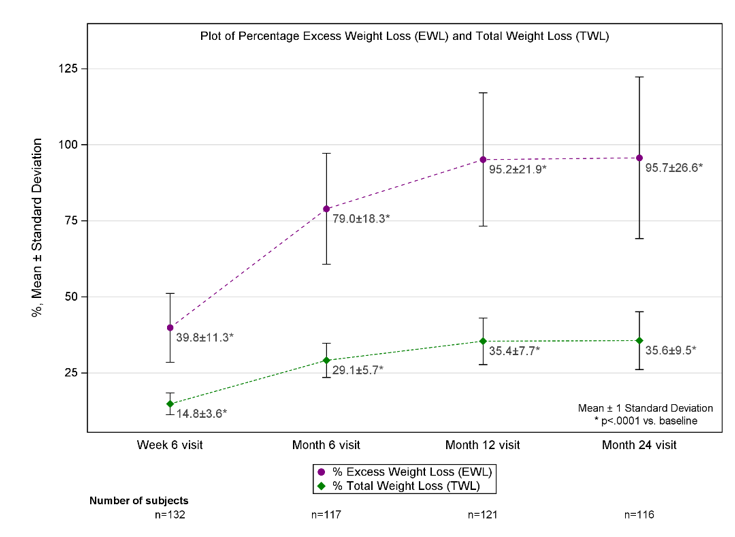
Figure 1: EWL TWL.
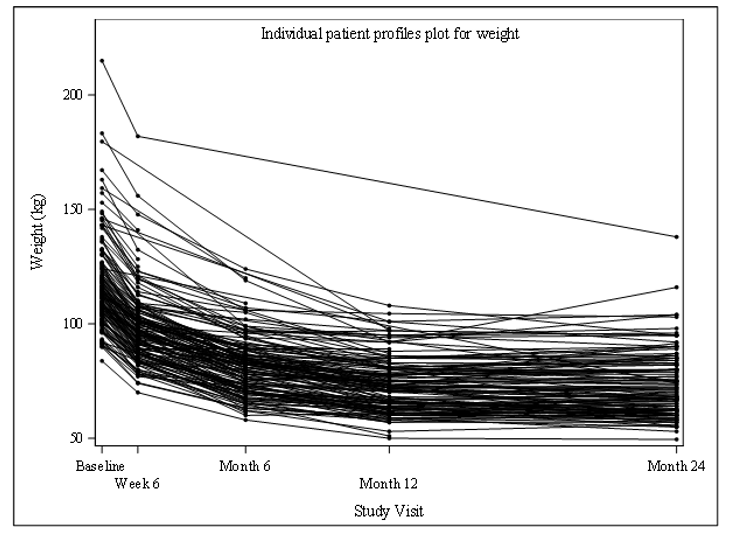
Figure 2: Weight profiles.
A total of 19 post-operative complications occurred in 15 patients (10.0%) during the 24-months follow-up period (Table 5), of which 7 complications occurred within 30 days after the operation. Regarding the primary endpoint of this study, one patient experienced bleeding of the gastrojejunostomy created by a circular stapler. A gastroscopy was performed and the bleeding vessel was clipped. A blood transfusion was required. A gastroscopy was also performed for a second patient because of melaena, but the bleeding could not be visualized. Presumably, the jejunojejunostomy was involved. The patient was successfully treated with tranexamic acid and fluid resuscitation. In addition, post-operative melaena occurred in 2 more patients, one of whom required a blood transfusion and one was treated with tranexamic acid. All 4 bleedings occurred post-operatively before discharge. Other post-operative complications included mainly internal herniation in 5 patients (3.3%) requiring a re-operation with reduction of the internal hernia and closure of the mesenteric defect. Three patients (2.0%) experienced obstruction of the small bowel due to adhesions treated with adhesiolysis. Laparoscopic cholecystectomy was performed in 2 patients with acute cholecystitis (1.3%). Acute pancreatitis due to blunt trauma was diagnosed in one patient (0.7%) and treated with laparoscopic rinsing and drainage. Other complications included dysphagia due to anastomotic stricture (0.7%) and Forrest III anastomotic ulcer (0.7%), both treated with a higher dose of proton pump inhibitors, and wound infection (0.7%) with surgical debridement and IV antibiotics. Therefore, in total, 11 re-interventions occurred (7.3%), 1 for intraluminal bleeding on the gastrojejunal anastomosis, 5 for internal herniation, 3 for small bowel obstruction, 1 for acute pancreatitis and 1 for ulceration. The re-intervention rate was also evaluated using Kaplan-Meier point estimate, which showed a rate of 8.3% at 24 months (Figure 3). One patient underwent a re-intervention 1.5 years after the initial RYGB surgery due to internal herniation. The patient reported limited abdominal pain (i.e., normal post-operative pain) during a checkup by the general practitioner and was found dead at home 6 days later. The reason remains unclear; no pathology was performed.
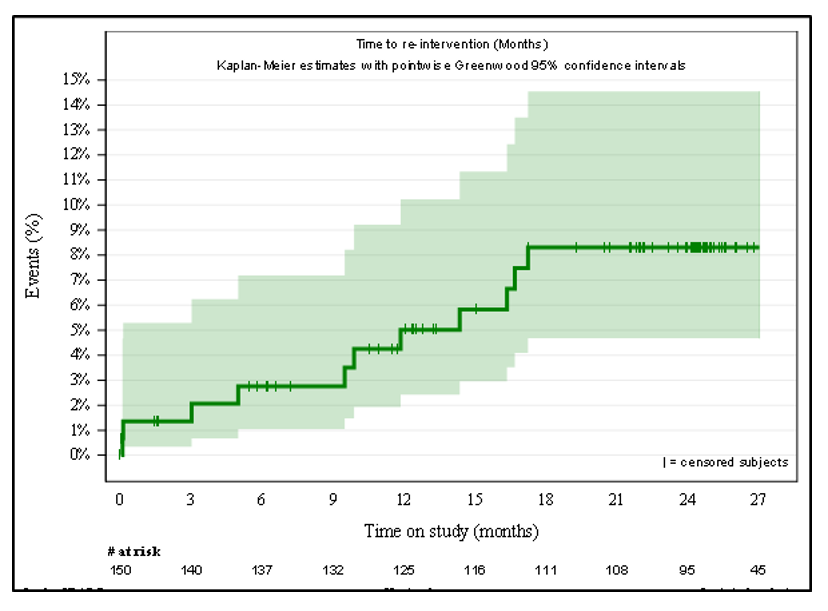
Figure 3:
|
Participants (N=150) |
|
|
Intra-operative complications |
|
|
Pouch rupture |
1/150 (0.7%) |
|
Post-operative complications |
|
|
Anastomotic bleeding |
1/150 (0.7%) |
|
Melaena |
3/150 (2.0%) |
|
Internal hernia |
5/150 (3.3%) |
|
Small bowel obstruction |
3/150 (2.0%) |
|
Acute cholecystitis |
2/150 (1.3%) |
|
Pancreatic injury |
1/150 (0.7%) |
|
Anastomotic stenosis/stricture |
1/150 (0.7%) |
|
Ulceration |
1/150 (0.7%) |
|
Wound infection |
1/150 (0.7%) |
|
Death |
1/150 (0.7%) |
Table 5: Intra- and post-operative complications.
Discussion
Laparoscopic RYGB is considered the gold standard among surgical bariatric options for obese patients. Despite the increasing number of procedures performed and, consequently, increasing surgical experience with this procedure, RYGB remains technically challenging. As with all medical procedures, post-operative complications can occur. And although they are rare (rates ranging between 2 and 15%), they can be life-threatening [21-24]. Gastro-intestinal leaks are the most important cause of RYGB surgery-related mortality with leak-associated mortality reaching from 37.5 to 50% [25-28]. Leaks are often early complications, usually occurring within 1 week of surgery [18]. The reported incidence of post-operative leaks for laparoscopic RYGB in the literature varies from 0.1 to 5.8% [25, 28-32]. Leaks were not observed in this study. Staple line disruption at the jejunojejunostomy was identified intra-operatively in 2 patients (1.3%) for which the staple line was oversewn. Furthermore, the most common sites of bleeding are the staple lines that are likely to bleed extraluminal (intraperitoneal) or intraluminal. Four bleedings (2.6%) were recognized early post-procedure of which 3 were managed conservatively without the need for a surgical re-intervention. Bleeding usually occurs in the early post-operative course within the first hours to days [25] and can occur at any of the five possible staple lines: the gastric pouch, excluded stomach, Roux limb staple line, gastrojejunostomy, and jejunojejunostomy. Reported incidences of post-operative bleeding are 1.3 to 3.1% [18]. As with any bleeding associated with surgery, early diagnosis is crucial by careful clinical and hemodynamic monitoring of the patient combined with observation of the output of the intra-abdominal drain. In contrast to the predominance of data on post-operative staple line leaks and bleeding, documentation of intra-operative leaks and bleeding is inconsistent or absent in most published studies on laparoscopic RYGB. A literature search by Gosh et al 2016 identified 2 articles that reported intra-operative leaks and/or bleeds in up to 8.3% and 3.5% of cases respectively, compared to 1.3% and 3.3% in the current study [33-35]. Rates of common RYGB surgery-related complications such as internal hernia, small bowel obstruction, anastomotic stricture and ulceration remained well within the reported ranges; 3.3% vs. 1-5% reported for internal herniation [36,37], 2.0% vs. 1.5-5% for small bowel obstruction [38], 0.7% vs. 3-7% for anastomotic stricture [27,39] and 0.7% vs. 1-16% for ulceration [27]. Technical defects of the easyEndoTM Universal Linear Cutting Stapler were observed in 9 patients (6%), including misfiring of the stapler, reload defect, incorrect installation of a reload, problems with assembly and spontaneous opening of the stapler prior to firing. All technical defects were corrected intra-operatively; a new stapler device was used in 3 cases. Based on the user feedback, EziSurg Medical reduced the climbing force of the stapler, organized enhanced training on reload loading and optimized the reload assembly method. None of the observed technical defects resulted in post-operative complications for the patient. Tissue slippage/movement during firing occurred in 3 patients without complications. The accuracy of bending control and the clamping force of the easyEndoTM Universal Linear Cutting Stapler were improved to minimize tissue slippage.
The present study has some limitations. It is a monocentric study and the study was initiated during the surgeon’s learning curve of the stapler. In addition, the stapler has undergone significant developments. Therefore, complications and complication rates may be different for the current device on the market.
In conclusion, the 24-months follow-up data show that RYGB using the easyEndoTM Universal Linear Cutting Stapler and Reloads is safe and effective with significant weight loss and comparable complication rates according to the literature.
Acknowledgements
The authors would like to thank Erik Spaepen (SBD Analytics) for his assistance with the statistical analyses.
Disclosures
Bruno Dillemans discloses he has conflicts of interest with Johnson and Johnson, Medtronic and Olympus. Willem Pype, Elodie Melsens, Pieter Van Aelst, Astrid Rycx and Dorien Haesen have no conflicts of interest or financial ties to disclose.
Funding
This study received funding from Palex Belgium (Mechelen, Belgium).
References
- Obesity and overweight (2021).
- Abdullah A, Peeters A, de Courten M, et al. The magnitude of association between overweight and obesity and the risk of diabetes: a meta-analysis of prospective cohort studies. Diabetes Res Clin Pract 89 (2010): 309-319.
- Bogers RP, Bemelmans WJ, Hoogenveen RT, et al. Association of overweight with increased risk of coronary heart disease partly independent of blood pressure and cholesterol levels: a meta-analysis of 21 cohort studies including more than 300 000 persons. Arch Intern Med 167 (2007): 1720-1728.
- Butterworth PA, Landorf KB, Smith SE, et al. The association between body mass index and musculoskeletal foot disorders: a systematic review. Obes Rev 13 (2012): 630-642.
- Heslehurst N, Simpson H, Ells LJ, et al. The impact of maternal BMI status on pregnancy outcomes with immediate short-term obstetric resource implications: a meta-analysis. Obes Rev 9 (2008): 635-683.
- Huerta JM, Tormo MJ, Chirlaque MD, et al. Risk of type 2 diabetes according to traditional and emerging anthropometric indices in Spain, a Mediterranean country with high prevalence of obesity: results from a large-scale prospective cohort study. BMC Endocr Disord 13 (2013): 7.
- Lim SS, Norman RJ, Davies MJ, et al. The effect of obesity on polycystic ovary syndrome: a systematic review and meta-analysis. Obes Rev 14 (2013): 95-109.
- Nguyen NT, Magno CP, Lane KT, et al. Association of hypertension, diabetes, dyslipidemia, and metabolic syndrome with obesity: findings from the National Health and Nutrition Examination Survey, 1999 to 2004. J Am Coll Surg 207 (2008): 928-934.
- Renehan AG, Tyson M, Egger M, et al. Body-mass index and incidence of cancer: a systematic review and meta-analysis of prospective observational studies. Lancet 371 (2008): 569-578.
- Strazzullo P, D'Elia L, Cairella G, et al. Excess body weight and incidence of stroke: meta-analysis of prospective studies with 2 million participants. Stroke 41 (2010): e418-426.
- Adams TD, Davidson LE, Litwin SE, et al. Health benefits of gastric bypass surgery after 6 years. JAMA 308 (2012): 1122-1131.
- Adams TD, Gress RE, Smith SC, et al. Long-term mortality after gastric bypass surgery. N Engl J Med 357 (2007): 753-761.
- Colquitt JL, Pickett K, Loveman E, et al. Surgery for weight loss in adults. Cochrane Database Syst Rev 2014 (2014): CD003641.
- Sjostrom L. Review of the key results from the Swedish Obese Subjects (SOS) trial - a prospective controlled intervention study of bariatric surgery. J Intern Med 273 (2013): 219-234.
- European Regional Obesity Report 2022. Copenhagen: WHO Regional Office for Europe (2022). Licence: CC BY-NC-SA 3.0 IGO.
- Lee WJ, Almalki O. Recent advancements in bariatric/metabolic surgery. Ann Gastroenterol Surg 1 (2017): 171-179.
- Castellana M, Procino F, Biacchi E, et al. Roux-en-Y Gastric Bypass vs Sleeve Gastrectomy for Remission of Type 2 Diabetes. J Clin Endocrinol Metab 106 (2021): 922-933.
- Silecchia G, Iossa A. Complications of staple line and anastomoses following laparoscopic bariatric surgery. Ann Gastroenterol 31 (2018): 56-64.
- Dillemans B, Sakran N, Van Cauwenberge S, et al. Standardization of the fully stapled laparoscopic Roux-en-Y gastric bypass for obesity reduces early immediate postoperative morbidity and mortality: a single center study on 2606 patients. Obes Surg 19 (2009): 1355-1364.
- Dillemans B, Deylgat B, Viskens S. Laparoscopic Roux-en-Y Gastric Bypass: The Standardized Technique. In: Agrawal S. (eds) Obesity, Bariatric and Metabolic Surgery. Springer, Cham (2022).
- Arterburn DE, Telem DA, Kushner RF, et al. Benefits and Risks of Bariatric Surgery in Adults: A Review. JAMA 324 (2020): 879-887.
- Clayton RD, Carucci LR. Imaging following bariatric surgery: roux-en-Y gastric bypass, laparoscopic adjustable gastric banding and sleeve gastrectomy. Br J Radiol 91 (2018): 20180031.
- Levine MS, Carucci LR. Imaging of bariatric surgery: normal anatomy and postoperative complications. Radiology 270 (2014): 327-341.
- Major P, Wysocki M, Pedziwiatr M, et al. Risk factors for complications of laparoscopic sleeve gastrectomy and laparoscopic Roux-en-Y gastric bypass. Int J Surg 37 (2017): 71-78.
- Acquafresca PA, Palermo M, Rogula T, et al. Early surgical complications after gastric by-pass: a literature review. Arq Bras Cir Dig 28 (2015): 74-80.
- Daigle CR, Brethauer SA, Tu C, et al. Which postoperative complications matter most after bariatric surgery? Prioritizing quality improvement efforts to improve national outcomes. Surg Obes Relat Dis 14 (2018): 652-657.
- Palermo M, Acquafresca PA, Rogula T, et al. Late surgical complications after gastric by-pass: a literature review. Arq Bras Cir Dig 28 (2015): 139-143.
- Valli PV, Gubler C. Review article including treatment algorithm: endoscopic treatment of luminal complications after bariatric surgery. Clin Obes 7 (2017): 115-122.
- Abou Rached A, Basile M, El Masri H. Gastric leaks post sleeve gastrectomy: review of its prevention and management. World J Gastroenterol 20 (2014): 13904-13910.
- Committee ACI. Updated position statement on sleeve gastrectomy as a bariatric procedure. Surg Obes Relat Dis 8 (2012): e21-26.
- Fullum TM, Aluka KJ, Turner PL. Decreasing anastomotic and staple line leaks after laparoscopic Roux-en-Y gastric bypass. Surg Endosc 23 (2009): 1403-1408.
- Wittgrove AC, Clark GW. Laparoscopic gastric bypass, Roux-en-Y- 500 patients: technique and results, with 3-60 month follow-up. Obes Surg 10 (2000): 233-239.
- Alasfar F, Chand B. Intraoperative endoscopy for laparoscopic Roux-en-Y gastric bypass: leak test and beyond. Surg Laparosc Endosc Percutan Tech 20 (2010): 424-427.
- Ghosh SK, Roy S, Chekan E, et al. A Narrative of Intraoperative Staple Line Leaks and Bleeds During Bariatric Surgery. Obes Surg 26 (2016): 1601-1606.
- Madan AK, Martinez JM, Lo Menzo E, et al. Omental reinforcement for intraoperative leak repairs during laparoscopic Roux-en-Y gastric bypass. Am Surg 75 (2009): 839-842.
- Ende V, Devas N, Zhang X, et al. Internal hernia trends following gastric bypass surgery. Surg Endosc 37 (2023): 7183-7191.
- Paroz A, Calmes JM, Giusti V, et al. Internal hernia after laparoscopic Roux-en-Y gastric bypass for morbid obesity: a continuous challenge in bariatric surgery. Obes Surg 16 (2006): 1482-1487.
- Husain S, Ahmed AR, Johnson J, et al. Small-bowel obstruction after laparoscopic Roux-en-Y gastric bypass: etiology, diagnosis, and management. Arch Surg 142 (2007): 988-993.
- Goitein D, Papasavas PK, Gagne D, et al. Gastrojejunal strictures following laparoscopic Roux-en-Y gastric bypass for morbid obesity. Surg Endosc 19 (2005): 628-632.