Kyeong Mee Park*,1, Tae Hwan Cho2
1Vibra Korean Medicine Clinic, Tongyeong, South Korea
2Cho Orthopaedic & Oriental Clinc, Seoul, South Korea
*Corresponding author: Kyeong Mee Park. Vibra Korean Medicine Clinic, Tongyeong, South Korea.
Received: 18 August 2026; Accepted: 25 August 2026; Published: XX August 2026
Fatigue is one of the most prevalent and clinically significant complaints among old adults worldwide. Bojungikgitang (BJIGT) has been one of the most widely used formulas for alleviating fatigue-related conditions in East Asia. The retrospective records of patients aged 50 to 60 years who presented with elevated fatigue severity and received BJIGT over a 20-day course were investigated. BJIGT administration resulted in improvements across three interrelated functional domains: reduction in fatigue severity, expansion of productive daily activity time and substantial improvement in digestive capacity.
Bojungikgitang; Fatigue; digestive dysfunction
Bojungikgitang articles; Fatigue articles; digestive dysfunction articles
Introduction
Fatigue is a common complaint in older adults and is associated with poor quality of life, functional disability and increased mortality [1-3]. A recent systematic review and meta-analysis reported that 42.6% of older adults suffered fatigue and the physical fatigability reached 58.2% in the group [4]. Nonetheless, fatigue in older adults remains undertreated in conventional medicine because there is no established standard pharmacological treatment [5]. Among East Asian herbal prescriptions, Bojungikgitang (BJIGT) has been one of the most widely used formulas for alleviating fatigue-related conditions in China, Japan and Korea [6]. BJIGT addresses the condition in which Spleen and Stomach function is weakened leading to Qi deficiency [7]. The treatment of BJIGT was shown to improve fatigue, loss of appetite and functional decline associated with qi-deficiency patterns in diverse clinical populations [8, 9]. Yet, there is limited clinical evidence specifically examining the effects of BJIGT on fatigue in adults with 50s and 60s who commonly encounter age-related physiological decline and qi deficiency. This study examines retrospectively the clinical records of patients aged 50 to 60 years who presented with elevated fatigue severity and received BJIGT for 20 days at a Korean Medicine outpatient clinic. The findings of this study may contribute to the growing evidence base supporting the clinical application of BJIGT for age-associated fatigue.
Materials and Methods
Subjects
This study was done by a retrospective chart review of patients with fatigue who presented at Vibra Korean Medicine Clinic in Tongyeong, South Korea between August 2025 and April 2026. Patients with fatigue in the age range of 51-69, with symptom duration of more than 3 months were included in the study. Exclusion criteria included history or presence of malignant disorders, auto-immune diseases, infection and recent history of severe trauma. The average age of patients was 62.3 ± 5.1 with 17 males and 19 females.
Preparation of Bojungikgitang (BJIGT)
Appropriate amounts of BJIGT were measured and boiled at 100 degrees Celsius in deionized water for three hours. The resulting decoction was then dispensed into polypropylene pouches at 120 mL per pouch, yielding a total of 40 pouches. Patients were instructed to consume two pouches per day. The amount of herbal ingradients of BJIGT per single dose was as follows: Astragalus root 5.625 g, Panax ginseng root 3.75 g, White Atractylodes rhizome 3.75 g, Licorice root 3.75 g, Angelica root 1.875 g, Tangerine peel 1.875 g, Bupleurum root 1.125 g and Cimicifuga rhizome 1.125 g.
Data collection and analysis
In the present study, outcome measures were obtained at two time points, prior to and post to the 20-day BJIGT administration course. The primary outcome measure was fatigue. At both assessment time points, patients completed the nine-item fatigue severity scale (FSS) questionnaire and the mean FSS score was calculated. A mean FSS score of ≥ 4.0 is generally considered indicative of clinically significant fatigue (10).
The secondary efficacy outcome measures include the digestive capacity and productive time. A 0–10 visual analogue scale (VAS) was used to capture self-rated digestive capacity which includes resolution of postprandial bloating, loss of appetite and indigestion. The patients were asked to indicate their feeling of digestive capacity by drawing a vertical line on a 10 cm VAS before and after 20-day administration of BJIGT. Higher scores of VAS indicate superior digestive function. At the same time, interviews for daily working hours without break were performed. Each patient was asked to denote how many hours they manage daily physical activities without sensation of fatigue and fatigue-evoked work break; which includes housework, 30 minute-walking outside, participating in their living communities and favorite pursuit, scored from zero to 12. The result was designated as productive time, in which low scores indicate severer disability. Data are expressed as the mean ± standard deviation. Statistical significance differences between before and after 20-day administration of BJIGT are determined with Student’s t-test.
Result
The baseline FSS of 5.8 in the present cohort indicates severe fatigue, substantially exceeding the clinical threshold. The post-treatment FSS of 3.3 represents that BJIGT administration reduced 2.6 points to non-fatigue territory (Fig. 1).
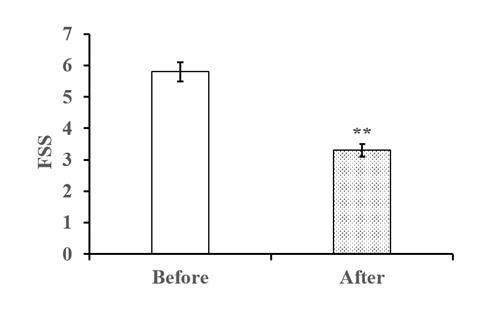
Figure 1: Effect of BJIGT on fatigue
Values of Y-axis represent fatigue severity scale. Statistical significances are denoted between before and after BJIGT administration; ** at p < 0.01.
As for digestive capacity, a 0–10 VAS was used to center patients and capture self-rating. The VAS value increased from 4.1 to 7.8, representing digestive improvement by 3.7 points (Fig. 2). The crossing of the midpoint from below to well above the scale center suggests a qualitative transition in the participants' experience from functional impairment to effective digestion.
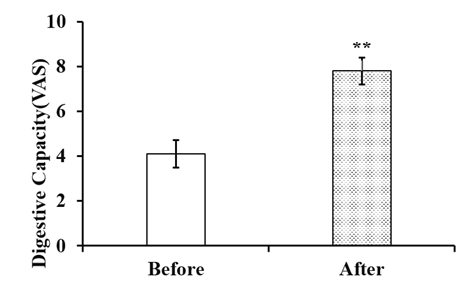
Figure 2: Effect of BJIGT on digestive capacity
Values of Y-axis represent degrees of digestibility expressed by VAS. Statistical significances are denoted between before and after BJIGT administration; ** at p < 0.01.
Productive time encompasses activities that require not only energy and absence of fatigue but also freedom from the gastrointestinal discomfort that can independently restrict activity. An increase in productive time was evident from 6.5 to 8.9 hours per day through BJIGT administration (Fig. 3). A gain of approximately 2.4 hours of fatigue-free productive time may reflect the combined and mutually reinforcing benefits of digestive restoration and fatigue reduction.
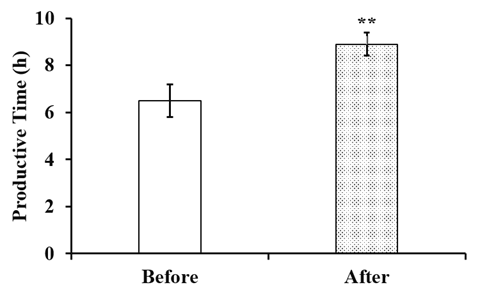
Figure 3: Effect of BJIGT on productive time
Values of Y-axis represent the moderate daily working hours without break. Statistical significances are denoted between before and after BJIGT administration; ** at p < 0.01.
Discussion
The most intellectually significant aspect of the present findings is the simultaneous and presumably interrelated improvement across the digestive and fatigue outcome domains. Classically BJIGT has been used for treating the condition in which Spleen and Stomach function is weakened leading to Qi deficiency encompassing loss of appetite, extreme fatigue and weakness of the limbs (11). The present cohort demonstrated BJIGT administration in 36 community-dwelling men and women aged 50–60 years resulted in interrelated improvements in productivity and digestibility.
From the traditional Korean medicine perspective, the decline of digestive and absorptive capacity impairs the ascent of clear nutritive energy to the Lung and disrupts the generation of the body's active energy, resulting in severe fatigue and lassitude. From a modern biological perspective, the improved gastric emptying and intestinal transit enhances the digestion and absorption of nutrients thereby increasing the substrate availability for mitochondrial energy production in peripheral tissues.
Among constituents of BJIGT, Astragalus supports mitochondrial function by improving cellular energy production and reducing age-related mitochondrial decline (12). Panax ginseng contributes through its adaptogenic, anti-fatigue and neuroendocrine-regulatory properties (13). Atractylodes macrocephala combines with Panax ginseng and Astragalus to elevate the excitability of both skeletal and smooth muscle, playing a central role in resolving fatigue and weakness of extremities (14). Experimental evidence demonstrated that BJIGT significantly increased intestinal transit rate and serum levels of motilin in mice (15), providing a direct mechanistic explanation for the BJIGT’s resolution of digestive dysfunction in the present cohort. A clinical trial of Korean herbal medicines for chronic COVID-19 sequelae demonstrated the BJIGT exhibited a particularly strong and consistent fatigue-relieving effect (80%) compared to other major tonifying formulas including Gyeongokgo (53.3%) and Cheonwangbosimdang (46.7%) (16).
The present study has important limitations that temper the strength of its conclusions and indicate the necessary directions for future investigation. First, the retrospective, uncontrolled design precludes causal inference. The outcome measures including FSS, digestive VAS and productive time are subjective self-report measures that are particularly susceptible to expectation effects in an unblinded setting. Second, the sample size of 36 participants is insufficient to yield reliable effect size estimates and confidence intervals. Future studies should be adequately powered for both fatigue and digestive outcomes, with a priori sample size calculations. Notwithstanding the significant methodological limitations inherent in this retrospective design, the finding provides a compelling rationale for BJIGT as an integrative intervention for digestive health and vitality in older adults.
Conclusion
This retrospective study provides preliminary evidence that BJIGT improved fatigue and productive time with substantial improvement in digestive capacity in community-dwelling adults aged 50–60 years.
Comments
Authors declare that there is no conflict of interest regarding the publication of this paper. Our study was conducted in accordance with the principles of the Declaration of Helsinki. Written informed consent was obtained from each patient.
References
- Cathébras PJ, Robbins JM, Kirmayer LJ, et al. Fatigue in primary care: prevalence, psychiatric comorbidity, illness behavior, and outcome. J Gen Intern Med 7 (1992): 276–286.
- Hardy SE, Studenski SA. Fatigue predicts mortality in older adults. J Am Geriatr Soc 56 (2008): 1910–1914.
- Knoop V, Cloots B, Costenoble A, et al. Fatigue and the prediction of negative health outcomes: a systematic review with meta-analysis. Ageing Res Rev 67 (2021): 101261.
- Hu T, Wang F, Duan Q, et al. Prevalence of fatigue and perceived fatigability in older adults: a systematic review and meta-analysis. Sci Rep 15 (2025): 4818.
- Dittner AJ, Wessely SC, Brown RG. The assessment of fatigue: a practical guideline for clinicians and researchers. J Psychosom Res 56 (2004): 157–170.
- Gong H, Qin F, He H. Herbal formula modified Buzhong-Yiqi-Tang for functional constipation in adults: a meta-analysis of randomized controlled trials. Evid Based Complement Alternat Med (2018): 9602525.
- Heo J. Dongui Bogam. Joseon Dynasty; 1613.
- Zeng J, Wu Q, Meng XD, et al. Systematic review of Buzhong Yiqi method in alleviating cancer-related fatigue: a meta-analysis and exploratory network pharmacology approach. Front Pharmacol 15 (2024): 1451773.
- Kang S, Lee AY, Nam HH, et al. Protective Effect of Bojungikki-Tang against Radiation-Induced Intestinal Injury in Mice: Experimental Verification and Compound-Target Prediction. Evid Based Complement Alternat Med (2023): 5417813.
- Krupp LB, LaRocca NG, Muir-Nash J, et al. The fatigue severity scale: application to patients with multiple sclerosis and systemic lupus erythematosus. Arch Neurol 46 (1989): 1121–1123.
- Nam D. The effectiveness of Bojungikgi-tang and its modifications on chronic fatigue syndrome: a systematic review and meta-analysis. J Korean Med 41 (2019): 93–106.
- Liu P, Zhao H, Luo Y. Anti-aging implications of Astragalus membranaceus (Huangqi): a well-known Chinese tonic. Aging Dis 8 (2017): 868–886.
- Irfan M, Kwak YS, Han CK, et al. Adaptogenic effects of Panax ginseng on modulation of cardiovascular functions. J Ginseng Res 44 (2020): 538–543.
- Ying G, Yu J, Jiao L, et al. Atractylodes macrocephala Koidz. water extract alleviates exercise-induced fatigue by activating mitochondrial biogenesis via the PGC-1α/NRF1/TFAM axis. J Ethnopharmacol 359 (2026): 121053.
- Kwon HE, Kim JN, Kwon MJ, et al. The traditional medicine bojungikki-tang increases intestinal motility. Pharmacogn Mag 17 (2021): s1–s8.
- Kim TH, Yoon J, Kim S, et al. Herbal medicines for long COVID: a phase 2 pilot clinical study. Heliyon 10 (2024): e37920.