Mohamed.Shokry1*, Abdelhaleem Elkasapy2
1Department of Surgery, Anaesthesiology and Radiology, Faculty of Veterinary Medicine, Cairo University, Giza, Egypt
2Department of Surgery, Faculty of Veterinary Medicine, Benha University, Moshtohor, Egypt
*Corresponding Author: Mohamed Shokry, Professor of Veterinary Surgery and Anesthesiology, Faculty of Veterinary Medicine, Cairo University, Egypt
Received: 15 October 2021; Accepted: 01 November 2021; Published: 06 November 2021
Caudal epidural xylazine 2% (0.15 mg/kg) or xylazine (0.10 mg/kg) /lidocaine 2% (0.22 mg/kg) combination anesthesia through the first intercoccygeal space was evaluated in 8 camels (16 trials). The total volume administered was fixed at 5.0 ml by adding 0.9% NaCl. The onset of epidural anesthesia was significantly faster (P<0.05) with xylazine/lidocaine (3.5 ± 0.4 minutes) than with xylazine (8.4 ± 0.4 minutes) while the duration was significantly longer ( P>0.05) with xylazine/lidocaine (98.3 ± 1.0 minutes) than with xylazine (71.6 ± 1.8 minutes). The reversal of epidural xylazine or xylazine/lidocaine induced- analgesia with IV atipamezole at (5.0 µg/kg, 10.0 µg/kg or 15.0µg/kg) was evaluated in 8 camels (13 trials). The total volume administered was fixed at 5.0 ml by adding 0.9% NaCl. Atipamezole at 15.0 µg/kg was the optimum dose rate for reversing the analgesic effect and provoked marked signs of arousal within few seconds without any side effects. We can concluded that caudal epidural anesthesia was easily performed in camels in standing position with xylazine or its combination with lidocaine. IV atipamezole at 15.0µg/kg for effectively reversing the induced caudal epidural anesthesia.
Epidural; Xylazine; Iidocaine; Atipamezole; Camels
Epidural articles; Xylazine articles; Iidocaine articles; Atipamezole articles; Camels articles
1. Introduction
Camels are important species uniquely adapted to the hot and arid environment in Africa and Asia and contribute significantly to the food security of the nomadic pastoral households [1-3]. Camels in the Arabian Gulf countries occupied an esteemed position and enclosed with adequate welfare and healthcare attentions. Therefore, veterinarians are frequently called upon to attend many surgical and obstetrical interventions in the perineal region of camels under epidural analgesia since general anesthesia may endanger the animal’s life [4, 5]. Alpha2–adrenoreceptor agonist xylazine, is the most reliable sedative and analgesic drug for use in ruminants, has been shown to produce adequate perineal analgesia when given epidurally in cattle [6] , in buffalo [7] and in Llamas [8]. A combination of epiduralxylazine and lidocaine showed rapid onset and duration in cattle [6] in Llamas [8] and in buffalo [7]. However, prolonged xylazine epidural analgesia in large ruminants might be accompanied by undesirable side effects such as cardiopulmonary depression, reduced ruminal motility, and ataxia [9]. Hence, looking for antidote to reverse xylazine action is crucial in ruminants.Atipamezole is the most potent and selective alpha2-adrenergic antagonist [10] and is currently used as an antidote for alpha2-agonist drugs in ruminants to restore mobility and normal physiological functions [4, 11, 12]. The objective of this study was to evaluate and compare the analgesic effects of epidural xylazineto its combination with lidocaine, and their antagonism with atipamezole in camels (Camelus dromedaries).
2. Materials and Methods
2.1 Animals
This study was approved by the institutional animal care and use Committee of the Faculty of Veterinary Medicine,Cairo University (IACUC). A total of 8 adult healthy dromedary camels (3-5 years old), weighing 300-400 kg(6 females and 2 males) from a private camel farm were studied using a randomized, crossover design. The animals were fasted for 12 hours prior to treatment.
2.2 Technique
The used camels were restrained in standing position when one of the front legs was flexed at the knee with a robe and holding the upper lip by an attendant. Male camels were restrained in sternal squatting recum-bency. The skin over the sacrococcygeal area was aseptically prepared for epidural injection through the first intercoccygeal space, using an 18-gauge 3.7 cm long hypodermic needle. Each camel received the following treatments with 2 weeks wash out period: epidural xylazine 2% 0.15 mg/kg (Xylaject 2% ; Adwia, Egypt) ( 8 trials) and epidural xylazine 2% 0.1 mg/kg with 0.22 mg/kg 2% lidocaine (Debocaine 2% ; the Arab Company of Pharmaceutical, Egypt) (8 trials). The total volume administered was fixed at 5.0 ml by adding 0.9% NaCl (Normal Saline 500 ml, Otsuka Pharmaceutical Company, Egypt). Minimal resistance to injection and the hanging drop technique confirmed the accurate placement in the epidural space. Following epidural injection, the camels were walked in the observation yard. The epidural treatment trials were conducted equally and randomly on the camels as designed before. Observations were performed at 1-minute intervals until onset occurred (the time from injection to loss of sensation of the tail and perineum), and then at 5-minute intervals to record the duration of anesthesia (the period of time between the onset and the return of sensation in the perineum). Loss of sensation was assessed by a lack of response to pinpricks and hemostat pressure in the perineal, and sacrococcygeal regions. Clinical physiological parameters including rectal temperature (oC), heart rate (HR), respiratory rate (RR) and rumen motility (RM) were recorded before injection and at 15,30,45,60,75,90 and 120 minutes after injection. Sedation was scored as (0) absent, (1) mild (slight drooping of the head and/or the lower lip); (2) moderate (drooping of the head and eyelids); (3) deep (marked drowsiness with drooping of the head). Ataxia was scored as (0) absent; (1) mild (stumbling during walking); (2) moderate ( swaying and leaning against objects); (3) severe (recumbency).
Thirty minutes after xylazine epidural injection, IV atipamezole (Antisedan 5.0 mg/ml, Orion Pharma, Finland) injection was made into the jugular vein at different dose rates ( 5.0µg/kg-3 trials), (10.0 µg/kg -5 trials), (15.0 µg/kg-5 trials) and 5.0 ml (0.9% 5.0 ml.NaCl as Placebo- 5 trials). The total volume administered was fixed at 5.0 ml by adding 0.9% NaCl. Observation and clinical physiological parameters were perform immediately after IV atipamezole administration and then at 5 minutes intervals including rectal temperature, heart rate, respiratory rate, and rumen motility. Sedation and ataxia were assessed as before. Alertness was assessed according to the response to some acoustic reflexes with sudden noise (lifting of the head and ears) and visual reflexes (menace, blinking of the eyelids, and eyeball movements). The sedation-reversing effects of atipamezole were evaluated by recording the arousal time (the time from the administration of atipamezole to the first signs of alertness, the return of some visual and acoustic responses, and the increase of cardiopulmonary and ruminal motility values) as well as the total recovery time (the time from administration of atipamezole to the stage of complete alertness and return of reflexes including normal drinking and eating. All observation were performed by a single observer who was unaware of the treatment applied.
2.3 Statistical analysis
A student’s t-test was used to compare groups data as mean±SD. Nonparametric data were compared using Mann-Whitny test. Differences were considered significant when P<0.05.
3. Results
The caudal epidural injection was successfully done in standing position in the camels by securing one of the forelimbs, flexed at the knee with a robe and securing the head by holding the lower lip. Caudal epidural anesthesia produced satisfactory analgesia, mild to moderate sedation and ataxia were easily induced in all camels following administration of xylazine 2% (0.15 mg/kg) or xylazine 2% (0.1mg/kg) and lidocaine 2% (0.22 mg/kg) combination. Loss of pin-prick sensation was observed in, the tail, sacral and perineum with xylazine 2% (0.15 mg/kg) and extended to the scrotum in males and udder in females with xylazine / Lidocaine combination. Onset was significantly faster (P<0.05)with xylazine/lidocaine (3.5 ± 0.4 minutes) than with xylazine (8.4 ± 0.4 minutes) (Figure 1a). Duration of epidural anesthesia was significantly longer (P<0.05) with xylazine-/lidocaine (98.3 ± 1.0 minutes) than with xylazine (71.6 ± 1.8 minutes) (Figure 1b). Rectal temperature, heart and respiratory rates showed non-significant reductions. No marked effect on ruminal motility was recorded (Figures 2a, 2b, 2c). Moderate sedation (score 2), and mild ataxia (score 1) developed with 0.15mg/kg xylazine 2% and manifested by slight drowsiness, drooping of the lower lip, and head in all camels. Mild sedation (score 1), and moderate ataxia (score 2) developed with 0.1 mg/kg xylazine 2% and 0.22mg/kg Lidocaine 2% combination in all camels and manifested by unsteady standing, swaying and slight stumbling during walking but without recum-bency.
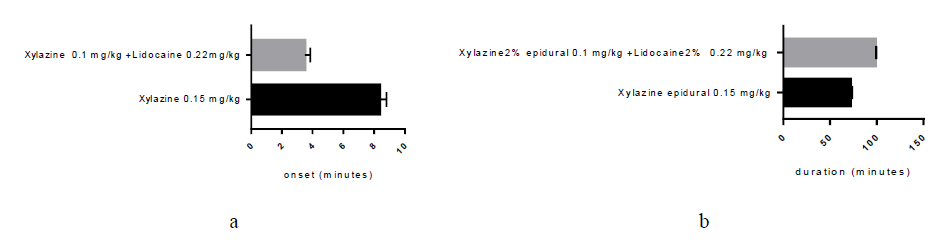
Figure 1a: Onset, b. Duration of action in minutes of xylazine 0.15mg/kg &xylazine 0.1 mg + lidocaine 0.22 mg/kg in camels. Data are presented as mean+SEM.
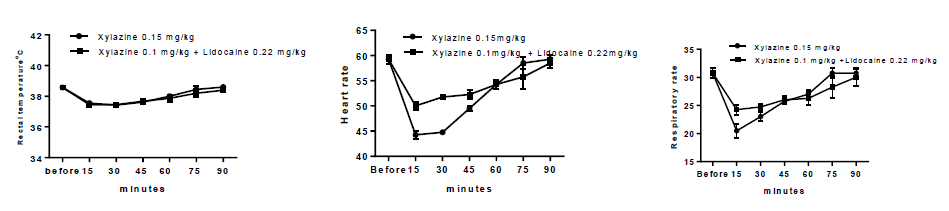
Figure 2a: Rectal temperature, b. Heart rate, c. Respiratory rate of xylazine 0.15mg/kg &xylazine 0.1 mg + lidocaine 0.22 mg/kg in camels. Data are presented as mean+SEM.
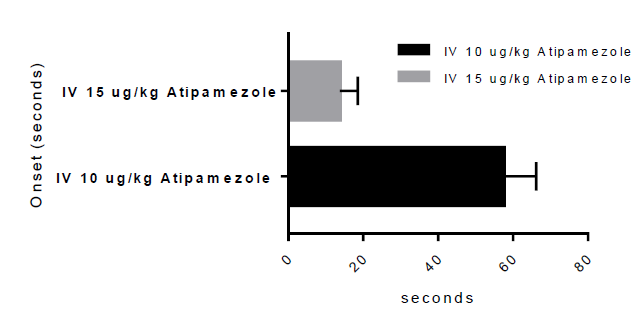
Figure 3: Onset in seconds of IV Atipamezole at dose rates (10µg/kg) and (15µg/kg) in camels. Data are presented as mean+SEM.
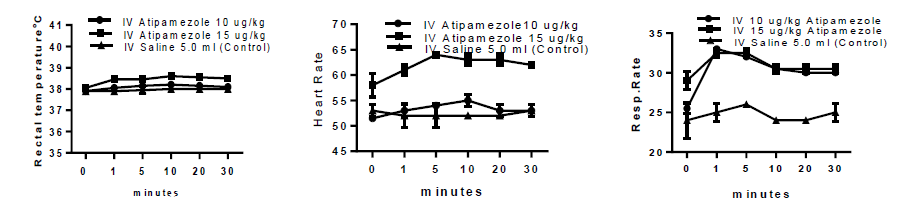
Figure 4a: Rectal temperature, b. Heart rate, c. Respiratory rate of IV Atipamezole at dose rates (10µg/kg), ( 15µg/kg) and Saline (0.9% NaCl-control) in camels.Data are presented as mean+SEM.
The IV injection of 15µg /kg atipamezolein the jugular vein in camels under the effect of caudal epidural xylazine analgesia was found the optimal dose manifested by fast and satisfactory alertness, without any side effects. The arousal signs were within only one minute after injection manifested by acoustic and visual alertness (Figure 3) with non-significant increase in the rectal temperature and cardiopulmonary values (Figures 4a, 4b, 4c) while ruminal motility showed no changes. No side effects were recorded. All camels recovered and regained normality (walking, running, eating, and other clinical physiological parameters) within a maximum of 5 minutes. Atipamezole at 5µg/kg was found not effective after 3 trials and discontinued thereafter.
4. Discussion
Caudal epidural analgesia was satisfactory performed with 0.15 mg/kg xylazine 2% or 0.1 mg/kg xylazine 2% and 0.22mg/kg Lidocaine 2% combination in all camels. The injection was made very comfortable in the first intercoccygeal space in a standing position with the lifting of one of the forelimbs in females or in sternal recumbency in males. The same space was used for injection in camels but in sternal recumbency by [13]. The same space is routinely used in cattle [6, 14]; in horses [15, 16]; in buffaloes [17] and in Llamas [8]. Xylazine or in combination with Lidocaine is commonly used for induction of epidural analgesia in cattle [6]; in buffaloes [7, 18] and in camels [13]. The onset of perineal analgesia was significantly shorter with Xylazine/Lidocaine (3.5 ± 0.4minutes) than with Xylazine alone (8.4 ± 0.4 minutes) while the duration was significantly longer with Xylazine/Lidocaine (98.3 ± 1.0 minutes) than with Xylazine 2% alone (71.6 ± 1.8 minutes). In this respect, the mean times to onset and duration of Xylazine 2% 0.17 mg/kg epidural analgesia in camels were (20.5 ± 3.32 minutes) and (53.75 ± 8.54 minutes) respectively and Xylazine 2% 0.17 mg/kg/ Lidocaine 0.22mg/kg combination were (11.75 ± 2.36 minutes and (185.27 ± 12.24 minutes) respectively [13]. The combination of Lidocaine and Xylazine prolonged the duration of analgesia as mentioned in other studies in cattle [19] in buffaloes [7], in Llamas [8] and in camels [13]. Such prolongation is desirable for relieving postoperative pain [20]. Prolongation of analgesia might be attributed to the vaso-constricting effect of α-2- agonist and inhibitions of local anesthetic vasodilatation effect with subsequent vascular uptake [17]. Adopting caudal epidural Xylazin/Lidocaine combination induced perineal analgesia, including the scrotum in males and udder in females with great benefits for doing surgical procedures. Epidural Xylazine 2% ( 0.1 mg/kg ) and Lidocaine 2% (0.22 mg/kg) combination induced mild to moderate sedation and ataxia without recumbency. This is consistent with the results of reported in camels [13]. In the present study, clinical physiological parameters (rectal temperature, heart and respiratory rates and ruminal motility) showed slight reduction. Similar results of clinical parameters have been reported in camels using the same treatments [13].
The IV administration of atipamezole at a dose rate of 15µg/kg provoked visible signs of arousal immediately after injection or even during the injection. The clinical physiological parameters showed a non-significant increase in the rectal temperature and cardiopulmonary values. The onset was within few seconds and the camel resumed normality after only one minute whereas successive continued reversing of analgesia and sedation scores were demonstrated. The outcome to antagonist the α2-agonist with the α2 antagonist atipamezole was very satisfactory and very specific for camels without any side effects. A nearly similar dose rate of IV atipamezole was used to antagonist the α2 agonists in goats [21] and cattle [4, 11, 22]; within 2 minutes. A similar effect was demonstrated in horses but with a higher dose rate of atipamezole ( 100-160 µg/kg) [23, 24]. However, the antagonizing effect of atipamezole was relatively short in horses as the re-sedation after 15 minutes was demonstrated [25]. In dogs and cats, atipamezole was dose-dependent relative to the α 2 agonist dose [26].
5. Conclusion
Caudal xylazine epidural anesthesia was easily performed in camels in a standing with a secured flexed one of the forelimbs or sternal squatting position and holding the lower lip by an attendant. Epidural xylazine 2% 0.1 mg/kg with 0.22 mg/kg 2% lidocaine combination induced faster onset (3.5 ± 0.4minutes) and longer duration (98.3 ± 1.0 minutes) without marked changes in the physiological parameters or side effects. The IV atipamezole at a dose rate of 15µg/kg was found effective and satisfactory and considered the most efficient reliable tool to antagonist the xylazine epidural effect. The onset was within one minute and without any side effects.
Conflict of Interest
The authors declare that there is no conflict of interest.
References
- Schwartz H . Reproductive performance and reproductivity of dromedaries (Camelus dromedarius). Animal Research and Development 35 (1992): 86-98.
- Sohail MA. Role of Arabian camel in animal production. Wild Animal Review 19 (1983): 37-40.
- Al-Ani FK. Camel management and diseases. Al-Sharq Printing. Press, Amman, Jordan (2004): 7-19.
- Arnemo JM, Soli NE. Chemical capture of free ranging cattle: immobilization with xylazine or medetomidine, and reversal with atipamezole. Veterinary Research Comm-unications 17 (1993) : 469-477.
- Skarda RT, Muir WW. Analgesic haemodynamic and respiratory effects of caudal epidurally administered xylazine hydrochloride solution in mares. American Journal Veterinary Research 57 (1996): 193-200.
- Grubb TL, Riebold TW, Crisman RO. Comparison of lidocaine, xylazine and lidocaine xylazine for caudal epidural analgesia in cattle, Veterinary Anaesthesia Analgesia 29 (2002): 64-68.
- Shokry MM, Elkasapy AH. Epidural anesthesia in Egyptian water buffalo (Bubalus bubalis): a comparison of lidocaine, xylazine and a combination of lidocaine and xylazine.VeterinaryAnaesthesia Analgesia 45 (2018): 707-710.
- Grubb TL, Riebold TW, Huber MJ. Evaluation of lidocaine, xylazine, and a combination of lidocaine and xylzine in ilamas. Journal of American Veterinary Medical Association 203 (1993): 1441-1443.
- Green SA, Thurmon C. Xylazine-A review of its pharmacology and use in veterinary medicine.Journal of Veterinary Pharma-cology and Therapeutics 11 (1988): 295-313.
- Virtanen R. Pharmacological profiles of medetomidine and the antagonist, atipa-mezole. Acta Vet Scand 85 (1989): 29-37.
- Thompson JM, Kersting KW, Hsu WH..Antagonistic effect of atipamezole on xylazine-induced sedation, bradycardia and ruminalatony in calves. American Journal Veterinary Research 52 (1991): 1265-1268.
- Tiwari SK, Kumar A,Vainio O. Reversal of sedative and clinic-physiological effect of epidural xylazine and detomidine with atipamezole and yohimbine in buffaloes (Bubalus bubalis).Veterinary Record 143 (1998): 529-532.
- Molaei MM, Azari O, Sakhaee E, et al. Comparison of lidocaine, xylazine, and a combination of lidocaine and xylazine for caudal epidural analgesia in dromedary camels. Iranian journal of Veterinary Surgery 5 (2010): 51-61.
- Caron JP, Le Blanc PH. Caudal epidural analgesia in cattle using xylazine.Canadian Journal Veterinarty Research 53 (1989): 486-489.
- LeBlanc PH, Caron JP. Clinical use of epidural xylazine in the horse. Equine Veterinary Journal 23 (1990):180-181.
- Grubb TL, Riebold TW, Huber MJ. Comparison of lidocaine, xylazine, and xylazine/lidocaine for caudal epidural analgesia in horses. Journal of American Veterinary Medical Association 201 (1992): 1187-1190.
- Saifzadeh S, Pourjafa M, Naghadeh BD, et al. Caudal epidural analgesia with lidocaine, xylazine and a combination of lidocaine and xylazine in Iranian river buffalo.Bulletin Veterinary Institute Pulway 51 (2007): 285-288.
- Singh P, Krishna P, Kinjavdekar P, et al. Xylazine, ketamine and their combination for lumbar epidural analgesia in water buffalo calves (Bubalus bubalis). Journal Veterinary Medicine 53 (2006): 423-431.
- Araujo MA, Albuquerque VB, Deschk M ,et al. Cardiopulmonary and analgesic effects of caudal epidurally administered ropivacaine in cattle, Veterinary Anaesthesia Analgesia 39 (2012): 409-413.
- De Rossi R, Zanenga NF, Alves OD, et al. Effects of caudal epidural ketamine and/or lidocaine on heifers during reproductive procedures: A preliminary study, Veterinary Journal 185 (2010): 344-346.
- Caroll GL, Hartsfield SM, Champney TH, et al. Effect of medetomidine and its antagonism with atipamezole on stress-related hormones, metabolites, physiologic responses, sedation, and mechanical threshold in goats. Veterinary Anaesthesia and Analgesia 32 (2005): 147-157.
- Hall LW, Clarke KW. Veterinary Anaes-thesia (19th Ed.) BailliereTindall, London (1991) ISBN: 9780702020353
- Raekellio M, Vainio O, Karjalainen J. The influence of atipamezole on the cardio-vascular effects of detomidine in horses. Veterinary Anaesthesia & Analgesia 17 (1990): 50-53.
- Kamerling S, Nauman S, Keowen M.et al.. Antagonism of the effects of detomidine by atipamezole in horses. ActaVeterinaria Scandinavica 87 (1991): 163-165.
- Ramseyer B, Schucker N, Schatzmann U, et al. Antagonism of detomidine sedation with atipamezole in horses. Journal of Veterinary Anaesthesia 25 (1998): 47-51.
- Vaha-Vahe AT. Clinical effectiveness of atipamezole as a medetomidine antagonist in dogs. Journal Veterinary Pharmacology and Therapeutics 13 (1990): 198-205.