Eleftherios Pelechas1*, Panagiota Karagianni2, Spyridoula Karatzeni3, Efstathia Karavoulia3
1Division of Rheumatology, Department of Internal Medicine, Medical School, University of Ioannina, Greece
2Biopathology Department, Medical School, University of Ioannina, Greece
3Division of Dermatology, Department of Internal Medicine, Medical School, University of Ioannina, Greece
*Corresponding Author: Eleftherios Pelechas, Division of Rheumatology, Department of Internal Medicine, Medical School, University of Ioannina, Greece
Received: 07 June 2019; Accepted: 17 June 2019; Published: 20 June 2019
Chemotherapy, Erythrodysesthesia, Hands, Fingers
1. Case
A 58-years-old female suffering from systemic lupus erythematosus (SLE) since 2018 underwent induction chemotherapy for acute myeloid leukaemia (AML). The diagnosis of SLE was based on: photosensitivity, malar rash, arthritis of the hands, positive antinuclear and Ro (SSA) antibodies. She was on remission receiving no medications. The treatment protocol of AML consisted of intravenous infusion of cytarabine plus daunorubicine. The patient, on day 11 developed erythematosus plaques on the dorsal and palmar surfaces of the hands, as well as a bullous skin lesion on the middle phalanx of the third finger on the left hand (Figure 1A: upper insert photo) and transverse white lines on the nails (Figure 1A: lower insert photo). An Immunological work-up was ordered to rule-out a flare-up of SLE which was unremarkable.
It is well known that inverse Gottron’s sign (erythema of the palmar surfaces, dorsa of the hands and extensor surfaces of the fingers sparing the interphalangeal joins-Figure 1A, 1B) could be a sign of an SLE flare. The diagnosis of the patient was palmo-plantar erythrodysesthesia and leukonychia striata or Mees’ lines. Both conditions have been observed in chemotherapy patients among other causes [1, 2]. The patient received Methylprednisolone 16 mg/day per os (p.o.) plus supportive measures and patient education. The skin rashes resolved completely within 5 days.
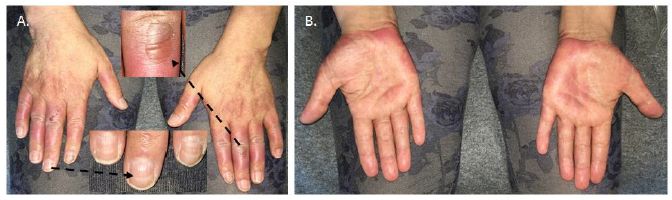
Figure 1: Skin and nail manifestations of an SLE patient on chemotherapy; (A). marked erythema of the dorsa of the hands and extensor surfaces of the fingers sparing the interphalangeal joints, bullous skin lesion on the middle phalanx of the third finger of the left hand and transverse white lines on the nails; (B) erythema of the palmar surfaces of the hands.
Disclosure Statement
Eleftherios Pelechas declares no conflicts of interest. Panagiota Karagianni declares no conflicts of interest. Spyridoula Karatzeni declares no conflicts of interest. Efstathia Karavoulia declares no conflicts of interest.
Funding Statement
The authors declare no financial support by any means for the current manuscript.
References
- Farr KP, Safwat A. Palmar-Plantar Erythrodysesthesia Associated with Chemotherapy and its Treatment. Case Rep Oncol 4 (2011): 229-235.
- Huang TC, Chao TY. Mees lines and Beau lines after chemotherapy. CMAJ 182 (2010): E149.