Nizar Ahmad Abu Alannaz MD1, Mohammad Al-Oun MD1, Mahdi Jaradat MD1, Zaid Al-Momani MD1, Sohaib F. Al-Hourani MD2, Mohannad Alarmouty MD1, Hamza Ahmad Abu-Ain MD1, Laith Mohammad Al Hseinat MD1*, Naser Fuad Shari MD1
1Department of Orthopedics, Royal Medical Services, Amman 11855, Jordan
2Department of Pediatric Surgery, Royal Medical Services, Amman 11855, Jordan
*Corresponding Author: Laith Mohammad Al Hseinat MD, Department of Orthopedics, Royal Medical Services, Amman 11855, Jordan.
Received: 10 August 2026; Accepted: 17 August 2026; Published: 21 August 2026
Objective: The purpose of this study is to conduct a current comparison of state-of-the-art arthroscopic and mini-open techniques in the surgical management of rotator cuff tears and The comparative effectiveness of All-Arthroscopic versus Mini-Open rotator cuff repair remains debated, particularly regarding differences in recovery trajectory and long-term outcomes.
Methods: This is a retrospective cohort study, in which we analyzed our department patients diagnosed to have retracted rotator cuff tear. The study covered patients managed in 4 hospitals -King Hussien Medical Center, Princes Haya Hospital, Queen Alia Military Hospital & Prince Rashed military hospital in the period between January 2018 and December 2024 to evaluate patient self-reported outcomes and complications. Total number of analyzed patients was 2028. Baseline demographics, tear characteristics, and functional scores were analyzed. Outcomes included Constant score, DASH score, pain (VAS), and range of motion, assessed over a 52-week follow-up period using repeated-measures analysis.
Results: Baseline characteristics were comparable between groups. The All-Arthroscopic group demonstrated significantly better early outcomes at 6 weeks, including lower DASH scores, reduced pain, and improved forward flexion (p < 0.05). However, differences decreased over time. At 52 weeks, Constant scores and VAS outcomes were similar between groups. Forward flexion remained slightly higher in the arthroscopic group (p = 0.011), while external rotation showed a late but modest advantage (p = 0.034).
Conclusion: Both techniques provide excellent long-term outcomes. Arthroscopic repair offers earlier functional recovery and improved early pain control, but long-term results are equivalent between techniques.
Rotator cuff repair; Arthroscopy; Mini-open; Double-row; Single-row
Rotator cuff repair articles; Arthroscopy articles; Mini-open articles; Double-row articles; Single-row articles
1. Introduction
Rotator cuff tears are a common cause of shoulder pain and functional disability [1], especially in middle-aged and older populations [2,3]. Surgical repair is typically required to allow return of function of the shoulder in patients whose pain and disability are severe enough that they fail individualized nonoperative management [1,4]. The last 20 years have seen tremendous improvements in rotator cuff repair, particularly when comparing arthroscopic and mini-open approaches for reconstruction, however with the emergence of two of the most common reconstructive techniques [5,6].
The mini-open technique has been traditionally regarded as a safe, reproducible approach, providing direct visualization of the tear and stable tendon fixation via controlled deltoid splitting [7,8]. These concerns with deltoid morbidity, postoperative pain, and extended rehabilitation have led to the development and popularity of all-arthroscopic repair techniques. Theoretically, arthroscopic techniques offer the advantage of potentially less soft-tissue trauma, better visualization of intra-articular pathology and faster postoperative recovery [6,9].
These benefits notwithstanding, the definitive superiority of arthroscopic over mini-open repair is still disputed [10,11]. Several other studies and meta-analyses have shown similar long-term functional outcomes between these two techniques [12]. Results regarding early postoperative recovery, pain control and return of range of motion are still conflicting but many available studies are hampered by small sample size and heterogenous tear patterns as well as a short follow-up period [13,14].
Notably, much of the literature is directed towards end-state outcomes as opposed to course of recovery over time—a potentially more clinically meaningful in-patient counselling and surgical decision [15]. Knowing if one method delivers an early functional benefit without a detrimental impact on long-term outcomes is critical to maximizing the effectiveness of treatment selection [15].
Thus, this study aimed to compare the clinical and functional outcomes of all-arthroscopic versus mini-open rotator cuff repair with a substantially sized patient cohort, all followed up at one year minimum [7,9,16-18]. In particular, our goals were to assess variation in pain, shoulder function and ROM over time, with a focus on short- and long-term recovery patterns [16,17]. We hypothesized the two approaches would result in similar long-term outcomes, but that benefit to early postoperative recovery would be observed following the all-arthroscopic approach.
2. Materials and Methods
This retrospective study was performed by analyzing our department patients through our computerized patients data system (CRPS) who are diagnosed to have retracted rotator cuff tear in the period between January 2018 and December 2024 to evaluate patient self-reported outcomes and complications. Total number of analyzed patients was 2028. The study covered patients managed in 4 hospitals King Hussien Medical Center, Princes Haya Hospital, Queen Alia Military Hospital & Prince Rashed military hospital, Ethical approval was obtained from the Jordanian Royal Medical Services Institutional Review Board.
2.1 Study Strategy
The databases for our patients comparing arthroscopic and mini-open rotator cuff repairs were obtained through our computerized patients data system (CRPS). Inclusion & exclusion criteria were as follows:
2.2 Inclusion Criteria:
- Patients with rotator cuff tears
- A comparison of arthroscopic and mini-open repair methods
2.3 Exclusion Criteria:
- Patients treated conservatively
- Those who underwent other shoulder surgeries, like fracture fixation or reverse shoulder arthroplasty for rotator cuff arthropathy
- Patients with shoulder instability who had surgical intervention
2.4 Study Screening:
So, we only looked at patients who were treated surgically in our facility for this study, and the screening was reviewed by two separate teams.
2.5 Data Abstraction:
Two reviewers independently gathered data, which we then organized into a Microsoft Excel spreadsheet. If there were any disagreements, we talked it out or brought in a third reviewer to help settle things. We collected all sorts of information, like patient demographics, surgical techniques, rehab protocols, post-op outcomes, and any complications.
2.6 Statistical Analysis:
For the stats, we used descriptive methods including mean, median, range, and variance.
3. Results
3.1 Study Characteristics:
Initially, we gathered data from 3,289 patients. Out of those, 2,028 met our inclusion criteria. Interestingly, about 63.6% of the studies were assessed after 2021, right at the end of the COVID crisis. This study involved patients from four military hospitals: King Hussein Medical Center, Princess Haya Hospital, Queen Alia Military Hospital, and Prince Rashed Military Hospital.
3.2 Patient Characteristics:
In total, we included 2,028 patients in our study. Breaking it down, there were 864 in the All-Arthroscopic group and 1,164 in the Mini-Open group. The average age was pretty similar across both groups—58.4 years versus 59.3 years. And as for gender, the distribution was fairly comparable: in the All-Arthroscopic group, there were 331 females and 533 males, while the Mini-Open group had 485 females and 679 males.
Most of the tears were due to falls, and about 80% of the patients had injuries on their dominant side. Before surgery, shoulder motion was somewhat limited for both groups, although only a few had restrictions in multiple directions. Other factors like smoking rates, tear location, retraction, and patterns of fatty muscle infiltration were quite similar too, suggesting that we had comparable baseline risk profiles.
When we looked at baseline functional scores, they were pretty close. The DASH scores were 88 ± 25 in one group and 93 ± 22 in the other. Both groups had Constant scores averaging around 42 ± 12, and the VAS pain and disability scores didn’t show any significant differences. Active forward flexion and external rotation were also alike across both groups. Overall, we found that the two groups were well matched in terms of demographics, clinical aspects, and functional characteristics. (Table 1).
|
All-Arthroscopic (n 864) |
Mini Open (n: 1164) |
|
|
Age (yr) |
58.4 |
59.3 |
|
Sex |
331 F, 533 M |
485 F, 679 M |
|
Etiology |
||
|
Fall |
533 |
728 |
|
Unknown |
331 |
436 |
|
Dominant side affected |
674 (78 %) |
966 (83 %) |
|
Pre-OP affected ROM 1. Abduction (66%) A. Full B. Up to 90 degrees C. Less than 90 degrees 2. External rotation (10%) A. Full B. Up to 40 degrees C. Less than 40 degrees 3. Internal rotation (15%) A. Full B. Between T8 & L1 C. Below L1 4. More than one plane of motion affected (9%) A. Abduction + ER B. Abduction + IR |
570 (27%) (55%) (18%) 86 (37%) (41%) (22%) 130 (72%) (18%) (10%) 78 (83%) (17%) |
768 (17%) (62%) (21%) 116 (18%) (57%) (25%) 175 (63%) (21%) (16%) 105 (95%) (5%) |
|
Smoker |
320 (37 %) |
466 (40 %) |
|
Tear location |
||
|
Anterior (81%) |
700 |
943 |
|
Posterior (19%) |
164 |
203 |
|
Tear retraction < 2 cm 2 – 4 cm >4 cm |
(43%) (35%) (22%) |
(17%) (38%) (45%) |
|
Fatty muscle infiltration Stage 0 Stage 1 Stage 2 Stage 3 Stage 4 |
36% 45 % 19 % 0 0 |
44 % 44 % 12 % 0 0 |
|
Baseline variables DASH (0-100 points) |
88 25 |
93 22 |
|
Constant (0-100 points) |
42 12 |
42 12 |
|
VAS pain (1-10 points) |
6.9 1.8 |
7.0 1.8 |
|
VAS disability (1-10 points) |
6.7 2.0 |
7.0 1.9 |
|
Active forward flexion (◦) |
107 38 |
106 39 |
|
Active external rotation (◦) |
46 22 |
47 23 |
Table 1: Patient characteristics.
3.3 Surgical Techniques
The included patients underwent both mini-open and arthroscopic repair techniques. The most common fixation methods for mini-open repairs were suture anchors, bone tunnels, or a combination of both. Arthroscopic repairs predominantly used double-row fixation (38.7%) and single-row fixation (23.7%) [19,20].
The double-row rotator cuff repair technique is designed to restore the native tendon footprint on the greater tuberosity and improve biomechanical strength [21,22]. In this technique, medial-row anchors are first placed adjacent to the articular margin of the humeral head. Sutures from these anchors are passed through the rotator cuff tendon in a mattress configuration, providing initial fixation and compression of the tendon to the medial footprint (Figure 1) [1,4].
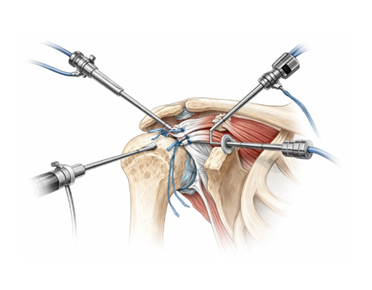
Figure 1: Showing Sutures (blue and white) which are used to anatomically reapproximate the torn rotator cuff tendon to its footprint on the greater tuberosity of the humerus. Arthroscopic portals facilitate the insertion of suture anchors and specialized instruments for minimally invasive tendon fixation. The image demonstrates standard technique for arthroscopic rotator cuff repair.
Subsequently, the sutures are secured laterally using lateral-row anchors placed more laterally on the greater tuberosity [21,23]. This creates a suture bridge (transosseous-equivalent construct), which compresses the tendon uniformly across the footprint [21,23].
3.4 This configuration:
Maximizes tendon-to-bone contact area [24,25].
Enhances load distribution [26].
Improves initial fixation strength [27,28].
Reduces gap formation under cyclic loading [29,30].
Overall, the double-row technique aims to improve healing rates and reduce re-tear risk [10,31,32] compared to single-row repairs, particularly in larger tears [22,29,33,34,] (Figure 2).
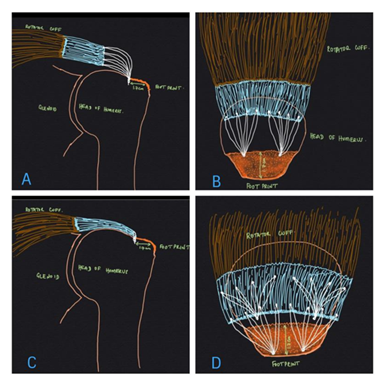
Figure 2: A) Denotes the coronal view of double row repair of rotator cuff. Note the placement of medial row anchors just lateral to the articular margin and the lateral row anchors placed far lateral in the footprint. B) Denotes the same in axial view. C & D) are the cuff after tying the knot of the suture anchor in coronal and axial view. Note that double row repair covers the whole of the footprint area with the cuff, after repair.
3.5 Rehabilitation Protocol
Our rehabilitation protocol was similar in the comparison of both groups. This was typically an abduction sling for immobilization postoperatively, then passive and active range of motion exercises for 6 weeks. Strengthening often started after 6 weeks, and heavy labor was allowed around 4–6 months post-surgery.
3.6 Outcomes
Our results showed that arthroscopic repair (AR) led to significantly lower VAS pain scores and better DASH, Constant, and UCLA scores at various follow-up periods compared to mini-open repair (MOR) (Table 2) [35].
|
Mean (SE) P Value Between-group Prespecified Treatment X |
|||||||
|
Week |
All Arthroscopic* Mini Open* Mean difference (95% CI) Main effect Time interaction Time |
||||||
|
6-52 |
68 (1.9) |
63 (1.8) |
4.6 (0.7 to 8.2) |
.10 |
.956 |
||
|
6 |
43 (1.8) |
38 (2.0) |
4.4 (1.8 to 9.3) |
.134 |
|||
|
12 |
62 (1.9) |
57 (2.3) |
4.8 (—2.1 to 9.0) |
||||
|
26 |
78 (2.1) |
75 (2.2) |
3.2 (—2.7 to 8.7) |
||||
|
52 |
89 (1.9) |
85 (2.1) |
3.4 (—3.1 to 8.3) |
.226 |
|||
|
DASH |
|||||||
|
6-52 |
62 (2.2) |
68 (2.3) |
—3.6 (—9.8 to 3.1) |
.321 |
.05 (.028) |
||
|
6 |
82 (3.2) |
93 (2.9) |
—10.9 (—19.7 to —3.3) |
.012 |
|||
|
12 |
61 (2.9) |
68 (3.3) |
—6.8 (—12.8 to 4.5) |
||||
|
26 |
54 (2.7) |
60 (3.5) |
—5.3 (—14.8 to 3.7) |
||||
|
52 |
50 (3.6) |
50 (3.3) |
—0.1 (—8.8 to 8.7) |
.995 |
|||
|
Forward flexion |
|||||||
|
6-52 |
131 (3.5) |
119 (3.5) |
12.2 (3.0 to 22.2) |
.011 |
.701 |
||
|
6 |
75 (4.5) |
60 (3.7) |
15.8 (5.2 to 26.0) |
.008 |
|||
|
12 |
128 (4.7) |
111 (5.6) |
17.4 (3.2 to 30.8) |
||||
|
26 |
153 (3.7) |
141 (5.8) |
8.9 (2.5 to 25.1) |
||||
|
52 |
171 (2.8) |
163 (4.7) |
8.5 (0.7 to 20.9) |
. |
|||
|
External rotation |
|||||||
|
6-52 |
53 (1.6) |
49 (1.6) |
4.6 (—0.7 to 9.2) |
.064 |
.236 |
||
|
6 |
32 (2.7) |
25 (2.3) |
7.7 (—0.5 to 13.8) |
.057 |
|||
|
12 |
43 (2.2) |
42 (2.1) |
1.1 (—5.2 to 7.3) |
||||
|
26 |
51 (2.4) |
50 (2.6) |
1.7 (—4.1 to 8.7) |
||||
|
152 |
81 (2.1) |
73 (3.0) |
8.6 (0.7 to 15.3) |
.034 |
|||
|
VAS pain |
|||||||
|
6-52 |
3.3 (0.3) |
3.8 (0.3) |
—0.5 (—1.1 to 0.3) |
.175 |
.278 |
||
|
6 |
4.7 (0.4) |
5.8 (0.4) |
—1.1 (—1.9 to —0.2) |
.027 |
|||
|
12 |
3.6 (0.4) |
3.7 (0.4) |
—0.1 (—1.1 to 0.8) |
||||
|
26 |
2.7 (0.4) |
3.1 (0.4) |
—0.4 (—1.2 to 0.6) |
||||
|
52 |
2.3 (0.3) |
2.7 (0.4) |
—0.4 (—1.0 to 0.5) |
.363 |
|||
|
VAS impairment |
|||||||
|
6-52 |
3.8 (0.2) |
4.4 (0.3) |
—0.6 (—0.3 to 1.2) |
.145 |
.052 (.038) |
||
|
6 |
5.1 (0.4) |
6.3 (0.3) |
—1.3 (—1.7 to —0.6) |
.002 |
|||
|
12 |
4.3 (0.4) |
4.5(0.4) |
—0.2 (—0.8 to 1.1) |
||||
|
26 |
3.2 (0.4) |
3.7 (0.4) |
—0.6 (—1.5 to 0.6) |
||||
|
52 |
2.9 (0.4) |
3.2 (0.4) |
—0.4 (—1.2 to 0.7) |
.231 |
|||
DASH, Disabilities of the Arm, Shoulder and Hand; VAS, visual analog scale.
*Values adjusted for baseline measurements.
†Assumes no interaction with time and indicates testing for overall between-group mean difference over the entire postoperative follow-up period.
: Indicates testing for overall changing treatment effects with time over the entire postoperative follow-up period.
Table 2: Results of Primary and Secondary Outcome Measures
3.7 Short-term Outcomes (up to 12 weeks)
Early postoperative recovery demonstrated significant differences between the two treatment groups. The All-Arthroscopic group demonstrated faster early functional recovery across multiple clinical outcome measures. By the 6-week mark, they had much better DASH scores compared to the Mini-Open group—82 versus 93, which is pretty significant (p = 0.012). They also reported less pain on the VAS scale, scoring 4.7 compared to 5.8 (p = 0.027). And, oh, their VAS impairment scores were also notably lower at that point (p = 0.002).
When it came to forward flexion, the All-Arthroscopic group had a clear edge, measuring at 75° compared to just 60° for the Mini-Open group (p = 0.008). Now, external rotation was showing some signs of improvement, but it wasn’t statistically significant just yet.
At the 12-week follow-up, both groups demonstrated continued improvement. However, there weren’t any major differences in Constant scores, DASH scores, or VAS pain scores, which suggests the differences in functional recovery between the two groups had diminished.
3.8 Long-term Outcomes (26–52 weeks)
At the intermediate and final follow-up assessments, both groups continued to show improvement in their functional outcomes. By 52 weeks, their Constant scores were pretty similar—89 for the All-Arthroscopic group and 85 for the Mini-Open group (p = 0.226). No significant differences popped up over time either (p = 0.10).
The DASH scores remained lower in the All-Arthroscopic group throughout follow-up; however, the between-group difference progressively decreased and approached borderline statistical significance (p ≈ 0.05).
Notably, forward flexion stayed consistently higher in the All-Arthroscopic group during the entire follow-up period, with an average difference of 12.2° (95% CI 3.0 to 22.2; p = 0.011). By the end of 52 weeks, they were flexing at 171° compared to 163° in the Mini-Open group.
As for external rotation, it didn’t show any significant differences early on, but there was a notable improvement in the All-Arthroscopic group by the 52-week mark (81° vs. 73°, p = 0.034). Both groups saw their VAS pain and impairment scores improve over time, but there weren’t any major long-term differences. early on, pain levels were significantly lower for the All-Arthroscopic group.
3.9 Complications
Regarding complications, overall, the rates were about 21.3%, and they were pretty similar between the All-Arthroscopic and Mini-Open groups, with no significant differences in most outcomes. Retear rates were comparable too, at 16% for All-Arthroscopic and 14% for Mini-Open (p = 0.24) (Figure 3) [20,35].
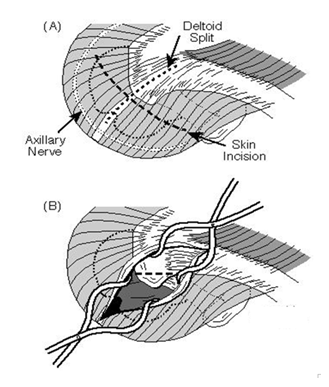
Figure 3: Mini-open rotator cuff repair approach demonstrating deltoid-splitting technique and protection of the axillary nerve. (A) Skin incision placed over the anterolateral aspect of the shoulder with a longitudinal deltoid split performed in line with the muscle fibers. The course of the axillary nerve is shown inferior to the deltoid split, highlighting the safe zone of dissection (approximately 3–5 cm from the acromion). (B) Exposure of the subacromial space following deltoid splitting, demonstrating visualization of the rotator cuff tear and preparation for repair.
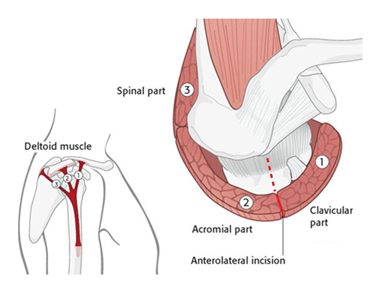
Figure 4: This illustration shows mini open approach used for rotator cuff repair demonstrating the anatomical divisions of the deltoid muscle—clavicular, acromial, and spinal parts—relevant to surgical exposure in mini open approach. Precise identification and protection of the deltoid’s segments are critical to optimizing postoperative shoulder function [7].
When it came to other complications, things like biceps tendinopathy, anchor pullout, superficial infection (0.4% vs 1.1%), septic arthritis (0.3% vs 0.6%), nerve injuries (1.1% vs 2.1%), or CRPS didn’t show any significant differences either. Interestingly, the rates of both radiological and symptomatic arthritis were also similar across the two techniques.
However, the Mini-Open group did show higher rates of adhesive capsulitis (16% vs 11%, p = 0.0016), persistent pain (18% vs 14%, p = 0.02), and persistent weakness (20% vs 15%, p = 0.0037). (Table 3).
|
All-Arthroscopic Mini-Open |
|||
|
(n: 864) |
(n: 1164) |
P value |
|
|
Retear |
138 (16 %) |
163 (14%) |
0.24 |
|
[smokers] Adhesive capsulitis |
[62] 95 (11%) |
[73] 186 (16%) |
0.0016 |
|
[smokers] Biceps tendinopathy |
[43] 18 (20%) |
[72] 23 (20%) |
0.99 |
|
Anchor pullout |
43 (5%) |
46 (4%) |
0.32 |
|
Superficial infection |
4 (0.4 %) |
12 (1.1%) |
0.24 |
|
Arthritis |
|||
|
-Radiological |
95 (11%) |
151 (13%) |
0.20 |
|
-Symptomatic |
60 (7 %) |
93 (8%) |
0.43 |
|
Septic arthritis |
3 (0.3 %) |
7 (0.6 %) |
0.63 |
|
Persistent pain |
121 (14%) |
209 (18%) |
0.02 |
|
Nerve injuries |
10 (1.1%) |
24 (2.1%) |
0.16 |
|
Persistent weakness |
129 (15%) |
23 (20%) |
0.0037 |
|
CRPS |
8 (0.9%) |
12 (1.1%) |
0.99 |
|
Miscellaneous (CVA, VTE) |
4 |
6 |
1.00 |
NOTE. Values are numbers of patients.
CVA, cerebrovascular accident; VTE, Venous thromboembolism.
Table 3: Complications
4. Discussion
In this large retrospective cohort study, we compared two surgical techniques for rotator cuff repair: the All-Arthroscopic technique and the Mini-Open technique. Both actually showed some impressive and lasting improvements in shoulder function [19,36]. At the start, the groups were pretty similar, but we found that the arthroscopic method had a clear leg up in those first few weeks after surgery. Patients reported less pain, better functional recovery, and more range of motion during that initial 6 to 12 weeks10,36. However, over time, those differences started to fade, and by the long-term mark, the outcomes were pretty much on par between the two groups [37,38].
One of the principal findings of this study is that the recovery profiles changed over time [12,39]. The arthroscopic repairs showed significantly better early DASH scores, less pain, and better forward flexion just six weeks in. We think this is likely due to less disruption to the soft tissues, less irritation to the deltoid muscle, and a lower inflammatory response compared to the Mini-Open approach (Figure 4) [7,20].
However, when we checked in at the mid-term follow-up, things started to even out. By the one-year mark, Constant scores, pain levels, and overall functionality were statistically similar, which suggests that, in the end, it’s really the biological healing of the tendon and the rehab process that take the lead in long-term recovery, no matter which surgical method you use [9].
Interestingly, the arthroscopic group continued to show better forward flexion throughout the follow-ups, and there was a significant overall effect that held up at the final follow-up [40]. As for external rotation, it took a bit longer to show a difference, only becoming significant at around 52 weeks [41]. Even though these differences were not huge, they might suggest that the arthroscopic method has slight advantages when it comes to preserving soft tissues and the mechanics of the shoulder [42].
It should be emphasized that these technical differences didn’t really lead to any significant changes in how patients felt about their disabilities over the long haul [43].
From a clinical perspective, both techniques represent effective and reliable treatment options. The arthroscopic approach could be especially beneficial for those who need to get moving again quickly—like working-age patients or anyone requiring early return to daily activities or work. On the flip side, the Mini-Oen technique is still a good choice and provides comparable long-term results, especially in places where the expertise or tools for arthroscopy aren’t readily available [39].
Our results back up what earlier studies have shown: that both arthroscopic and mini-open techniques generally lead to similar long-term outcomes [9]. But this research provides additional evidence to suggest that the principal advantage of arthroscopy is the quicker recovery right after surgery, rather than how well you do in the long run [17]. These findings highlight that the type of surgery you influences the recovery process, even if the ultimate healing of the tendon is what really matters in the end [31,44-46].
5. Limitations
This study has several important limitations. The primary limitations relate to the quality and quantity of the patient data we had available. We ran into some challenges gathering information because of the large sample sizes and the need for long-term follow-ups. That leaves us with this nagging question: do double-row suture techniques really make arthroscopic repair (AR) better than mini-open repair (MOR)? We can’t say for sure just yet. Plus, there was a lack of detailed documentation in the data we reviewed—including specific surgical techniques and outcomes. Because of that, we couldn’t make a solid comparison between AR and MOR, or really evaluate how different suture types might play a role. On top of that, the quality of the studies we looked at was only moderate. A few randomized controlled trials (RCTs) had some significant risks due to issues like randomization and patient blinding not being properly handled.
6. Future Directions
Future research should focus on it’s clear we need more robust studies. Strong RCT designs or large cohort studies focusing on different suture techniques in AR—like double-row versus single-row repairs—compared to MOR would be really helpful. Ideally, these studies should include a diverse group of patients and have enough follow-up time to accurately track complications and re-tear rates. Furthermore, proper documentation is key! We need to capture patient data, surgical techniques, rehabilitation phases (like mobilization periods), and outcomes in detail to really understand the differences between AR and MOR. Also, minimizing bias through solid randomization is going to be super important for future research.
7. Conclusions
In conclusion, both all-arthroscopic and mini-open rotator cuff repair techniques offer significant and lasting improvements in shoulder function, and their long-term clinical outcomes are pretty comparable. Now, arthroscopic repair does tend to allow for quicker early recovery, better pain management, and a greater range of motion in those initial stages. However, those benefits seem to level out over time, leading to similar functional outcomes by the time we do the final follow-up. So, it should be emphasized that the choice of surgical approach should really depend on the surgeon’s expertise and what the patient values most—especially when it comes to expectations around early recovery.
8. Declarations
Ethical approval and consent to participate
Ethical approval was obtained from the Jordanian Royal Medical Services Institutional Review Board, IRB#: 27/4/2026. The study adhered to international standards for research involving human subjects. Patient confidentiality was strictly maintained, and identifying information was anonymized. Where possible, informed consent was obtained from patients or their legal guardians.
Consent for Publication
Written informed consent was obtained from the parents/legal guardians of the patients for publication of this study and any accompanying images. A copy of the written consent is available for review by the Editor-in-Chief of this journal upon reasonable request.
Availability of Data:
Data is available upon request.
Competing Interests:
The Authors declare no competing of interests.
Funding:
This research did not receive any funds.
Authors Contribution:
Please see the Title page for the Authors contributions.
Acknowledgments:
We Would thank the Jordanian Royal Medical Services for the help of processing this study and the Biostatic department for their great efforts of finishing the analysis and the tables.
References
- Mitchell C, Adebajo A, Hay E, et al. Shoulder pain: diagnosis and management in primary care. BMJ 331 (2005): 1124-1128.
- Yamamoto A, Takagishi K, Osawa T, et al. Prevalence and risk factors of a rotator cuff tear in the general population. J Shoulder Elbow Surg 19 (2010): 116-120.
- Randelli P, Cucchi D, Ragone V, et al. History of rotator cuff surgery. Knee Surg Sports Traumatol Arthrosc 23 (2015): 344-362.
- Piper CC, Hughes AJ, Ma Y, et al. Operative versus nonoperative treatment for the management of full-thickness rotator cuff tears: a systematic review and meta-analysis. J Shoulder Elbow Surg 27 (2018): 572-576.
- Rees JL. The pathogenesis and surgical treatment of tears of the rotator cuff. J Bone Joint Surg Br 90 (2008): 827-832.
- Nazari G, MacDermid JC, Bryant D, et al. Effects of arthroscopic vs. mini-open rotator cuff repair on function, pain and range of motion: a systematic review and meta-analysis. PLoS One 14 (2019): e0222953.
- Zhang Z, Gu B, Zhu W, et al. Arthroscopic versus mini-open rotator cuff repair: a prospective, randomized study with 24-month follow-up. Eur J Orthop Surg Traumatol 24 (2014): 845-850.
- Bell S, Lim Y-J, Coghlan J. Long-term longitudinal follow-up of mini-open rotator cuff repair. J Bone Joint Surg Am 95 (2013): 151-157.
- Kasten P, Keil C, Grieser T, et al. Prospective randomised comparison of arthroscopic versus mini-open rotator cuff repair of the supraspinatus tendon. Int Orthop 35 (2011): 1663-1670.
- Hui YJ, Teo AQA, Sharma S, et al. Immediate costs of mini-open versus arthroscopic rotator cuff repair in an Asian population. J Orthop Surg (Hong Kong) 25 (2017): 1-6.
- Kuper G, Shanmugaraj A, Horner NS, et al. Critical shoulder angle is an effective radiographic parameter that is associated with rotator cuff tears and osteoarthritis: a systematic review. J ISAKOS Jt Disord Orthop Sports Med 4 (2019): 113-120.
- Barnes LAF, Kim HM, Caldwell J-M, et al. Satisfaction, function and repair integrity after arthroscopic versus mini-open rotator cuff repair. Bone Jt J 99-B (2017): 245-249.
- Vicenti G, Moretti L, Carrozzo M, et al. Evaluation of long-term postoperative outcomes between mini-open and arthroscopic repair for isolated supraspinatus tears: a retrospective analysis. Musculoskelet Surg 102 (2018): 21-27.
- Norberg FB, Field LD, Savoie FH. Repair of the rotator cuff: mini-open and arthroscopic repairs. Clin Sports Med 19 (2000): 77-99.
- Lee YS, Jeong JY, Park C-D, et al. Evaluation of the risk factors for a rotator cuff retear after repair surgery. Am J Sports Med 45 (2017): 1755-1761.
- Liu J, Fan L, Zhu Y, et al. Comparison of clinical outcomes in all-arthroscopic versus mini-open repair of rotator cuff tears: a randomized clinical trial. Medicine (Baltim) 96 (2017): e6322.
- van der Zwaal P, Thomassen BJW, Nieuwenhuijse MJ, et al. Clinical outcome in all-arthroscopic versus mini-open rotator cuff repair in small to medium-sized tears: a randomized controlled trial in 100 patients with 1-year follow-up. Arthrosc J Arthrosc Relat Surg 29 (2013): 266-273.
- Bond EC, Hunt L, Brick MJ, et al. Arthroscopic, open and mini-open approach for rotator cuff repair: no difference in pain or function at 24 months. ANZ J Surg 88 (2018): 50-55.
- Colvin AC, Egorova N, Harrison AK, et al. National trends in rotator cuff repair. J Bone Joint Surg Am 94 (2012): 227-233.
- Cho C-H, Song K-S, Jung G-H, et al. Early postoperative outcomes between arthroscopic and mini-open repair for rotator cuff tears. Orthopedics 35 (2012): e1347-e1352.
- Noticewala MS, Ahmad CS. Double-row rotator cuff repair: the new gold standard. Tech Shoulder Elbow Surg 16 (2015): 6-9.
- Talmaç MA, Görgel MA, Bozca MA, et al. Mini-open versus arthroscopic rotator cuff repair: a comparison of clinical results and re-tear rates by magnetic resonance arthrogram. Med Bull Haseki 57 (2019): 274-278.
- Chen M, Xu W, Dong Q, et al. Outcomes of single-row versus double-row arthroscopic rotator cuff repair: a systematic review and meta-analysis of current evidence. Arthrosc J Arthrosc Relat Surg 29 (2013): 1437-1449.
- Mormino MA, Gross RM, McCarthy JA. Captured shoulder: a complication of rotator cuff surgery. Arthrosc J Arthrosc Relat Surg 12 (1996): 457-461.
- Wall LB, Keener JD, Brophy RH. Double-row vs single-row rotator cuff repair: a review of the biomechanical evidence. J Shoulder Elbow Surg 18 (2009): 933-941.
- Meier SW, Meier JD. Rotator cuff repair: the effect of double-row fixation on three-dimensional repair site. J Shoulder Elbow Surg 15 (2006): 691-696.
- Milano G, Grasso A, Zarelli D, et al. Comparison between single-row and double-row rotator cuff repair: a biomechanical study. Knee Surg Sports Traumatol Arthrosc 16 (2008): 75-80.
- Ma CB, Comerford L, Wilson J, et al. Biomechanical evaluation of arthroscopic rotator cuff repairs: double-row compared with single-row fixation. J Bone Joint Surg Am 88 (2006): 403-410.
- Brady PC, Arrigoni P, Burkhart SS. Evaluation of residual rotator cuff defects after in vivo single- versus double-row rotator cuff repairs. Arthrosc J Arthrosc Relat Surg 22 (2006): 1070-1075.
- Aydin N, Karaismailoglu B, Gurcan M, et al. Arthroscopic double-row rotator cuff repair: a comprehensive review of the literature. SICOT-J 4 (2018): 57.
- Shen C, Tang Z-H, Hu J-Z, et al. Incidence of retear with double-row versus single-row rotator cuff repair. Orthopedics 37 (2014): e1006-e1013.
- Osti L, Del Buono A, Maffulli N. Microfractures at the rotator cuff footprint: a randomised controlled study. Int Orthop 37 (2013): 2165-2171.
- Sarmento MC, Cartucho AE, Monteiro JM. Short-term results (1 year) of vented versus solid polyetheretherketone anchors in treatment of rotator cuff tears. SICOT-J (2019): 1-6.
- Barth J, Andrieu K, Fotiadis E, et al. Critical period and risk factors for retear following arthroscopic repair of the rotator cuff. Knee Surg Sports Traumatol Arthrosc 25 (2017): 2196-2204.
- Vastamäki M, Lohman M, Borgmästars N. Rotator cuff integrity correlates with clinical and functional results at a minimum 16 years after open repair. Clin Orthop 471 (2013): 554-561.
- Ames JB, Horan MP, Van der Meijden OAJ, et al. Association between acromial index and outcomes following arthroscopic repair of full-thickness rotator cuff tears. J Bone Joint Surg Am 94 (2012): 1862-1869.
- Mall NA, Chahal J, Heard WM, et al. Outcomes of arthroscopic and open surgical repair of isolated subscapularis tendon tears. Arthrosc J Arthrosc Relat Surg 28 (2012): 1306-1314.
- Bartl C, Scheibel M, Magosch P, et al. Open repair of isolated traumatic subscapularis tendon tears. Am J Sports Med 39 (2011): 490-496.
- Landis JR, Koch GG. The measurement of observer agreement for categorical data. Biometrics 33 (1977): 159-174.
- Huang R, Wang S, Wang Y, et al. Systematic review of all-arthroscopic versus mini-open repair of rotator cuff tears: a meta-analysis. Sci Rep 6 (2016): 22857.
- Moher D, Shamseer L, Clarke M, et al. Preferred reporting items for systematic review and meta-analysis protocols (PRISMA-P) 2015 statement. Syst Rev 4 (2015): 1.
- Slim K, Nini E, Forestier D, et al. Methodological index for non-randomized studies (MINORS): development and validation of a new instrument. ANZ J Surg 73 (2003): 712-716.
- Wright JG, Swiontkowski MF, Heckman JD. Introducing levels of evidence to the journal. J Bone Joint Surg Am 85 (2003): 1-3.
- Bisson L, Zivaljevic N, Sanders S, et al. A cost analysis of single-row versus double-row and suture bridge rotator cuff repair methods. Knee Surg Sports Traumatol Arthrosc 23 (2015): 487-493.
- Prasathaporn N, Kuptniratsaikul S, Kongrukgreatiyos K. Single-row repair versus double-row repair of full-thickness rotator cuff tears. Arthrosc J Arthrosc Relat Surg 27 (2011): 978-985.
- Karaman O, Karakus O, Saygi B. A comparison of full arthroscopic and arthroscopic-assisted mini-open repair methods in rotator cuff tears 1-3 cm in size. J Orthop 15 (2018): 894-898.