Paola Fernandez Santos Viniegra1, Tadeu Lima Montagnoli1, Bruno Eduardo Dematte2, Fernanda Bezerra de Mello Monte1, Margarete Manhães Trachez3, Gisele Zapata-Sudo*,1,2,3
1Graduate Program in Pharmacology and Medicinal Chemistry, Institute of Biomedical Sciences, Federal University of Rio de Janeiro, Rio de Janeiro, Brazil
2Graduate Program in Cardiology, School of Medicine, Federal University of Rio de Janeiro, Rio de Janeiro, Brazil
3Edson Saad Heart Institute, School of Medicine, Federal University of Rio de Janeiro, Rio de Janeiro, Brazil
*Corresponding author: Gisele Zapata-Sudo. M.D., Ph.D., Federal University of Rio de Janeiro, Edson Saad Heart Institute, School of Medicine, Health Sciences Center, Block J, Room 14, Rio de Janeiro, RJ, Brazil, 21941-902.
Received: 23 September 2026; Accepted: 28 September 2026; Published: 06 November 2026
Objectives. Neuropathic pain results from a structural and functional dysfunction of the somatosensory nervous system, which affects 10% of the population worldwide. Despite the high prevalence and the increased research aimed at improving pain therapy, up to 50% of patients do not obtain satisfactory relief. Current pharmacological therapy based on the combination of drugs, includes tricyclic antidepressants, anticonvulsants, opioids and local anesthetics with multiple sites of action. Opioid is the choice in the management of severe and persistent chronic pain, which long-term use can trigger the development of tolerance and chemical dependence.
Methods: To introduce a new alternative to treat neuropathic pain, this study investigated the analgesic action of the association of metamizole, widely used in Brazil, with donepezil. It was evaluated the association of metamizole, a nonsteroidal anti?inflammatory drug with donepezil, an anticholinesterase in animal models of acute and chronic pain.
Results: In acute and inflammatory pain, the combination metamizole + donepezil promoted greater antinociceptive effect when compared to their use alone. Moreover, in a model of neuropathic pain induced by spinal nerve ligation, the continuous treatment with metamizole + donepezil reduced thermal hyperalgesia and mechanical allodynia.
Conclusion: This association of interest as an alternative in the therapy of neuropathic pain.
Metamizole; donepezil; neuropatic pain; analgesia
Metamizole articles; donepezil articles; neuropatic pain articles; analgesia articles
Introduction
Chronic pain results from persistent nociceptive signaling, which extends to the time of tissue lesion recovery1, and has the involvement of several factors including socio-demographic, psychological, clinical and biological. Women and the elderly have higher prevalence of chronic pain when compared to man and young patients2 which is also related to alcohol abuse, tobacco, sedentary lifestyle, weight extremes. Neuropathic pain is a chronic pain that has no protective or supportive function3, but rather the result of dysfunction in the somatosensory system, caused by direct injury or disease. Neuropathic pain results from modifications of the central and peripheral nervous systems in response to injuries in the somatosensory system, such as neuronal trauma, chemical toxicity (chemotherapy), metabolic diseases (diabetes mellitus) and infections (HIV)4. Its clinical/social importance relates to the complexity of the symptoms, difficulty of treatment and the decrease in the quality of life of patients. There are several mechanisms involved in this chronic condition, changes in signaling pathways, sensitization of nociceptors, abnormal excitability of affected neurons, reduced of descending spinal inhibitory system4 . In the presence of a nerve injury, the decrease in the inhibitory response results in increased depolarization and excitation of neurons5. Several drugs used in the treatment of neuropathic pain, such as inhibitors of the norepinephrine and serotonin reuptake, agonists of opioid receptor, GABAergic agonists play important role in increasing the transmission of inhibitory pathways6,7. After an axonal peripheral nerve injury, a progressive degeneration directed to the neuronal body occurs along with infiltrate of macrophages, neutrophils, basophils, platelets, endothelial cells, fibroblasts. In this condition, inflammatory mediators such as bradykinin and prostaglandins, pro-inflammatory cytokines such as interleukins and tumor necrosis factorα (TNF-α), as well as growth factors such as neural growth factor (NGF) are also released. There is an increase in excitability and spontaneous neuronal activity, thus configuring peripheral sensitization and an amplification of the neuronal receptive field resulting in hyperalgesia8.
There is no fully effective treatment for neuropathic pain and 40-50% of patients do not receive adequate treatment, either due to difficulty in diagnosis, ineffectiveness of analgesic therapy, or incomplete knowledge of pathophysiology of this disease9,10. Considering the difficulty in the treatment of neuropathic pain and the tendency to direct the therapeutic regimen with the use of drugs with actions on multiple targets, or combinations of drugs with different mechanisms of action, greater focus will be given to drugs that act on the different descending inhibitory pathways related to pain. Metamizole, an analgesic, antipyretic and anti-inflammatory agent is currently in use in therapeutic scheme of acute and chronic pain in Latin American (including Brazil) and African countries, as well as in some European countries such as Germany, Spain, Israel and Poland. Several studies have demonstrated metamizole ability to attenuate pain in various animal models, such as chronic constriction of the sciatic nerve, inflammatory pain, partial ligation of the sciatic nerve, cancer pain and mechanical hypersensitivity due to diabetic neuropathy11,12.
It is usual to introduce the use of morphine, or other opioids, to improve the quality of life of patients with chronic pain, but tolerance and addiction are serious side effects. Thus, it is important to investigate the association of drugs that may interacts in different signaling pathways involved in the generation and propagation of pain and decrease the use of opioid. Considering this alternative, it was evaluated the pharmacological effects of metamizole combined with donepezil, an anticholinesterase agent, which could optimize central cholinergic transmission causing an increase in the concentration of acetylcholine (ACh)13, and interferes with the descending pain inhibitory pathways.
Methods
Experimental protocols approved by the Ethics Committee on the Use of Animals, Universidade Federal do Rio de Janeiro (protocols #120/21 and 121/21).
Animals and drugs
Male Swiss mice (25 - 30 g) and Wistar rats (180 - 250 g) kept in light/dark cycles of 12/12 h and with free access to water and food, were transferred to experimental room 30 min before the beginning of the tests. Metamizole and donepezil provided by Cristália Produtos Químicos e Farmacêuticos Ltda (Itapira, São Paulo, Brazil) and dissolved in saline solution at the time of use.
Acute pain tests
- Central neurogenic nociception - Hot plate test
Mice placed on a hot plate, had their reactions associated to supraspinal responses, observed in intervals of 5 min to determine the latency. The maximum time of permanence of the animal on the hot plate during the test was 3 times the control latency, to avoid lesion on the paws. Five minutes before intravenous injection of metamizole, animals were treated with subcutaneous injection of donepezil. The doses used in this protocol were as follows: metamizole 300; 750; 1,000 and 3,000 μmol/kg (i.v.) and donepezil 1, 3, 10 and 30 μmol/kg (s.c.) and combination of metamizole (300 μmol/kg, i.v.) with donepezil (3 and 10 μmol/kg, (s.c.). The results obtained determined the maximum effect (MPE) of each group: MPE (%) = (observed latency - control latency) (s) X100 cutt-off - control latency (s).
- Neurogenic and inflammatory nociception - Formalin test
Threshold to appear pain behavior (licking/biting/paw) in animals was determined after intradermal formalin (2.5%) injection into the dorsal surface of right hind paw. The nociceptive response to the chemical stimulus was detected by determining the duration of the stereotyped reactions of animals in the neurogenic and inflammatory phases, in the absence or presence of treatment with metamizole and donepezil.
Chronic pain model
Spinal nerve ligation (SNL) surgery causes symptoms of neuropathic pain including hyperalgesia and allodynia in 24 to 48 hours, which persist for up to 10-16 weeks. SNL (L5 ligation) was performed in male Wistar rats under anesthesia with ketamine (90 mg/kg) and xylazine (15 mg/kg). Thermal and mechanical hyperalgesia were evaluated before and after 7, 10, 14, 21 days of surgery. Sham group included animals submitted to the same surgical protocol except for the absence of L5 ligation. Metamizole and donepezil were injected in animals with neuropathic pain for 14 days.
Digital analgesimeter (Insight, Brazil) measured the tactile sensitivity (g) of the animal in response to increasing mechanical stimulus. Seven days after surgery, mechanical allodynia was observed in the animal with reduction of the paw removal threshold caused by L5 neuronal lesion. Thermal hyperalgesia was confirmed when latency of paw removal was decreased when stimulated by the beam of radiant light on its plantar surface.
Statistical Analysis
Data were expressed as mean ± SEM and difference between the groups was considered significant when p< 0.05, using ANOVA analysis of variance test, followed by the Dunnett test or Tukey's test.
Results
Antinociceptive effects of metamizole and donepezil in acute pain
Administration of metamizole and donepezil promoted analgesic activity (MPE) in a dose dependent manner in the hot plate test (Figure 1). After 30 min, the intravenous injection of metamizole produced 37.2 ± 4.9 and 58.8 ± 6.9% at doses of 1,000 and 3,000 μmol/kg, respectively (Figure 1A). Similarly, MPE of donepezil at 10 and 30 μmol/kg was 30.7 ± 4.6 and 50.5 ± 6.0% in 30 min of subcutaneous administration (Figure 1B).
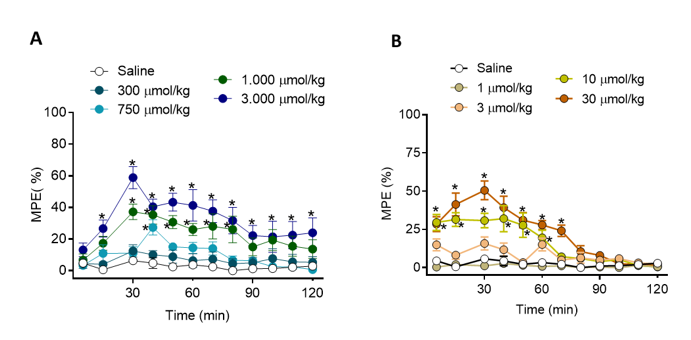
Figure 1: Central antinociceptive activity of metamizole (A) and donepezil (B). Analgesic activity (MPE %) of metamizole and donepezil during 120 min, in the hot plate test. Values expressed as mean± E.P.M. (n=10/dose). *p<0.05 when compared to saline (two-way ANOVA test followed by Tukey's test).
Note that no antinociceptive effect was observed with administration of donepezil alone at a dose of 3 μmol/kg (Figure 1B). Then, it was tested the co-administration of metamizole and donepezil, and the dose of 300 μmol/kg of metamizole was selected because it did not produce activity alone. The combination of metamizole (300 μmol/kg i.v) plus donepezil, 3 and 10 μmol/kg produced 42.6 ± 7.9 and 74.3 ± 8.9%, respectively as shown in Figure 2.
Metamizole, donepezil and the combination were tested in a model of inflammatory pain. Formalin-induced tissue damage generated responses, which were observed during the time that the animal remained licking or biting the paw. Metamizole and donepezil were administered 30 min before intraplantar formalin injection and time (s) of animal reactivity was evaluated during the neurogenic (central) and inflammatory (peripheral) phases. In the neurogenic phase, the reactivity of the animals treated with metamizole (1,000 μmol/kg) was significantly reduced from 51.5 ± 5.1 (saline group) to 29.0 ± 3.9 s. In contrast, metamizole did not interfere with the inflammatory phase (Figure 3A).
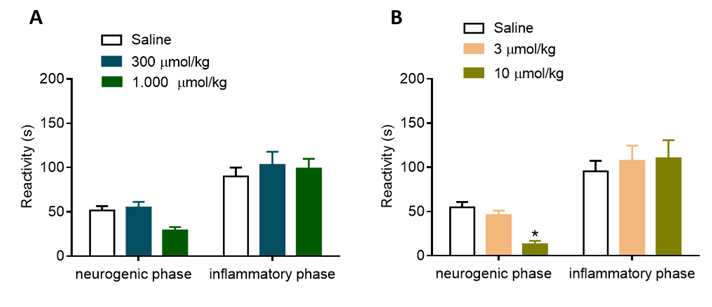
Figure 2: Central antinociceptive activity of the combination of metamizole (300 μmol/kg) plus increasing doses of donepezil. Analgesic activity (MPE %) of the combination in the hot plate test. Data expressed as mean± SEM (n=10/dose). *p<0.05 compared to saline (two-way ANOVA test followed by Tukey's test).
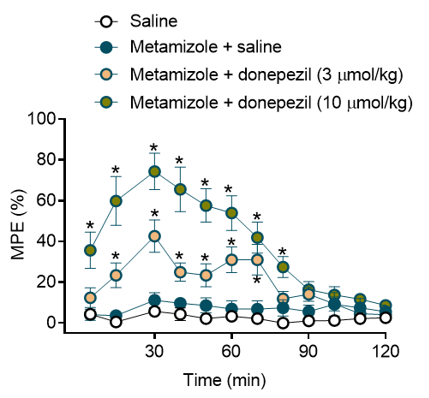
Figure 3: Animal reactivity in response to intraplantar injection of formalin (2.5%). Reactivity was observed in animals previously treated with metamizole (A) or donepezil (B). Metamizole: 300 and 1,000 μmol/kg (i.v. n=10/dose) and donepezil: 3 e 10 μmol/kg (s.c. n=10/dose). *p<0.05 compared to saline (two-way ANOVA test followed by Dunnett's test).
Same profile was found with the administration of donepezil (Figure 3B). Low dose of donepezil (3 μmol/kg) showed no antinociceptive effect however, when increased to 10 μmol/kg significantly reduced reactivity to 13.1 ± 3.9 s. None of the doses tested caused significant reduction in the inflammatory phase. The combination of metamizole (300 μmol/kg, i.v.) plus donepezil (3 and 10 μmol/kg s.c.) was evaluated in the formalin test. In the neurogenic phase, the administration of the combination of metamizole and donepezil, at low dose of 3 μmol/kg, significantly reduced the reactivity to from 53.4 ± 5.4 to 28.8 ± 4.2 s. This combination showed no significant alteration when compared to the administration of donepezil alone. When the dose used of donepezil was 10 μmol/kg, a reduction in reactivity was observed from 16.9 ± 4.9 to 2.7 ±1.5 s (Figure 4A). In the inflammatory phase, the association of both doses of donepezil (3 and 10 μmol/kg) with metamizole reduced the reactivity of the animals. In the case of 3μmol/kg, donepezil reduced the reactivity from 107.4 ± 17.2 to 53.4 ±12.7 s and the high dose of 10 μmol/kg decreased from 114.5 ± 23.6 to 1.1 ± 1.1 s (Figure 4B).
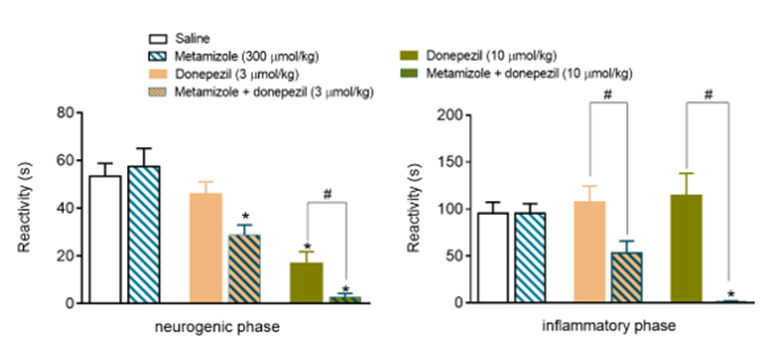
Figure 4: Reactivity after intraplantar injection of formalin (2.5%) in animals previously treated with saline, metamizole, donepezil land combination. Metamizol: 300 µmol/kg and donepezil: 3 and 10 μmol/kg alone or combined with metamizole (n=8/dose). *p<0.05 compared to saline (One-way ANOVA, Dunnett's post-test), #p<0.05 compared to treatment alone (t-Studant test).
Antinociceptive effects of metamizole and donepezil in chronic pain
Antinociceptive effects of the combination of metamizole plus donepezil in a neuropathic pain model was tested through the observation of thermal hyperalgesia and mechanical allodynia. Based on the profile detected in the acute pain, the effects of the combination metamizole plus donepezil were investigated in a model of neuropathic pain using the SNL. After the onset of neuropathic pain, which occurs 7 days after SNL surgery, the treatment with the combination of metamizole (300μmol/kg) plus donepezil (10 μmol/kg) initiated. Latency of paw withdrawal (s) as a function of time (days) showed that a significant reduction from 15.9 ± 1.1 to 7.8 ± 0.4 s indicating the appearance of thermal hyperalgesia (Figure 5). Three days of treatment with the combination, there was a significant increase in latency to 11.9 ± 1.5 s that remained during the 14 days of treatment with 13.4 ± 1.1 s on the last day.
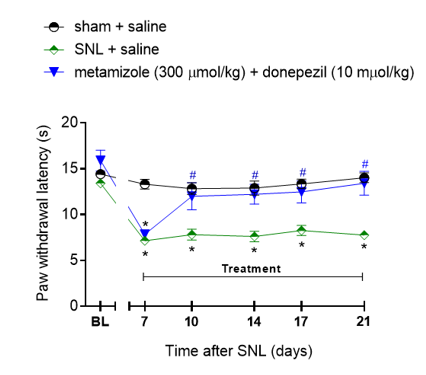
Figure 5: Time course of the antinociceptive effect of the combination of metamizole (300 μmol/kg) plus donepezil (10μmol/kg). Note the thermal hyperalgesia developed after SNL surgery. Data are expressed as mean ± SEM (n= 6/group). *p <0.05 compared to Sham (One-way ANOVA test, after Tukey's test); #p<0.05 compared to SNL+ saline (unpaired t-test).
Mechanical allodynia was also observed after 7 days of SNL surgery, because the mechanical stimulus threshold for paw removal reduced from 40.9 ± 2.4 to 21.5 ± 1.1 g. The animals submitted to the SNL procedure and treated with saline had thermal hyperalgesia and mechanical allodynia throughout the evaluation period. As a result of the treatment with the combination metamizole plus donepezil, there was a recovery in the paw removal threshold to 27.1 ± 2.9 g (Figure 6).
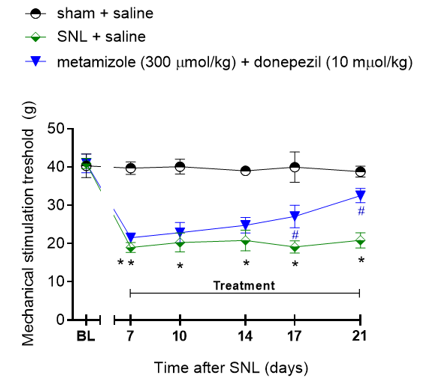
Figure 6: Time course of the antinociceptive effect of the combination of metamizole (300 μmol/kg) plus donepezil (10 μmol/kg). Mechanical allodynia induced by SNL. Data are expressed as mean ± SEM (n=6/group). *p <0.05 compared to Sham (One-way ANOVA test, after Tukey's test); #p<0.05 compared to SNL+ saline (unpaired t-test).
Discussion
This work is based on the use of combined therapy of metamizole (dipyrone) with donepezil because of possible positive interactions of metamizole with the cholinergic pathway, and its possible use as an alternative in the treatment of neuropathic pain. The prevalence of neuropathic pain worldwide reaches 6.9% of the population and the existing pharmacological therapies promote relief greater than 50% in only 25% of patients14,15. Considering the multiple mechanisms of action suggested to metamizole, the possible interaction of this drug with agents that interfere with the cholinergic system could contribute to antinociceptive effects of greater intensity. The improvement in analgesic efficacy expected by such interaction would provide the eventual use of lower doses of the drugs and, therefore, less occurrence of adverse effects. Models of acute pain were used for the pharmacological evaluation of the different substances, to select the effective dose to use in the combination. Metamizole and donepezil demonstrated analgesic efficacy in central nociception models, both in the hot plate test and in the initial phase of the formalin test. The combination of low dose of metamizole (300 μmol/kg equivalent to 105 mg/kg) with increasing doses of donepezil resulted in increased analgesia and prolongation of its duration. These data reinforce the hypothesis that the analgesic activity of metamizole is related to central mechanisms, probably with involvement of the opioid16-20 and endocannabinoid systems21-23. The bioactive metabolites of metamizole (4-MAA and 4-AA) are found in blood plasma and cerebrospinal fluid associated to peripheral and central analgesic activity24.
The central analgesic action of metamizole concerns the endocannabinoid system by direct activation of cannabinoid receptors (especially CB1) and by the indirect promotion of increased levels of circulating endocannabinoids. The increase in arachidonic acid caused by the inhibition of COX-1 and COX-2 by metamizole would result in a greater amount of substrate for the synthesis of prostaglandins, prostanoids, leukotrienes, lipoxins and endocannabinoids23.
Since the administration of opioid antagonists at various sites of the descending system reversed the antinociceptive effects of metamizole, reinforces the hypothesis of its involvement in the opioid system19. AChE inhibitors such as donepezil seem to promote analgesic effect predominantly through the activation of spinal mAChR25, especially M2 and M426. Antinociception is induced by increased levels of ACh and consequent suppression of adenylate cyclase and Cav channel activity25,27. The increase in ACh caused by donepezil would still produce indirect antinociceptive effect by the activation of GABAergic interneurons26-28 Thus, the increase of the antinociceptive effect observed with the treatment of combination may represent the interaction between the cannabinoid and opioid systems (activated by metamizole) and the muscarinic and gabaergic systems (donepezil).
Metamizole and donepezil when tested alone, did not provoke antinociceptive activity in the inflammatory phase of the formalin test. This phase reflects the sensitization of neurons in the dorsal horn of the medulla, due to the development of inflammation, central sensitization and increased generation of nociceptive impulses by afferent neurons29. The formalin stimulus evokes spinal release of the excitatory neurotransmitters glutamate and substance P that, through their receptors (NMDA and neurokinin-1, respectively), initiate a signaling cascade leading to the facilitation state in sensory neurons30. When this stimulus is persistent, it results in the activation of TRPA1 cation channels, highly expressed in a subpopulation of C-type nociceptors31. The administration of the combination in a model of SNL, resulted in improvement of the neuropathic pain condition. In the thermal hyperalgesia test, there was a significant improvement in pain, represented by an increase in the latency of paw removal, from the third day of treatment for the association with donepezil. The improvement in mechanical allodynia, represented by the increase in the threshold for movement of the stimulated animal's paw, occurred after 10 days of treatment for the combination of metamizol plus donepezil.
The improvement of thermal hypersensitivity and mechanical allodynia, induced by treatment with the combination of metamizole plus donepezil, can be attributed to central effects. After the maintenance of a nerve injury, the cholinergic terminals would become less excitable and the inhibitory cholinergic tone would be decreased32. Drugs approved for the treatment of chronic neuropathic pain, involves the spinal activation of α2 adrenergic receptors and subsequent release of ACh at the spinal level33,34. These actions would be based on the increase of descending adrenergic and cholinergic tone, through the activation of mAChR and nAChR by donepezil. The combination with metamizole and consequent activation of the opioid and cannabinoid systems would provide relief from neuropathic pain with the use of lower doses than usual. Metamizole can interferes on microglial activity and the development of neuropathic pain, which is based on the inhibition of the activation of microglia and spinal macrophages, causing a decrease in the levels of pro-nociceptive cytokines11. Similarly, donepezil directly inhibits microglial inflammatory activity by reducing the production and release of inflammatory mediators and, consequently, blocks the amplification of neuroinflammation35. Thus, the improvement of hypersensitivity and allodynia present in neuropathic pain may be due to inhibition of microglial activity, combined with pre- and postsynaptic medullary mechanisms.
Acknowledgments: This research was funded by Coordenação de Aperfeiçoamento de Pessoal de Nível Superior (CAPES), Conselho Nacional de Desenvolvimento Científico e Tecnológico (CNPq, #309498/2020-1), Fundação de Amparo à Pesquisa do Estado do Rio de Janeiro (FAPERJ, #E-26/200.881/2021) and Cristália Produtos Químicos e Farmacêuticos Ltda.
The authors declare no conflict of interest
References
- Haddad JJ. On the enigma of pain and hyperalgesia: A molecular perspective. Biophys. Res. Commun 353 (2007): 217-224.
- Mills SEE, Nicolson KP & Smith BH. Chronic pain: a review of its epidemiology and associated factors in population-based studies. J. Anaesth 123 (2019): e273-e283.
- Michael Costigan, Joachim Scholz and CJW. Neuropathic Pain: A Maladaptive Response of the Nervous System to Damage Michael. Annu Rev Neurosci 32 (2009): 1-32.
- Colloca L. et al. Neuropathic pain. Rev. Dis. Prim 3 (2017): 17002.
- Seifert F & Maihöfner C. Central mechanisms of experimental and chronic neuropathic pain: Findings from functional imaging studies. Mol. Life Sci 66 (2009): 375-390.
- Rowbotham MC, Goli V, Kunz NR & Lei D. Venlafaxine extended release in the treatment of painful diabetic neuropathy: a double-blind, placebo-controlled study. Pain 110 (2004): 697-706.
- Goldstein DJ, Lu Y, Detke MJ, Lee TC & Iyengar S. Duloxetine vs. placebo in patients with painful diabetic neuropathy. Pain 116 (2005): 109-118.
- Kuner R. Central mechanisms of pathological pain. Med 16 (2010): 1258-1266.
- Salat K, Gryzlo B & Kulig K. Experimental Drugs for Neuropathic Pain. Neuropharmacol 16 (2018): 1193-1209.
- Moisset X, et al. Pharmacological and non-pharmacological treatments for neuropathic pain: Systematic review and French recommendations. Neurol. (Paris). 176, 325-352 (2020).
- Zajaczkowska R, et al. Involvement of microglial cells in the antinociceptive effects of metamizol in a mouse model of neuropathic pain. Biochem. Behav 175 (2018): 77-88.
- Nassini R, et al. The TRPA1 channel mediates the analgesic action of dipyrone and pyrazolone derivatives. J. Pharmacol 172 (2015): 3397-3411.
- Seltzer B. Donepezil: a review (2005): 527-536.
- Yoon SY, et al. Analgesic Efficacy of α2 Adrenergic Receptor Agonists Depends on the Chronic State of Neuropathic Pain: Role of Regulator of G Protein Signaling 4. Neuroscience 455 (2021): 177-194.
- Nightingale, S. The neuropathic pain market. Rev. Drug Discov 11 (2012): 101-102.
- Jasiecka A, Mas̈lanka T & Jaroszewski JJ. Pharmacological characteristics of metamizole. J. Vet. Sci. 17 (2014): 207-214.
- Vazquez E, Hernandez N, Escobar W & Vanegas H. Antinociception induced by intravenous dipyrone (metamizol) upon dorsal horn neurons: Involvement of endogenous opioids at the periaqueductal gray matter, the nucleus raphe magnus, and the spinal cord in rats 1048 (2005): 211-217.
- Vazquez E, Escobar W, Ramirez K & Vanegas H. A nonopioid analgesic acts upon the PAG-RVM axis to reverse inflammatory hyperalgesia. J. Neurosci. 25 (2007): 471-479.
- Tortorici V & Vanegas H. Opioid tolerance induced by metamizol (dipyrone) microinjections into the periaqueductal grey of rats. J. Neurosci 12 (2000): 4074-4080.
- Vanegas H & Tortorici V. Opioidergic effects of nonopioid analgesics on the central nervous system. Mol. Neurobiol 22 (2002): 655-61.
- Topuz RD, Gündüz Ö, Karadağ ÇH & Ulugöl A. Non-opioid Analgesics and the Endocannabinoid System. Balkan Med. J 37 (2020): 309-315.
- Rogosh T, et al. Novel bioactive metabolites of dipyrone (metamizol). Bioorg Med Chem 20 (2013): 101-107.
- Crunfli F, Vilela FC & Giusti-Paiva A. Cannabinoid CB1 receptors mediate the effects of dipyrone. Exp. Pharmacol. Physiol 42 (2015): 246-255.
- Goncalves dos Santos G. et al. CB1 receptor-dependent desensitisation of TRPV1 channels contributes to the analgesic effect of dipyrone in sensitised primary sensory neurons. J. Pharmacol. 177 (2020): 4615-4626.
- Clayton BA, Hayashida KI, Childers SR, et al. Oral donepezil reduces hypersensitivity after nerve injury by a spinal muscarinic receptor mechanism. Anesthesiology 106 (2007): 1019-1025.
- Naser PV & Kuner R. Molecular, Cellular and Circuit Basis of Cholinergic Modulation of Pain. Neuroscience 387 (2018): 135-148.
- Kimura M, Hayashida KI, Eisenach JC, et al. Relief of hypersensitivity after nerve injury from systemic donepezil involves spinal cholinergic and γ-aminobutyric acid mechanisms. Anesthesiology 118 (2013): 173-180.
- Schechtmann G, Song Z, Ultenius C, et al. Cholinergic mechanisms involved in the pain relieving effect of spinal cord stimulation in a model of neuropathy. Pain 139 (2008): 136-145.
- Khodayar MJ, Shafaghi B, Naderi N et al. Antinociceptive effect of spinally administered cannabinergic and α2-adrenoceptor drugs on the formalin test in rat: Possible interactions. Psychopharmacol 20 (2006): 67-74.
- Yoon MH, Yoo KY & Jeong CY. Synergistic Effects Between Intrathecal Clonidine and Neostigmine in the Formalin Test. Korean Med. Sci 16 (2001): 498.
- McNamara CR, et al. TRPA1 mediates formalin-induced pain. Natl. Acad. Sci. U S A 104 (2007): 13525-13530.
- Hayashida KI, & Eisenach JC. Spinal α2-adrenoceptor-mediated analgesia in neuropathic pain reflects brain-derived nerve growth factor and changes in spinal cholinergic neuronal function. Anesthesiology 113 (2010): 406-412.
- Hayashida K, Parker R & Eisenach JC. Oral Gabapentin Activates Spinal Cholinergic Circuits to Reduce Hypersensitivity after Peripheral Nerve Injury and Interacts Synergistically with Oral Donepezil. Anesthesiology 106 (2007): 1213-1219.
- Pan H-L, Chen S-R & Eisenach JC. Intrathecal Clonidine Alleviates Allodynia in Neuropathic Rats. Anesthesiology 90 (1999): 509-514.
- Hwang J, Hwang H, Lee HW & Suk K. Microglia signaling as a target of donepezil. Neuropharmacology 58 (2010): 1122-1129.