Zefri*, Nurwahyi
Universitas Krisnadwipayana Jakarta, Bekasi, Indonesia
*Corresponding Author: Zefri, Universitas Krisnadwipayana Jakarta, Bekasi, Indonesia
Received: 26 August 2019; Accepted: 17 September 2019; Published: 30 September 2019
The physical character of coastal settlements as residential areas characterized by the collective activity as fishermen. These activities serve as fishermen's settlements identity that is implemented in a good space utilization personal space in a dwelling, as well as communal spaces in residential areas along the coast. Routines fishing activity occurs continuously, thus making the coastal area as a space that has activity throughout the day both day and night. In the context of settlements, typology functions as coastal settlements with fishing activity, showed a difference that is quite thick.
This study aims to give the concept of the arrangement and construction of residential areas and settlements in the coastal area of eco-green-based, so that the quality of housing and residential environment for the better. The methodology used in this study was conducted on the basis of the actual condition of residential areas and settlements in the study area in District Babelan, and Tarumajaya as described earlier in the discussion forward and combined with the assessment parameters based eco-green. The variables that were examined consisted of eight (8) components were: 1) State of the Environment, 2) Administration Building, 3) Water, 4) Wastewater, 5) Drainage, 6) Waste, 7) Energy, and 8) Transportation.
Based on the results of surveys and interviews show one housing unit occupied by a family of 2-3. This resulted in the number of residents in one house numbers between 8-11 people. A large number of families in one house unit was based on a very close family relationship that is in the relationship of parents and children, or fellow brothers, even though they already have their own families. Owners of residential buildings remained based on joint ownership with the parents as the primary owner. The system shows that the system of living together is a common prac
Housing and Settlement, Coastal Region, Eco-green
1. Introduction
The coastal communities in the District Babelan and Tarumajaya Bekasi in daily life can not be separated from its dependency on infrastructure, public facilities and means of supporting the environment. The environmental question is the local road infrastructure, drainage channels, water supply, sewerage, electric. The public facilities are facilities education of environment, health, trade, government, public service, worship, recreation, culture, sport and the open field. The problem of housing and settlements in coastal regions there are some concepts in its development, the concept of "Eco-green", Eco-green is one term that meant "one with nature", or at least the characteristics and capacity of the environment to be one of the main considerations in the development/construction, including the development and construction of housing and settlements.
Paling not there is five things that must be considered in the development of housing and residential-based "eco-green", namely:
- Smart design, namely how to maximize the function of space, both physical space and the space housing the region.
- Eco-materials, namely the selection/use of various building materials, furniture, other environmental infrastructure are re-useable, renewable, and recyclable.
- Energy efficiency, the energy-saving measures, electrical/lighting (in order to reduce global warming).
- Water conservation, namely saving efforts in the use of water (water supply).
- Healthy environment, which is an effort to create a beautiful environment (through the planting of green plants), to add oxygen and refresh the eye.
1.1 Formulation of the problem
The research problem is as follows:
- Factor - what factors cause the housing and slums emerged in coastal areas?
- What are the criteria residential areas and settlements in coastal areas based eco-green?
- How the concept of the arrangement and construction of residential areas and settlements in coastal areas based eco-green?
1.2 Research purposes
- Analyzing factors - what factors cause the housing and slums emerged in coastal areas.
- Analyzing the criteria of residential areas and settlements in coastal areas based eco-green.
- Develop the concept of the arrangement and construction of residential areas and settlements in coastal areas of eco-based so that the quality of housing and settlement environment for the better.
1.3 Benefits of research
This study is expected to:
- Providing an overview of the state of the residential areas and settlements in coastal areas especially coastal District of Babelan and Tarumajaya.
- Recommendations in the concept and direction of development and regulation of housing and settlements in coastal areas, so it can be used as a material consideration and input Bekasi government in formulating and developing policies for managing housing and settlements in coastal areas based eco-green.
2. Literature Review
2.1 Definition of coastal areas
The coastal area is a transitional area of ??land and sea. When viewed from the coastline (coastline), then a coastal region has two kinds of boundaries (boundaries), the boundaries parallel from the coastline (longshore) and boundary perpendicular to the shoreline (cross-shore). In Law No.27 / 2007 on the Management of Coastal Areas, defined as the coastal areas of the mainland region that is still influenced by ocean dynamics and processes such as tides, seawater intrusion; and marine areas that are still under the influence of the dynamics and processes such as sedimentation and pollution mainland.
2.2 The theory and the concept of eco-green
Some theories, understanding relating to the study of which is to be associated with urban problems, civilization or activities of human life, and environmental matters in this case are related to the ecological environment.
2.3 Eco-effectiveness and eco-efficiently
Strategies that can be done to achieve good governance:
a. Subsidiarity - Solidarity
- Subsidiarity taking into account the development cost-effectively with the possible risk as small as possible.
- Solidarity providing education to the public in environmental awareness, as well as taking into account the tolerance of the society in the implementation of the planning assessment - areas design.
b. Cooperation with market segments, anticipating the strength and market trends, where the urban economic policy should be based on it.
c. Establish cooperation with the stakeholders, the readiness of the central and local governments to involve all stakeholders (communities, NGOs, religious leaders, urban communities, individuals) in development planning as a public service effort.
d. Government prioritization prioritizes grounded in the public interest.
2.4 Eco-urban design
Its application to the design of cities beckon us to better perform environmental considerations, regarding ecological, economic and cultural that will give birth to eco urban design as a more responsible approach.
3. Research Methods
3.1 Scope of the study
Regional Scope The administration, an area of ??research that are in the coastal area of ??the District Babelan and Tarumajaya.
3.2 Data collection technique
The data collected in this study are primary data and secondary data. Primary data is data obtained from the first source, while secondary data is primary data obtained by others or primary data that has been processed further and presented well by collecting primary data or by other parties that are generally presented in the form of tables or diagrams -diagram. Techniques of primary and secondary data collection are done in several ways, namely: interviews; questionnaires; observation; and documentation (Figure 1).
3.3 Validity testing data
Eight residential areas and settlements variables studied were: 1) State of the Environment, 2) Administration Building, 3) Water, 4) Wastewater, 5) Drainage, 6) Waste, 7) Energy, and 8) Transportation.
3.4 Methods of analysis research
In detail, the analysis methods used are provided in Table 1.
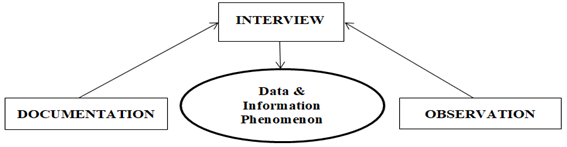
Figure 1: Implementation Method of Triangulation.
 |
Table 1: Methods of Analysis Research.
4. Results and Discussion
4.1 Housing and area development-based eco-green in study areas
Housing and Settlement Development Studies based Eco-green in Bekasi include two (2) districts, the District Babelan, and District Tarumajaya. Furthermore, in the analysis phase conducted pedestrian to all residential areas and settlements that exist in the three districts, which consists of 103 blocks of the study. The details of the division of blocks in each district are as follows:
- as many as 38 blocks in the district Babelan;
- as many as 26 blocks in the district Tarumajaya.
Block division studies were done by considering the physical limits, agglomeration area, the homogeneity of the functions and characteristics of residential areas and settlements as the basis for the effectiveness of the span of control in developing housing and settlements based eco-green. There is two purposes block division of the study, namely:
- Getting a clear structure and accurate data for various uses in control and regulate the physical development of housing and settlements, so that results can be obtained in addition to a detailed assessment also in order as far as possible the concept of eco-green can be applied optimally.
- Make it easy for institutions or government agencies in order to determine the allocation of priority programs for each development activity against residential areas and settlements based eco-green.
4.1.1 Distribution of study in District Babelan: Study area in District Babelan consists of 38 blocks, consisting of 5 blocks in the village of Babelan City, 5 blocks in the Village of Joy, 1 block in the village Buni Bakti, 7blok Village Hurip Jaya, 4 blocks in the village Kebalen, 4 blocks in Kedung Jaya, 5 blocks Kedung Supervisors, 3 blocks in the village of Muara Bakti, and 4 blocks in the village of Hurip Beach.
4.1.2 Distribution of study in District Tarumajaya: Study area in District Babelan consists of 26 blocks, consisting of 4 blocks in Village Pahlawan Faithful, 6 blocks in the village of Beach Makmur, 1 block in the Village Heritage People, 2 blocks in Village Samudra Jaya, 6 blocks in Village Segara Jaya, 2 blocks Village Segara Makmur, 4 blocks in Village Setia Asih, and 1 block in Village Setia Mulya.
4.2 Identification typology of housing and settlement condition-based eco-green in study areas
Identification carried out on the facts housing and settlement conditions in order to determine a current picture are contained in the study area to be used as the basis for determining the handling of the Housing and Settlement Development-Based Eco-green. The identification process is done on the results of the surveys, interviews and field observations, which includes:
- Identification of housing and settlement conditions completeness and supporting facilities; and
- Problem identification parameters of eco-green found in the study area.
In the process of analysis, the variables were studied in Housing and Residential Development-Based Eco-green include the following eight (8) typology components as follows:
- Environmental conditions, Who studied, among others, concerning the regularity of the pattern of the building, the availability of green open space (RTH) and its vegetation in public housing blocks and settlements, and safety from the dangers of pollution and the potential for disaster;
- Building Management, Who studied, among others, concerning the availability of the yard and/or green open space (RTH) private, the distance between buildings, building materials, and the conditions of habitability of the building;
- Clean water, Who studied among others regarding the fulfillment of clean water, use clean water, clean water sources are used, the condition of a water supply network, water quality, and the presence of water treatment plants;
- Wastewater, Who studied, among others, concerning the location of the sewer and the existence of the wastewater treatment plant;
- Drainage, Who studied, among others, concerning the existence of drainage channels, drainage channel conditions, channel type, and the presence of absorption wells;
- Solid Waste, Who studied among others regarding where waste dumps by residents in the block housing and settlements, and efforts as well as the separation of waste by residents in the block of the study;
- Energy, Who studied among others regarding the fulfillment of the electrical energy in housing and residential blocks, the network of electrical energy and energy-saving measures carried out by people in the study block.
- Transportation, Who studied, among others, concerning the condition of the transport network, where pedestrian and bicycle paths, where green space and vegetation around the road, and the existence of a drainage channel along with the road condition.
4.3 Environmental conditions
4.3.1 The availability of green open space (RTH): In the development of housing and residential-based eco-green, green open space in a residential area and the settlements must meet a minimum area of ??green open space so that it can fulfill the function and provide benefits in order to preserve, harmony and balance of ecosystems that include elements of the environment, social and cultural rights, so it is expected the presence of green open space in residential areas and settlements can serve as efforts to conserve germplasm, retaining and filter solid particles from the air, overcoming puddles, climate amelioration, preservation of groundwater, the filters glare, enhance the beauty, as habitat and reduce stress problems of the people living in residential areas and settlements. Based on the results of the study as a whole there are 31 blocks which have RTH and 72 blocks that do not have green space (Figure 2).
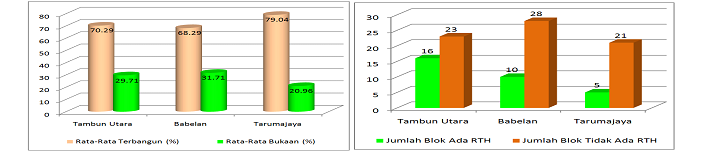
Figure 2: Graph Block RTH.
4.3.2 Availability vegetation: In addition to a green open space, which is no less important consideration in the development of housing and settlements based eco-green vegetation that is available, in this case the trees in residential areas and settlements. Overall there were 83 blocks that have quite a lot of vegetation and 20 blocks less availability of vegetation. The description in each district is discussed as follows.
4.3.2.1 Availability vegetation in District Babelan: In Sub Babelan majority bloc in residential areas and settlements have enough available vegetation (31 blocks), while the less provided the vegetation is 7 blocks.
4.3.2.2 Availability vegetation in District Tarumajaya: Similarly, the sub-district and District Babelan Tambun Utara, the majority bloc in residential areas and settlements in the District Tarumajaya have enough available vegetation (18 blocks), while the less available vegetation as much as 8 blocks.
4.3.2.3 Building management: The growing movement of "Green Architecture", "Eco-Architecture" or "Sustainable Architecture", has provided color on housing in Indonesia since the 1980s. Simply put, "Sustainable Architecture" or "Sustainable Architecture" can be defined as Environmental Architectural Design. Furthermore, the "Sustainable Architecture" looking for ways to minimize the negative impact on the environment by improving the efficiency and discretion in the application of materials, energy and space arrangement.
In the housing and settlement development based eco-green, administration building/house must meet the following requirements:
- Design strategies that improve the efficiency of resource use;
- Selecting building materials, building equipment that is environmentally friendly, durable.
4.3.2.4 Building future shape: The future shape of the building as ecology, namely the adoption of forms that are environmentally friendly, such as: the form of the traditional architecture of the local, the future shape of the building is open so that no entanglement between the environment and the building or on the contrary, the dimensions of the building processed as much as possible so that the absence of a significant difference to the building local residents, well adapted to the shape of the building material used. Based on the results of the study, overall there are 17 blocks whose condition is quite dense and have less time building openings (yard) while the rest (86 blocks) mostly have a yard.
4.3.2.5 Availability courtyard house in District Babelan: In Sub Babelan large blocks in residential areas and settlements in the majority of the house have a yard (adequate openings). Nevertheless, there is some relatively solid block as many as 11 blocks.
4.3.2.6 Availability courtyard house in District Tarumajaya: In Sub Tarumajaya as many as 20 blocks available in the majority of his yard, while the majority of homes do not have a yard that as many as 6 blocks.
4.3.3 Lighting: A review of the District Babelan, and Tarumajaya mostly residential areas and settlements in natural lighting will be sufficient, as many as 94 blocks. While the rest, as many as 9 blocks which house less natural lighting conditions.
4.3.4 Air circulation: Based on the results of the study in District Babelan, and Tarumajaya most (about 93 blocks) in terms of natural air circulation may be sufficient, the remaining 10 blocks air openings in the housing so that the relative lack of air circulation in nature (the natural air) becomes inadequate.
4.3.5 Organic material: The results of the study in Tambun Utara subdistrict, Babelan, and Tarumajaya almost the entire block of studies on housing and settlement using the wall (brick or brick), roofing material mostly using clay and concrete, while the majority of the house foundation using ceramics.
4.3.6 Clean water: A review of the District Babelan, and Tarumajaya water supply used by people mostly from wells. Water conditions in residential areas and settlements in the three subdistricts are relative lack of potable quality (taste), so for the purposes of public consumption using water that is sold in cans and gallon water refills.
4.3.7 Wastewater: Based on the results of the study in District Babelan, and Tarumajaya majority of waste disposal is done through a system of on-site position, namely through septic tanks and rivers.
4.3.8 Drainage
Rainwater drainage network of the road surface, roof construction, the sink wastewater, and courtyard. Based on the results of the study, there are drainage networks in the study area is located in a side street (in the form of road drainage) bordering the fence and drainage area (in the form of a river).
4.3.9 Solid waste
Waste management centralized help minimize waste that must be disposed of to the final processing (TPA). In principle, waste management must be done as close as possible to the source. Based on the results of the study in Babelan, and District waste management Tarumajaya most have not done well. And on the one hand, the disposed waste is still mixed between wet waste and dry waste. Even with managing the waste in the smallest environments, such as RT or RW, by making it into compost at least the volume of waste can be reduced/reduced. In the housing and settlement development based eco-green, litter is important attention in creating residential or Ecological region. Because An Ecological occupancy can not be said if the garbage is not managed properly, some negative effect on the occupancy Ecological trash, namely:
- Causing a residential environment becomes dirty and can cause diseases and environmental pollution;
- The loss of aesthetic values ??and comfort;
- Physically damage the building.
4.3.10 Energy
In terms of energy, throughout the study area and the residential area in the district Babelan settlement, and the District Tarumajaya already served by the electricity grid. Electricity network that was developed in the study area is the cable network that follows the road network.
4.3.11 Transportation
Aspects of transportation are one of the aspects that need to be considered in the development of housing and settlements based eco-green. In conjunction with this research, the study of aspects of transport more emphasis on the service road network, the physical quality of the road, the availability of pedestrian paths, and provider networks for environmentally friendly modes of transportation (eg, bike lanes). In addition, the drainage factor is also a consideration, given its presence can affect the quality of the environment because it reduces the puddles that can cause germs and dilapidated neighborhoods in residential areas and settlements.
4.4 Housing development based on the concept of eco-green
4.4.1 Rationale: The analysis was conducted on the basis of the actual condition of residential areas and settlements in the study area in District Babelan, and Tarumajaya as described earlier in the discussion forward and combined with the assessment parameters based eco-green. The variables that were examined consisted of eight (8) components, while the eco-green valuation parameters include 5 factors.
|
Table 2: Correlation Matrix Variables Housing and Residential Areas with Eco-Green Parameter.
4.4.2 Housing and settlement development concept in the coastal zone-based eco-green:
4.4.2.1 Owners and occupants: Based on the results of surveys and interviews show one housing unit occupied by a family of 2-3. This resulted in the number of residents in one house numbers between 8-11 people. A large number of families in one house unit was based on a very close family relationship that is in the relationship of parents and children, or fellow brothers, even though they already have their own families. Owners of residential buildings remained based on joint ownership with the parents as the primary owner. System lives together indicate that this joint is a common practice. Democratization in the family makes this habit become commonplace.
4.4.2.2 Typology function: The physical character of coastal settlements as residential areas characterized by the collective activity as fishermen. These activities serve as fishermen's settlements identity that is implemented in a good space utilization personal space in a dwelling, as well as communal spaces in residential areas along the coast. Routines fishing activity occurs continuously, thus making the coastal area as a space that has activity throughout the day both day and night.
4.4.2.3 The fishing activities carried out each day: Characters coastal settlements can be caught by the presence of facilities boat, boat mooring space is available, the activity of fishing (fishing), and storage space nets and other equipment. In the context of settlements, typology functions as coastal settlements with fishing activity, showed a difference that is quite thick. Getting away from the residential building positions the coast, coastal settlements character will be weakened. This is caused by the arrangement dwelling in settlements, the reduction in equipment space for fishing activity and varying the mixing between indigenous and immigrant communities. Classification residential zone and coastal settlements can be seen in Figure 3.
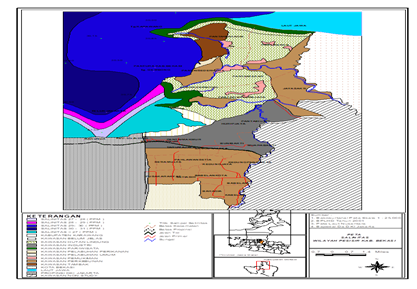
Figure 3: Classification Activity Base on Zone.
4.4.2.4 Typology geometry: Based on the historical origins obtained during the interview in the survey conducted, the residential area of coastal communities is a residential area that formed the background based on the relationship of origin, cultural and familial ties. In the context of settlement areas with different backgrounds in common, especially kinship and culture, there are many similarities in the implementation of physical occupancy. This is achieved through analysis of the typology of geometry with the focus area of the building, hierarchy and types of spaces including the shape of the building.
4.4.2.5 Morphology region: Coastal settlements are particularly among the sites of the nonfishing settlement located on the seashores and Tarumajaya Babelan village which is a complex condition both in the region as well as socio-cultural visualization. Coastal areas are not only used as a space of social interaction, but every day is used as a space to meet the economic needs of the family. Coastal areas also serve as space between is between the coast and inland, but also as a work transaction space, namely to remove the fish from the boat to the catcher to be brought to market. At this moment a very strong interaction between people.
4.4.3 Based on concept of eco-green:
4.4.3.1 Green open space zone: Green open space in addition to preserving the environment, can also be used as a meeting place where citizens or residents to interact socially. Thus, in the provision of green open spaces, these things must be considered.
4.4.3.2 Structuring concepts river border region: River border region in the region has built houses of citizens, so that needed to do the arrangement. It is associated with spatial planning regulations which confirm that the river border region is an area which should be free of local protection of houses.
4.4.3.3 The concept of quality improvement settlement: The house as a basic requirement needs to be established well supported by various supporting infrastructure. So that people can live decently. Their houses are uninhabitable in the area, leading to the need to improve the quality of settlements. In addition, an increase in the quality of housing also will prevent or reduce the formation of slums in the region.
4.4.3.4 Road network development concept: The concept of road network development is to support the movement, whether the movement of people and movement of vehicles in the region. So that the road network should be equipped with supporting infrastructure. With the good road network, the movement of people and vehicles will be smooth and can improve the quality of life of its citizens.
4.4.3.5 Waste management concept: Handling of waste based on the concept of environmentally friendly. Handling waste recycling system will give priority to non-organic garbage and composting system for organic waste.
4.4.3.6 Water handling concepts: Meeting the needs of clean water in the area is done by using the concept of gravity and utilize water resources for different needs. With the concept of gravity, water will be pumped to a higher place for further distributed to every home by gravity. With this concept, the energy used to reduce.
4.4.3.7 Concept of waste water treatment: Similarly, clean water, wastewater handling concept also done using gravity. In addition, the wastewater treatment can also be done with processing sites that can also function as a passive green space.
5. Conclusions and Recommendations
5.1 Conclusions
Typology of Eco-Green-based housing and settlement areas from typology aspects consists of; 1) Function Typology. Namely the physical character of the settlement as a coastal settlement area is characterized by collective activity as a fisherman: 2) Typology of Geometry. Ie the origin of history, the area of coastal community settlements is a residential area that is formed based on the background relationship of origin, culture and family relations. Characteristics and typologies of housing and settlement areas in coastal areas are marked by several things, namely; 1) Housing and settlement areas in coastal areas, especially in the study area initially had a clustered settlement pattern, but after the development of the road construction the pattern changed to linear following the road based on the form of community activities, namely farmers and industrial workers; 2) The number of family members who live in one house in the coastal area ranges from 3-5 people per house and is a very close family relationship, that is the relationship between parents and children, or fellow siblings, even though they already have their own families. Status of permanent home / residential ownership is based on joint ownership with parents as the main owner; 3) The characteristics of housing and settlements in the coastal area are always marked by the place room for the main activities of fishermen (fishing); 4) The concept of developing housing and settlements in coastal areas based on eco-green in Babelan and Tarumajaya Districts so that the quality of the housing and settlement environment is better.
The parameters used in the development of eco-green-based coastal areas are; a) layout (efficiency of spatial patterns, water infiltration yards, KDB and KDH standards, provision of green space); b) Building layout (distance between buildings, use of environmentally friendly materials, sufficient air); c) Clean water (availability of clean water, efficient use of water, use of a gravity system); d) Wastewater (provision of WWTP and recycling / refining systems); e) Drainage (adequate drainage in the area and along the road); f) waste (provision of TPS); g) energy (use of renewable energy); h) transportation (provision of bicycle lanes and environmentally friendly modes of transportation).
5.2 Recommendations
- Interaction of spatial patterns of land use with the pattern of eco-green-based development of an area, it should be noted aspects of the typology of the area.
- Planning for housing and settlement areas based on eco-green should also be adjusted to the potential and planning of coastal areas. The facts show that due to changes in spatial use in coastal areas an increase in inundation areas.
- It is expected that the community and developers in the construction of housing and residential areas in the coastal area the concept of eco-green are absolutely a condition so that damage can be avoided for the preservation of the housing and settlement environment itself.
References
- Ahmadi Partowiyoto. Empowerment of Appropriate Technology to Grow Agricultural Industry. Proceedings of the National Seminar on Appropriate Technology: Department of Agricultural Technology Unpad (2000).
- Bettle and Crsitopher Mc. Carthy. Sustainable Ecosystem (2001).
- Djajadiningrat Suryana T and Melia Famiola. Environmental Friendly Industrial Zone, Bandung: Engineering Science (2004).
- Hall, Peter, Ultric Pfeiffer. Urban Future (2000).
- Kusumastanto T. Ocean Policy in Building a Maritime Land in the Era of Regional Autonomy. Gramedia Pustaka Utama, Jakarta (2003).
- Kusumastanto T. Ocean Economics. PKSPL-IPB Press. Bogor (2006).
- Wijanarko W. The Role of Civil Society in Participatory Development Planning Encourages the Establishment of a Better Governance System. Yogyakarta: Griya Mandiri Foundation (YGM) (2006).
- Mohammad BS. Come Take Care of the Earth with Green ICT. SWA (2011).