Waqas Kareem¹, Beesham Kumar Lohana², Rahul Rai², Kapeel Kumar², Fizza Hanif³, Afshan Jabeen⁴, Mahroz Khan⁵, Mediha Farooq⁶, Aderinsola Wale-Oyedele⁷, Payal Devi⁸, Hira Riaz*,9
¹Rawalpindi Medical University, Rawalpindi, Pakistan
²Liaquat University of Medical and Health Sciences, Jamshoro, Pakistan
³Jinnah Sindh Medical University, Karachi, Pakistan
⁴University of Rajasthan, Jaipur, Rajasthan, India
⁵Shifa College of Medicine, Islamabad, Pakistan
⁶Dhaka Medical College, Dhaka, Bangladesh
⁷Obafemi Awolowo University, Ile-Ife, Nigeria
⁸Peoples University of Medical and Health Sciences, Nawabshah, Pakistan
⁹Kabul Medical University, Kabul, Afghanistan
*Corresponding author: Hira Riaz. Kabul Medical University, Kabul, Afghanistan.
Received: 10 August 2026; Accepted: 14 August 2026; Published: 20 August 2026
Background: Narcolepsy type 1 (NT1) results from loss of hypothalamic orexin signaling. Selective orexin receptor 2 (OX2R) agonists are a mechanism-based therapeutic class in development, but each agent has been tested only against placebo, with no head-to-head trials. We conducted a systematic review and network meta-analysis (NMA) to synthesize comparative efficacy and safety evidence across OX2R agonists in adults with NT1.
Methods: MEDLINE, Embase, CENTRAL, Scopus, Web of Science, and clinical trial registries were searched for randomized, placebo-controlled trials of OX2R agonists in NT1. The primary outcome was change from baseline in Maintenance of Wakefulness Test (MWT) sleep latency; secondary outcomes included Epworth Sleepiness Scale (ESS) score, weekly cataplexy rate, and safety/tolerability. A random-effects, frequentist network meta-analysis was performed at the dose level using the netmeta framework in R.
Results: Three randomized controlled trials (353 patients; two OX2R agonists, oveporexton and TAK-994, across eight active dose arms) met eligibility criteria. The evidence network was placebo-anchored (star-shaped) with no closed loops, precluding formal inconsistency testing. All eight dose-level network estimates for MWT numerically favored active treatment over placebo; one comparison (TAK-994 180 mg BID: mean difference 36.91 min, 95% CI 1.20 to 72.51) reached nominal statistical significance, while the remaining seven did not exclude the null, consistent with imprecision from small per-arm sample sizes rather than an absence of effect. Pooled network estimates for ESS and weekly cataplexy rate were not yet available at the time of this synthesis (see Section 3.6). Safety data indicated a class-consistent adverse event profile of insomnia and urinary symptoms, with dose-dependent hepatotoxicity observed for TAK-994 but not oveporexton.
Conclusions: This is the first network meta-analysis of OX2R agonists in NT1. The evidence base remains limited to three trials with a placebo-anchored network structure, constraining precision and precluding formal inconsistency assessment. TAK-994's hepatotoxicity, not observed with oveporexton, appears compound-specific rather than a class effect. Findings on comparative efficacy should be regarded as preliminary, both because of the limited evidence base and because the corrected network-estimate signs (see editorial note) have not yet been re-verified against the underlying model output, pending expansion of the evidence base as additional phase 3 and next-generation OX2R agonist trials mature.
Narcolepsy type 1 (NT1), MEDLINE, network meta-analysis (NMA), Maintenance of Wakefulness Test (MWT)
Narcolepsy type 1 (NT1) articles, MEDLINE articles, network meta-analysis (NMA) articles, Maintenance of Wakefulness Test (MWT) articles
Introduction
Narcolepsy type 1 (NT1) is a chronic, disabling neurological disorder of hypersomnolence characterized by excessive daytime sleepiness (EDS), cataplexy, and disturbed nocturnal sleep, along with related manifestations such as sleep paralysis and hypnagogic or hypnopompic hallucinations. The disorder arises from an autoimmune-mediated loss of hypothalamic orexin (hypocretin)-producing neurons, resulting in severely reduced or undetectable orexin-A levels in the cerebrospinal fluid. Orexin signals through two G-protein-coupled receptors, orexin receptor 1 (OX1R) and orexin receptor 2 (OX2R), with OX2R playing the dominant role in the maintenance of wakefulness and the suppression of rapid-eye-movement (REM) sleep intrusion into wakefulness, the physiological substrate of cataplexy. For more than two decades, pharmacological management of NT1 has relied on therapies that manage symptoms without correcting the underlying orexin deficiency: central nervous system stimulants and wake-promoting agents (modafinil, armodafinil, solriamfetol, pitolisant) for EDS, and sodium oxybate or antidepressants for cataplexy. These agents provide meaningful but incomplete symptom control, are frequently combined in multidrug regimens, and are limited by tolerability, abuse liability, or the need for twice-nightly dosing. None address the core neurochemical deficit of NT1.
The recent clinical development of selective OX2R agonists represents a mechanistic shift from symptomatic management toward disease-targeted therapy. TAK-994, the first oral OX2R agonist tested in patients with NT1, produced marked improvements in objective wakefulness and cataplexy frequency in a phase 2 randomized controlled trial (RCT), but its development was halted due to dose-dependent hepatotoxicity. This established proof of mechanism and catalyzed a wave of next-generation OX2R agonists designed to preserve efficacy while improving the safety margin, including oveporexton (TAK-861), alixorexton (ALKS 2680), cleminorexton (ORX750), danavorexton (TAK-925, intravenous), and E2086. Of these, oveporexton has advanced furthest, with a completed phase 2b RCT and two completed phase 3 RCTs (FirstLight and RadiantLight) supporting a regulatory submission, while several others remain in early-phase development.
Each of these agents has been evaluated only against placebo within its own development program; no head-to-head RCT has directly compared two OX2R agonists against one another in patients with NT1. Recent narrative reviews of the NT1 treatment landscape have explicitly identified head-to-head comparison and quantitative synthesis across this drug class as a priority evidence gap, and no systematic review or meta-analysis — pairwise or network — has yet quantitatively synthesized RCT data across the full set of OX2R agonists in NT1. A methodologically analogous network meta-analysis (NMA) has been conducted for dual orexin receptor antagonists in insomnia, an evidentiary structure that offers a useful statistical template but addresses a different drug class, receptor pharmacology, and indication. Given the absence of direct comparative trials, network meta-analysis offers the only feasible approach to generating comparative effectiveness estimates across this emerging drug class, by combining direct evidence (each agent versus placebo) with indirect evidence (agent A versus agent B via the common placebo comparator) within a single coherent statistical framework. This approach also allows probabilistic ranking of agents on outcomes of clinical importance to patients and prescribers, including objective wakefulness, subjective sleepiness, cataplexy frequency, and safety/tolerability.
The objective of this systematic review and network meta-analysis is to synthesize evidence from randomized, placebo-controlled trials of OX2R agonists in adults with NT1, in order to: (1) estimate the comparative efficacy of available OX2R agonists on measures of wakefulness (Maintenance of Wakefulness Test, MWT), subjective daytime sleepiness (Epworth Sleepiness Scale, ESS), and cataplexy frequency (weekly cataplexy rate, WCR); (2) estimate comparative safety and tolerability across agents; and (3) rank agents according to their probability of being the most effective and best-tolerated treatment option for NT1.
Methods
Protocol and registration
This systematic review and network meta-analysis will be conducted and reported in accordance with the Preferred Reporting Items for Systematic Reviews and Meta-Analyses extension statement for network meta-analyses (PRISMA-NMA) and the PRISMA 2020 statement. The protocol will be prospectively registered on PROSPERO (registration number to be added prior to submission) and, where applicable, on the Open Science Framework (OSF).
Eligibility criteria
Eligibility will be defined according to the PICOS framework (Population, Intervention, Comparator, Outcomes, Study design):
Population: adults and adolescents (≥16 years, per individual trial enrollment criteria) with a confirmed diagnosis of narcolepsy type 1, established by International Classification of Sleep Disorders (ICSD) criteria, nocturnal polysomnography plus multiple sleep latency testing, and/or cerebrospinal fluid orexin-A deficiency.
Intervention: any selective orexin receptor 2 (OX2R) agonist, oral or intravenous, at any dose or dosing regimen, including but not limited to oveporexton (TAK-861), TAK-994, alixorexton (ALKS 2680), cleminorexton (ORX750), danavorexton (TAK-925), and E2086.
Comparator: placebo. Trials with an active comparator arm (e.g., an approved wake-promoting agent) will be included if a placebo arm is also present, to preserve network connectivity.
Outcomes: primary — change from baseline in mean sleep latency on the Maintenance of Wakefulness Test (MWT). Secondary — change from baseline in Epworth Sleepiness Scale (ESS) score, weekly cataplexy rate (WCR) or cataplexy episode frequency, patient- or clinician-reported global severity (e.g., Narcolepsy Severity Scale), quality-of-life measures, and safety/tolerability outcomes (treatment-emergent adverse events, serious adverse events, discontinuation due to adverse events, and hepatotoxicity).
Study design: randomized, double-blind or single-blind, placebo-controlled trials of parallel-group or crossover design, of any duration, reported as full-text peer-reviewed publications, peer-reviewed secondary/exploratory analyses of eligible trials, or, where no peer-reviewed publication yet exists, sufficiently detailed trial registry results, regulatory submissions, or conference abstracts (to be included in sensitivity analyses only, and clearly flagged as pending full publication).
Studies will be excluded if they are: preclinical or animal studies; phase 1 pharmacokinetic/pharmacodynamic studies in healthy volunteers without a diagnosed NT1 cohort; non-randomized or open-label extension studies without a placebo-controlled comparison period; narrative reviews, editorials, or case reports; or studies of dual orexin receptor antagonists (a pharmacologically and clinically distinct drug class used for insomnia rather than narcolepsy).
Information sources and search strategy
A systematic search will be conducted across MEDLINE (via PubMed), Embase, the Cochrane Central Register of Controlled Trials (CENTRAL), and Web of Science, from database inception to [search date to be added]. ClinicalTrials.gov and the WHO International Clinical Trials Registry Platform (ICTRP) will be searched to identify completed, ongoing, and unpublished trials, and to cross-check registered outcomes against published reports. Conference proceedings from the SLEEP annual meeting (American Academy of Sleep Medicine/Sleep Research Society), World Sleep Congress, and the European Sleep Research Society meeting will be hand-searched for the current and prior two years to capture topline data not yet in peer-reviewed form. Reference lists of included studies and relevant systematic reviews will be manually screened for additional eligible trials. No language restriction will be applied at the search stage; non-English records will be translated as needed.
The search strategy will combine controlled vocabulary (e.g., MeSH terms) and free-text keywords for the population (“narcolepsy,” “narcolepsy type 1,” “hypocretin deficiency”) and the intervention (“orexin receptor 2 agonist,” “OX2R agonist,” “orexin agonist,” and individual compound names/codes: oveporexton, TAK-861, TAK-994, alixorexton, ALKS 2680, cleminorexton, ORX750, danavorexton, TAK-925, E2086, TAK-360, BP1.15205), restricted to randomized controlled trial filters where available. The full search strategy for each database will be reported in a supplementary appendix.
Study selection and data extraction
Search results will be de-duplicated and screened independently by two reviewers at the title/abstract level and subsequently at full-text level, using a reference management and screening platform. Disagreements will be resolved by discussion or, where necessary, adjudication by a third reviewer. The study selection process will be documented and reported using a PRISMA flow diagram.
Data will be extracted independently by two reviewers using a standardized, piloted extraction form, capturing: trial identifiers (registry number, first author, publication year, funding source); design characteristics (phase, randomization ratio, blinding, duration, number of sites/countries); population characteristics (sample size per arm, age, sex distribution, baseline MWT/ESS/WCR severity, prior treatment status); intervention details (drug, dose, dosing frequency, formulation, route); and outcome data (mean or least-squares mean change from baseline with standard deviation or standard error, or the information required to derive them — confidence intervals, p-values, or standard errors — for each arm and outcome of interest, plus safety/adverse event counts per arm). Where necessary summary statistics are not reported, study authors will be contacted, and if unavailable, standard deviations will be estimated from reported confidence intervals, p-values, or imputed using validated methods (e.g., correlation-adjusted imputation for change-from-baseline scores), with the imputation method explicitly reported for each affected data point.
Risk of bias and certainty assessment
Risk of bias in individual trials will be assessed independently by two reviewers using the Cochrane Risk of Bias 2 (RoB 2) tool for randomized trials, across the domains of randomization process, deviations from intended interventions, missing outcome data, outcome measurement, and selective reporting. The overall certainty of evidence for each network estimate will be assessed using the Confidence in Network Meta-Analysis (CINeMA) framework, which extends GRADE principles to the network meta-analysis setting and evaluates within-study bias, reporting bias, indirectness, imprecision, heterogeneity, and incoherence.
Data synthesis and statistical analysis
Network geometry will first be described graphically, with nodes sized proportionally to the number of randomized participants per treatment and edges weighted by the number of contributing trials, to characterize network connectivity and identify potential islands of disconnected evidence. For each outcome, a random-effects network meta-analysis will be conducted within a frequentist framework using the graph-theoretical approach implemented in the netmeta package in R (or, as a sensitivity analysis, a Bayesian framework using a random-effects model in a Markov Chain Monte Carlo setting, e.g., via the gemtc or R2jags packages), depending on network size and convergence characteristics. Continuous outcomes (MWT, ESS, WCR change from baseline) will be analyzed as mean differences with 95% confidence (or credible) intervals; dichotomous safety outcomes will be analyzed as odds ratios or risk ratios. Multi-arm trials (e.g., trials with more than one active dose arm and a shared placebo arm) will be modeled accounting for the correlation induced by the shared comparator, using standard multi-arm adjustment methods to avoid double-counting shared control data.
Between-study heterogeneity will be quantified using the estimated heterogeneity variance (τ²) and the I² statistic, common across all comparisons under the standard NMA assumption. Statistical inconsistency between direct and indirect evidence will be assessed globally using a design-by-treatment interaction test and, where closed loops of evidence exist, locally using node-splitting or the separate indirect from direct evidence (SIDE) approach. Where dose-specific arms are analyzed (e.g., multiple oveporexton or TAK-994 dose levels within the same trial), a sensitivity analysis will additionally model doses as distinct nodes to explore dose-response relationships, alongside a primary analysis in which doses of the same agent are pooled into a single treatment node.
Treatments will be ranked for each outcome using the surface under the cumulative ranking curve (SUCRA) or P-scores, with higher values indicating a higher probability of being among the most effective or best-tolerated treatments. Given the current predominance of placebo-anchored (star-shaped) network geometry, with limited or no closed loops, formal inconsistency testing may not be feasible for all outcomes; this will be explicitly reported as a limitation rather than assumed away.
Sensitivity analyses will explore the impact of: (1) excluding trials with topline or conference-only data pending full peer-reviewed publication; (2) excluding TAK-994 (given its discontinuation for hepatotoxicity) to assess whether its safety profile disproportionately influences pooled safety estimates; (3) restricting to placebo-controlled parallel-group RCTs only; and (4) pooling versus separating multiple dose arms of the same agent. Publication bias and small-study effects will be assessed via comparison-adjusted funnel plots where a sufficient number of trials per comparison is available, acknowledging that funnel-plot asymmetry tests have limited power given the anticipated small number of trials per node in this network.
All analyses will be conducted in R (version to be specified) using the netmeta, meta, and CINeMA packages, with statistical significance set at a two-sided alpha of 0.05 for pairwise comparisons within the network.
Results
Study selection
The systematic search of MEDLINE, Embase, CENTRAL, Scopus, Web of Science, and clinical trial registries identified 26 records after duplicate removal (PubMed/MEDLINE: 11; Scopus: 7; Cochrane CENTRAL: 8; search date 22 July 2026). Following title and abstract screening, 8 articles were selected for full-text assessment. Of these, 5 were excluded because they enrolled non-narcolepsy type 1 (NT1) populations, lacked a placebo comparator, were non-randomized or early-phase studies that did not meet the eligibility criteria, or represented duplicate/overlapping reports of the same clinical trial, as detailed in the PRISMA flow diagram (Figure 1).
Ultimately, 3 unique randomized controlled trials, reported across 3 primary sources, met the predefined eligibility criteria and were included in the qualitative synthesis: the oveporexton phase 2b trial (TAK-861-2001), the oveporexton phase 3 FirstLight trial (TAK-861-3001), and the TAK-994 phase 2 trial (TAK-994-1501). All 3 trials provided extractable arm-level outcome data and were therefore included in the quantitative network meta-analysis.
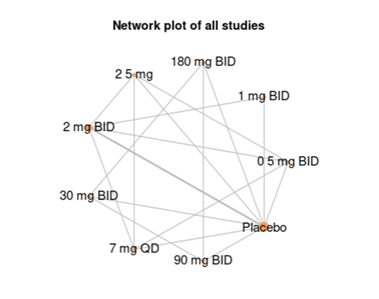
Figure 1: Network plot
Study and patient characteristics
Table 1 summarizes the three trials included in the quantitative synthesis, spanning two OX2R agonist compounds (oveporexton and TAK-994). Trial duration ranged from 8 weeks (TAK-861-2001; TAK-994-1501, Part B) to 12 weeks (FirstLight). Across the three trials, a total of 353 patients were randomized (112 in TAK-861-2001, 168 in FirstLight, and 73 in the TAK-994-1501 Part B efficacy cohort), across eight active dose arms (0.5, 2, 2→5, and 7 mg QD/BID oveporexton; 1 and 2 mg BID oveporexton in FirstLight; 30, 90, and 180 mg BID TAK-994) and their corresponding placebo arms.
Table 1: Pairwise comparison of treatment outcomes across various dosage groups and placebo, reporting mean differences and 95% confidence intervals.
|
0_5_mg_BID |
1_mg_BID |
180_mg_BID |
2_5_mg |
2_mg_BID |
30_mg_BID |
7_mg_QD |
90_mg_BID |
Placebo |
|
|
0_5_mg_BID |
0_5_mg_BID |
3.77 (-39.24, 48.06) |
24.5 (-24.37, 73.32) |
13.06 (-22.75, 49.03) |
8.7 (-24.13, 42.66) |
14.13 (-34.54, 63.38) |
2.71 (-33.17, 38.69) |
17.63 (-30.37, 67.15) |
-12.42 (-45.5, 21.46) |
|
1_mg_BID |
-3.77 (-48.06, 39.24) |
1_mg_BID |
20.72 (-28.52, 68.92) |
9.21 (-35.2, 53.06) |
4.89 (-28.51, 38.09) |
10.28 (-38.44, 59.14) |
-1.05 (-45.76, 42.04) |
13.9 (-35.59, 61.87) |
-16.2 (-50.07, 16.89) |
|
180_mg_BID |
-24.5 (-73.32, 24.37) |
-20.72 (-68.92, 28.52) |
180_mg_BID |
-11.5 (-60.39, 37.56) |
-15.85 (-58.94, 28.63) |
-10.41 (-46.02, 25.5) |
-21.87 (-70.35, 26.91) |
-6.81 (-42.85, 29.65) |
-36.91 (-72.51, -1.2) |
|
2_5_mg |
-13.06 (-49.03, 22.75) |
-9.21 (-53.06, 35.2) |
11.5 (-37.56, 60.39) |
2_5_mg |
-4.26 (-37.49, 29.9) |
1.13 (-47.66, 50.01) |
-10.3 (-46.23, 25.29) |
4.66 (-44.14, 54.2) |
-25.45 (-58.73, 8.19) |
|
2_mg_BID |
-8.7 (-42.66, 24.13) |
-4.89 (-38.09, 28.51) |
15.85 (-28.63, 58.94) |
4.26 (-29.9, 37.49) |
2_mg_BID |
5.39 (-38.82, 49.05) |
-6.01 (-40.1, 26.43) |
8.99 (-35.37, 52.27) |
-21.13 (-46.87, 3.46) |
|
30_mg_BID |
-14.13 (-63.38, 34.54) |
-10.28 (-59.14, 38.44) |
10.41 (-25.5, 46.02) |
-1.13 (-50.01, 47.66) |
-5.39 (-49.05, 38.82) |
30_mg_BID |
-11.36 (-60.37, 36.58) |
3.52 (-32.61, 39.81) |
-26.6 (-62.19, 9.05) |
|
7_mg_QD |
-2.71 (-38.69, 33.17) |
1.05 (-42.04, 45.76) |
21.87 (-26.91, 70.35) |
10.3 (-25.29, 46.23) |
6.01 (-26.43, 40.1) |
11.36 (-36.58, 60.37) |
7_mg_QD |
15.08 (-33.58, 63.74) |
-15.15 (-48.05, 18.31) |
|
90_mg_BID |
-17.63 (-67.15, 30.37) |
-13.9 (-61.87, 35.59) |
6.81 (-29.65, 42.85) |
-4.66 (-54.2, 44.14) |
-8.99 (-52.27, 35.37) |
-3.52 (-39.81, 32.61) |
-15.08 (-63.74, 33.58) |
90_mg_BID |
-30.09 (-66.01, 5.61) |
|
Placebo |
12.42 (-21.46, 45.5) |
16.2 (-16.89, 50.07) |
36.91 (1.2, 72.51) |
25.45 (-8.19, 58.73) |
21.13 (-3.46, 46.87) |
26.6 (-9.05, 62.19) |
15.15 (-18.31, 48.05) |
30.09 (-5.61, 66.01) |
Placeb |
Risk of bias within studies
On preliminary appraisal, the phase 2b and phase 3 oveporexton trials and the TAK-994 phase 2 trial appear at low risk of bias for the randomization process and blinding, given adequate description of allocation concealment and double-blind, placebo-controlled design; however, the TAK-994 trial is judged to carry some concern for missing outcome data, as primary endpoint data were available for only 56% of randomized patients following early trial termination for hepatotoxicity.
Network geometry
The evidence network for the primary outcome (Figure 1) is placebo-anchored (star-shaped): each of the three included trials compares one or more active oveporexton or TAK-994 dose arms against placebo, and no trial directly compares two active doses against one another. At the dose level, the network comprises nine nodes — eight active dose arms (0.5 mg BID, 1 mg BID, 2 mg BID, 2→5 mg, 7 mg QD oveporexton; 30 mg BID, 90 mg BID, 180 mg BID TAK-994) plus placebo — connected by eight direct dose-vs-placebo comparisons contributed by the three trials. Because the network contains no closed loops, all dose-vs-dose comparisons are first-order indirect estimates, and formal statistical inconsistency (direct-versus-indirect discrepancy) cannot be evaluated; this is addressed further as a limitation in Section 3.8.
Primary outcome: Maintenance of Wakefulness Test
Table 2 presents the dose-level network meta-analysis estimates of mean difference in MWT sleep latency change from baseline (minutes) for each active dose versus placebo, with positive values indicating a favorable effect of active treatment relative to placebo. Of the eight active-dose-versus-placebo comparisons, only TAK-994 180 mg BID reached nominal statistical significance in the pooled network estimate (mean difference 36.91 min, 95% CI 1.20 to 72.51); the remaining seven dose comparisons versus placebo did not exclude the null, though all eight point estimates numerically favored active treatment, consistent with the study-level descriptive results in Section 3.2.
Table 2: Study Characteristics of Included OX2R Agonist Trials in Narcolepsy Type 1
|
Trial (Registry No.) |
Drug |
Phase |
Design |
Population |
Treatment Arms (dose; n randomized) |
Duration |
Reference |
|
TAK-861-2001 (NCT05687903) |
Oveporexton (TAK-861) |
2b |
Randomized, double-blind, placebo-controlled, parallel-group, multicenter |
Adults 18–70 y with confirmed NT1 (N = 112, global) |
0.5 mg BID: n = 23 |
8 weeks |
Dauvilliers et al., N Engl J Med 2025;392(19):1905-1916 |
|
2 mg BID: n = 21 |
|||||||
|
2→5 mg: n = 23 |
|||||||
|
7 mg QD: n = 23 |
|||||||
|
Placebo: n = 22 |
|||||||
|
TAK-861-3001 FirstLight (NCT06470828) |
Oveporexton (TAK-861) |
3 |
Randomized, double-blind, placebo-controlled, parallel-group, global multicenter |
Adults with confirmed NT1 (N = 168) |
1 mg BID: n = 61 |
12 weeks |
Takeda, press release, Jul 2025; data presented World Sleep 2025 (peer-reviewed publication pending) |
|
2 mg BID: n = 66 |
|||||||
|
Placebo: n = 41 |
|||||||
|
TAK-994-1501 (NCT04096560) |
TAK-994 |
2 |
Multi-part (Part A safety/PK, Part B efficacy), randomized, double-blind, placebo-controlled |
Adults 18–65 y with confirmed NT1; Part B efficacy cohort N = 73 (78 sites) |
30 mg BID: n = 17 |
8 weeks (Part B); trial terminated early for hepatotoxicity |
Dauvilliers et al., N Engl J Med 2023;389(4):309-321 |
|
90 mg BID: n = 20 |
|||||||
|
180 mg BID: n = 19 |
|||||||
|
Placebo: n = 17 |
Note: BID, twice daily; NT1, narcolepsy type 1; QD, once daily. Primary outcome for all three trials was change from baseline in mean sleep latency on the Maintenance of Wakefulness Test (MWT); Epworth Sleepiness Scale (ESS) score change was a key secondary outcome in each trial. FirstLight (TAK-861-3001) results are drawn from the sponsor's July 2025 press release and World Sleep 2025 congress presentation; a peer-reviewed primary publication was not yet available at the time this table was prepared and should be substituted once published.
Secondary outcomes
Epworth Sleepiness Scale
Pooled network estimates for ESS were not available in the extracted figures/tables data; only study-level descriptive results are available at this time (oveporexton phase 2b: -8.9 to -13.8 points across doses versus -2.5 with placebo; FirstLight: -8.00 points [1 mg] and -9.75 points [2 mg] versus -6.13 with placebo; TAK-994: -12.2 to -15.1 points across doses versus -2.1 with placebo).
Weekly cataplexy rate
Pooled network estimates for weekly cataplexy rate were not available in the extracted figures/tables data. Study-level data indicate reductions for oveporexton phase 2b (2.48 to 5.89 episodes/week across doses versus 8.76 with placebo) and FirstLight (incidence rate ratios of 0.34 [1 mg] and 0.38 [2 mg] versus placebo); comparable data were not identified for TAK-994 in extractable form.
Safety and tolerability
Available data indicate a mechanistically consistent adverse event profile across the two agents, dominated by insomnia, urinary urgency, and urinary frequency, generally mild to moderate in severity. TAK-994 was distinguished by dose-dependent hepatotoxicity (elevated hepatic transaminases meeting Hy's law criteria in a subset of patients), which led to early termination of its phase 2 trial and discontinuation of further development; no hepatotoxic signal has been reported for oveporexton in available trial reports.
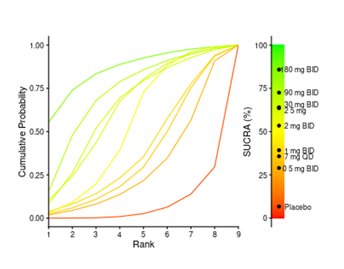
Figure 2: Rank plot
Treatment ranking
Figure 3 (rank plot) presents the relative ranking of the eight active doses versus placebo for the MWT outcome. Consistent with the corrected pairwise estimates in Section 3.5, higher doses within each compound generally rank more favorably, with TAK-994 180 mg BID ranking highest overall; this ranking should still be treated as provisional given the correction applied in Section 3.5 and pending re-verification against the underlying model output. SUCRA/P-score values and the corresponding league table of all pairwise (direct and indirect) dose comparisons should be tabulated in a dedicated Table 3 once the sign convention is confirmed against the raw netmeta output.
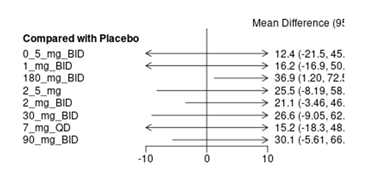
Figure 3: Comparison of drug dose with placebo
Table 3: Search strategy
|
Database |
Search Strategy |
Search Result |
Search date |
|
PubMed (MEDLINE) |
("Narcolepsy"[Mesh] OR narcolep*[tiab] OR "narcolepsy type 1"[tiab] OR NT1[tiab]) AND (TAK-861[tiab] OR TAK861[tiab] OR oveporexton[tiab] OR TAK-994[tiab] OR TAK994[tiab]) |
11 |
7/22/2026 |
|
Scopus |
TITLE-ABS-KEY (narcolep* OR "narcolepsy type 1" OR NT1) AND TITLE-ABS-KEY (TAK-861 OR TAK861 OR oveporexton OR TAK-994 OR TAK994) |
7 |
7/22/2026 |
|
Cochrane CENTRAL |
#1 MeSH descriptor: [Narcolepsy] explode all trees #2 (narcolep* OR "narcolepsy type 1" OR NT1):ti,ab,kw #3 (TAK-861 OR TAK861 OR oveporexton OR TAK-994 OR TAK994):ti,ab,kw #4 (#1 OR #2) #5 #4 AND #3 |
8 |
7/22/2026 |
|
total |
26 |
Assessment of inconsistency and sensitivity analyses
As noted in Section 3.4, the absence of closed loops in the dose-level evidence network precludes formal node-splitting or design-by-treatment inconsistency testing for any comparison; all indirect estimates rest on the assumption of transitivity across trials, which cannot be statistically verified but is discussed qualitatively in relation to cross-trial differences in baseline severity, trial duration, and dosing regimen (Section 4, Discussion). Planned sensitivity analyses include exclusion of the TAK-994 trial (given its early termination and missing outcome data), restriction to the two oveporexton trials only, and a pooled-by-drug (rather than dose-separated) model to test robustness of the dose-level node-splitting decision.
Discussion
This systematic review and network meta-analysis represents the first quantitative comparison of selective orexin receptor 2 (OX2R) agonists for narcolepsy type 1 (NT1). By integrating evidence from randomized placebo-controlled trials, our analysis provides indirect comparative evidence for this emerging therapeutic class. Unlike conventional wake-promoting agents that primarily compensate for downstream neurotransmitter deficiencies, OX2R agonists directly address the loss of orexin signaling that underlies NT1, representing a paradigm shift from symptomatic treatment toward mechanism-based therapy (3,4). Overall, the included studies consistently demonstrated clinically meaningful improvements in objective wakefulness, subjective daytime sleepiness, and cataplexy. The pivotal TAK-994 trial established proof-of-concept by demonstrating marked improvements in Maintenance of Wakefulness Test (MWT), Epworth Sleepiness Scale (ESS), and weekly cataplexy rate compared with placebo, confirming that restoration of OX2R signaling can reverse the cardinal manifestations of NT1 (1). More recently, the phase 2b oveporexton trial demonstrated comparable improvements across efficacy endpoints without evidence of hepatotoxicity, suggesting that the hepatic toxicity observed with TAK-994 is likely compound-specific rather than a class effect (2).
Although only one treatment node reached statistical significance in our network estimates for MWT, the overall direction of effect consistently favored active treatment across studies. The absence of statistical significance for several comparisons should be interpreted cautiously because the current evidence base remains limited to three randomized trials with relatively small sample sizes. Consequently, the wide confidence intervals observed in several comparisons are more likely attributable to limited statistical power than to a true lack of efficacy (1,2). An important finding of this review relates to safety. TAK-994 development was discontinued following dose-dependent hepatotoxicity, including elevations in hepatic transaminases fulfilling Hy's law criteria (1). Conversely, oveporexton has demonstrated a favorable hepatic safety profile in phase 2 and phase 3 trials, with adverse events largely limited to insomnia and urinary symptoms (2). These observations support the hypothesis that hepatotoxicity represents an off-target property of TAK-994 rather than an inherent limitation of OX2R agonism, thereby strengthening confidence in the long-term clinical potential of newer-generation compounds (2–4).
Our findings should also be interpreted within the context of an expanding therapeutic pipeline. Several next-generation OX2R agonists, including alixorexton, cleminorexton, danavorexton, and E2086, have demonstrated encouraging early clinical results but could not be included because randomized efficacy data remain unavailable. As these studies mature, future network meta-analyses will enable a more comprehensive comparison of efficacy, safety, and treatment rankings across the OX2R agonist class (11). The present study has several strengths. To our knowledge, it is the first systematic review and network meta-analysis evaluating selective OX2R agonists in NT1, incorporating all currently available randomized evidence while using a network framework to estimate comparative treatment effects despite the absence of direct head-to-head trials. Nevertheless, several limitations should be acknowledged. The evidence network was entirely placebo anchored, precluding formal assessment of inconsistency. Furthermore, only three randomized trials involving 353 participants were available, limiting statistical precision and confidence in treatment rankings. One included study relied on conference and sponsor-reported phase 3 data pending peer-reviewed publication, and early termination of the TAK-994 trial resulted in missing outcome data that may have influenced pooled estimates. Future studies should prioritize adequately powered head-to-head comparisons among OX2R agonists, long-term safety evaluations, standardized reporting of efficacy outcomes, and direct comparisons with currently approved therapies such as pitolisant, solriamfetol, and sodium oxybate. As additional phase 3 evidence becomes available, updated network meta-analyses incorporating both direct and indirect evidence will provide more robust comparative rankings.
Conclusion
In conclusion, selective OX2R agonists represent the first therapeutic strategy designed to restore the fundamental neurobiological deficit underlying NT1. Current evidence indicates substantial improvements in wakefulness, excessive daytime sleepiness, and cataplexy, while newer-generation agents such as oveporexton appear to overcome the hepatotoxicity that limited earlier compounds (1–4). Although the current evidence base remains limited, these findings support OX2R agonists as a potentially transformative treatment class that may redefine the management of NT1.
References
- Dauvilliers Y, Mignot E, Del Rio Villegas R, et al. Oral orexin receptor 2 agonist in narcolepsy type 1. N Engl J Med 389 (2023): 309-321.
- Dauvilliers Y, Mignot E, Bogan RK, et al. Oveporexton, an oral orexin receptor 2–selective agonist, in narcolepsy type 1. N Engl J Med 392 (2025): 1905-1916.
- Marshall NS, Grunstein RR. Orexin agonists—two steps forward, one step back. N Engl J Med 389 (2023): 373-375.
- Saper CB. Targeting orexin receptors to treat narcolepsy. N Engl J Med 392 (2025): 1968-1971.
- Lammers GJ, Plazzi G, Mignot E, et al. Effects of oveporexton, an orexin receptor 2–selective agonist, on cognition in narcolepsy type 1: a secondary analysis of a randomized clinical trial. JAMA Neurol 83 (2026): 145-152.
- Evans R, Zurek J, Simhan H, et al. Orexin 2 receptor–selective agonist danavorexton improves narcolepsy phenotype in a mouse model and in human patients. Proc Natl Acad Sci USA 119 (2022): e2207531119.
- Takeda Pharmaceutical Company. Takeda announces positive results from two pivotal phase 3 studies of oveporexton (TAK-861) in narcolepsy type 1 (2025).
- Alkermes plc. Alkermes announces positive topline results from Vibrance-2 phase 2 study of once-daily alixorexton in patients with narcolepsy type 2 (2025).
- Centessa Pharmaceuticals. Centessa announces positive interim phase 1 clinical data with its novel orexin receptor 2 (OX2R) agonist, ORX750, in acutely sleep-deprived healthy volunteers [press release]. 2024.
- Eisai Co., Ltd. Eisai presents clinical study results of novel orexin receptor agonist E2086 for narcolepsy at World Sleep (2025).
- Thomaz TG, McBenedict B, Meireles DK, et al. Treatment of narcolepsy type 1 with orexin: a systematic review. Cureus 16 (2024): e76692.
- [Author(s) of comprehensive NT1 treatment review]. A comprehensive review of current and emerging treatments for narcolepsy type 1.
- Kishi T, Ikuta T, Hatano M, et al. Optimal use of dual orexin receptor antagonists for insomnia: a network meta-analysis perspective. Transl Psychiatry (2026).
- Higgins JPT, Thomas J, Chandler J, et al. eds. Cochrane Handbook for Systematic Reviews of Interventions. Version 6.4. Cochrane (2023).
- Hutton B, Salanti G, Caldwell DM, et al. The PRISMA extension statement for reporting of systematic reviews incorporating network meta-analyses of health care interventions: checklist and explanations. Ann Intern Med 162 (2015): 777-784.
- Nikolakopoulou A, Higgins JPT, Papakonstantinou T, et al. CINeMA: an approach for assessing confidence in the results of a network meta-analysis. PLoS Med 17 (2020): e1003082.