Mariam Khaled Mohamed, Reem A Taha, Hareem Tahir Baig, Hadeel Gehad Heji, Nura Osman Abyan, Senthilnathan Ramakrishnan, Sunitha Bhagavathi Mysore*
Fatima College of Health Sciences, Al Mafraq, United Arab Emirates
*Corresponding Author: Sunitha Bhagavathi Mysore, Fatima College of Health Sciences, Abu Dhabi, Al Mafraq, United Arab Emirates
Received: 25 May 2020; Accepted: 02 June 2020; Published: 05 January 2021
Background: Footwear provides stability and support for the foot and the type of footwear has a significant impact on balance and gait. Research has shown that high heels alter postural stability and mobility. There is limited research on type of footwear and its impact on individuals balance and gait in young healthy adults.
Objective: To compare the effects of sports shoes versus high heels on balance and gait among young healthy individuals.
Material and Methods: A baseline questionnaire was given to young female healthcare students to find out the use of high heels and the regular users of high heels were only recruited for this study. Total of 30 students participated in the study, and their balance and gait were measured and compared using FRT, mCTSIB and 6 MWT between the use of high heels and sports shoes.
Results: Results showed better balance and gait parameters while using sport shoes when compared to the use of high heels. Differences were noted in the functional reach task (FRT) and 6-minute walk test (MWT) but there was no difference in the mCTSIB scores. Comparison of regular to occasional high heel users showed significant differences in the forward FRT.
Conclusion: Use of high heels affected the balance and gait of young female healthcare students and limited the distance of reach and six minutes walking for both regular and occasional users.
Footwear; Balance; Gait; High heel; Sport shoe
1. Background
Footwear plays a vital role in balance and gait in both healthy subjects and patients. Females tend to wear High Heels (HH) regularly to enrich their feminity and to look taller. Several researchers have reported that wearing HH increases muscle activity and postural sway that may lead to fatigue and risk of falls [1-6]. A systematic review, including 19 papers on the effects of high heeled shoes on gait, showed that wearing HH resulted in an increased ankle plantarflexion and activation of tibialis anterior, medial gastrocnemius, and quadriceps muscles while walking. This in return, increased knee flexion and lordosis of the lower back [6]. Knowing that posture control depends on the somatosensory information transmitted from the foot in contact with the support surface, it is assumed that the higher the heel is, the more somatic sensory information will change. These changes reduce the ability to maintain balance during various activities and increase the risk of falls and musculoskeletal injuries [5].
A study involving 30 young healthy females has found that heel height exceeding 7 cms increased the postural sway and reduced the ability to maintain an upright posture [4]. These findings are consistent with previous studies which reported that as the heel height increases, so does the postural sway to assist in maintaining balance [7, 8]. Similarly, Weon and Cha [5] investigated the effects of 3, 6, and 9 cms heel height on ability to maintain balance and concluded that the higher the heel height, lower the balance and walking efficiency. In addition, a study found that high heeled shoes (4.5cm) led to a 16% increase in sway compared to the standard shoes [2].
Additionally, a study was done to compare the activity of lower limb muscles and knee and ankle kinematics throughout gait while wearing low heels (4-cm) and high-heels (10-cm) in young and middle-aged adult women. It concluded that high heeled shoes increased knee flexion and decreased ankle eversion during the heel strike phase [9]. Furthermore, Ho et al. [10] have found that high-heeled shoes are considered a potential risk factor for the development of patellofemoral pain in women due to the stress applied on the joint. Another important factor affecting balance and gait is the different types of insoles. According to Hijmans et al. [11], insoles with tubing or vibrating elements may improve balance, whilst thick or soft material may worsen it. A study done on 12 healthy women has found that different midsole hardness, or even the presence of it can impede dynamic balance specifically during sudden gait stopping [12]. Similarly, a paper by Menant et al. [13] has stated that soft sole shoes elicited greater halt than the standard shoes. Meanwhile, Perry et al. [14] reported that a simple change in insole design can influence sole sensation and might enhance balance control. In addition, Stern & Gottschall [15] studied the difference between regular footwear and barefoot conditions for variables like speed, step length, and width. They concluded that speed increased with foam and textured insoles in comparison to regular footwear. Step length was similarly longer with textured insole conditions as compared to the barefoot condition.
As for barefoot conditions, a research where participants were injected with intradermal anesthesia to the feet concluded that plantar sensation is of moderate importance for standing balance, especially when subjects stand on one foot or close their eyes [16]. However, in other studies, wearing sport shoes (SS) or being barefoot did not affect the standing balance in certain outcomes including FRT, mCTSIB, and unilateral stance [17, 18]. Several studies have investigated the effect of different types of footwear and heels in younger and older populations; however, not much has been studied comparing heels to other footwear in young healthy females. Therefore, this study undertook the latter with healthcare female students at a health care institution based in the United Arab Emirates.
According to similar studies, it was found that there is no significant difference on balance and gait outcomes when wearing shoes or being barefooted, hence the team has decided to explore differences between shoes and heels only, as this was less time consuming [17, 18]. The primary aim of this paper was to evaluate the effect of SS and HH on balance and gait across three outcome measures (OMs) amongst healthcare students. The team’s secondary objectives were to investigate how SS and HH affect the stability and support of the foot during gait and activities of daily living (ADLs), to link the importance of appropriate footwear to the risk of falls, and to study how the frequency of wearing HH affects OMs included.
2. Material and Methods
2.1 Participants
Thirty female students from a higher education institution were selected based on a questionnaire that provided the data regarding the use of footwear. This baseline questionnaire served as a screening tool for inclusion/exclusion criteria. Inclusion criteria were: Students aged 17-25 years old, students who wore heels of a minimum heel height of 6cm regularly or occasionally were invited for the study. One of the previous studies concluded that no difference was found on standing balance when wearing low heels (4cm) compared to flat shoes [4].
Exclusion criteria were: recent ankle sprain, neurological conditions that affecting balance and gait, and students who were pregnant. The sample size was based on previous studies with a similar topic [2, 4, 18]. A total of 100 questionnaires were distributed to the female students to determine the eligibility of the participants for this study. All of 100 questionnaires returned with a response. From the screening of survey results 41 students were excluded as they have had previous ankle sprains or pregnant at present, missing data, did not meet the age criteria for the study and/or have been using heels that is less than 6cms height. 59 students were eligible for the study and all of them were invited to participate. 30 students consented to participate and joined the study. Among those 19 were regular users of HH and the other 11 were occasional users of HH.
2.2 Procedure
The study was approved by the Institution Ethics Committee. A pilot study was done prior to conducting the main study in order to ensure the efficiency of testing process. The participants for the study were approached through the instructors and group of students were given the baseline questionnaire. The questionnaire included demographic data such as age, weight, height, dominant hand, and included questions that provided data about regular or occasional users of heels. Those who met the inclusion criteria were sent an email with additional comprehensive information about the research study as well as a timetable for the participants to choose a convenient time for data collection.
The data collection took place in the gymnasium and physiotherapy clinic situated within the institution. A written consent was taken from each participant prior to collecting the data. Every participant had to complete three different assessments wearing both HH and SS. The assessments were conducted by the same investigator throughout the entire study. Sufficient resting time was given between the tests if required.
2.3 Outcome measures
Three outcome measures were used in this study to assess balance and gait:
Functional Reach Test (FRT), modified Clinical Test
of Sensory Integration in Balance (mCTSIB) and the 6-minute walk test (6MWT). The aim of this study was to measure the bilateral forward and lateral reach of participants while using the HH and SS. mCTSIB was used to measure the balance in various conditions with both eyes open and eyes closed positions on firm and foam surfaces and the mean scores of three trails were recorded. Finally, participants were asked to perform the 6MWT and the total distance covered in 6-minute was recorded and during this test the participants were instructed to walk at their normal, comfortable pace and were provided rest whenever needed.
2.4 Statistical analysis
Firstly, normality of the data was assessed by calculating descriptive statistics through Excel. Most data sets had a skewness score falling between –2 and +2, which indicates that the data is presumably normally distributed. Therefore, a parametric test was chosen as it yielded more accurate comparisons. Secondly, data was analyzed using the paired t-test in Microsoft excel. Comparison between the use of SS and HH was established for both regular and occasional HH users using a paired t-test for means. In addition, the balance and gait scores of occasional and regular high heel users were analyzed using a t-test for two samples assuming equal variance.
3. Results
Participant demographic information collected included age, height, weight and the BMI and the details are presented in Table 1. All participants wore standard SS. On the other hand, Figure 1 illustrates the included heel types. Such as, thin, thick, and wedge. Table 2 presents the comparison between SS and HH among regular users of HH. Data analysis for 6MWT showed a significant difference (P>0.0001) favoring wearing shoes. Furthermore, in mCTSIB, participants were able to keep their balance for 30 seconds in both conditions of eyes open with no mean difference. No significant difference was found when comparing eyes close test conditions for both foam and firm surfaces (p-value of 0.3305). Moreover, in FRT, there was a significant difference in forward left side (p-value of 0.0131). However, there was no significant difference when testing the forward right side (p-value of 0.0701), and sideways FRT in both right and left sides (p-value of 0.1921 & p-value of 0.2078 respectively).
Table 3 presents the comparison between SS and HH among the occasional users of HH. In 6MWT, a significant difference of (p-value of 0.0455) was found favoring sports shoes. mCTSIB had no difference across all four test components because all maintained balance for the duration required. In FRT, there were significant differences noted in both right (p-value of 0.0016) and left (p>0.0001) in forward testing. Similarly, significant differences were found in both right and left sideways testing (p-value of 0.0230, p-value of 0.0249 respectively). Table 4 compared the data between regular and occasional HH users. In 6MWT, no significant difference was noted between the two groups (p-value of 0.1026). In addition, mCTSIB showed no significant differences in all four components. No statistical analysis was made for eyes open conditions, whereas, eyes close testing showed a p-value of 0.4564. Lastly, forward FRT showed a significant difference of (p-value of 0.1540) when testing the right side as compared to the left side (p-value of 0.0135), which showed no significant difference. On the other hand, no significant differences were noted when testing both right (p-value of 0.8478) and left (p-value of 0.1624) sideways FRT.
|
Regular |
Occasion |
Range |
P-value |
|
|
N |
19 |
11 |
||
|
Height |
157.45 ± 5.59 |
159.43 ± 6.60 |
148-170 |
0.3890 |
|
Weight |
56.75 ± 12.57 |
62.99 ± 15.46 |
37-98.9 |
0.2382 |
|
BMI |
22.84 ± 4.80 |
24.97 ± 7.01 |
16.89-42.25 |
0.3311 |
|
Age |
19.89 ± 1.97 |
21.45 ± 1.81 |
17-25 |
0.0402 |
|
Dominant |
15 right, 4 left |
11 right, 0 left |
Mean ± Standard Deviation. n, number of participants. BMI, Body Mass Index.
Table 1: Participants Baseline Demographic Data.
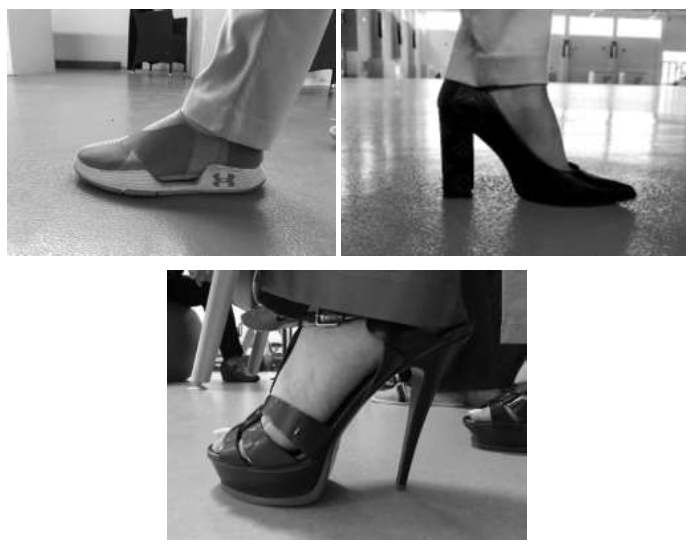
Figure 1: Footwear types, (A)Sport shoes; (B) Thick high heel; (C) Thin high heel.
|
OM |
Side/type |
SS (Mean ± SD) |
HH (Mean ± SD) |
MD |
t-test |
||
|
t stat |
t critical |
P-value |
|||||
|
FRT- forward (cm) |
Right |
30.27 ± 8.41 |
27.07 ± 6.31 |
3.21 |
1.9254 |
2.1009 |
0.0701 |
|
Left |
30.13 ± 6.77 |
26.88 ± 6.27 |
3.25 |
2.7511 |
2.1009 |
0.0131 |
|
|
FRT-sideways (cm) |
Right |
26.47 ± 4.99 |
24.54 ± 6.11 |
1.93 |
1.3552 |
2.1009 |
0.1921 |
|
Left |
25.25 ± 5.76 |
23.68 ± 5.14 |
1.57 |
1.3066 |
2.1009 |
0.2078 |
|
|
mCTSIB (sec) |
EO-firm |
30 ± 0 |
30 ± 0 |
0 |
- |
- |
- |
|
EC-firm |
29.84 ± 0.69 |
29.95 ± 0.23 |
-0.1 |
-1 |
2.1009 |
0.3306 |
|
|
EO-foam |
30 ± 0 |
30 ± 0 |
- |
- |
- |
||
|
EC- foam |
29.58 ± 1.84 |
29.32 ± 2.98 |
0.26 |
1 |
2.1009 |
0.3306 |
|
|
6MWT (meters) |
398.87 ± 55.19 |
346.11 ± 49.99 |
52.76 |
5.0636 |
2.1009 |
<0.0001 |
|
FRT, Functional Reach Test. mCTSIB, Modified Clinical Test of Sensory Interaction in Balance. 6MWT, 6 Min Walk Test. SS, Sport Shoes. HH, High Heels. MD, Mean Difference= SS mean- HH mean. cm, centimeters. Sec, second
Table 2: Comparison Between, Wearing Sport Shoes and High Heels Among Students Who Wear Heels Regularly.
|
OM |
Side/type |
SS (Mean ± SD) |
HH (Mean ± SD) |
MD |
t-test |
||
|
t stat |
t critical |
P-value |
|||||
|
FRT- forward (cm) |
Right |
29.48 ± 6.89 |
23.72 ± 5.50 |
5.76 |
4.3462 |
2.2281 |
0.0016 |
|
Left |
28.31 ± 5.76 |
20.96 ± 5.27 |
7.35 |
6.8055 |
2.2281 |
<0.0001 |
|
|
FRT-side (cm) |
Right |
27.68 ± 6.69 |
24.08 ± 6.54 |
3.60 |
2.6814 |
2.2281 |
0.0230 |
|
Left |
24.61 ± 6.43 |
21.00 ± 4.54 |
3.61 |
2.6372 |
2.2281 |
0.0249 |
|
|
mCTSIB (sec) |
EO-firm |
30 ± 0 |
30 ± 0 |
0 |
- |
- |
- |
|
EC-firm |
30 ± 0 |
30 ± 0 |
0 |
- |
- |
- |
|
|
EO-foam |
30 ± 0 |
30 ± 0 |
0 |
- |
- |
- |
|
|
EC- foam |
30 ± 0 |
30 ± 0 |
0 |
- |
- |
- |
|
|
6MWT (meters) |
358.00 ± 76.72 |
311.82 ± 59.60 |
46.18 |
2.2835 |
2.2281 |
0.0455 |
|
FRT, Functional Reach Test. mCTSIB, Modified Clinical Test of Sensory Interaction in Balance. 6MWT, 6 Min Walk Test. SS, Sport Shoes. HH, High Heels. MD, Mean Difference= SS mean- HH mean. cm, centimeters. Sec, second
Table 3: Comparison Between, Wearing Sport Shoes and High Heels Among Students Who Wear Heels Occasionally.
|
OM |
Side/type |
Reg - HH (Mean ± SD) |
Occ- HH (Mean ± SD) |
MD |
t-test |
||
|
t stat |
t critical |
P value |
|||||
|
FRT- forward (cm) |
Right |
27.07 ± 6.31 |
23.72 ± 5.50 |
3.35 |
1.4654 |
1.7011 |
0.1540 |
|
Left |
26.88 ± 6.27 |
20.96 ± 5.27 |
5.92 |
2.6358 |
1.7011 |
0.01353 |
|
|
FRT-side (cm) |
Right |
24.54 ± 6.12 |
24.08 ± 6.54 |
0.46 |
0.1937 |
2.0484 |
0.8478 |
|
Left |
23.68 ± 5.12 |
21 ± 4.55 |
2.68 |
1.4348 |
2.0484 |
0.1624 |
|
|
mCTSIB (sec) |
EO-firm |
30 ± 0 |
30 ± 0 |
0 |
6554 |
2.0555 |
- |
|
EC-firm |
29.95 ± 0.23 |
30 ± 0 |
-0.05 |
-0.7552 |
2.0484 |
0.2282 |
|
|
EO-foam |
30 ± 0 |
30 ± 0 |
0 |
65535 |
2.0484 |
- |
|
|
EC- foam |
29.32 ± 2.98 |
30 ± 0 |
-0.68 |
-0.7552 |
2.0484 |
0.4564 |
|
|
6MWT (meters) |
346.11 ± 49.99 |
311.82 ± 59.59 |
34.29 |
1.6878 |
2.0484 |
0.1026 |
|
FRT, Functional Reach Test. mCTSIB, Modified Clinical Test of Sensory Interaction in Balance. 6MWT, 6 Min Walk Test. HH, High Heels. Reg, Regular Users. Occ, occasional user. MD, Mean Difference= Reg mean- Occ mean. cm, centimeters. Sec, second
Table 4: Comparison Between, Regular Heel Users and Occasional Users.
4. Discussion
The current study aimed at investigating the effects of wearing SS and HH on balance and gait among young healthy females using three outcomes: FRT, mCTSIB, and 6MWT. Our findings suggest that wearing HH, either regularly or occasionally, negatively impact balance and total distance covered on all other outcomes except for mCTSIB.
4.1 Sport shoes versus high heels
As for the 6MWT, the total distance covered was the sole parameter to undergo data analysis. There was a significant difference favoring SS as opposed to heels for both regular and occasional users. However, for students who wore heels regularly, the difference was higher. This can possibly be explained by the results of Cronin [19] and Stefanyshyn et al. [20], which explained that heels alter the position of the foot-ankle complex and interfere with the ideal pattern of walking. It has been reported that wearing HH increases the activity of ankle joint muscles, leading to stiffness of the joint. Moreover, Csapo et al. [21] found that long-term use of HH causes shortening of the gastrocnemius medialis muscle and increases achilles’ tendon stiffness. It was noted that participants experienced fatigue wearing HH than in SS, with post-test fatigue ranging from 0-5 when wearing SS and from 0-8 when wearing HH on a scale of 0-10. This is due to prolonged contraction and muscle loading resulting in early fatigue and limited endurance [3, 6]. High heels have been found to increase the energy required for travel, making gait overall less efficient and stable [19]. When conducting mCTSIB, the majority of the participants who wore HH on a regular and occasional basis managed to maintain their balance on both firm and foam surfaces with their eyes open for the entire 30 seconds, failing to yield a P-value.
However, an antero-posterior sway was observed in eyes closed conditions in all the participants regardless of the surface. A possible explanation by Brenton-Rule et al. [22] was that the system responsible for transferring sensory information to the CNS for promoting balance can be altered by the type of footwear worn. Several studies emphasized the importance of vision as an important factor in maintaining an upright posture and balance [7, 23]. Furthermore, a study by Menant et al. [24] reported greater postural sway in 29 elderly people when wearing a heel height of 4.5 cm compared to standard shoes (2.7 cm). As for FRT, reaching forward have been tested by wearing different footwear, with an average mean difference of 6.55cm for occasional HH users and 3.2cm for regular HH users favoring SS in both groups. This result is supported by Arnadottir and Mercer [17], who had investigated the effect of three footwear in forward reach amongst older females, which resulted in a decline in FRT scores with an average of 15% and mean difference of 5.1cm when changing from the barefoot or SS conditions to HH condition. However, in the present study, this difference wasn’t significant when reaching with dominant hand in regular HH users, this indicted that reaching with non-dominant hand wearing HH affect balance more when compared to reaching with dominant hand, this is also shown in the occasional user group with less p-value with significant difference. However, no previous studies had compared assessing dominant or non-dominant hand with FRT. Moreover, to date, there are no studies investigating the effect of footwear in reaching sideways, so the results of sideways FRT of the present study cannot be supported with any previous literature. In sideways FRT, there were no significant differences when reaching with HH and SS in the regular users’ group, contradictory to the occasional users of HH. This indicates that HH altered the balance more when reaching sideways in occasional users.
4.2 Occasional high heels versus regular high heel
Previous studies have shown wearing HH alter balance and gait regardless of the experience of wearing heels. It was assumed that the experienced heel users show better performance than the inexperienced heel users [25, 26]. However, in this study, there were no significant differences in most of the outcomes when comparing experience versus in-experienced heel users. This result can be explained by Hapsari and Xiong [4], as they predicted that the outcomes were not very different especially in a young healthy population. Therefore, further study with more dynamic and challenging tasks is required to confirm this hypothesis. Interestingly, in FRT, there was a significant difference between the 2 groups when reaching forward with non-dominant hand, favoring the regular user. On the contrary, Hapsari and Xiong [4] found that the occasional HH user reached more during FRT, due to two causes. Firstly, participants in the regular user group were significantly shorter than the occasional user group, which is associated with shorter arm length, making it harder for regular users to reach [4]. Secondly, long term users of HH have more shortened calf muscles and stiffened achilles tendon according to the finding of the previous study [21]. On the other hand, the participants of this study were in their early 20’s, which made them early users of HH, as Csapo et al. [21] identified the average age of long-term users is 42 years old.
5. Conclusions
This study concluded that the use of high-heeled shoes had a negative influence on balance and gait when compared to SS. Wearing HH reduced the total distance walked in 6MWT for both regular and occasional users. Similarly, the reach distance in FRT was lesser when wearing HH. However, no differences were reported for mCTSIB. As for the limitations of this study, the team did not collect information regarding how long the participants have been wearing heels, which is concerned with experience and therefore can affect the results obtained. Moreover, there was a significant difference (P-value= 0.0402) in the mean age of participant's, with occasional users being older than regular ones, which could be a source of bias. One of the limitations encountered during the data collection period was a change in testing locations. The team initially started with a gym hall, where 6MWT was performed with 30 meters stretch, then midway had to move to the physiotherapy clinic with 10 meters stretch. This caused an increase in the number of laps and turns which could have lowered the distance scored by participants. This as well caused three participants to feel dizzy. Future studies should involve gait analysis and make comparisons between wearing SS and HH. In regard to FRT, the impact of wearing different footwear on sideways reach needs to be investigated, as well as the influence of reaching with dominant and non-dominant hands. This study should be replicated in middle-aged women in order to draw comprehensive conclusions, preferably with higher level and more challenging balance assessment tools. More studies regarding the reliability of mCTSIB test on young females should be done and whether it is applicable for the young population.
Declaration of Interest
The authors have no conflict of interest and haven’t received any funding, as this study was done for the completion of Advanced Clinical Research course and for publication purposes only.
Acknowledgements
The authors thank Dr. Marian Gabor for guidance provided in analyzing the data. The team also extends their sincere gratitude to the participants of the study.
References
- Koepsell T D, Wolf M E, Buchner D M, et al. Footwear style and risk of falls in older adults. Journal of the American geriatrics society 52 (2004): 1495-1501.
- Menant J C, Steele J R, Menz H B, et al. Effects of footwear features on balance and stepping in older people. Gerontology 54 (2008a): 18-23.
- Hong W-H, Lee Y-H, Lin Y-H, et al. Effect of shoe heel height and total-contact insert on muscle loading and foot stability while walking. Foot & Ankle International 34 (2013): 273-281.
- Hapsari V D, Xiong S. Effects of high heeled shoes wearing experience and heel height on human standing balance and functional mobility. Ergonomics 59 (2016): 249-264.
- Weon J H, Cha H G. The influence of high heeled shoes on balance ability and walking in healthy women. Journal of Physical Therapy Science 30 (2018): 910-912.
- Wiedemeijer M M, Otten E. Effects of high heeled shoes on gait. A review. Gait & Posture 61 (2018): 423-430.
- Gerber S B, Costa R V, Grecco L A C, et al. Interference of high-heeled shoes in static balance among young women. Human movement science 31 (2012): 1247-1252.
- Emmanouil A, Rousanoglou E N. Effect of high-heeled shoes on postural control in the upright and the leaning body stance. Physical Medicine and Rehabilitation Research 3 (2018): 1-5.
- Mika A, Oleksy L, Mika P, et al. The influence of heel height on lower extremity kinematics and leg muscle activity during gait in young and middle-aged women. Gait & Posture 35 (2012): 677-680.
- Ho K-Y, Blanchette M G, Powers C M. The influence of heel height on patellofemoral joint kinetics during walking. Gait & Posture 36 (2012): 271-275.
- Hijmans J M, Geertzen J H B, Dijkstra P U, et al. A systematic review of the effects of shoes and other ankle or foot appliances on balance in older people and people with peripheral nervous system disorders. Gait & Posture 25 (2007): 316-323.
- Perry S D, Radtke A, Goodwin C R. Influence of footwear midsole material hardness on dynamic balance control during unexpected gait termination. Gait & Posture 25 (2007): 94-98.
- Menant J C, Steele J R, Menz H B, et al. Rapid gait termination: effects of age, walking surfaces and footwear characteristics. Gait & posture 30 (2009): 65-70.
- Perry S D, Radtke A, McIlroy W E, et al. Efficacy and effectiveness of a balance-enhancing insole. The Journals of Gerontology. Series A, Biological Sciences and Medical Sciences 63 (2008): 595-602.
- Stern K A, Gottschall J S. Altering footwear type influences gait during level walking and downhill transitions. Journal of applied biomechanics 28 (2012): 481-490.
- Meyer P F, Oddsson L I E, De Luca C J. The role of plantar cutaneous sensation in unperturbed stance. Experimental Brain Research 156 (2004): 505-512.
- Arnadottir S A, Mercer V S. Effects of footwear on measurements of balance and gait in women between the ages of 65 and 93 years. Physical Therapy 80 (2000): 17-27.
- Alghadir A H, Zafar H, Anwer S. Effect of footwear on standing balance in healthy young adult males. Journal of Musculoskeletal & Neuronal Interactions 18 (2018): 71-75.
- Cronin N J. The effects of high heeled shoes on female gait: a review. Journal of Electromyography and Kinesiology: Official Journal of The International Society of Electrophysiological Kinesiology 24 (2014): 258-263.
- Stefanyshyn D J, Nigg B M, Fisher V, et al. The influence of high heeled shoes on kinematics, kinetics, and muscle EMG of normal female gait. Journal of Applied Biomechanics 16 (2000): 309-319.
- Csapo R, Maganaris C N, Seynnes O R, et al. On muscle, tendon and HH. The Journal of Experimental Biology 213 (2010): 2582-2588.
- Brenton-Rule A, D’Almeida S, Bassett S, et al. The effects of sandals on postural stability in patients with rheumatoid arthritis: an exploratory study. Clinical Biomechanics 29 (2014): 350-353.
- Hytönen M, Pyykkö I, Aalto H, et al. Postural control and age. Acta oto-laryngologica 113 (1993): 119-122.
- Menant J C, Steele J R, Menz H B, et al. Optimizing footwear for older people at risk of falls. Journal of Rehabilitation Research and Development 45 (2008b): 1167-1181.
- Schaefer S, Lindenberger U. Thinking while walking: experienced high-heel walkers flexibly adjust their gait. Frontiers In Psychology 4 (2013): 316.
- Chien H-L, Lu T-W, Liu M-W. Effects of long-term wearing of high-heeled shoes on the control of the body’s center of mass motion in relation to the center of pressure during walking. Gait & Posture 39 (2014): 1045-1050.