Ramune Masiene1, Rita Asakaviciute2*, Ausra Blinstrubiene1
1Department of Plant Biology and Food Sciences, Faculty of Agronomy, Agriculture Akademy, Vytautas Magnus University, Donelaičio str. 58, 44248 Kaunas, Lithuania
2Vilniaus kolegija/Higher Education Institutition, Faculty of Agrotechnologies, Studentu str. 39A, Vilnius, Lithuania
*Corresponding author: Rita Asakaviciute, Vilniaus kolegija/Higher Education Institutition, Faculty of Agrotechnologies, Studentu str. 39A, Vilnius, Lithuania.
ORCID:
Ramune Masiene: 0000-0002-4931-8373
Rita Asakaviciute: 0000-0002-3848-2733
Ausra Blinstrubiene: 0000-0003-3461-9162
Received: 31 August 2026; Accepted: 04 September 2026; Published: 09 September 2026
DOI: 10.26502/jbb.2642-91280226
ShareLavandula angustifolia Mill. is an economically important medicinal and aromatic plant widely used in the pharmaceutical, cosmetic, and food industries. Efficient in vitro culture systems based on reliable callus induction are essential for large-scale propagation and future biotechnological applications. The aim of this study was to optimize callus induction in L. angustifolia by evaluating the effects of different plant growth regulators and their cytokinin–auxin combinations on callus formation and biomass accumulation. Leaf and stem explants were cultured on Murashige and Skoog medium supplemented with various concentrations of benzylaminopurine (BAP), naphthaleneacetic acid (NAA), and kinetin under controlled in vitro conditions. Callus development was assessed during three consecutive subcultivations at 28-day intervals. The results showed that callus induction was significantly influenced by both explant type and cytokinin–auxin interaction. Leaf explants exhibited a consistently higher callogenic response and produced significantly greater callus biomass than stem explants. The highest callus mass (up to 1489.2 mg) was recorded after the third subcultivation on medium supplemented with 0.5 mg L?¹ BAP, 0.5 mg L?¹ kinetin, and 1.0 mg L?¹ NAA. Higher concentrations of either auxins or cytokinins negatively affected callus proliferation. These findings demonstrate that optimized cytokinin–auxin combinations are crucial for efficient callus induction in L. angustifolia and provide a robust basis for micropropagation and applied plant biotechnology.
Lavender; in vitro culture; Callus induction; Subcultivations; Cytokinin–auxin-kinetin interaction.
Lavender articles; in vitro culture articles; Callus induction articles; Subcultivations articles; Cytokinin–auxin-kinetin interaction articles.
Introduction
Lavandula belongs to the family Lamiaceae, which comprises approximately 39 species. However, only three are widely recognized for their economic importance: true lavender (Lavandula angustifolia Mill.), spike lavender (Lavandula latifolia Med.), and their hybrid, lavandin (Lavandula angustifolia × Lavandula latifolia) (Chaimae et al., 2020). Although the genus includes nearly 40 species, only about 20 have been thoroughly described in the scientific literature (Babanina et al., 2023; Najar et al., 2019). Lavender is one of the most valuable plants globally due to its aromatic, medicinal, and ornamental properties. Given Lithuania’s temperate climate, many lavender species struggle to thrive in local conditions. However, true lavender (L. angustifolia) and French lavender (Lavandula stoechas L.) are among the few species that can be successfully cultivated in this region. Lavender can be propagated via both generative (seed) and vegetative methods. While seed propagation is cost-effective, it often results in progeny that deviate genetically from the parent plant over successive generations. In contrast, vegetative propagation preserves the genetic fidelity of the mother plant but is less efficient and does not guarantee protection against pests or diseases. To overcome these limitations, modern biotechnology—specifically in vitro micropropagation—offers a promising solution. This technique enables the production of high-quality, genetically identical, and pathogen-free plants (Brailko et al., 2017). In vitro propagation is characterized by its ability to ensure high phytosanitary quality, rejuvenation, vigorous growth, and uniformity of plantlets (Kimura et al., 2023; Yegorova et al., 2019). This is based on the principle of totipotency, the ability of somatic plant cells to express the full genetic program necessary for the formation of organs or an entire plant (Babanina et al., 2023; Ezhova, 2003). A major advantage of in vitro methods is the controlled environment, including air humidity, temperature, and the use of media with precise concentrations of plant growth regulators. These conditions support the formation of high-quality, true-to-type clones from both herbaceous and woody plant species. In vitro studies also allow researchers to observe dedifferentiation (callus formation) and the potential for organogenesis from cultured cells or tissues (Yegorova et al., 2019; Ezhova, 2003). Although in vitro propagation is not always the most economical choice, it yields genetically stable and uniform clones that often result in higher productivity and quality—outweighing the initial investment (Chaimae et al., 2020). Phytohormones play a central role in regulating in vitro plant development, including vitality, biomass growth, and organ initiation. Without phytohormones, it is not possible to manipulate plant morphogenesis effectively (Vivanco & Flores, 2024; Kimura et al., 2023; Blinstrubienė et al., 2021). Lavandula angustifolia (medicinal lavender) is an important medicinal and aromatic plant widely used in the perfumery, cosmetics, food, and pharmaceutical industries for its essential oils and biologically active compounds. In order to ensure a stable supply of raw materials and preserve the valuable properties of the plant, biotechnological methods, including callogenesis and micropropagation technologies, are increasingly being used. The creation of effective in vitro culture conditions is essential for both commercial propagation and secondary metabolite production. The aim of the study was to determine how different concentrations and combinations of growth regulators (BAP, NAA, and KIN) affect the formation and growth of callus tissue in Lavandula angustifolia using leaf and stem explants. The aim was to evaluate the most effective hormonal combinations that promote potassium mass accumulation at different stages of subculture.
Materials and Methods
Experimental site and plant material
The experiment was conducted during 2023–2024 at the Agrobiotechnology Laboratory, Department of Plant Biology and Food Sciences, Faculty of Agronomy, Vytautas Magnus University (Kaunas, Lithuania). The plant material used in the study was true lavender (Lavandula angustifolia Mill.). Leaf and stem segment explants excised from healthy donor plants were used for callus induction experiments.
Plant growth regulators
The following plant growth regulators (PGRs) were used: 6-benzylaminopurine (BAP), 1-naphthaleneacetic acid (NAA), and kinetin (6-furfurylaminopurine). Different concentrations and combinations of these PGRs were tested to evaluate their effects on callus induction and biomass accumulation.
Explant sterilization and culture conditions
Excised explants were initially rinsed in distilled water for 10 min, followed by surface sterilization in 70% (v/v) ethanol for 20s. Subsequently, explants were immersed in a 1% sodium hypochlorite solution containing one drop of Tween-20 for 15min. After sterilization, explants were rinsed three times with sterile distilled water (5 min each) under laminar airflow conditions. Sterilized explants were placed on Murashige and Skoog (MS) basal medium (Murashige and Skoog, 1962), solidified with agar, and cultured in sterile Petri dishes. Cultures were maintained in a growth chamber under controlled conditions: light intensity of 50 µmol m⁻² s⁻¹, a 16 h photoperiod, temperature of 22 ± 1°C during the light period and 18 ± 1°C during the dark period, and relative humidity of approximately 75%.
Media composition and experimental design
Factorial structure of the experiment included three factors: (1) explant type (2 levels), (2) hormone combination (4 levels), and (3) subcultivation stage (3 levels).
For both explant types (leaves and stem segments), MS medium without growth regulators was used as a control. Experimental media consisted of MS medium supplemented with different cytokinin–auxin combinations as follows:
- varying concentrations of NAA combined with 2.0 mg L⁻¹ BAP;
- varying concentrations of BAP combined with 0.5 mg L⁻¹ NAA;
- varying concentrations of NAA combined with 0.2 mg L⁻¹ BAP;
- varying concentrations of BAP combined with 0.5 mg L⁻¹ kinetin and 1.0 mg L⁻¹ NAA.
Each treatment consisted of 30 explants (three Petri dishes × 10 explants per dish) and the experiment was repeated three independent times. Thus, data represent means of n = 90 explants per treatment. Petri dishes were considered experimental units. Callus fresh weight was measured individually and averaged per replicate before statistical analysis. Explants were subcultured every 28 days, and callus development was evaluated over three consecutive subcultivation cycles (4, 8, and 12 weeks).
Statistical analysis
All experiments were conducted using a completely randomized design. Callus fresh weight data were collected at the end of each subcultivation cycle (4, 8, and 12 weeks). Each treatment consisted of replicated explants, and results are presented as mean values ± standard error (SE). The effects of plant growth regulator combinations, explant type (leaf and stem), and subcultivation period on callus biomass were analyzed using analysis of variance (ANOVA). When significant differences were detected, mean comparisons were performed using the least significant difference (LSD) test at a significance level of p ≤ 0.05. Prior to analysis, data were checked for normality and homogeneity of variance. All
statistical analyses were performed using the Statistica 5 software package (StatSoft Inc., USA).
Results
The quality and growth rate of Lavandula angustifolia callus were significantly influenced by the nutrient medium composition, particularly the type and concentration of plant growth regulators. Callus formation (Figure 1) was initiated in both leaf and stem explants under various hormonal conditions.
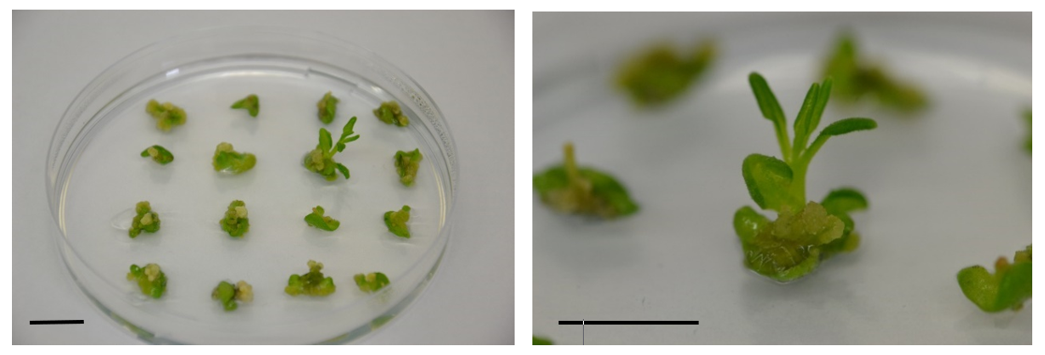
Figure 1: Lavender (Lavandula angustifolia Mill.) callus after four weeks of cultivation, bars = 1.5 cm (Agrobiotechnology laboratory, Kaunas, 2023-2024).
Effect of explant type and growth regulator combinations
In control media without growth regulators, leaf explants produced only 10.2 mg of callus after subcultivation I (Figure 2).
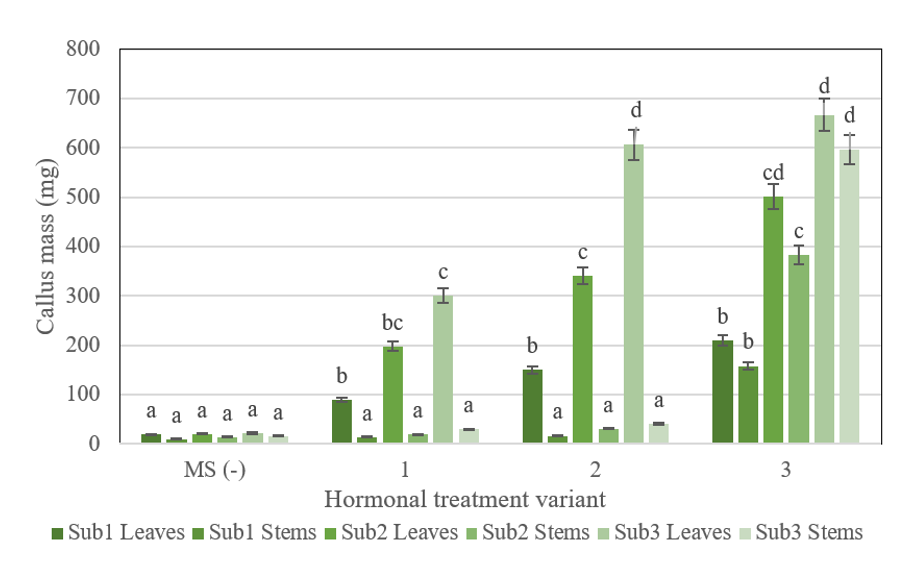
Figure 2: Effect of growth regulators and subcultivations on callus formation in lavender (Lavandula angustifolia Mill.) culture using varying levels of NAA in combination with 2 mg l-1 BAP (LSDSub1 Leaves – 1.235, LSDSub1 Stems – 1.220, LSDSub2 Leaves – 1.568, LSDSub2 Stems – 1.354, LSDSub3 Leaves - 1.235, LSDSub3 Stems – 1.312).
Note: 1) 2.0 mg l-1 BAP + 0.5 mg l-1 NAA; 2) 2.0 mg l-1 BAP + 1.0 mg l-1 NAA; 3) 2.0 mg l-1 BAP + 1.5 mg l-1 NAA.
In contrast, media supplemented with BAP and NAA significantly increased callus mass, ranging from 89.6 mg to 210.2 mg. The highest value (210.2 mg) was obtained with 2.0 mg L⁻¹ BAP + 1.5 mg L⁻¹ NAA. After subcultivation II, the highest callus mass (501.7 mg) was achieved in medium with 1.5 mg L⁻¹ NAA. In subcultivation III, maximum callus mass was observed in the medium with 2.0 mg L⁻¹ BAP + 1.0 mg L⁻¹ NAA.
Effect of BAP concentration with constant NAA
Leaf explants cultured (Figure 3) with 1.5 mg L⁻¹ BAP + 0.5 mg L⁻¹ NAA produced the highest callus mass across three subcultivations, reaching 1216.6 mg in subcultivation III. Stem explants, by comparison, showed significantly lower callus formation. In the same hormonal combination, they formed 500.1 mg after subcultivation I and 869.1 mg after subcultivation II.
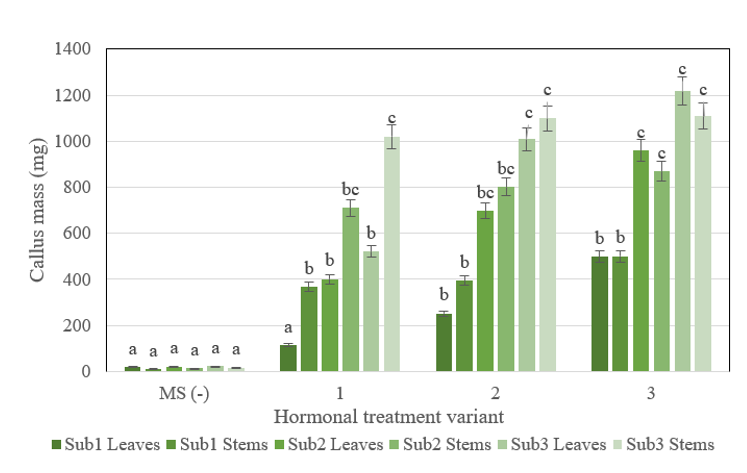
Figure 3: Effect of growth regulators and subcultivations on callus formation in lavender (Lavandula angustifolia Mill.) culture using variable levels of BAP in combination with 0.5 mg l-1 NAA (LSDSub1 Leaves – 1.241, LSDSub1 Stems – 1.200, LSDSub2 Leaves – 1.235, LSDSub2 Stems – 1.561, LSDSub3 Leaves - 2.103, LSDSub3 Stems – 2.303).
Note: 1) 2.0 mg l-1 BAP + 0.5 mg l-1 NAA; 2) 1.0 mg l-1 BAP+ 0.5 mg l-1 NAA; 3) 1.5 mg l-1 BAP+ 0.5 mg l-1 NAA.
Effect of NAA variation with constant low BAP
When NAA concentrations (0.5–1.5 mg L⁻¹) were varied in combination with 0.2 mg L⁻¹ BAP, a decreasing trend in callus mass was observed (Figure 4). After subcultivation I, the highest callus mass (56.3 mg) was achieved with 0.5 mg L⁻¹ NAA. The trend persisted in subcultivation II (168.2 mg) and became less significant by subcultivation III.

Figure 4: Effect of growth regulators and subcultivations on callus formation in lavender (Lavandula angustifolia Mill.) culture using varying levels of NAA in combination with 0.2 mg l-1 BAP (LSDSub1 Leaves – 0.897, LSDSub1 Stems – 1.243, LSDSub2 Leaves – 0.989, LSDSub2 Stems – 1.987, LSDSub3 Leaves - 1.421, LSDSub3 Stems – 1.988).
Note: 1) 0.2 mg l-1 BAP + 0.5 mg l-1 NAA; 2) 0.2 mg l-1 BAP + 1.0 mg l-1 NAA; 3) 0.2 mg l-1 BAP + 1.5 mg l-1 NAA.
Effect of BAP variation with constant KIN and NAA
The highest callus mass (Figure 5) after subcultivation I (653.9 mg) and III (1238.3 mg) was recorded in media with 0.5 mg L⁻¹ BAP + 0.5 mg L⁻¹ KIN + 1.0 mg L⁻¹ NAA. Increasing BAP concentration to 1.0 or 1.5 mg L⁻¹ resulted in decreased callus formation. A peak callus mass of 1489.2 mg was reached after subcultivation III with the same optimal hormonal combination.
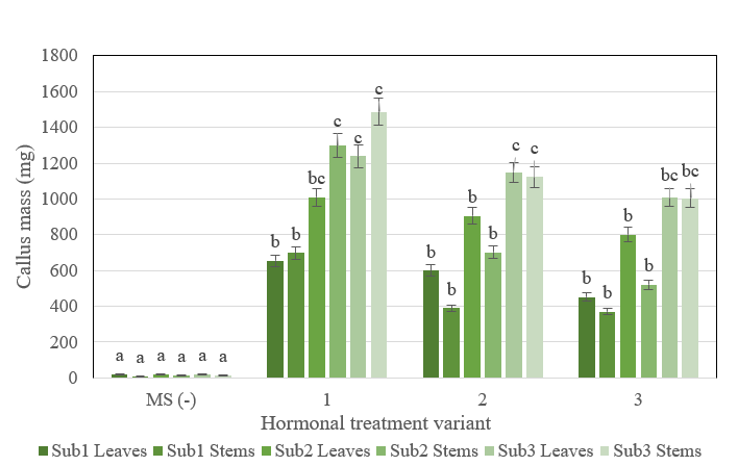
Figure 5: Effect of growth regulators and subcultivations on callus formation in lavender (Lavandula angustifolia Mill.) culture using varying levels of BAP in combination with 0.5 mg l-1 KIN + 1 mg l-1 NAA (LSDSub1 Leaves – 1.324, LSDSub1 Stems – 1.230, LSDSub2 Leaves – 1.987, LSDSub2 Stems – 2.104, LSDSub3 Leaves - 2.236, LSDSub3 Stems – 2.410.
Note: 1) 0.5 mg l-1 BAP + 0.5 mg l-1 KIN +1.0 mg l-1 NAA; 2) 1.0 mg l-1 BAP + 0.5 mg l-1 KIN + 1.0 mg l-1 NAA; 3) 1.5 mg l-1 BAP + 0.5 mg l-1 KIN +1.0 mg l-1 NAA.
Discussion
The results demonstrate that Lavandula angustifolia callus formation is significantly influenced by the type of explant and the hormonal composition of the nutrient medium. Leaf explants consistently outperformed stem explants in all treatments, indicating higher regenerative potential in leaf-derived tissues. The observed enhancement of callus mass in media containing optimal concentrations of both BAP and NAA confirms the central role of cytokinin–auxin balance in callus induction and proliferation. Cytokinins, particularly BAP, are known to promote cell division, whereas NAA stimulates cell elongation and root formation. The most effective combinations—such as 1.5 mg L⁻¹ BAP + 0.5 mg L⁻¹ NAA—produced callus masses several-fold higher than in media lacking growth regulators, aligning with findings from Marković et al. (2023), Ngomuo et al. (2013), and others (Blinstrubiene et al., 2020). The superior performance of the 0.5 mg L⁻¹ BAP + 0.5 mg L⁻¹ KIN + 1.0 mg L⁻¹ NAA combination may be explained by complementary cytokinin signaling pathways. While BAP is known to strongly activate cell cycle–related genes, kinetin may enhance cytokinin receptor sensitivity, resulting in amplified mitotic activity. Concurrently, moderate NAA levels likely maintained cellular dedifferentiation competence without triggering organogenic polarity. The decline observed at higher hormone concentrations suggests feedback inhibition and possible disruption of endogenous auxin–cytokinin homeostasis.
Interestingly, increasing the auxin concentration beyond optimal levels resulted in decreased callus formation. This inhibitory effect at higher auxin concentrations supports previous observations that excess auxin can suppress cell division and reduce biomass accumulation (Vivanco & Flores, 2024). Similarly, elevated cytokinin concentrations (BAP > 1.0 mg L⁻¹) were less effective, suggesting a narrow hormonal window for optimal callusogenesis. The addition of kinetin (KIN) alongside BAP and NAA proved synergistic, particularly in early subcultivation stages. Kinetin's role in promoting cell division was evident in the substantial increase in callus mass in media with BAP + KIN combinations, confirming earlier reports by Najar et al. (2019) and Yegorova et al. (2019). Overall, the findings emphasize that fine-tuning the concentration and ratio of auxins and cytokinins is essential for efficient callus induction and proliferation in L. angustifolia tissue culture. These insights contribute to the optimization of in vitro protocols for lavender propagation and secondary metabolite production. In summary, this study demonstrated that callus induction and proliferation in Lavandula angustifolia are significantly affected by both the type of explant and the concentration and combination of plant growth regulators. Leaf explants consistently produced greater callus mass than stem explants, indicating their superior regenerative capacity. Among the tested hormonal combinations, the most effective included 1.5–2.0 mg L⁻¹ BAP with 0.5–1.5 mg L⁻¹ NAA, while the addition of kinetin further enhanced callus growth, particularly in early subcultivations. Excessive concentrations of auxins or cytokinins led to reduced callus formation, highlighting the importance of balanced hormone ratios. These findings provide a valuable basis for optimizing in vitro culture protocols for lavender propagation and future biotechnological applications, such as the production of secondary metabolites.
The maximum callus biomass obtained in the present study (1489.2 mg after the third subcultivation) exceeds values reported by Yegorova et al. (2019), who observed lower biomass accumulation under prolonged micropropagation conditions. Similarly, Chaimae et al. (2020) reported optimal callogenesis at lower cytokinin concentrations (≤1.0 mg L⁻¹ BAP), whereas our findings indicate that a balanced multi-cytokinin system (BAP + KIN) further enhances proliferation. This suggests that synergistic cytokinin interactions may be more critical than previously recognized in Lavandula angustifolia tissue culture. Unlike previous studies focusing on single cytokinin–auxin combinations, this research systematically evaluated multi-cytokinin systems across three consecutive subcultivation cycles, demonstrating that hormonal balance requirements shift during prolonged culture. The identification of a stable high-biomass protocol across subcultivations provides a reproducible platform for secondary metabolite production and genetic transformation studies in L. angustifolia.
Conclusion
This study confirmed that successful callus induction and biomass accumulation in Lavandula angustifolia are strongly dependent on both explant type and the concentration and ratio of plant growth regulators. Leaf explants showed superior regenerative capacity compared to stem explants across all treatments, making them the preferred source material for callus-based in vitro systems. Among the tested hormonal combinations, media supplemented with balanced cytokinin–auxin ratios, particularly 0.5 mg L⁻¹ BAP in combination with 0.5 mg L⁻¹ kinetin and 1.0 mg L⁻¹ NAA, resulted in the highest callus biomass after repeated subcultivations. In contrast, elevated concentrations of auxins or cytokinins negatively affected callus growth, indicating an inhibitory effect beyond optimal levels. These findings provide a practical and reproducible protocol for callus induction in L. angustifolia, which can be effectively applied in micropropagation, germplasm conservation, and future biotechnological applications, including the production of bioactive secondary metabolites.
Authorship contribution statement
R.M., A.B. and R.A. designed the experiments; A.B., R.M. and R.A. performed the experiments and analyzed the data, assisted by R.A.; R.A., R.M. and A.B. drafted the manuscript; R.A. revised the manuscript & editing and provided materials.
Ethical Approval (for Research Involving Animals or Humans)
:
Not applicable.
Declaration of competing interest
The authors declare that they have no known competing financial interests or personal relationships that could have appeared to influence the work reported in this paper.
Funding details :
No funding was received.
Data availability
All data generated or analyzed during this study are included in this published article
References
- Babanina SS, Yegorova NA, Stavtseva IV, et al. Plants Obtained during Long-Term Clonal Micropropagation. Russ Agricult Sci 49: 132-139.
- Blinstrubiene A, Burbulis N, Jonytiene V, et al. Evaluation of Factors Affecting Direct Organogenesis in a Somatic Tissue Culture of Sinningia speciosa (Lodd.) Hiern. Agronomy 10 (2020): 1783.
- Blinstrubiene A, Jancauskiene I, Burbulis N, et al. Effect of Explant Type and Growth Regulators. Plants 10 (2021): 2799.
- Brailko V, Mitrofanova O, Lesnikova-Sedoshenko N, et al. 2017 Anatomy features of Lavandula angustifolia Mill. and Lavandula hybrida Rev. plants in vitro. Agriculture & Forestry/Poljoprivreda i šumarstv 63 (2017).
- Chaimae S, Hakima S, Chaimae R, et al. Improvement of germination rate and in vitro multiplication of Lavandula angustifolia. Journal of Applied Biology & Biotechnology 8 (2020): 52-57.
- Ezhova TA. Genetic Control of Totipotency of Plant Cells in an in vitro Culture. Russian Journal of Developmental Biology 34 (2003): 197-204.
- Yegorova NA, Mitrofanova IV, Brailko VA, et al. Morphogenetic, physiological, and biochemical features of Lavandula angustifolia at long-term micropropagation in vitro. Russ J Plant Physiol 66 (2019): 326-334.
- Kimura M, Moteki H, Ogihara M. Role of hepatocyte growth regulators in liver regeneration. Cells 12 (2023): 208.
- Marković M, Trifunović-Momčilov M, Radulović O, et al. The Effects of Different Auxin–Cytokinin Combinations on Morphogenesis of Fritillaria meleagris Using Bulb Scale Sections In Vitro. Horticulturae 9 (2023): 910.
- Murashige T, Skoog F. A revised medium for rapid growth and bioassays with tobacco tissue cultures. Physiologia Plantarum 15 (1962): 473-497.
- Najar B, Demasi S, Caser M, et al. Cultivation Substrate Composition Influences Morphology. Volatilome and Essential Oil of Lavandula Angustifolia Mill. Agronomy 9 (2019): 411.
- Ngomuo M, Mneney E, Ndakidemi P. The effects of auxins and cytokinin on growth and development of (Musa sp.) var. “Yangambi” explants in tissue culture. American Journal of Plant Sciences 4 (2013): 2174.
- Vivanco JM, Flores HE. Control of root formation by plant growth regulators. In Plant Growth Regulators in Agriculture and Horticulture. CRC Press (2024).