Walter Ogutu Amulla1*, Aaron Gichaba Misati2
1Department of Public Health, University of Eastern Africa, Baraton, Kenya
2Department of Public Health, Kabarak University, Kenya
*Corresponding Author: Walter Ogutu Amulla, Department of Public Health, University of Eastern Africa, Baraton, Kenya
Received: 16 March 2021; Accepted: 27 March 2021; Published: 20 April 2021
Work-related musculoskeletal disorders (WMSDs) are a leading occupational health problem in the world. The main risk factors for WMSDs are ergonomic hazards and supermarket workers are among the most-at-risk occupational groups. However, there are few studies on Supermarket luggage attendants/security personnel in Kenya. This study assessed ergonomic hazards among luggage attendants and security personnel at leading supermarkets in an urban center in western Kenya. Data was collected using structured ergonomic assessment checklist and analyzed descriptively on SPSS version 23. Chi-square, Risk Ratios (RR), Mann-Whitney U Test and Fisher’s Exact Test (FET) were used to explore association between variables. Results showed that repetitive motions, awkward posture, pressure points and ergonomically-suboptimal work environment were the main hazards. Being a luggage attendant was associated with higher risk of bending (RR=1.50, 95% CI:1.005—2.238), trunk twisting (RR=2.40, 95% CI:1.229—4.688) and forceful exertion (RR=5.50, 95% CI:1.534—19.714) while being a security personnel was associated with higher risk of prolonged standing (RR=2.40, 95% CI:1.229—4.688), static loading (RR=1.833, 95% CI:1.015—3.310), lacking seats (RR=6.00, 95% CI:1.693—21.262) and showing ≥2 signs of fatigue (RR=2.50, 95% CI:1.080—5.786). Utilizing sitting opportunity was significantly associated with fewer signs of fatigue (p = 0.032, FET). Supermarket luggage attendants and security guards were exposed to ergonomic hazards that are established risk factors for work-related musculoskeletal disorders. Supermarket management should take steps to mitigate these risks.
Ergonomics; Supermarket; Luggage attendant; Security guards
Introduction
The Constitution of the World Health Organization (1946) which entered into force on April 7, 1948 declared that the enjoyment of the highest attainable standard of health is one of the fundamental rights of every human being without distinction of race, religion and political belief, economic or social condition. As labor constitutes a great proportion of adult life, occupational safety and health is evidently one of the key elements in the realization of this aspiration.
Over the years, workplace safety and health has become one of the chief concerns in the public health sphere. The global burden of occupational-related fatalities is estimated at 2.3 million per annum skewed towards the lower-income countries of the world [1] and ergonomic hazards contribute significantly to this burden [2].
In Kenya the situation is even more glaring. According to ILO (2013) most workers in Kenya are left exposed to occupational hazards without intervention. Though the constitution (2010) grants the right of every person to the highest attainable standard of health and reasonable working conditions; and the Occupational Safety and Health Act (2007) stipulates the safety, health and welfare of all workers, these aspirations are yet to be realized for the laboring population. The Directorate of Occupational Safety and Health Service (DOSHS) which manages occupational safety and health in the country has only 71 professional OSH officers and is represented in only 29 out of the 47 counties [3].
Supermarkets are among the most rapidly growing groceries in developing countries with Kenya being particularly noteworthy [4]. According to Anton and Weeks (2016) [5] supermarket workers are among the occupational groups with especially high rates of work-related musculoskeletal disorders. Nearly 80% of this cadre of workers report musculoskeletal injuries or illness of some sort. As musculoskeletal disorders are among the leading occupational health concerns around the world [6], and coupled with the rising burden of noncommunicable diseases around the world, WMSDs should be accorded more attention than hitherto granted [7,8].
The major risk factors for WMSDs are ergonomic (biomechanical) including awkward postures and repetitive tasks that elicit sudden or continuous strain on workers’ musculoskeletal system [9], though psychosocial factors have also been implicated in their etiology [10]. It has thus been reported that physically arduous occupations have markedly high prevalence of MSDs [11]. The economic and social costs of these disorders are enormous [12] though it is contended that the true burden remains unknown and available reports are underestimations [13].
Despite this evidence, studies focusing on ergonomic hazards among supermarket attendants are rare not only in Kenya but seemingly the world over. A literature such on PubMed® returned few related but not similar studies [14,15].
While it is true that addressing the challenge requires more than academic research, it is equally true that supporting occupational safety and health research, facilitates changes in the policy environment and the health and safety practices of various occupational groups in developing countries. It is against this backdrop that the present study undertook to assess ergonomic hazards among supermarket luggage attendants and security guards at a leading urban center in Kenya. The specific objectives were 1) to identify the ergonomic hazards among supermarket luggage attendants and security guards and 2) to explore distribution of ergonomic hazards across categories of luggage attendants and security guards.
Methods
Study Area and Design
The study was conducted at a leading urban center in western Kenya. The urban center serves a population in excess of 400, 000 according to the 2009 census, majority of whom are employed in the informal sector and is an economic hub in the region. The poverty index of the county to which the metropolis belongs is high and has other negative health outcomes. A cross-sectional analytical design was used to document the situation at the time of the study. For ethical reasons, the study area, population and participants were anonymized.
Study Population and Sampling
The study was conducted in 12 supermarkets located in the urban center. The supermarkets were selected by census method with the aim of including all leading supermarkets in the urban center. The study population (based on physical counts) were 38 consisting of 15 luggage attendants and 23 security guards distributed across all the supermarkets. A convenience sample of 24 participants, consisting of 12 luggage attendants and 12 security guards (one participant per cadre per supermarket), were chosen to represent the population. Where there were present more than one potential participant at the time of data collection, a simple lottery was used to select the subject to be observed.
Survey Instrument
Data was collected using an observation checklist developed by the researcher based on elaborate literature search and study objectives. The checklist was designed to capture data on geo-demographics (time, place, gender, count, and cadre) and ergonomic hazards (thematized as repetitive motions, awkward posture, pressure points and work environment). Repetitive motions included elbow flexion, shoulder abduction, shoulder flexion, neck flexion/extension and neck rotation/twisting. Awkward posture variables were bending, trunk twisting, overreaching, squatting, and feet-hip alignment standing. Pressure point hazards were grasping, leaning against hard surface, static loading, prolonged standing and forceful exertion. Work environment hazards were confined space, extreme heights (above shoulders/below knees), non-resilient floor and opportunity for sitting. Thematization of ergonomic hazards was based on a publication by NIOSH (2007).
Data Collection Procedure
Participants were covertly observed for 10-20 minutes per supermarket and the data was electronically captured on Microsoft Word using an android smartphone. Data was collected during business hours extending between 9am-6pm in the months of December 2018 and January 2019.
Statistical Analysis
Data from the android phone was uploaded into a personal computer, cleaned, printed, coded and entered into SPSS version 23. Supermarkets were anonymized using alphabetical letters, time was coded into morning, afternoon and evening while hazards were dichotomized into yes/no. Cadre was initially coded as luggage = 1, security = 2 and later reverse-coded to change the base for risk estimates.
For purposes of ranking themes, scores were assigned subjectively based on occurrence of the specific hazards under each ergonomic theme (None=0, Few=2, Most=3 and All= 4) and the mean hazard occurrence score (MHOS) computed as the sum of scores over cases. This procedure facilitated comparison of means across themes and using Mann-Whitney U Test, the distribution of mean occurrence scores was compared across categories of Personnel Cadre. Normality was tested using Shapiro-Wilk test. Pearson chi-square was used to compare distribution of temporo-demographic and ergonomic variables across categories of personnel cadre.
Results
Table 1: Distribution of temporo-demographic variables across cadres of personnel
|
Test Variable |
Participant’s Cadre |
|||||
|
Luggage |
Security |
|||||
|
n/no |
%/yes |
n/no |
%/yes |
p(FET)a |
||
|
1. |
Gender |
|||||
|
Male |
11 |
91.7 |
5 |
41.7 |
0.027* |
|
|
Female |
1 |
8.3 |
7 |
58.3 |
||
|
2. |
Count |
|||||
|
One |
9 |
75.0 |
1 |
8.3 |
0.003* |
|
|
Two |
3 |
25.0 |
11 |
91.7 |
||
|
3. |
Time |
|||||
|
Morning |
6 |
50 |
6 |
50 |
1.000 |
|
|
Afternoon |
4 |
33.3 |
4 |
33.3 |
||
|
Evening |
2 |
16.7 |
2 |
16.7 |
||
- p values are based on Fisher’s Exact Test (FET)
* Significant at p<0.05
The results of Shapiro-Wilk test of normality returned a p value < 0.0005. As a result, the assumption of normality was rejected and nonparametric tests were used in subsequent analyses. As illustrated above (Table 1) there were no significant differences in observation time across both cadres (p = 1.000). Males were the predominant gender observed but security guards were more in pairs than luggage attendants (p = 0.003).
Table 2: Distribution of hazards across cadres of personnel
|
Test Variable |
Participant’s Cadre |
|||||
|
Luggage |
Security |
|||||
|
no |
yes |
no |
yes |
p(FET)b. |
||
|
1. |
Repetitive motions |
|||||
|
Elbow flexion |
0.0% |
100.0% |
8.3% |
91.7% |
1.000 |
|
|
Shoulder abduction |
0.0% |
100.0% |
8.3% |
91.7% |
1.000 |
|
|
Shoulder flexion |
0.0% |
100.0% |
8.3% |
91.7% |
1.000 |
|
|
Neck flexion/Extension |
0.0% |
100.0% |
8.3% |
91.7% |
1.000 |
|
|
Neck Rotation/twisting |
0.0% |
100.0% |
0.0% |
100.0% |
a. |
|
|
2. |
Awkward posture |
|||||
|
Bending |
0.0% |
100.0% |
33.3% |
66.7% |
0.093 |
|
|
Twisting (trunk) |
0.0% |
100.0% |
58.3% |
41.7% |
0.005 |
|
|
Overreaching |
8.3% |
91.7% |
100.0% |
0.0% |
0.000 |
|
|
Squatting |
83.3% |
16.7% |
100.0% |
0.0% |
0.478 |
|
|
Feet-hip alignment standing |
66.7% |
33.3% |
91.7% |
8.3% |
0.317 |
|
|
3. |
Pressure points |
|||||
|
Grasping |
0.0% |
100.0% |
0.0% |
100.0% |
a. |
|
|
Leaning against hard surface |
8.3% |
91.7% |
16.7% |
83.3% |
1.000 |
|
|
Static loading |
50.0% |
50.0% |
8.3% |
91.7% |
0.069 |
|
|
Prolonged standing |
58.0% |
41.7% |
0.0% |
100.0% |
0.005 |
|
|
Forceful exertion |
8.3% |
91.7% |
83.3% |
16.7% |
0.001 |
|
|
4. |
Work environment |
|||||
|
Confined space |
16.7% |
83.3% |
100.0% |
0.0% |
0.000 |
|
|
Extreme heights |
0.0% |
100.0% |
100.0% |
0.0% |
0.000 |
|
|
Non-resilient floor |
0.0% |
100.0% |
0.0% |
100.0% |
a. |
|
|
Opportunity for sitting |
16.7% |
83.3% |
100.0% |
0.0% |
0.000 |
|
- statistic not computed because the variable is a constant
- p values are based on Fisher’s Exact Test (FET); * Significant at p<0.05
In Table 2, trunk twisting, overreaching, forceful exertion, confined space and extreme heights were significantly more common among luggage attendants than security guards. Hazards relating to neck twisting/rotation, grasping and non-resilient floor were equally common to both cadres, hence no variation.
The outcome of scores analysis (Table 3) showed that, overall, repetitive motions had the highest MHOS (3.87) followed by pressure points (3.04), awkward posture (2.66) and finally suboptimal work environment (2.50).
Table 3: Distribution of mean hazard occurrence scores (MHOS)
|
Theme |
Count |
Mean |
Std. Error |
|
Repetitive Motion |
24 |
3.8750 |
0.06896 |
|
Awkward Posture |
24 |
2.6667 |
0.11526 |
|
Pressure Point |
24 |
3.0417 |
0.04167 |
|
Work Environment |
24 |
2.5000 |
0.13460 |
Further, as illustrated in Figure 1 below, the mean occurrence scores for awkward posture and work environment were significantly higher in luggage attendants than security personnel (U= 16.50, p= 0.001 and U=12.00, p<0.0005, respectively) while the distribution of repetitive motions and pressure point scores were statistically similar across categories of personnel cadre (p= 0.319 and 0.755 respectively).
Table 4: Risk estimates across cadres of personnel
|
Test Variable |
Cohort |
Reference |
RR |
95% CI |
|
|
Lower |
Upper |
||||
|
Bending |
Bending = Yes |
Security |
1.50 |
1.005 |
2.238 |
|
Trunk twisting |
Twisting = Yes |
Security |
2.40 |
1.229 |
4.688 |
|
Forceful exertion |
Exertion = Yes |
Security |
5.50 |
1.534 |
19.714 |
|
Prolonged standing |
Standing = Yes |
Luggage |
2.40 |
1.229 |
4.688 |
|
Static loading |
Loading = Yes |
Luggage |
1.83 |
1.015 |
3.310 |
|
Seat provided |
Seat = No |
Luggage |
6.00 |
1.693 |
21.262 |
|
Signs of fatigue |
Signs = ≥2 |
Luggage |
2.50 |
1.080 |
5.786 |
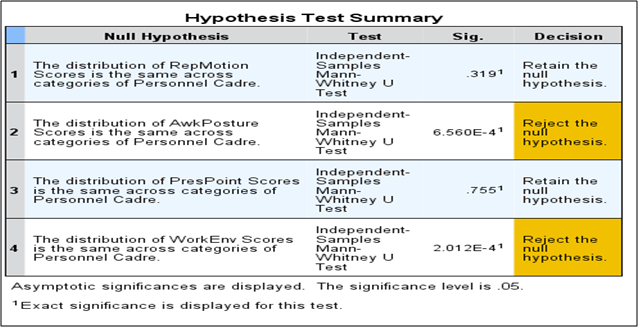
Figure 1: Mann-Whitney U test for distribution of scores across categories of cadre
The results of risk estimates (Table 4) indicated luggage attendants were at higher risk of bending (RR=1.50, 95% CI:1.005—2.238), trunk twisting (RR=2.40, 95% CI:1.229—4.688) and forceful exertion (RR=5.50, 95% CI:1.534—19.714) while security guards had higher risk of prolonged standing (RR=2.40, 95% CI:1.229—4.688), static loading (RR=1.833, 95% CI:1.015—3.310), lacking seats (RR=6.00, 95% CI:1.693—21.262) and showing ≥2 signs of fatigue (RR=2.50, 95% CI:1.080—5.786).
Discussion
Studies examining ergonomic hazards among supermarket luggage attendants and security guards are very rare. This study aimed to bridge the gap by investigating occurrence and distribution of ergonomic hazards among luggage attendants and security guards working in supermarkets at a leading urban center in western Kenya. The leading ergonomic hazards pertained to repetitive motions (MHOS = 3.875) and pressure points (MHOS = 3.042) while awkward posture and ergonomically-suboptimal work environment trailed.
The prevalence of ergonomic hazards have been associated with musculoskeletal symptoms in previous studies. Repetitive motion is a risk factor for cumulative stress disorders and repetitive strain injuries [16], with repetitive neck twisting associated with neck musculoskeletal disorders [9]. The high incidence of repetitive motions in this study therefore indicates luggage attendants and security guards are at elevated risk of suffering these disorders. According to summary evidence by Niu (2010) [2], exposure to pressure point hazards can also affect musculo-skeletal, nervous and vascular systems even when incurred only for short periods of time.
In this study, security guards were twice (RR = 2.40) as likely to experience prolonged standing as luggage attendants. This was due to the fact that none of the security guards observed were provided with seats at their work stations. This is further worsened by the observation that the floors on which they stood were all non-resilient. These findings are contrary to best practices in occupational ergonomics. It is required that workers at risk of prolonged standing should, among other interventions, be provided with seats and anti-fatigue mats [17,18].
Further, prolonged standing has been associated numerous adverse health outcomes including with musculo-skeletal disorders, varicose veins and nocturnal leg cramps in a number of studies [17,19]. Based on the findings of this study, it is reasonable to argue that security guards working in supermarkets are at risk of suffering these morbidities due to their exposure to prolonged standing. This may also explain the observation that security guards were more than twice (RR = 2.50) as likely to exhibit more signs of fatigue compared to luggage attendants.
Compared to security guards, luggage attendants were five times (RR = 5.5) more likely to be exposed to forceful hand exertions. This was due to the fact that the nature of their work required frequent lifting of weights involving client luggage. A pooled study conducted among US workers from several industries associated forceful hand exertion with incidence of carpal tunnel syndrome[20].
Likewise a prospective study by Burt et al., (2013) [21] also implicated forceful exertion in the development of carpal tunnel syndrome even if the activity only occurs in 20% of the work-shift. Other studies have linked forceful exertion with increased risk to musculo-skeletal disorders of the shoulder according to Cutlip and colleagues (2015) [22]. Moreover, according to Nimbarte (2014) [23], epidemiological evidence also links forceful exertion with musculo-skeletal disorders of the neck. In the context of these evidences, the finding of this study suggests that supermarket luggage attendants may be at elevated risk of carpal tunnel syndrome as well as musculo-skeletal disorders of neck and shoulders due to their observed exposure to forceful hand exertion.
This study also found that on ergonomic principles, the work environment for luggage attendants was significantly poorer than for security guards (U=12.00, p<0.0005). This was due to the fact that two of the four individual constructs under work environment (confined space and extreme heights) only occurred among luggage attendants with the third (non-resilient floor) being equally common to both cadres. In literature, extreme heights (below knees and above shoulders) necessitates frequent bending and overreaching which are risk factors for lower back pain as well as disorders of neck and shoulders [24], while working in confined spaces exposes workers to risks of accidents and poor air quality [25].
Conclusion and Recommendations
This study established occurrence of ergonomic hazards among supermarket luggage attendants and security guards in the study area. Distribution of hazards differed significantly across cadres with some hazards affecting one occupational cadre than the other. It is necessary for supermarket managers to take mitigation measures to rectify the situation. Further research to document work-related musculo-skeletal disorders among supermarket luggage attendants and security guards is recommended. A similar survey should also be conducted in other Kenyan urban centers to enlarge the evidence base.
Some suggestions on mitigation include:
- Providing instruction on proper work practices and the use of rest breaks.
- Golfer’s lift training for work requiring forward bending bending/overreaching.
- Changing working positions frequently to minimize working in one position for long duration.
- Using a foot rail or portable footrest to shift body weight from between legs.
- Installing pass-through metal detectors to replace hand-held ones.
- Providing seats designed to support sit-working.
Conflict of Interest:
The authors declare no conflict of interest
References
- Takala J, Hämäläinen P, Saarela KL, et al. Global estimates of the burden of injury and illness at work in 2012. Journal of Occupational and Environmental Hygiene 11 (2014): 326-337.
- Niu S. Ergonomics and occupational safety and health: An ILO perspective. Applied Ergonomics 41 (2010): 744-753.
- Kituyi B. National Profile on Occupational Safety and Health–Kenya. International Labour Office, Geneva. Republic of Kenya–Ministry of Labour (2013).
- Demmler KM, Klasen S, Nzuma JM, et al. Supermarket purchase contributes to nutrition-related non-communicable diseases in urban Kenya. PloS One 12 (2017): e0185148.
- Anton D, Weeks DL. Prevalence of work-related musculoskeletal symptoms among grocery workers. International Journal of Industrial Ergonomics 54 (2016): 139-145.
- Van Der Beek AJ, Dennerlein JT, Huysmans MA, et al. A research framework for the development and implementation of interventions preventing work-related musculoskeletal disorders. Scandinavian Journal of Work, Environment & Health (2017): 526-539.
- Benziger CP, Roth GA, Moran AE. The global burden of disease study and the preventable burden of NCD. Global Heart 11 (2016): 393-397.
- Hoy D, Geere JA, Davatchi F, et al. A time for action: opportunities for preventing the growing burden and disability from musculoskeletal conditions in low-and middle-income countries. Best Practice & Research Clinical Rheumatology 28 (2014): 377-393.
- Nordander C, Hansson GÅ, Ohlsson K, et al. Exposure–response relationships for work-related neck and shoulder musculoskeletal disorders–Analyses of pooled uniform data sets. Applied Ergonomics 55 (2016): 70-84.
- Bernal D, Campos-Serna J, Tobias A, et al. Work-related psychosocial risk factors and musculoskeletal disorders in hospital nurses and nursing aides: a systematic review and meta-analysis. International Journal of Nursing Studies 52 (2015): 635-648.
- Rasmussen CD. Is job rotation effective for prevention of work-related musculoskeletal disorders and sick leave? (2017).
- Liu HC, Cheng Y, Lin HH. 719 Estimating disease burdens and health care costs of work-related musculoskeletal disorders in taiwan. Occupational and Environmental Medicine 75 (2018).
- Schulte PA, Pana-Cryan R, Schnorr T, et al. An approach to assess the burden of work-related injury, disease, and distress. American Journal of Public Health 107 (2017): 1051-1057.
- Anthony Ryan G. The prevalence of musculo-skeletal symptoms in supermarket workers. Ergonomics 32 (1989): 359-371.
- Violante FS, Graziosi F, Bonfiglioli R, et al. Relations between occupational, psychosocial and individual factors and three different categories of back disorder among supermarket workers. International Archives of Occupational and Environmental Health 78 (2005): 613-624.
- Oyewole SA. Enhancing ergonomic safety effectiveness of repetitive job activities: prediction of muscle fatigue in dominant and nondominant arms of industrial workers. Human Factors and Ergonomics in Manufacturing & Service Industries 24 (2014): 585-600.
- Waters TR, Dick RB. Evidence of health risks associated with prolonged standing at work and intervention effectiveness. Rehabilitation Nursing 40 (2015): 148-165.
- Wiggermann N, Keyserling WM. Effects of anti-fatigue mats on perceived discomfort and weight-shifting during prolonged standing. Human Factors 55 (2013): 764-775.
- Coenen P, Parry S, Willenberg L, et al. Associations of prolonged standing with musculoskeletal symptoms—a systematic review of laboratory studies. Gait & Posture 58 (2017): 310-318.
- Harris-Adamson C, Eisen EA, Kapellusch J, et al. Biomechanical risk factors for carpal tunnel syndrome: a pooled study of 2474 workers. Occupational and Environmental Medicine 72 (2015): 33-41.
- Burt S, Deddens JA, Crombie K, et al. A prospective study of carpal tunnel syndrome: workplace and individual risk factors. Occupational and Environmental Medicine 70 (2013): 568-574.
- Cutlip K, Nimbarte AD, Chowdhury SK, et al. Evaluation of Shoulder Stability During Forceful Arm Exertions. Industrial and Systems Engineering Review 3 (2015): 49-58.
- Nimbarte AD. Risk of neck musculoskeletal disorders among males and females in lifting exertions. International Journal of Industrial Ergonomics 44 (2014): 253-259.
- Alessa F, Ning X. Changes of lumbar posture and tissue loading during static trunk bending. Human Movement Science 57 (2018): 59-68.
- Stojkovic A. Occupational safety in hazardous confined space. Inzenjerstvo Zaštite 137 (2013).