Sabic A1* , Sabic DZ2, Cuvaj S3, Becirovic A4
1Health Center Zivinice, Department of Family Medicine, Zivinice, Bosnia and Herzegovina
2Health Centre Zivinice, Department of Neuropsychiatry, Zivinice, Bosnia and Herzegovina
3Health Centre Zivinice, Department of Radiology, Zivinice, Bosnia and Herzegovina
4Institute for Health Insurance of Tuzla Canton, Tuzla, Bosnia and Herzegovina
*Corresponding Author: Sabic A, Health Center Zivinice, Department of Family Medicine, Zivinice, Bosnia and Herzegovina
Received: 25 March 2022; Accepted: 18 April 2022; Published: 27 April 2022
Aim: The aim of this paper is to show the existence of sesamoid fabella bone as a cause of knee pain.
Methods: The female aged 54 with pain in her right knee that has lasted for 6 months. She has none a history of trauma and previous injuries. In the physical finding the right knee is slightly enlarged from the left, the surrounding skin neat looking. The patient is obese by gynoid type, BMI 31 kg / m2. An X-ray of both knees described minor marginal osteophytes on individual joint surfaces in terms of gonarthrotic changes and a fabella visible in the right popliteal fossa. She has dyslipidemia and glucose intolerance in laboratory findings. The patient was referred for a consultative orthopedic examination that promotes physical treatment, NSAID therapy and weight management.
Results: Physical treatment was carried out, she felt a slight improvement, but the pain was still present.
Conclusion: Given the pain of movement and previous patient reports indicate that surgical treatment is the fastest method to eliminate pain.
Fabela; Knee pain; Treatment
1. Introduction
Sesamoid bone, fabella (lat. faba-bean) is located in the knee joint behind the lateral condyle of the femur, embedded in the tendon of the lateral grip of the abdominal muscle of the leaf (lat. musculus gastrocnemius) and which is responsible for walking and upright posture. The prevalence in humans ranges from 3 to 87%. Fabella has an occasional cartilaginous form and is then hidden for X-ray or CT scans [1]. Often atypical knee pain caused by fabella is misdiagnosed as osteophyte or intraarticular other body [2]. When neglecting the fabella as a cause of pain by many professionals, an error occurs in the very outcome of treatment [3]. When posterolateral knee pain occurs, it is periodic and pronounced when the joint is in extension and leads to irritation of the peroneal nerve, which can result in the appearance of neurological symptoms such as stiffness or tingling. Conservative treatment can improve joint mobility including flexion, extension and rotation [4].
Previous research has indicated that the presence of fabela leads to a higher risk of osteoarthritis and can also lead to compression of the popliteal artery [5]. A tumor that should not be missed or misdiagnosed for fabella syndrome should always be considered when making a differential diagnosis [6]. In this paper, we present a woman who has pain when walking and occasionally at rest in the right knee.
2. Case Report
The female aged 54 with pain in her right knee that has lasted for 6 months. She has none a history of trauma and previous injuries. In the physical finding the right knee is slightly enlarged from the left, the surrounding skin neat looking. The patient is obese by gynoid type, BMI 31 kg / m2. An X-ray of both knees described minor marginal osteophytes on individual joint surfaces in terms of gonarthrotic changes and a fabella visible in the right popliteal fossa. She has dyslipidemia and glucose intolerance in laboratory findings.
The female aged 54 with pain in her right knee that has lasted for 6 months. She has none a history of trauma and previous injuries. In the physical finding the right knee is slightly enlarged from the left, the surrounding skin neat looking. The patient is obese by gynoid type, BMI 31 kg / m2. An X-ray of both knees described minor marginal osteophytes on individual joint surfaces in terms of gonarthrotic changes and a fabella visible in the right popliteal fossa. She has dyslipidemia and glucose intolerance in laboratory findings
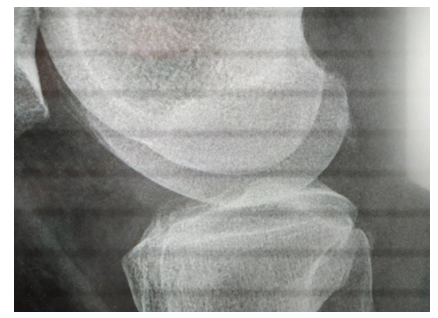
Picture 1: The right knee X-ray showed mild osteoarthritis with a significant fabella bone at the posterolateral side of knee.
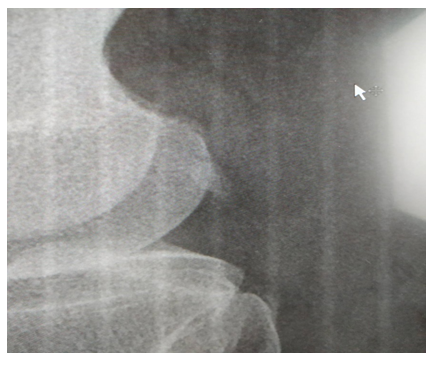
Picture 2: The right knee X-ray showed mild osteoarthritis with a significant fabella bone at the posterolateral side of knee.
The patient was referred for a consultative orthopedic examination that promotes physical treatment, NSAID therapy and weight management. Physical treatment was carried out, she felt a slight improvement, but the pain was still present. The second finding of the orthopedist recommends the regulation of body weight and the continuation of physical treatment and possibly the application of the drug to the joint.
3. Discussion
From this presentation of the patient we see that the right method has not been selected for the treatment of knee pain caused by the existence of sesamoid bone. Earlier research has documented conservative treatment and physiotherapy with not very encouraging results. Local application of corticosteroids also did not improve the long-term treatment. Subsequently, the patients underwent surgical excision of the fabella [7]. Patients undergoing surgery were mostly satisfied with the increased range of motion of the knee, lack of pain, and adequate limb position [8]. Collision syndrome caused by the existence of a fabela and inconsistency of the joint surface accompanied by pain have also been described, and after excision of the fabela the symptoms have been receded [9]. Patients undergoing arthroscopic phabelectomy are relieved of pain and gradually regain full muscle strength after rehabilitation [10]. It has been described that the intervention of manule therapy also leads to the withdrawal of symptoms and that this renal fabela reposition can be performed periodically in some patients [11]. Fabela is very often associated with conditions such as osteoarthritis and old age. The papers indicate that during total knee arthroplasty, the fabula should also be removed because it affects the stability of the posterolateral structure [12].
4. Conclusions
Do we properly diagnose and treat the appearance of sesamoid fabelae bone? Given the pain of movement and previous patient reports indicate that surgical treatment is the fastest method to eliminate pain and restore stability during movement to the patient. We should always pay attention to what quality of life we give to the patient with our decisions.
Transparency Declaration
Conflict of Interests
None to declare.
References
- Berthaume MA, Di Federico E, Bull AMJ. Fabella prevalence rate increases over 150 years, and rates of other sesamoid bones remain constant: a systematic review. J Anat 235 (2019): 67-79.
- Adedigba JA, et al. Fabella and patella variants: radiographic prevalence, distribution and clinical relevance in a population of black African descent. Anat Cell
- Oliveira SS, Oliveira WJSF. The Anatomy of the Fabela Bone and its Clinical Importance. Int J Anat Var14 (2021): 59-65.
- Provencher MT, et al. Arthroscopy-Assisted Fabella Excision: SurgicalTechnique. Arthrosc Tech 6 (2017): e369-e374.
- Egerci OF, Kose O, Turan A, et al. Prevalence and distribution of the fabella: a radiographic study in Turkish subjects. Folia Morphol 3 (2017): 478-483.
- Garcia-German D, et al. Intra-articular osteoid osteoma simulating a painful fabella syndrome. The Knee 17 (2010): 310-312.
- Loscos S,Lopez-Vidriero R,Lopez-Vidriero E. Fabella syndrome in an elite swimmer. Rev Esp Cir Ortop Traumatol 64 (2020): 361-364.
- Asghar A, Naaz S, Narayan RK, et Does the Prevalence of Ossified Fabella Vary in Knee Osteoarthritis and Age-Related Degeneration? A Meta-Analysis of About 11,000 Knees. Cureus 13 (2021): e12535.
- Kim T, H.Chung H, H. Lee, Y. Choi, J.H. Son. A case report and literature review on fabella syndrome after high tibial osteotomy. Medicine (Baltimore). 2018 Jan; 97(4): e9585
- Weng SP, Wu TM, Chien CS, et al. Treatment of Fabella syndrome with
arthroscopic fabellectomy: a case series and literature review. BMC Musculoskeletal Disorders (2021) 22: 748. - Zipple JT, Hammer RL, Loubert Treatment of fabella syndrome with manual therapy: a case report. J Orthop Sports Phys Ther 33 (2003): 33-39.
- Hou W, et al. Fabellar prevalence, degeneration and association with knee osteoarthritis in the Chinese population. Sci Rep 9 (2019): 13046.