Mutsumi Takahashi1,*, Yogetsu Bando2, Takuya Fukui3,4
1Department of Physiology, The Nippon Dental University School of Life Dentistry at Niigata 951-8580, Japan
2Bando Dental Clinic, Ishikawa 920-0922, Japan
3Department of Sport Science, Kanazawa Gakuin University of Sport Science, Ishikawa 920-1392, Japan
4Japan Gymnastics Association Trampoline Committee, Tokyo 160-0013, Japan
*Corresponding Author: Mutsumi Takahashi, Department of Physiology, The Nippon Dental University School of Life Dentistry at Niigata 951-8580, Japan.
Received: 10 August 2026; Accepted: 17 August 2026; Published: 18 August 2026
The purpose of this study was to clarify the relationship of visual function with jump time and landing position during trampoline gymnastics. Participants were 12 male trampoline gymnasts (mean age 17.8±2.1 years). Visual function was measured using three items: depth perception (DP), dynamic visual acuity (DVA), and eye–hand coordination (EHC). The jumping skills of the trampoline gymnasts were assessed in two trials: 1) 10 consecutive straight jumps (S-jump), and 2) five consecutive sets of one back somersault followed by one forward somersault with a 1/2 twist Barani, for a total of 10 jumps (B-jump). The analytical items were flight time (T-score) and landing position (H-score) for the S-jump and the T-score for the B-jump. The correlation between DP and jumping skills was analyzed using Spearman’s rank correlation coefficient, and the correlation between DVA or EHC and jumping skills were analyzed using Pearson’s product-moment correlation coefficient. A significant negative correlation was found between DP and each jumping skill, a significant positive correlation was found between DVA and each jumping skill. EHC showed a significant negative correlation only with the T-score of B-jump. The results of this study revealed that flight time and landing position in trampoline gymnastics are related to DP and DVA. Furthermore, the findings suggested that EHC is related only to jumps that involve rotation and twisting.
Trampoline Competition; T-score; H-score; Visual function; Depth Perception; Dynamic Visual Acuity; Eye-hand Coordination
Trampoline Competition articles; T-score articles; H-score articles; Visual function articles; Depth Perception articles; Dynamic Visual Acuity articles; Eye-hand Coordination articles
Introduction
Postural control is heavily dependent on feedback from multisensory inputs, including vision, the somatosensory system, and vestibular sensation, and the ability of the central nervous system to integrate these sensory inputs [1-3]. The threshold for sensory input has been reported to depend on the speed of body sway: during slow sway, the threshold for somatosensory input is higher than that for visual input, whereas, during fast sway, the thresholds for visual and somatosensory input are equivalent and the threshold for vestibular input is higher than that for visual and somatosensory input [4].
In central sensory integration, the weighting of each sensory input varies from person to person, with athletes influenced by the characteristics of their sport or event and their level of competition [3,5-9]. For example, a study of cyclists found that, while road riding relies heavily on visual input, off-road riding adapts to rely more on somatosensory input, indicating that the reweighting of sensory input differs depending on the riding environment [8]. It has also been shown that gymnasts have a lower center of gravity sway than athletes in other sports, and that postural training increases the weighting of visual input [7].
Trampoline competitions have an acrobatic aspect, with gymnasts performing a series of 10 aerial movements involving spins and twists [10]. Gymnasts must instantly recognize the center of the trampoline bed while in the air, establish their posture, and control their body movements. Therefore, fine postural control and sports vision are essential for competitive trampolining [11]. Straight jumps are a basic trampoline exercise in which the gymnast maintains a standing position during the airborne phase [12]. This movement is a test that directly reflects postural control [13]. On the other hand, jumps that involve rotation and twisting require a large shift in the center of gravity, which means that the landing position is likely to deviate from the center of the bed. It is thus likely that visually based postural control will be more necessary for such jumps than for straight jumps.
The purpose of this study was to clarify the relationship of visual function with jump time and landing position during trampoline gymnastics. The null hypothesis was that there is no correlation of flight time and landing position in trampoline gymnastics jumps with visual function.
Materials and Methods
Ethical approval of studies and informed consent
This study was conducted with the approval of the Ethics Committee of The Nippon Dental University School of Life Dentistry at Niigata (approval no. ECNG-R-443). The study aims and procedures were fully explained to all participants, and written informed consent was obtained from all individuals before their participation.
Participants
The participants were 12 male high school and university students who belonged to the trampoline club (average age ± standard deviation, 17.8±2.1 years; average competitive experience, 11.8±2.0 years). Students were trained six times a week (3 hours each).
Measurement of visual function
Visual function was measured using three items: depth perception (DP), dynamic visual acuity (DVA), and eye–hand coordination (EHC).
DP was measured using an electronic depth perception meter (AS-7JS1, KOWA Co. Ltd., Aichi, Japan). Participants sat at a distance of 2.5 m, with the measuring device at eye level. They were instructed to press the stop button when they perceived that a single moving rod, moving at 50 mm/s, was aligned horizontally with two fixed rods. The difference in distance between the fixed and moving rods displayed on the position indicator was recorded [14-17].
DVA was measured using a dynamic visual acuity tester (AS-4A, KOWA Co. Ltd.) designed to correspond to a visual acuity value of 1.0 when the Landolt ring was positioned at a distance of 30 m. Participants were instructed to press a switch at the moment they identified a break in the Landolt ring, which was moving straight ahead from 50 m to 2 m at 30 km/h. If the answer was correct, the value converted from the distance was the measurement value [14,16-19].
EHC was measured using a coordination measurement device (Acu Vision-1000, KOWA Co. Ltd.). The measuring device consisted of a 300 × 130-cm panel with 120 touch sensors, each 3 cm in diameter. The touch sensor turned off the light when pressed, and all 120 sensors were activated for each measurement. The time elapsed until the 120th randomly lit sensor was deactivated was recorded [16,17].
Measurement of flight time and landing position
The jumping skills of the trampoline gymnasts were assessed in two trials: 1) 10 consecutive straight jumps (S-jump), and 2) five consecutive sets of one back somersault followed by one forward somersault with a 1/2 twist Barani, for a total of 10 jumps (B-jump). Flight times and landing positions were measured using the HDTS all-in-one measurement system (EU-7100, Eurotramp, Weilheim an der Teck, Germany) [13,20-22]. In each trial, recording began after a preliminary jump. For each of the first to tenth jumps, the flight time and landing position in the forward and backward and left and right directions from the center of the bed were recorded. In addition, the total flight time (T-score) and movement points (H-score) of the 10 jumps were recorded. A single trial consisted of 10 jumps, and measurements were taken three times. The analytical items were the T-score and H-score for the S-jump and the T-score for the B-jump.
Statistical analysis
Statistical analyses were performed using SPSS 17.0 software (SPSS Japan Inc., Tokyo, Japan). The Shapiro-Wilk test was used to test for normality, and normality was confirmed at all levels except for DP.
The correlation of DP with the T-score and H-score of the S-jump and with the T-score of the B-jump was analyzed using Spearman’s rank correlation coefficient. For the T-score and H-score of the S-jump and the T-score of the B-jump, the correlations with DVA and EHC were analyzed using Pearson’s product-moment correlation coefficient.
Results
The results of the correlation analysis of DP with the T-score and H-score are shown in Figure 1. A significant negative correlation was found between DP and the T-score of the S-jump, the H-score of the S-jump, and the T-score of the B-jump (P<0.05). A lower DP was associated with a higher jump score.
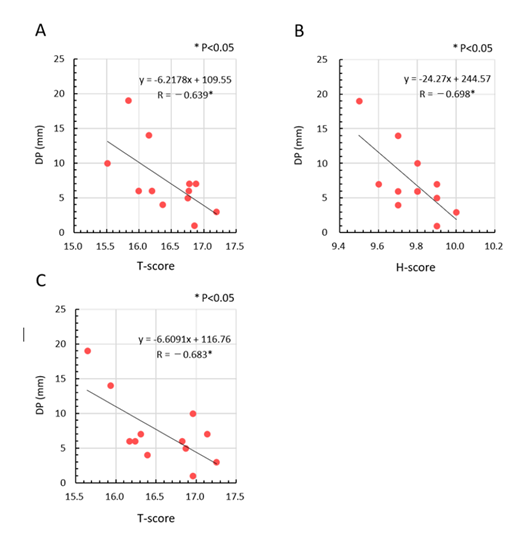
Figure 1: Correlation of depth perception with the T-score or H-score. A, Straight jump, T-score; B, Straight jump, H-score; C, Barany jump, T-score.
The results of the correlation analysis between DVA and jumping skill are shown in Figure 2. A significant positive correlation was found between DVA and the T-score of the S-jump, the H-score of the S-jump, and the T-score of the B-jump (P<0.05). A higher DVA was associated with a higher jump score.
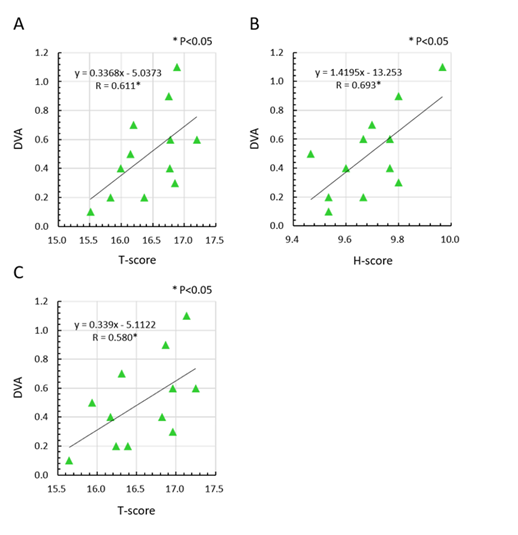
Figure 2: Correlation of dynamic visual acuity with the T-score or H-score. A, Straight jump, T-score; B, Straight jump, H-score; C, Barany jump, T-score.
Figure 3 shows the results of the correlation analysis between EHC and jumping skills. No significant correlation was found between EHC and S-jump scores. However, a significant negative correlation was found between EHC and the T-score of the B-jump, with a lower EHC associated with a higher jump score (P<0.05).
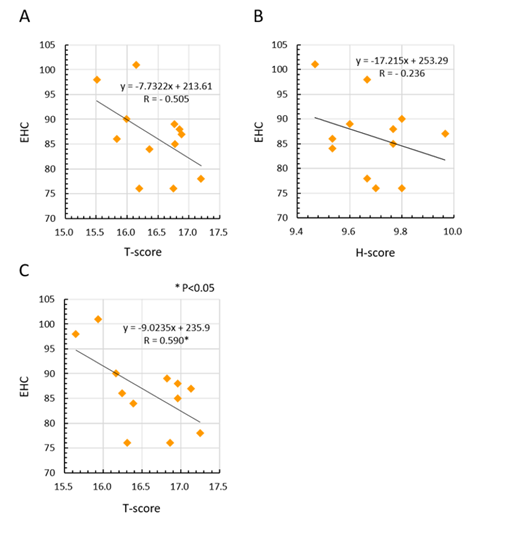
Figure 3: Correlation of eye–hand coordination with the T-score or H-score. A, Straight jump, T-score; B, Straight jump, H-score; C, Barany jump, T-score.
Discussion
The results of this study revealed that flight time and landing position in trampoline gymnastics are related to DP and DVA. Furthermore, the results suggested that EHC was relevant only for jumps that involved rotation and twisting. Therefore, the null hypothesis, namely, that there is no correlation of flight time and landing position in trampoline gymnastics jumps with visual function, was rejected.
During many sports competitions, athletes rely on visual information to understand the ever-changing environment, adjust their posture to maintain body position, and generate functional movements [23]. At this time, visual input is transmitted to the central nervous system as sensory input for postural adjustment, contributing to postural control and the generation of fast or slow movements [4]. In sports, visual function (i.e., sports vision) is assessed using various measures, including static visual acuity, DVA, and instantaneous visual acuity [16,17,23-25]. The importance of sports vision has been reported to differ depending on the type of sport, with elite athletes having elevated sports vision abilities [23]. There are also some reports on the use of visual function training in an attempt to improve athletic performance [25]. Sports vision can be divided into the ability to quickly and accurately direct one's gaze toward a target, the ability to quickly and accurately recognize a captured target, and the ability to immediately react to and move toward the captured target [23]. The DP and DVA assessed in this study are items that evaluate an individual’s ability to quickly and accurately recognize a captured target, while EHC evaluates an individual’s ability to immediately react and move toward a captured target.
The participants in this study were trampoline gymnasts. Trampoline jumping relies on the strong rebound force of the trampoline bed, transmitted through the soles of the feet, to propel the body upward [12,13,20-22]. Because a trampoline bed is supported by four legs, it is essential to land in the center of the bed to effectively utilize the bed’s elasticity [13]. Generally, gymnasts recognize the red cross displayed in the center of the bed in an instant during airborne and adjust their landing position [11]. Trampoline competitions are scored based on four criteria: the difficulty of the performance (D-score), the performance score (E-score), the jump time score (T-score), and the movement deduction (H-score) [10]. To execute highly advanced techniques, gymnasts require adequate air time and must land in the center of the bed to ensure this [11,12]. In this study, we selected trampoline gymnasts with long competitive careers as participants and examined the relationship between visual function and jumping skills. We predicted that the use of visual functions during jumps would differ depending on whether rotations or twists were involved. Accordingly, the jumps were divided into basic trampoline attempts (S-jumps) and more advanced jumps with rotations or twists (B-jumps). In consecutive jumps involving rotations and twists, the landing direction reverses for each jump, so the H-scores of B-jumps were not evaluated.
The results of this study showed that DP and DVA were significantly correlated with jumping skill in both trials. This suggests that experienced trampoline gymnasts are able to quickly and accurately recognize the target captured by the fovea of the eye (i.e., the cross mark in the center of the trampoline bed). DP evaluates an individual’s ability to see the stereoscopic vision of an object relative to its position, which can be rephrased as the ability to instantly recognize the difference in distance between the body and the trampoline bed. On the other hand, DVA evaluates the ability to recognize an object approaching in front of the eyes in a straight line from a distance and can be thought of as the ability to gauge the distance to a nearby trampoline bed as an airborne body descends. Visual training has been reported to be more effective in children than in adults, especially in those aged 8 to 13 [23,24]. Beginners in trampoline gymnastics gradually improve their skills by starting with basic techniques such as straight jumps and progressing to more difficult techniques that involve rotations and twists. The basic action of quickly checking the trampoline bed during a jump and preparing to land is the same for all types of jumps [11]. None of the participants in this study had experience with vision training, but the average age at which they began competing was 6.2 years, so it can be assumed that their stereoscopic vision ability was developed by participating in trampoline gymnastics from a young age.
Only the B-jump showed a significant correlation with EHC. EHC encompasses an individual’s ability to focus on the entire visual field without concentrating on a single point, capture a target using peripheral vision, quickly and accurately interpret the sensory information captured by the visual sense, convert that information into motor commands, and initiate movement [17]. When the body rotates and twists, there are times when the view of an object is blocked, requiring peripheral vision. Furthermore, because the B-jump requires an individual to recognize the captured object and adjust the landing position, a significant correlation was observed only in the B-jump. Sports vision can be improved through vision training and reaction time training [25], and improved information gathering through vision training may have a positive effect on situational judgment and action selection [23]. Since the type of sports vision required differs depending on the type of sport, we would like to investigate the effects of vision training and the relationship between sports vision and competitive performance in future work and use the data obtained to support the development of athletes.
Conclusions
The results of this study revealed that flight time and landing position in trampoline gymnastics are related to DP and DVA. Furthermore, the findings suggested that EHC is related only to jumps that involve rotation and twisting.
Acknowledgments
This work was supported by JSPS KAKENHI Grant Number JP23K10617.
Conflicts of interest statement
The authors have no conflicts of interest relevant to this article.
References
- Saito H. Mechanism of posture retention. Gen Rehabil 24 (1996): 699-703.
- Nishimori T. Evaluation of postural stability. Kansai Physic 3 (2003): 41-47.
- Itaya A. Feedback system for sensory and postural control. J Biomech 39 (2015): 197-203.
- Fitzpatrick R, McCloskey DI. Proprioceptive, visual and vestibular thresholds for the perception of sway during standing in humans. J Physiol 478 (1994): 173-186.
- Perrin PP, Deviterne D, Hugel F, Cyril P. Judo, better than dance, develops sensorimotor adaptabilities involved in balance control. Gait Posture 15 (2002): 187-194.
- Paillard T, Noé F. Effect of expertise and visual contribution on postural control in soccer. Scand J Med Sci Sports 16 (2006): 345-348.
- Asseman FB, Caron O, Crémieux J. Are there specific conditions for which expertise in gymnastics could have an effect on postural control and performance? Gait Posture. 27 (2008): 76-81.
- Lion A, Gauchard GC, Deviterne D, Philippe PP. Differentiated influence of off-road and on-road cycling practice on balance control and the related-neurosensory organization. J Electromyogr Kinesiol 19 (2009): 623-630.
- Paillard T, Margnes E, Portet M, Arnaud B. Postural ability reflects the athletic skill level of surfers. Eur J Appl Physiol 111 (2011): 1619-1623.
- Izumi T. Report on trampoline competitions that involved in as a physical coach: physical training strengthening plan for the national team. NSCA JAPAN 25 (2018): 26-30.
- Matsushima M, Yano S. Relation between muscle activity during takeoff and landing positions in the trampoline straight jump. Res J Sports Perform 10 (2018): 15-26.
- Ito N, Yamazaki H, Hirai T, Suzuki M, Miyamoto E, Ishii K. Kinematics on straight jump in trampoline. Bull Nippon Sport Sci Univ 30 (2000): 59-64.
- Takahashi M, Bando Y, Fukui T, Maruyama A, Sugita M. Straight jump landing position of trampoline gymnasts with stable occlusal balance reflects standing postural control function. Appl Sci 13 (2023): 6689.
- Ohno S, ed. Standard ophthalmology. 11th ed. Tokyo, IGAKU-SHOIN Ltd. (2010).
- Hirouchi T. Principles of stereoscopic vision and their application to 3D technology. JISSJ 8 (2013): 5-16.
- Japan Sports Vision Association. Sports vision medical science textbook. Tokyo, Japan Sports Vision Association (2019).
- Murakami H, Komuro T, Kuniyoshi K. Studies on sports vision of university male kendo players: comparison with other athletes. Kyoto Sangyo Univ Essays 47 (2020): 3-22.
- Mashita I. Dynamic visual acuity. J Phys Fit Sports Med 46 (1997): 321-326.
- Niwa S, Taguchi T, Matsuda F, Sakakima H, Morimoto N. Visual functions and risk factors for visual impairment in community-dwelling Japanese elderly. Med J Kagoshima Univ 65 (2014): 37-47.
- Takahashi M, Bando Y, Fukui T, et al. Influence of occlusion on flight time in trampoline competition. Int J Dent Oral Health 9 (2023): 405.
- Takahashi M, Bando Y, Fukui T. Impact of improved feedforward control on flight time in trampoline competitions. Adv Phys Educ 15 (2025): 187-196.
- Takahashi M, Bando Y, Fukui T. Research on jumping height of straight jumps and barani jumps in competitive trampoline gymnasts: influence of occlusal correction. Fortune J Health Sci 8 (2025): 803-808.
- Mashita I. Sports and vision. JSCSM 12 (2004): 19-26.
- Maeda A, Komori Y, Shibayama S. Effects of training to see fastballs on dynamic visual acuity and bunting performance in baseball players. J Train Sci 11 (1999): 1-8.
- Faure C, Limballe A, Bideau B, Kulpa R. Virtual reality to assess and train team ball sports performance: a scoping review. J Sports Sci 38 (2020): 192-205.