Fernanda Costas Casal de Faria1, Paula Sabbo Bernardo1, Maria Eduarda Bento Leal1, Marcos Barcelos de Pinho2, Chaquip Daher Netto3, Paulo R. R. Costa4, Raquel Ciuvalschi Maia1*
1Laboratório de Hemato-Oncologia Celular e Molecular, Programa de Hemato-Oncologia Molecular, Instituto Nacional de Câncer (INCA), Rio de Janeiro (RJ), Brazil.
2Departamento de Engenharia Bioquímica, Escola de Química, Universidade Federal do Rio de Janeiro (UFRJ), RJ, Brazil.
3Laboratório de Química, Universidade Federal do Rio de Janeiro (UFRJ), Macaé, RJ, Brazil
4Laboratório de Química Bioorgânica, Instituto de Pesquisas de Produtos Naturais (IPPN), Universidade Federal do Rio de Janeiro (UFRJ), RJ, Brazil.
*Corresponding author: Raquel C Maia, ratório de Hemato-Oncologia Celular e Molecular, Programa de Hemato-Oncologia Molecular, Instituto Nacional de Câncer (INCA), Rio de Janeiro (RJ), Brazil
Received: 22 July 2020; Accepted: 29 July 2020; Published: 17 August 2020
Chronic myeloid leukemia (CML), a myeloproliferative disorder characterized by the BCR-ABL oncoprotein, presents its treatment based on tyrosine kinase inhibitors (TKIs), mainly imatinib. However, despite its clinical success, almost 30% of all CML patients demand alternative therapy. In this context, the development of drugs capable of overcoming TKIs resistance is imperative. LQB-118 is a compound with anti-tumour effect in two CML cell lines (K562, sensitive and K562-Lucena, resistant) whose mechanism of action is being elucidated. Here, we demonstrate that combined treatment of CML cell lines with imatinib and LQB-118 increased cell death and that microarray analysis of CML cells treated with LQB-118 presented several differentially expressed genes. Also, IGF-1R, AKT and mTOR protein levels are decreased after LQB-118 treatment and the compound alters the expression of all members of miR-29 family. CML cells silenced for IGF-1R were less sensitive to LQB-118 treatment than negative control and protein levels of IGF-1R and AKT were no longer altered after LQB-118 or imatinib treatment. Taken together, our results highlight IGF-1R/AKT/mTOR as a critical axis for LQB-118 activity and demonstrate that LQB-118 is effective in sensitizing CML cells to TKI, contributing to the development of a more efficient therapy.
Chronic Myeloid Leukemia; LQB-118; Imatinib; IGF-1R; AKT; miRNAs
1. Introduction
Chronic myeloid leukemia (CML) is a myeloproliferative disorder characterized by the fusion of ABL1 oncogene and the BCR gene. The BCR-ABL protein originated from the fusion of these genes leads to inhibition of tumor suppressor genes, increased genomic instability and activation of survival pathways [1-3]. Several signaling pathways are activated by BCR-ABL, such as MAPK, JNK, PI3K, NFκB, STAT, Scr Kinases and Myc [4, 5]. Imatinib mesylate, the first tyrosine kinase inhibitor (TKI) approved by the Food and Drug Administration (FDA) for CML treatment, acts on BCR-ABL cellular signaling, by inhibiting the function of this kinase in phosphorylating target substrates [6]. However, despite the response improvement of CML patients to imatinib, or second and third generation TKIs, about 30% of patients will present treatment resistance based on several molecular mechanisms [7-9]. Therefore, the development of new compounds that can overcome TKIs resistance mechanisms is imperative. The compound LQB-118 has demonstrated to be effective against CML and AML cells, without toxicity when administrated in mice [10-13].
Recently, we have provided some information about molecular pathways possibly involved in LQB-118 response. It has been demonstrated that LQB-118 inhibits XIAP, Survivin and P-glycoprotein expression and modulates protein expression and subcellular localization of the transcription factors NFκB and FOXO3a [10-12, 14]. Thus, we aimed to extend the studies of LQB-118 effects and molecular mechanism of action in CML cell lines with different resistance phenotypes.
2. Materials and Methods
2.1 Cell lines and compounds
The human CML cell line K562 and its vincristine-resistant derivative K562-Lucena [15] were cultured in RPMI-1640 medium supplemented with 10% fetal bovine serum (FBS) at 37°C in humidified atmosphere with 5% CO2. K562-Lucena cells were maintained in the presence of 60 nM vincristine. Pterocarpanquinone-LQB-118 was synthesized in the Laboratory of Bioorganic Chemistry, IPPN, Federal University of Rio de Janeiro, Brazil [16]. Imatinib mesylate was purchased from Santa Cruz Technologies (USA). Stock solutions of both compounds were prepared at 25 mM in DMSO and stored at -20°C. Cell lines genotypes were confirmed by short tandem repeat (STR), followed by comparison with ATCC (American Type Culture Collection, http://www.atcc.org) data available. The cell lines were also evaluated for Mycoplasma contamination by PCR.
2.2 Cell death assay
Induction of cell death by the compounds (isolated or combined) and after IGF-1R inhibition was evaluated by Annexin V/PI assay, following manufacturer’s instructions (FITC-labeled Annexin V from Invitrogen). Cells fluorescence was measured by flow cytometry (CyAn ADP Beckman Coulter Inc; Brea, CA, US) and analyzed using Summit v4.3 software. The percentage of cell death was calculated as a percentage of Annexin V+ cells (annexin V+/PI- and annexin V+/PI+) in the presence or absence of the compounds. The significance of combined treatment was evaluated by statistical analysis followed by the interaction ratio (R) whenever it was statistically significant. The R was proposed by Fischell and colleagues [17]: R= survival (LQB-118 + imatinib) / (survival LQB-118 x survival imatinib). When R< 0.8 there is a synergic effect, while 0.8 < R < 1.2 is an additive effect, and R > 1.2 is an antagonistic effect.
2.3 DNA microarray
For DNA microarray analysis, 200 ng of mRNA of K562 and Lucena cells treated with LQB-118 at 0.75 µM and 1.5 µM for 48 h were used. All the reactions were realized in thermo cycler Mastercycler Personal (Eppendorf, Germany). Gene expression profiles were obtained with the GeneChip Human Gene 1.0 ST Array (Affymetrix, Singapore) according to the manufacturer’ instructions and all experiments were carried out in duplicate. Data were analyzed with different packages from Bioconductor (R version 2.12.0; www.bioconductor.org). Data pre-processing, background correction, normalization and expression estimates were carried out with the GCRMA package [18]. Differentially expressed genes were analyzed with a GENFILTER [19] for removing Affymetrix control probes and genes that exhibit low variance across samples, with duplicate entries, or without a corresponding “entrez gene tag”. The identification of differentially expressed genes among the samples tested was realized using a statistical model selected from the LIMMA package [20]. Significance was analyzed by the moderated t-statistics method and the false discovery rate (FDR) controlled by the Benjamini and Hochberg (BH) method [21] (<0.05 p-values indicative of differences in biological functions). The gene expression comparison cutoff criteria accounted for p < 0.01 (after BH correction), followed by an absolute expression difference of (fold change) ≥ 2×. Genes demonstrated as differentially expressed were analyzed for biological functions with Ingenuity Pathways Analysis (Ingenuity® Systems, www.ingenuity.com) and classified by Gene Ontology (GO). In order to estimate the probability that each biological function assigned to datasets was due to chance, the Right-tailed Fisher’s Exact Test was used.
2.4 Western blotting
For protein expression analysis, Western blotting was performed according to a protocol previously described [14]. Briefly, protein samples (25 - 30 µg) were subjected to SDS-PAGE on 6% and 10% polyacrylamide gels and transferred to Hybond-P membranes (Amershan Biosciences, USA). The blots were blocked and incubated with antibodies against β-actin (1:3000, Sigma-Aldrich, USA), p-mTOR (1:1000, Invitrogen, USA), mTOR (1:1000, Invitrogen, USA), IGF-1R (1:1000, Cell Signaling, USA), HSC70 (1:1000, Santa Cruz Biotechnology, USA) overnight. Blots were then incubated for 1 h with secondary antibodies (HRP)-labelled anti-mouse and anti-rabbit (Amersham Biosciences, USA). Antibody complexes were visualised with the ECL Prime Detection System (Amershan Biosciences, USA), membranes were scanned using C-Digit™ Blot Scanner and images were generated using Image Studio Lite software (Li-cor Biosciences, USA).
2.5 RNA isolation and quantitative real-time polymerase chain reaction (qRT-PCR)
RNA isolation, cDNA synthesis and qRT-PCR from CML cell lines treated with LQB-118 3.0 µM for 24 h were realized following the protocol demonstrated in [14]. After cDNA synthesis, mature miRNA-29a, miRNA-29b, miRNA-29c and RNU6B (ID 001093) expressions were detected using hsa-miR-29a (ID 2112), hsa-miR-29b (ID 413) and hsa-miR-29c (ID 587) probes (TaqMan® MicroRNA Assay), following the manufacturer’s instructions. qRT-PCR was performed in the StepOne™ Real-Time PCR System (Applied Biosystems, USA).
2.6 IGF-1R siRNA
For IGF-1R inhibition, Lucena cells were seeded in 24-well plates and transfected using 100 nM siRNA or negative control siRNA (Cell Signaling), performing an optimized protocol previously described [22]. After 48 h of IGF-1R siRNA incubation, the cells were once again seeded for imatinib (1.0 μM) and LQB-118 (3.0 μM) treatment. At the end of a 48h period, the cells were collected for protein extraction and cell death evaluation.
2.7 Statistical analysis
Statistical analysis was performed using GraphPad Prism 5.0 software (USA). Statistical significance was calculated by student's t test, Mann Whitney or ANOVA test followed by Bonferroni post-test.
3. Results and Discussion
Second and third generation TKI are well stablished in overcoming BCR-ABL-dependent resistance phenotype, except for the T315I mutation. However, the molecular mechanisms of TKI resistance that are independent of BCR-ABL [9] protein can be important targets for new antitumor compounds. Previously our group has demonstrated that LQB-118 exerts its antitumor activity in K562 and Lucena cell lines without inhibition of BCR-ABL activity [11]. Several studies have been demonstrating that combination of TKI and new compounds presents promising results. Natural compounds, like α-bisabolol and neferine, sensitize CML cell to TKI treatment [23, 24]. Thus, the combined use of LQB-118 and imatinib could offer benefits to the group of patients resistant to standard therapy. In this context, LQB-118 was simultaneously associated with imatinib to evaluate a possible enhanced effect in apoptosis induction after combination. We evaluated the effect of combining LQB-118 (3.0 μM) and subclinical doses of imatinib (0.2 μM and 0.4 μM) in CML cell lines. After 48h, imatinib (0.2 μM and 0.4 μM) and LQB-118 (3.0 μM) treatment alone induced cell death in K562 and Lucena cell lines. However, only the combination of imatinib 0.4 μM with LQB-118 promoted a statistically significant increase in cell death in comparison to isolated treatments (p < 0.05) (Figures 1A-C). Afterwards, the interaction ratio demonstrated an additive effect between LQB-118 and imatinib in K562 and Lucena cells (R = 0.94 and 1.02, respectively). Therefore, these preliminary results suggest that LQB-118 may sensitize CML cell lines to low doses of imatinib.
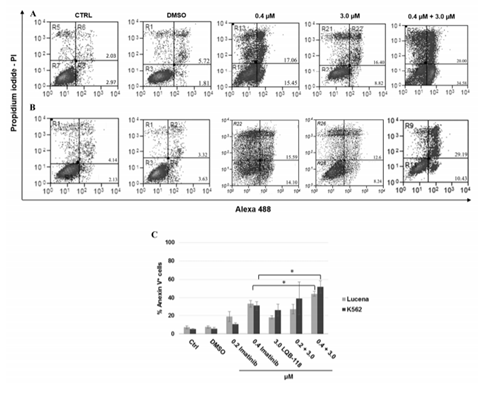
Figure 1: Effect of LQB-118 associated with imatinib on cell death in CML cell lines. (A) Representative dot plot of combined treatment of LQB-118 with imatinib in K562 cell line and (B) in Lucena cell line. (C) Percentage of Annexin V positive cells (annexinV+/PI– + annexinV+/PI+) in K562 and Lucena cell lines, evaluated by flow cytometry, after combined treatment of LQB-118 with imatinib. Mean of three independent experiments ±SD.
In a previous study, we demonstrated that NFκB and miRNAs -9 and -21 were modulated after LQB-118 treatment in CML cell lines K562 and Lucena [14]. Therefore, in order to provide a better understanding on LQB-118 mechanisms of action, we evaluated differences in global gene expression profile by DNA microarray of CML cell lines treated with 1.5 µM of LQB-118 for 48h. Gene expression profile of K562 and Lucena after treatment with LQB-118 were compared to control cells. The gene results presenting fold change difference ≥ 2X were considered as differentially expressed. Comparisons between K562 and Lucena treated with LQB-118 identified 176 differentially expressed genes. The number of overexpressed genes after treatment with LQB-118 for K562 and Lucena cells was 85 and 36, respectively. For down-regulated genes, K562 and Lucena cells treated with the compound presented 26 and 39 genes with underexpression, respectively (Figure 2A). The differentially expressed genes in K562 and Lucena cells treated with LQB-118 were classified by gene ontology and grouped by Ingenuity Pathway Analysis. This analysis demonstrated several biological functions and signaling pathways related to CML as modulated by the compound (Figure 2A). Among them, PI3K/AKT/mTOR axis and IGF-1R were shown to be down-regulated in cells treated with LQB-118.
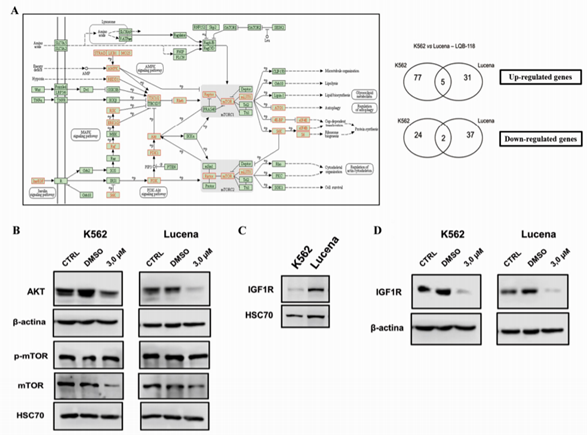
Figure 2: Microarray analysis and validation of differentially expressed genes after LQB-118 treatment in K562 and Lucena cell lines. (A) Schematic representation of the differentially expressed genes and modulated pathways of CML cells after 48h treatment with 1.5 μM LQB-118. In red, the genes that are differentially expressed after LQB-118 treatment in comparison to control cells (http://www.genome.jp/). (B) Akt, pAkt, mTOR and p-mTOR expression levels were analyzed after LQB-118 treatment (3.0 μM for 24h) in K562 and Lucena cell lines. (C) IGF-1R expression level in K562 and Lucena cell lines. (D) IGF-1R expression levels were analyzed after LQB-118 treatment (3.0 μM for 24h) in K562 and Lucena cell lines. Figure representative of three independent experiments.
BCR-ABL inhibition by TKI results in a consecutive inhibition of downstream pathways. However, even in a scenario of BCR-ABL inhibition, leukemic cells survival remains due to the activation of pathways like PI3K/AKT/mTOR [25, 26]. Thus, we evaluated protein expression of AKT and mTOR in those cells, in order to validate microarray analysis and to elucidate LQB-118 mechanism of action. K562 and Lucena cell lines treated with LQB-118 for 24h presented reduced levels of AKT and mTOR proteins, without modulating p-mTOR expression (Figure 2B). PI3K/AKT/mTOR pathway is frequently deregulated in hematological neoplasias and is associated with poor prognosis [27]. Several studies have suggested members of this pathway as promising targets for therapy. The use of PI3K/mTOR inhibitors, such as NVPBEZ235, everolimus or LY294002, sensitize CML stem cells or TKI resistant cells to second and third generation TKI [26, 28, 29]. Therefore, the reduction of AKT and mTOR protein expression by LQB-118 can be associated to the antitumor activity of the compound.
Our group has also demonstrated reduced levels of AKT protein induced by LQB-118 in glioblastoma cells [30] and in acute myeloid leukemia cell lines (unpublished data). For that, we continued to explore possible mechanisms regulated by LQB-118 that could modulate AKT protein expression. miRNAs play an important role in regulation of several cellular functions, like proliferation and survival. Deregulated miRNAs are involved in a variety of hematological neoplasia and are key regulators of PI3K/AKT/mTOR, suggesting miRNAs as possible therapeutic targets [28]. miR-29 family members (miR-29a, -29b e -29c) are described as tumor suppressors in a variety of cancers. They are less expressed in CML patients and overexpression of some members are associated with proliferation reduction and apoptosis induction in K562 cell line [31, 32]. Also, PI3K/AKT/mTOR pathway is one of miR-29 targets for inhibition [33]. Reduced levels of AKT observed after LQB-118 treatment could be associated to its post-transcriptional regulation by miRNAs. Because of that, we evaluated miR-29 family members (-29a, -29b and -29c) expression, after 24h of 3.0 μM LQB-118 incubation. miR-29a expression was slightly increased in K562 cell line and it was decreased in Lucena cells (Figures 3A and 3B). The levels of miR-29b did not alter in K562 cells, but were decreased in Lucena cells treated with LQB-118 (Figures 3A and 3B). miR-29c expression was reduced in both CML cell lines after LQB-118 treatment (Figures 3A and 3B). Our results point out that reduced AKT expression by LQB-118 is not mediated by miR-29 family.
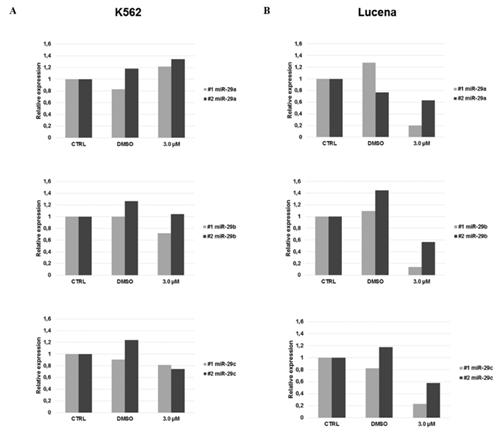
Figure 3: Effect of LQB-118 treatment on miRNA-29a, -29b and -29c expressions. (A) miR-29a, -29b and -29c expression pattern after 24h exposure of 3.0 μM LQB-118 in K562 cells. (B) miR-29a, -29b and -29c expression pattern after 24h exposure of 3.0 μM LQB-118 in Lucena cells. miRNA expressions were normalized by RNU6B. Graphics demonstrate two independent experiments (#1 and #2) for each miRNA and cell line.
Microarray analysis also pointed out that Insulin-like growth factor (IGF-1) receptor, a well known regulator of PI3K/AKT/mTOR pathway was possibly modulated by LQB-118. IGF-1R is a tyrosine kinase receptor that, once activated by IGF1, triggers various signaling pathways, especially PI3K/AKT/mTOR and MAPK pathways [34, 35]. It has been previously demonstrated that IGF-1R is overexpressed in cells of CML patients in blast phase and its overexpression in hematopoietic cells promotes cellular proliferation and survival [25, 34]. Also, IGF-1R is constitutively active in K562, a blast phase derived cell line, and Lucena presents even higher expression of IGF-1R in comparison to its parental cell line (Figure 2C) [25]. For that, we aimed to evaluate IGF-1R expression after LQB-118 treatment. The compound reduced protein levels of IGF-1R in K562 and Lucena cell lines, despite the differences in IGF-1R expression (Figure 2D).
The inhibition of this pathway induces cell death in resistant cells by blocking proliferative downstream pathways, such as PI3K/AKT/mTOR and MAPK. Therefore, IGF-1R down-regulation mediated by LQB-118 may be an important event for its antitumor activity. Thus, we sought to investigate the effect of LQB-118 after IGF-1R inhibition by siRNA. IGF-1R was silenced in Lucena cells, since it is the cell line presenting the highest level of its expression. After silencing, the cells from negative control (scramble – SCR) and siRNA IGF-1R were incubated for 48h with 1.0 μM of imatinib and 3.0 μM of LQB-118. IGF-1R inhibition did not sensitize Lucena cells to imatinib treatment (cell death index of 34% for SCR and 32% for siRNA IGF-1R). However, cells silenced for IGF-1R were less sensitive to LQB-118 treatment than negative control (40% and 54%, respectively) (Figures 4A and 4B). Moreover, we evaluated the expression of IGF-1R and AKT after treatment with imatinib and LQB-118 of negative control and siRNA IGF-1R cells. Corroborating the previous data, LQB-118 and imatinib treatment reduced IGF-1R and AKT protein expression in negative control cells. Nevertheless, protein levels of IGF-1R and AKT were not altered after LQB-118 or imatinib treatment in IGF-1R silenced cells (Figure 4C). Thus, our results indicate that LQB-118 is partially dependent of IGF-1R, suggesting that resistant patients presenting IGF-1R overexpression would benefit from LQB-118 therapy.
Figure 4: Effect of LQB-118 treatment in Lucena cell line after IGF-1R inhibition by siRNA. (A) Representative dot plot of Lucena cells silenced for IGF-1R (siRNA IGF-1R and negative control (SCR) after 24h treatment with 3.0 μM LQB-118 or 1.0 μM imatinib. (B) Percentage of Annexin V positive cells (annexinV+/PI– + annexinV+/PI+) in Lucena cells silenced for IGF-1R (siRNA IGF-1R) and negative control (SCR) after 24h treatment with 3.0 μM LQB-118 or 1.0 μM imatinib. Mean of three independent experiments ±SD. (C) Akt, and IGF-1R expression levels were analyzed by Western blotting in Lucena cells silenced for IGF-1R (siRNA IGF-1R and negative control (SCR) after 24h treatment with 3.0 μM LQB-118 or 1.0 μM imatinib. Figure representative of three independent experiments.
Taken together, our results expand our knowledge about the molecular pathways involved in LQB-118 mechanism of action, since it demonstrates that IGF1-R/PI3K/AKT/mTOR pathway play an important role in LQB-118 antitumoral activity. Moreover, the data presented in this report demonstrate that LQB-118 is effective in sensitizing CML cells to TKI, contributing to the development of a more efficient therapy, specially for TKI resistant patients. Importantly, our results highlight IGF-1R as critical molecule for LQB-118 activity.
Authors Contribution
FCCF designed the experiments, performed the microarray assays, cellular effects assays, IGF-1R silencing and protein expression analysis, analyzed the data and wrote the manuscript. PSB performed and analyzed the quantitative miR-29 PCR experiments and analyzed the interaction ratio (R) of combined treatment. MEBL performed and analyzed the combination experiments of LQB-118 and imatinib. MBP performed the microarray data analysis. CDN and PRRC provided the compound LQB-118. RCM provided the conception, resources and design of the study, revised it critically and gave final approval of the version to be submitted. All authors revised critically the final version of the manuscript.
Funding
This work was funded by the Conselho Nacional de Desenvolvimento Científico e Tecnológico (CNPq grant numbers - 304565/2016-4 and 429687/2018-4), and Fundação para Amparo à Pesquisa do Estado do Rio de Janeiro (FAPERJ grant number - E26/202-798/2017).
Conflict of Interest
The authors declare no conflict of interest.
References
- Zhou T, Medeiros LJ, Hu S. Chronic Myeloid Leukemia: Beyond BCR-ABL1. Curr Hematol Malig Rep 13 (2018): 435-445.
- Perrotti D, Jamieson C, Goldman J, et al. Chronic myeloid leukemia: mechanisms of blastic transformation. J Clin Invest 120 (2010): 2254-2264.
- Chereda B, Melo JV. Natural course and biology of CML. Ann Hematol 94 Suppl 2 (2015): S107-S121.
- Kantarjian HM, Giles F, Quintas-Cardama A, et al. Important therapeutic targets in chronic myelogenous leukemia. Clin Cancer Res 13 (2007): 1089-1097.
- Melo JV, Chuah C. Novel agents in CML therapy: tyrosine kinase inhibitors and beyond. Hematology Am Soc Hematol Educ Program (2008): 427-435.
- Schindler T, Bornmann W, Pellicena P, et al. Structural mechanism for STI-571 inhibition of abelson tyrosine kinase. Science 289 (2000): 1938-1942.
- Singh VK, Coumar MS. Chronic Myeloid Leukemia: Existing Therapeutic Options and Strategies to Overcome Drug Resistance. Mini Rev Med Chem 19 (2019): 333-345.
- Yang K, Fu LW. Mechanisms of resistance to BCR-ABL TKIs and the therapeutic strategies: A review. Crit Rev Oncol Hematol 93 (2015): 277-292.
- Nestal de Moraes G, Souza PS, Costas FC, et al. The Interface between BCR-ABL-Dependent and -Independent Resistance Signaling Pathways in Chronic Myeloid Leukemia. Leuk Res Treatment 2012 (2012): 671702.
- Nestal de Moraes G, Castro CP, Salustiano EJ, et al. The pterocarpanquinone LQB-118 induces apoptosis in acute myeloid leukemia cells of distinct molecular subtypes and targets FoxO3a and FoxM1 transcription factors. Int J Oncol 45 (2014): 1949-1958.
- Maia RC, Vasconcelos FC, de Sa Bacelar T, et al. LQB-118, a pterocarpanquinone structurally related to lapachol [2-hydroxy-3-(3-methyl-2-butenyl)-1,4-naphthoquinone]: a novel class of agent with high apoptotic effect in chronic myeloid leukemia cells. Invest New Drugs 29 (2011): 1143-1155.
- de Souza Reis FR, de Faria FC, Castro CP, et al. The therapeutical potential of a novel pterocarpanquinone LQB-118 to target inhibitor of apoptosis proteins in acute myeloid leukemia cells. Anticancer Agents Med Chem 13 (2013): 341-351.
- Cunha-Junior EF, Martins TM, Canto-Cavalheiro MM, et al. Preclinical Studies Evaluating Subacute Toxicity and Therapeutic Efficacy of LQB-118 in Experimental Visceral Leishmaniasis. Antimicrob Agents Chemother 60 (2016): 3794-3801.
- de Faria FCC, Leal MEB, Bernardo PS, et al. NF kappa B Pathway and microRNA-9 and-21 are Involved in Sensitivity to the Pterocarpanquinone LQB-118 in Different CML Cell Lines. Anti-Cancer Agents in Medicinal Chemistry 15 (2015): 345-352.
- Rumjanek VM, Trindade GS, Wagner-Souza K, et al. Multidrug resistance in tumour cells: characterisation of the multidrug resistant cell line K562-Lucena 1. Anais Da Academia Brasileira De Ciencias 73 (2001): 57-69.
- Netto CD, da Silva AJM, Salustiano EJS, et al. New pterocarpanquinones: Synthesis, antineoplasic activity on cultured human malignant cell lines and TNF-alpha modulation in human PBMC cells. Bioorganic & Medicinal Chemistry 18 (2010): 1610-1616.
- Fischel JL, Formento P, Milano G. Epidermal growth factor receptor double targeting by a tyrosine kinase inhibitor (Iressa) and a monoclonal antibody (Cetuximab). Impact on cell growth and molecular factors. Br J Cancer 92 (2005): 1063-1068.
- Wu ZJ, Irizarry RA, Gentleman R, et al. A model-based background adjustment for oligonucleotide expression arrays. Journal of the American Statistical Association 99 (2004): 909-917.
- Gentleman RC, Carey VJ, Bates DM, et al. Bioconductor: open software development for computational biology and bioinformatics. Genome Biology 5 (2004).
- Smyth GK. In: R. Gentleman VJC, W. Huber, R.A. Irizarry, S. Dudoit ed. Statistics for Biology and Health Springer, New York, NY (2005): 397-420.
- Benjamini Y, Hochberg Y. Controlling the False Discovery Rate - a Practical and Powerful Approach to Multiple Testing. Journal of the Royal Statistical Society Series B-Statistical Methodology 57 (1995): 289-300.
- Mazzoccoli L, Robaina MC, Apa AG, et al. MiR-29 silencing modulates the expression of target genes related to proliferation, apoptosis and methylation in Burkitt lymphoma cells. Journal of Cancer Research and Clinical Oncology 144 (2018): 483-497.
- Bonifacio M, Rigo A, Guardalben E, et al. alpha-bisabolol is an effective proapoptotic agent against BCR-ABL(+) cells in synergism with Imatinib and Nilotinib. PLoS One 7 (2012): e46674.
- Zhang Y, Xiao Y, Dong Q, et al. Neferine in the Lotus Plumule Potentiates the Antitumor Effect of Imatinib in Primary Chronic Myeloid Leukemia Cells In Vitro. J Food Sci 84 (2019): 904-910.
- Machado-Neto JA, Favaro P, Lazarini M, et al. Knockdown of insulin receptor substrate 1 reduces proliferation and downregulates Akt/mTOR and MAPK pathways in K562 cells. Biochim Biophys Acta 1813 (2011): 1404-1411.
- Airiau K, Mahon FX, Josselin M, et al. PI3K/mTOR pathway inhibitors sensitize chronic myeloid leukemia stem cells to nilotinib and restore the response of progenitors to nilotinib in the presence of stem cell factor. Cell Death & Disease 4 (2013).
- Gao Y, Yuan CY, Yuan W. Will targeting PI3K/Akt/mTOR signaling work in hematopoietic malignancies? Stem Cell Investig 3 (2016): 31.
- Bertacchini J, Heidari N, Mediani L, et al. Targeting PI3K/AKT/mTOR network for treatment of leukemia. Cellular and Molecular Life Sciences 72 (2015): 2337-2347.
- Alves R, Goncalves AC, Jorge J, et al. Everolimus in combination with Imatinib overcomes resistance in Chronic myeloid leukaemia. Med Oncol 36 (2019): 30.
- Bernardo PS, Guimaraes GHC, De Faria FCC, et al. LQB118 compound inhibits migration and induces cell death in glioblastoma cells. Oncol Rep 43 (2020): 346-357.
- Kollinerova S, Vassanelli S, Modriansky M. The role of miR-29 family members in malignant hematopoiesis. Biomed Pap Med Fac Univ Palacky Olomouc Czech Repub 158 (2014): 489-501.
- Xu L, Xu Y, Jing Z, et al. Altered expression pattern of miR-29a, miR-29b and the target genes in myeloid leukemia. Exp Hematol Oncol 3 (2014): 17.
- Shi JY, Chen C, Xu X, et al. miR-29a promotes pathological cardiac hypertrophy by targeting the PTEN/AKT/mTOR signalling pathway and suppressing autophagy. Acta Physiol (Oxf) (2019): e13323.
- Iams WT, Lovly CM. Molecular Pathways: Clinical Applications and Future Direction of Insulin-like Growth Factor-1 Receptor Pathway Blockade. Clinical Cancer Research 21 (2015): 4270-4277.
- Brahmkhatri VP, Prasanna C, Atreya HS. Insulin-Like Growth Factor System in Cancer: Novel Targeted Therapies. Biomed Research International (2015).