Ercan Gumusburun*, Tulay Kus
Department of Medical Oncology, Faculty of Medicine, Gaziantep University, Gaziantep, 27310, Türkiye
*Corresponding Author: Ercan Gumusburun, Department of Medical Oncology, Faculty of Medicine, Gaziantep University, Gaziantep, 27310, Türkiye
Received: 02 September 2026; Accepted: 07 September 2026; Published: 17 September 2026
Background: Molecular profiling, particularly concerning homologous recombination repair (HRR) genes, is increasingly crucial in managing endocrine therapy (ET) resistance in hormone receptor-positive (HR+) breast cancer. While CHEK2 is a recognized moderate-penetrance susceptibility gene, its predictive value for therapeutic responses to specific systemic agents, especially when present at a low variant allele frequency (VAF), warrants further elucidation.
Case Presentation: We present the case of a 40-year-old female with HR+/HER2- breast cancer who developed early visceral metastases and secondary ET resistance. The patient exhibited aggressive disease biology, with rapid progression across multiple lines of standard chemotherapies, including anthracyclines, taxanes, and antimetabolites. Conversely, an extraordinary and sustained progression-free survival (PFS) was achieved upon switching to a platinum-based doublet (carboplatin and gemcitabine). Molecular profiling via next-generation sequencing (NGS) on an archival tissue specimen identified a rare CHEK2 exon 14 p.T519M variant with a VAF of 2.89%.
Conclusion: This case highlights that rare CHEK2 alterations, even at exceptionally low VAF levels, may act as pathogenic drivers of secondary endocrine and multi-line chemotherapy resistance. Furthermore, such variants can induce a homologous recombination deficiency (HRD) phenotype, conferring profound and durable sensitivity to platinum-based therapies through synthetic lethality. Identifying these atypical mutations provides vital predictive insights, emphasizing the importance of comprehensive genomic profiling in tailoring treatment for refractory HR+ breast cancer.
Breast cancer, CHEK2 mutation, platinum sensitivity, endocrine resistance, Variant Allele Frequency, Homologous Recombination Deficiency.
Breast cancer articles, CHEK2 mutation articles, platinum sensitivity articles, endocrine resistance articles, Variant Allele Frequency articles, Homologous Recombination Deficiency articles.
Introduction
Molecular and genetic profiling of tumors has become the most important peace of modern cancer treatment in the age of precision medicine. Beyond standard histopathological classifications, these molecular features are fairly significant figuring out the best treatment choice and predicting survival. Breast cancer is among the leading solid tumors where molecular subtyping and genetic mutation analyses most profoundly shape clinical practice and treatment algorithms. In addition to the classical classification based on hormone receptor (HR) and human epidermal growth factor receptor 2 (HER2) expressions, genetic alterations in the homologous recombination repair (HRR) and DNA damage response (DDR) pathways directly impact the therapeutic decision-making process today [1]. Endocrine therapy (ET) resistance significantly limits the success of treatment in HR+ breast cancer, presenting either de novo (primary resistance) or developing during therapy (secondary resistance) [2]. The presence of HRR is not only a treatment-modifying biomarker but also it is associated with treatment resistance to endocrine therapy in hormone positive breast cancer.
Among the most extensively studied genes associated with recurrence risk and therapeutic susceptibility are BRCA1 and BRCA2. Alterations in these genes not only potentially contribute to endocrine therapy resistance but also play a predictive role in treatment selection. However, the spectrum of HRR genes extends beyond BRCA1/2 to include others such as PALB2, ATM, ATR, CHEK1, CHEK2, BARD1, BRIP1 and RAD51. Among these, CHEK2 (Checkpoint kinase 2) is a tumor suppressor gene encoding a serine/threonine kinase. Like BRCA, CHEK2 is a fundamental HRR gene involved in DNA repair, cell cycle regulation, and apoptosis in response to DNA damage [3]. Known as a moderate-penetrance breast cancer susceptibility gene, CHEK2 plays a key role in the repair of DNA double-strand breaks. Although the association of germline or somatic CHEK2 mutations with an increased risk of cancer is well-defined in the literature, the predictive value of these mutations regarding the response to specific systemic therapies still warrants further investigation. The hypothesis that primary or secondary resistance to ET may develop in breast cancer patients harboring a CHEK2 mutation, even when the tumor is HR-positive, is a matter of clinical interest. Conversely, the inactivation of CHEK2—or any of the HRR genes—creates a homologous recombination deficiency (HRD) phenotype. This biologically plausible mechanism creates an increased susceptibility to platinum-based chemotherapies, which are DNA cross-linking agents, and renders the tumor highly sensitive to PARP inhibitors through the mechanism of synthetic lethality [4,5].
In this report, we present the case of a female patient initially diagnosed with early-stage HR+/HER2- breast cancer who developed visceral metastases while receiving adjuvant ET. Due to a high symptom burden and the clinical need for a rapid response in the setting of recurrent metastatic disease, systemic chemotherapy was initiated; however, the patient experienced early disease progression across multiple lines of standard chemotherapy regimens. Notably, a dramatic clinical response was achieved upon switching to a platinum and gemcitabine combination. Despite her history of resistance to both ET and prior chemotherapies, this platinum-based doublet yielded a highly favorable response, and sustained disease control was achieved for years with subsequent maintenance therapy. The patient's next-generation sequencing (NGS) panel revealed a CHEK2 exon 14 p.T519M variant with a Variant Allele Frequency (VAF) of 2.89%. We present this clinically challenging case of endocrine and multi-line chemotherapy resistance to discuss the remarkable platinum sensitivity observed, highlighting the potential predictive value of CHEK2 alterations even at exceptionally low VAF levels.
Case Presentation
A 40-year-old female patient with no known prior chronic illnesses presented with a notable family history of prostate cancer in her father and breast cancer in her older sister. In January 2009, following a complaint of a palpable mass in her right breast, a core needle biopsy was performed, revealing invasive ductal carcinoma (IDC). Histopathological evaluation demonstrated that the tumor was estrogen receptor (ER) 80% positive, progesterone receptor (PR) 30% positive, and HER2-negative, with a Ki-67 proliferation index of 10% and histologic grade 2. Classified as the Luminal A subtype and clinically staged as cT2-3N0M0, the patient underwent upfront curative breast surgery. Postoperatively, the disease was staged as pT3N0. She received 4 cycles of adjuvant chemotherapy consisting of a cyclophosphamide and docetaxel combination. Adjuvant radiotherapy was not administered, and she was subsequently initiated on ET with tamoxifen and goserelin. In January 2014, during a routine follow-up, the asymptomatic patient was found to have an elevated CA 15-3 level (30.3 U/mL). A subsequent PET-CT scan revealed multiple hypermetabolic lesions in the liver, most prominently in segment 6 (early SUVmax: 5.8 / late SUVmax: 5.9) (Figure 1-B). A liver core needle biopsy confirmed metastatic carcinoma, and the hormone receptor profile was consistent with the primary tumor (ER 90%+, PR 0%+, HER2-negative; Ki-67 was not specified). Due to the extensive burden of hepatic metastases in this patient with metastatic Luminal A breast cancer, the clinical decision was made to initiate systemic chemotherapy rather than pursuing further ET. The sequential multi-line chemotherapy regimens administered to the patient are detailed in Table 1.
Table 1: Sequential systemic therapies in the metastatic setting.
|
Date |
Treatment |
PFS (months) |
Best response |
|
Jan-14 |
CAF (Cyclophosphamide + Adriamycin + 5-FU) |
3 |
Progression |
|
Mar-14 |
Paclitaxel + Capecitabine |
3 |
Partial regression |
|
May-14 |
Capecitabine + Goserelin + Letrozol |
3 |
Progression |
|
Aug-14 |
Carboplatin + Gemcitabine + Letrozole |
23 |
Regressive disease |
|
Jun-16 |
Gemcitabine + Exemestane |
66 |
Stable disease |
|
Dec-21 |
Ribociclib + Fulvestrant |
22 |
Progression |
|
Sep-23 |
Everolimus + Exemestane |
6 |
Progression |
|
May-24 |
Single-agent Carboplatin |
4 |
Progression |
|
Jul-24 |
Letrozole + Gemcitabine + Carboplatin |
8 |
Progression |
|
May-25 |
Palliative Radiotherapy |
IMRT technique: C5, T11 and right acetabulum 10Fx 30Gy RT |
Pain palliation |
The patient was sequentially treated with CAF (cyclophosphamide + adriamycin + 5-fluorouracil), paclitaxel + capecitabine, and a combination of capecitabine with endocrine therapy (letrozole + goserelin); however, the disease demonstrated rapid progression within a short interval of 9 months. Following the initiation platinum-based doublet chemotherapy (carboplatin + gemcitabine) in August 2014, a follow-up PET-CT scan in March 2015 revealed significant regression of the metastatic liver lesions (early SUVmax: 4.4 / late SUVmax: 5), which was accompanied by a decline in tumor markers. Following of carboplatin plus gemcitabine, a progression-free survival (PFS) of 23 months was achieved. Subsequently, a PFS of 66 months was achieved with single-agent gemcitabine, a progression-free survival (PFS) of 23 months was achieved. During this period, follow-up PET-CT scans revealed no pathological findings suspicious for malignancy or metastasis, and the patient was monitored with stable disease. The PET-CT images of the liver throughout the clinical course of our case are presented in Figure 1.
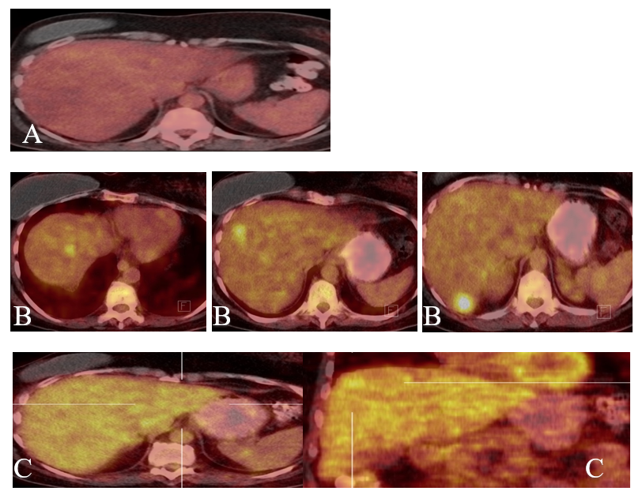
Figure 1: PET-CT images of the liver throughout the clinical course. (A: At initial diagnosis; B: At the time of first metastasis; C: After platinum doublet therapy).
In December 2021, disease progression in the liver was detected once again (SUVmax: 5.1); however, a biopsy could not be performed due to the small size of the lesions, and the patient's treatment was switched to ribociclib plus fulvestrant. In 2022, a hereditary cancer panel was analyzed, revealing no pathogenic genomic mutations in BRCA1/2 or other high-penetrance hereditary cancer genes. Following a PFS of 22 months on the ribociclib and fulvestrant regimen, recurrent progression in the liver was observed in September 2023. A fine-needle aspiration (FNA) biopsy targeting the involved left supraclavicular lymph node (SUVmax: 2.3) confirmed breast carcinoma metastasis. Receptor status could not be optimally evaluated from the FNA sample and was reported as entirely negative. Consequently, therapy was switched to everolimus plus exemestane; however, this regimen was poorly tolerated and had to be discontinued due to severe adverse events, including grade 4 mucositis and stomatitis. Upon further hepatic progression in December 2023, a core needle (tru-cut) biopsy of the liver was successfully performed. The histopathological evaluation of this biopsy demonstrated estrogen receptor (ER) 20% positive, progesterone receptor (PR) 0% positive, HER2-negative, and a Ki-67 proliferation index of 20% furthermore, a liquid biopsy using next-generation sequencing (NGS) was performed, which revealed no mutations in the BRCA1/2, PIK3CA, ESR1, or AKT1 genes. The Genomic Instability Score (GIS) was 16, and the homologous recombination deficiency (HRD) status was reported as negative. Notably, however, a p.T519M variant in exon 14 of the CHEK2 gene was identified in this analysis. This molecular profiling was recently performed on an archival tissue specimen, as NGS was not routinely utilized in clinical practice at the time of the initial diagnosis. In March 2024, the patient was switched to single-agent carboplatin; however, progressive disease was observed again after 3 cycles. In July 2024, a PET-CT scan revealed new metastases in the T11 vertebra and right iliac bone (SUVmax: 3.4 and 10.4, respectively) in addition to the liver (SUVmax: 7.5). This was evaluated as progressive disease, and a regimen of carboplatin + gemcitabine + letrozole + zoledronic acid (4 mg once every 28 days) was initiated, which the patient received for 16 cycles. In March 2025, SBRT was administered for the bone metastases. In October 2025, a repeat tru-cut biopsy of the liver was performed, confirming breast carcinoma metastasis with a hormone profile similar to the primary tumor. A Next-Generation Sequencing (NGS) panel analyzed from this newly acquired tissue revealed no mutations in homologous recombination genes or other genes. Due to observed clinical progression and a significant elevation in tumor markers (CA 15-3 increased from 24 to 875), the treatment was switched to cisplatin + gemcitabine in October 2025. Following the first administration, the patient presented to the emergency department with complaints of anemia, fatigue, and abdominal pain. Upon detecting widespread abdominal ascites and a portal vein thrombus, the patient was admitted to our inpatient clinic. We performed a therapeutic and diagnostic paracentesis with albumin replacement, draining 5 liters of fluid. Cytology was benign, and the ascites demonstrated portal characteristics. In November 2025, immunohistochemistry (IHC) testing was negative for both HER2 and HER2-low, and PD-L1 was reported as CPS=0.
Discussion
In this case report, our patient developed secondary endocrine therapy (ET) resistance in HR(+)/HER2- breast cancer, progressing to metastatic disease within 5 years. The patient's rapid clinical course and short intervals between transitions to new treatment lines indicate an aggressive tumor biology. The absence of mutations in key genes and pathways typically associated with the development of endocrine resistance—such as PIK3CA, ESR1, PTEN, and AKT1—suggests that the rapid progression and multi-line treatment failure in this case were driven by a mechanism outside the standard pathways. Another known cause of endocrine resistance is a defect in homologous recombination repair genes (HRD). In our case, detailed genomic analysis of a liquid biopsy obtained from blood during the development of metastasis revealed a CHEK2 mutation, which involves one of the HRD genes. Platinum sensitivity is well-documented in the presence of this gene. Indeed, the dramatic platinum response observed in our patient, despite prior resistance to three lines of chemotherapy and endocrine therapy, reflects this phenomenon. However, in the next-generation sequencing (NGS) analysis of the biopsy obtained during subsequent progression, no gene defects were observed in the HRD pathway, which correlated with a concomitant decline in platinum sensitivity. Although the development of breast cancer is predominantly sporadic, it can also develop hereditarily as a result of mutations in genes implicated in this disease, such as BRCA1, BRCA2, TP53, and CHEK2. DNA repair genes exhibit a high degree of genomic instability in breast cancer and are associated with the deletion/insertion of chromosome segments, chromosomal abnormalities, and the induction of proliferation. These DNA alterations are a function of modifications in the molecular pathways that regulate cell proliferation, differentiation, apoptosis, and DNA repair [6]. The CHEK2 1100delC mutation, the earliest identified mutation known to double breast cancer risk, is associated with early-age diagnosis and a poor clinical prognosis. Additionally, it has a known association with colorectal and prostate cancers [3]. While the CHEK2 variant identified in our patient is categorized as a variant of uncertain significance (VUS), the aggregation of cancers in first-degree relatives (father with prostate cancer, sibling with breast cancer) highlights its potential pathogenicity. Although the lack of familial genetic screening and segregation analysis presents a limitation, it is highly probable that this somatically detected variant, in this context, is pathogenic for our patient. Rare variants, including missense variants and small in-frame deletions, constitute approximately 50% of the CHEK2 variants detected through panel testing [7]. In 2022, a European group utilized a mouse embryonic stem cell-based system to quantitatively determine the functional impact of 50 missense VUS (variants of uncertain significance) in human CHEK2 cells and their association with breast and prostate cancer. A correlation was demonstrated between loss of function and breast cancer risk, suggesting that such assays could serve as valuable tools to assist in clinical management [8]. A review of the literature indicates that CHEK2 or TP53 mutations are associated with resistance to anthracycline-based chemotherapy in patients with breast cancer [9]. However, a study conducted in China identified the CHEK2 H371Y mutation in 41 out of 2,382 patients who underwent mastectomy and demonstrated that these patients might respond more favorably to anthracycline-based neoadjuvant chemotherapy (p=0.031) [10]. In our case, the observed resistance to anthracyclines, paclitaxel, capecitabine, and endocrine therapy—the cornerstones of breast cancer treatment—may be associated with the CHEK2 mutation. Indeed, it is well-established that in the presence of BRCA mutations, the primary HRD genes, the response to taxane therapy is low [11-13], while the response to platinum-based therapy is superior [12,14-16]. The dramatic response to platinum-based chemotherapy following these treatments suggests that the CHEK2 mutation in our patient is likely a pathogenic mutation rather than a VUS. In our case, an asymptomatic patient followed up for HR+/HER2- breast cancer under ET presented with visceral metastasis five years post-diagnosis and subsequently underwent multiple lines of chemotherapy. The absence of mutations in genes well-established in ET resistance—such as ESR1, AKT, and PIK3CA—in the NGS analysis of metastatic liver tissue suggests that the rapid progression and multi-line treatment failure were driven by mechanisms beyond conventional pathways. Upon progression at the 22nd month, a repeat liver biopsy revealed a decrease in hormone receptor expression. Subsequent Liquid DNA based NGS identified the CHEK2 p.T519M variant (VAF 2.89%), which has not been previously reported in the literature, as a pathogenic HRR mutation. Considering the interaction of CHEK2 with cell cycle checkpoints and estrogen receptor (ER) signaling pathways, we hypothesize that this unique variant may be a primary driver of secondary ET resistance. Furthermore, given the critical role of CHEK2 in DNA double-strand break repair (HRR), we propose that the resulting repair defect accounts for the patient's platinum sensitivity. This is clinically supported by the dramatic 9-year PFS observed with platinum-based therapy. Moreover, following rapid progression on sequential everolimus plus exemestane, the initiation of carboplatin led to a significant regression in tumor markers and a marked reduction in pathological SUVmax uptake in liver lesions, further confirming the platinum-sensitive phenotype associated with this CHEK2 variant.
Funding Declaration
The authors declare that no funds, grants, or other support were received during the preparation of this manuscript.
Note
During the preparation of this work, the authors used AI-based language tools to improve readability. The content was subsequently reviewed and edited by the authors, who take full responsibility for the final manuscript
Consent to Publish
Informed consent was obtained from the patient for the publication of this case report and any accompanying images.
Conflict of Interest
The authors declare that they have no conflict of interest.
Ethics Statement
Institutional Review Board (IRB) approval is not required for single case reports at our institution. This study was conducted in accordance with the Declaration of Helsinki. Written informed consent was obtained from the patient for the publication of this case report and any accompanying data.
References
- Sung H, Ferlay J, Siegel RL, et al. Global Cancer Statistics 2020: GLOBOCAN Estimates of Incidence and Mortality Worldwide for 36 Cancers in 185 Countries. CA Cancer J Clin 71 (2021): 209-249.
- Sledge GW, Jr Toi M, Neven P, et al. The Effect of Abemaciclib Plus Fulvestrant on Overall Survival in Hormone Receptor-Positive, ERBB2-Negative Breast Cancer That Progressed on Endocrine Therapy-MONARCH 2: A Randomized Clinical Trial. JAMA Oncol 6 (2020): 116-124.
- Apostolou P, Papasotiriou I. Current perspectives on CHEK2 mutations in breast cancer. Breast Cancer (Dove Med Press) 9 (2017): 331-335.
- Lord CJ, Ashworth A. The DNA damage response and cancer therapy. Nature 481 (2012): 287-294.
- Telli ML, Timms KM, Reid J, et al. Homologous Recombination Deficiency (HRD) Score Predicts Response to Platinum-Containing Neoadjuvant Chemotherapy in Patients with Triple-Negative Breast Cancer. Clin Cancer Res 22 (2016): 3764-3773
- Ansari N, Shahrabi S, Khosravi A, et al. Prognostic Significance of CHEK2 Mutation in Progression of Breast Cancer. Laboratory Medicine 50 (2019): e36-e41.
- Stern RH. Correspondence on "Management of individuals with germline pathogenic/likely pathogenic variants in CHEK2: A clinical practice resource of the American College of Medical Genetics and Genomics (ACMG)" by Hanson et al. Genet Med 26 (2024): 101031.
- Boonen R, Wiegant WW, Celosse N, et al. Functional Analysis Identifies Damaging CHEK2 Missense Variants Associated with Increased Cancer Risk. Cancer Res 82 (2022): 615-631.
- Knappskog S, Chrisanthar R, Løkkevik E, et al. Low expression levels of ATM may substitute for CHEK2 /TP53 mutations predicting resistance towards anthracycline and mitomycin chemotherapy in breast cancer. Breast Cancer Res 14 (2012): R47.
- Liu Y, Xu Y, Ouyang T, et al. Association between CHEK2 H371Y mutation and response to neoadjuvant chemotherapy in women with breast cancer. BMC Cancer 15 (2015): 194.
- Discussion on the use of taxanes for treatment of breast cancers in BRCA1 mutations carriers. Hered Cancer Clin Pract 5 (2007): 119-43.
- Byrski T, Gronwald J, Huzarski T, et al. Pathologic complete response rates in young women with BRCA1-positive breast cancers after neoadjuvant chemotherapy. J Clin Oncol 28 (2010): 375-379.
- Kriege M, Jager A, Hooning MJ, et al. The efficacy of taxane chemotherapy for metastatic breast cancer in BRCA1 and BRCA2 mutation carriers. Cancer 118 (2012): 899-907.
- Mori H, Kubo M, Nishimura R, et al. BRCAness as a Biomarker for Predicting Prognosis and Response to Anthracycline-Based Adjuvant Chemotherapy for Patients with Triple-Negative Breast Cancer. PLoS One 11 (2016): e0167016.
- Robson M. Selecting patients with triple negative breast cancer for platinum-based therapy: we still haven’t found what we’re looking for. Annals of Oncology 29 (2018): 1609-1610.
- Mavaddat N, Barrowdale D, Andrulis IL, et al. Pathology of breast and ovarian cancers among BRCA1 and BRCA2 mutation carriers: results from the Consortium of Investigators of Modifiers of BRCA1/2 (CIMBA). Cancer Epidemiol Biomarkers Prev 21 (2012): 134-147.