Scotton Massimiliano1*, Milella Maria Serena2, Barbagallo Maria Chiara2, Rapacioli Silvia2
1SSI Pharma s.r.l., Via Colomba 71, 36061, Bassano Del Grappa, Vicenza (VI), Italy
2Bict Srl, 26818 Villanova del Sillaro (LO), Italy
*Corresponding Author: Scotton Massimiliano, SSI Pharma s.r.l., Via Colomba 71, 36061, Bassano Del Grappa, Vicenza (VI), Italy
Received: 11 September 2026; Accepted: 18 September 2026; Published: 30 September 2026
DOI: 10.26502/jfsnr.2642-110000201
ShareGastrointestinal symptoms may result from overlapping disturbances in nutrient digestion, intestinal epithelial barrier integrity, and mucosal inflammatory signalling. Loss of epithelial integrity increases the passage of luminal molecules across the intestinal barrier, a condition commonly described as increased intestinal permeability or “leaky gut” and may coexist with epithelial inflammatory activation. Against this background, the present in vitro study evaluated Lactobromin®, a formulation combining lactase, which supports lactose digestion, and bromelain, a proteolytic enzyme mixture with reported intestinal biological activity.
Lactobromin® was evaluated alongside matched amounts of the individual enzyme preparations in two complementary Caco-2 models. SDS-induced epithelial damage was assessed by measuring apical-tobasolateral Lucifer Yellow passage, while TNF-α-induced IL-8 secretion was used to evaluate the effect of intestinally digested products on the inflammatory response.
Lactobromin® attenuated SDS-induced Lucifer Yellow passage under both single- and double-administration regimens, with concentrationrelated reductions. At 2.2 mg/mL, tracer passage was reduced by 81.1% and 51.7%, respectively, relative to SDS-treated controls. At several matched enzyme amounts, Lactobromin® produced lower mean tracer passage than either enzyme alone. Following simplified intestinal digestion, Lactobromin® at 2.2 mg/mL reduced TNF-α-induced IL-8 secretion by approximately 32% under the single-administration condition. Under the double-administration condition, IL-8 secretion was reduced by lactase at 0.090 mg/mL, whereas bromelain and Lactobromin® did not differ from the TNF-α control.
These findings provide an initial characterisation of Lactobromin® across complementary models of epithelial hyperpermeability and inflammatory activation, supporting the biological activity of the complete formulation and its potential relevance to conditions characterised by altered epithelial homeostasis
Bromelain; Lactase; Caco-2 cells; Intestinal permeability; Epithelial barrier; Inflammation
Bromelain articles; Lactase articles; Caco-2 cells articles; Intestinal permeability articles; Epithelial barrier articles; Inflammation articles
1. Introduction
Gastrointestinal symptoms can arise from different, and sometimes overlapping, alterations in nutrient digestion, epithelial barrier integrity, and mucosal inflammatory signalling. Lactose intolerance is a common example of digestive insufficiency, in which reduced intestinal lactase activity leads to lactose malabsorption and the development of symptoms following lactose ingestion [1]. Other gastrointestinal conditions involve more complex alterations of the intestinal environment. Crohn’s disease and celiac disease are characterized by chronic inflammatory or immune-mediated injury to the intestinal mucosa [2-4], while increased epithelial permeability has been documented in specific subgroups of patients with irritable bowel syndrome (IBS) [5,6]. These mechanisms are not mutually exclusive. Lactase expression at the apical brush border of mature enterocytes is markedly reduced in active celiac disease, illustrating how mucosal injury may contribute to a digestive deficit within an already compromised intestinal environment [7]. This intersection provides a rationale for approaches addressing both digestive function and epithelial homeostasis.
Lactase-phlorizin hydrolase is the brush-border β-galactosidase responsible for hydrolysing lactose into the absorbable monosaccharides glucose and galactose. Supplementation with exogenous lactase compensates for insufficient endogenous enzyme activity and can improve the digestion and tolerance of lactose-containing foods [1]. This benefit has been demonstrated using different modes of administration. Kluyveromyces lactis β-galactosidase added to milk reduced hydrogen excretion and gastrointestinal symptoms in individuals with lactose malabsorption and intolerance [8], while direct administration of lactase tablets produced comparable improvements in a randomized, double-blind crossover trial [9]. Although the digestive function of lactase is well established, its potential influence on intestinal epithelial barrier function and inflammatory responses, either alone or as part of a combined enzyme formulation, has received comparatively limited attention.
Bromelain is a pineapple-derived mixture of proteolytic enzymes that remains enzymatically active within the gastrointestinal tract when administered under appropriate formulation conditions [10]. It has been demonstrated that proteolytically active bromelain reduced the release of selected pro-inflammatory cytokines and chemokines from colonic biopsies obtained from patients with Crohn’s disease and ulcerative colitis [11]. In experimental colitis and Caco-2 models, purified fruit bromelain attenuated inflammatory signalling and counteracted epithelial barrier dysfunction, with modulation of epithelial tumour necrosis factor receptor pathways implicated in these responses [12]. More recently, a randomized, triple-blind, placebo-controlled trial in patients with mild-to-moderate ulcerative colitis reported a greater reduction in clinical disease activity following bromelain supplementation than with placebo, although no between-group improvement in quality of life was observed [13]. Collectively, these findings indicate that bromelain can exert intestinal effects extending beyond its proteolytic function, although the available clinical evidence remains preliminary.
Combining lactase and bromelain may bring together their respective intestinal activities within a single formulation and provide a broader functional profile than either component considered individually. Direct evaluation of the complete formulation is therefore required to determine how the two enzymes behave when administered together. However, the activity of a complete formulation cannot be predicted solely from studies of its individual components, because enzyme proportions, formulation-related interactions, and gastrointestinal processing may affect the activity presented to the intestinal epithelium. Published evidence evaluating bromelain and lactase together in intestinal epithelial systems remains limited.
The present study therefore evaluated Lactobromin® [14], a formulation combining bromelain and lactase, in complementary human Caco-2 intestinal epithelial models. Differentiated Caco-2 monolayers were used to model increased epithelial permeability, a condition commonly described as “leaky gut”, by inducing barrier disruption with sodium dodecyl sulfate and measuring the apical-to-basolateral passage of Lucifer Yellow [15]. In parallel, TNF-α-stimulated Caco-2 cells provided a defined model of epithelial inflammatory activation in which extracellular IL-8 secretion was quantified [16]. The complete formulation was evaluated alongside matched amounts of the individual enzyme preparations after identifying concentration ranges that maintained cell metabolic activity.
To reflect the possibility of repeated daily use, both single- and double-administration schedules were investigated. By combining barrier-related and inflammatory endpoints with single and repeated exposure schedules, the study was designed to provide a characterization of the intestinal biological activity of the bromelain-lactase combination.
2. Materials and Methods
2.1 Preparation of Test Products
Lactobromin® in coated-tablet formulation was evaluated as the complete product, including its excipients and coating materials. Each tablet had a total mass of 550 mg and contained 100 mg of bromelain with a declared activity of 2500 gelatin-digesting units per gram (GDU/g), corresponding to 250 GDU per tablet, and 22.5 mg of lactase with a declared activity of 200,000 acid lactase units per gram (ALU/g), corresponding to 4500 ALU per tablet.
The bromelain preparation was a water-extracted powder derived from the stem of Ananas comosus, supplied by Amita Health Care Italia S.r.l. (Solaro, Milan, Italy; product code MPPATT0076), and contained maltodextrin as a carrier. Its declared proteolytic activity was not less than 2500 GDU/g. The lactase preparation, supplied by NUTRAS S.r.l., was a β-galactosidase derived from Aspergillus oryzae, with a declared activity of not less than 200,000 ALU/g and a batch-specific activity of 213,632 ALU/g.
For preparation of the Lactobromin® stock, tablets were ground to a powder and dispersed in cell culture medium at a total product concentration of 4.4 mg/mL. Bromelain and lactase were prepared separately in the same medium at 0.8 and 0.18 mg/mL, respectively, corresponding to the amounts present in the complete formulation stock. All preparations were passed through 0.22 µm polyethersulfone (PES) membrane filters to ensure sterility before cell exposure. Twofold dilution series (1:2) were subsequently prepared to obtain the three final concentrations used in the functional experiments (Table 1). The Lactobromin® concentrations tested were selected to reflect the estimated product concentration in contact with the intestinal epithelium, based on the recommended dosage of the product. Test samples were freshly prepared for each experiment.
|
Test product |
High concentration (mg/mL) |
Intermediate concentration (mg/mL) |
Low concentration (mg/mL) |
|
Bromelain |
0.4 |
0.2 |
0.1 |
|
Lactase |
0.090 |
0.045 |
0.022 |
|
Lactobromin® (complete formulation) |
2.2 |
1.1 |
0.55 |
Table 1: Final concentrations of Lactobromin® and the corresponding individual enzymes used in the intestinal barrier and epithelial inflammatory response experiments. Bromelain and lactase were tested at concentrations equivalent to their respective amounts in the complete formulation.
For experiments assessing TNF-α-induced IL-8 secretion, all samples were subjected to the in vitro intestinal digestion simulation, described in Section 2.3 and subsequently diluted to the final concentrations reported in Table 1.
2.2 Cell Culture
The project was conducted on human Caco-2 intestinal epithelial cells, isolated from colon tissue derived from a patient with colorectal adenocarcinoma. Caco-2 cells were obtained from IZS Lombardia ed Emilia Romagna (BS TCL 87, batch 18). Cells were cultured in minimum essential medium (MEM) supplemented with 10% fetal bovine serum, 1% L-glutamine, and 1% penicillin-streptomycin and maintained at 37 °C in a humidified atmosphere containing 5% CO₂.
2.3 In Vitro Simulation of Intestinal Digestion
A 50-fold concentrated stock solution of each test product was subjected to a simplified in vitro intestinal digestion procedure in a solution containing 10 mg/mL pancreatin and 0.05 M potassium dihydrogen phosphate (KH₂PO₄) at pH 7.5. Samples were incubated for 2 h at 37 °C under agitation and subsequently diluted to the final concentrations reported in Table 1.
2.4 Cell Metabolic Activity (MTT) Assay
Caco-2 cells were seeded in 96-well plates at a density of 1.0 × 10⁴ cells per well and allowed to attach for at least 24 h. Cell metabolic activity was evaluated under single- and double-administration conditions using serial twofold dilutions of bromelain, lactase, and Lactobromin®, starting from concentrations of 0.8, 0.18, and 4.4 mg/mL, respectively. Under the single-administration condition, cells received one treatment and were exposed to the test products for approximately 24 h. Under the double-administration condition, the first treatment was followed after 8 h by complete replacement of the culture medium with fresh medium containing newly prepared products at the same concentrations. Cells were then maintained until 24 h after the first administration. At the end of the treatment period, the culture medium was removed and MTT was added at a final concentration of 0.5 mg/mL. After 2 h of incubation, the resulting formazan crystals were solubilized in isopropanol and absorbance was measured at 595 nm using an Infinite M Nano+ plate reader (Tecan). Results were expressed as a percentage of the corresponding untreated control.
2.5 Evaluation of the Epithelial Inflammatory Response
Caco-2 cells were seeded in 48-well plates at a density of 3.0 × 10⁴ cells per well. To induce IL-8 secretion, cells were stimulated with TNF-α at 200 ng/mL and simultaneously treated with intestinally digested bromelain, lactase, or Lactobromin® at the final concentrations reported in Table 1. TNF-α-induced IL-8 secretion was evaluated under single- and double-administration conditions. Under the single-administration condition, cells received one treatment and were maintained for 24 h. Under the double-administration condition, 8 h after the initial treatment, the culture medium was completely replaced with fresh medium containing newly prepared and intestinally digested test products at the same concentrations, together with TNF-α at 200 ng/mL. Cells were then maintained until 24 h after the first administration. Untreated cells and cells stimulated with TNF-α alone were included as basal and inflammatory controls, respectively.
At the end of the treatment period, culture supernatants were collected, and IL-8 concentrations were quantified using the Human IL-8 Uncoated ELISA Kit (catalogue no. 88-8086; Thermo Fisher Scientific). IL-8 concentrations were expressed as pg/mL.
2.6 Evaluation of Intestinal Barrier Integrity Restoration
Caco-2 cells were seeded at a density of 3.5 × 10⁴ cells per insert in 24-well Transwell inserts with a pore size of 0.4 µm (Sarstedt) and maintained for 21 days to allow the formation of differentiated epithelial monolayers. The culture medium was replaced with fresh medium every 48 h. Differentiated Caco-2 monolayers were pretreated with bromelain, lactase, or Lactobromin® at the concentrations reported in Table 1. As previously described, the treatment was performed using the single- and double-administration pretreatment regimens. Following 24 h of product treatment, the medium was replaced with fresh medium containing the same product concentration, 180 µM SDS, to induce barrier integrity damage, and 4.5 µM Lucifer Yellow, in order to analyse barrier integrity. Untreated monolayers and SDS-exposed monolayers were included as intact-barrier and damaged-barrier controls, respectively. Lucifer Yellow was added to the apical compartment, and its passage into the basolateral compartment was quantified at the respective endpoints using an Infinite M Nano+ plate reader (Tecan) at excitation and emission wavelengths of 428 and 540 nm, respectively. Fluorescence was expressed as fold change relative to the untreated control.
2.7 Statistical Analysis
Data are presented as mean ± standard deviation (SD) of three technical replicates within each assay. Statistical analyses were performed using GraphPad Prism (GraphPad Software). Differences among experimental groups were analysed using one-way analysis of variance (ANOVA), followed by Dunnett’s multiple-comparisons test. Treatment groups were compared with the untreated control in the metabolic activity assay, the TNF-α-stimulated control in the IL-8 assay, and the SDS-exposed control in the intestinal permeability assay. A p-value < 0.05 was considered statistically significant. Consistent with the exploratory design of the study, statistical comparisons were interpreted alongside effect magnitude and concentration-related patterns.
3 Results
3.1 Selection of Metabolically Compatible Test Concentrations
Cell metabolic activity following exposure to bromelain, lactase, and Lactobromin® was evaluated in Caco-2 cells under single- and double-administration conditions (Figure 1). Results showed that bromelain and Lactobromin® maintained metabolic activity close to the untreated control levels in all tested doses and under both administration schedules. Lactase produced a modest decrease in MTT reduction at the highest concentrations, which was more apparent under the double-administration condition.
On the basis of these findings, bromelain concentrations of 0.4-0.1 mg/mL, lactase concentrations of 0.090-0.022 mg/mL, and Lactobromin® concentrations of 2.2-0.55 mg/mL were selected for the subsequent functional assays. All selected concentrations maintained MTT reduction comparable to untreated control (CTR) under the experimental conditions used.
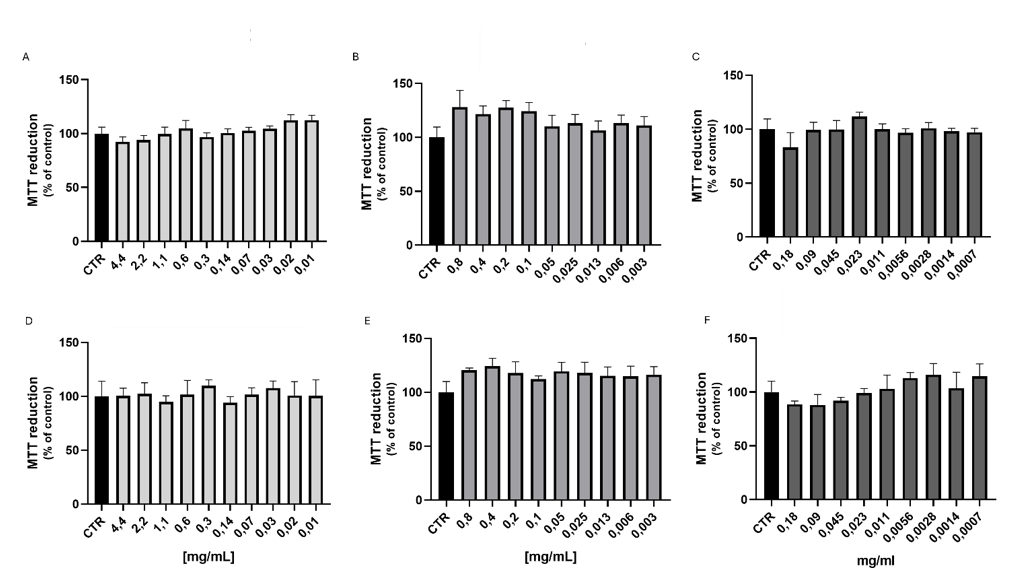
Figure 1: Cell metabolic activity following exposure to bromelain, lactase, and Lactobromin®. Caco-2 cells were exposed to serial twofold dilutions of the test products under single-administration (A-C) or double-administration (D-F) conditions. Panels show Lactobromin® (A, D), bromelain (B, E), and lactase (C, F). MTT reduction was measured at the end of the 24 h treatment period and expressed as a percentage of the corresponding untreated control, set to 100%. Data are presented as mean ± SD of three technical replicates.
3.2 Lactobromin® Modulates the Epithelial Inflammatory Response
The intestinal inflammatory model was established by treating Caco-2 cells with TNF-α, and the inflammatory response was evaluated by measuring IL-8 secretion relative to unstimulated Caco-2 cells. TNF-α-stimulated cells were treated with the test products, following simulated in vitro intestinal digestion. Results (Figure 2) showed distinct anti-inflammatory response patterns under the two administration schedules.
Under the single-administration condition, bromelain produced a concentration-related reduction in IL-8 secretion, with statistical differences from the TNF-α control at 0.4 and 0.2 mg/mL. Lactobromin® showed a similar concentration-related pattern and reduced significantly the intestinal inflammation at a concentration of 2.2 mg/mL, where IL-8 secretion was approximately 32% lower compared to TNF-α condition. Lactase produced a smaller response and did not differ statistically from the TNF-α control at the concentrations tested.
Under the double-administration condition, lactase at 0.090 mg/mL reduced IL-8 secretion relative to the corresponding TNF-α control, whereas bromelain and Lactobromin® did not show statistical differences. Each administration schedule was interpreted relative to its own experimental control, without direct comparison of response magnitude between the two schedules.
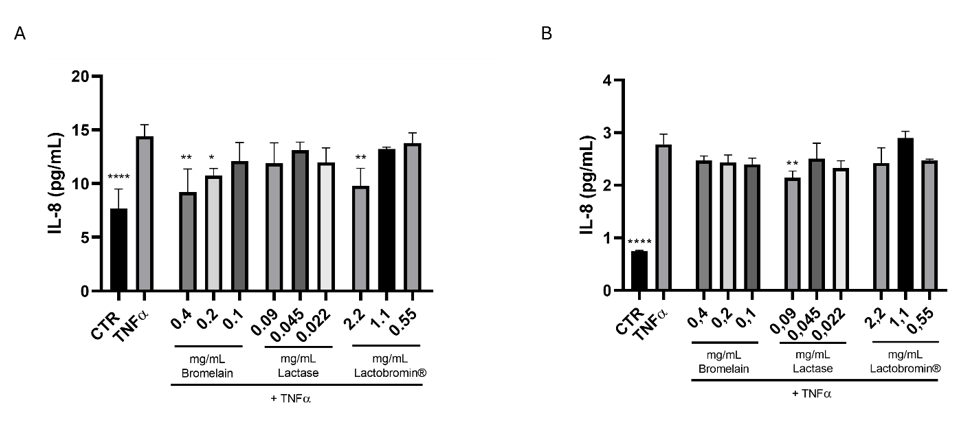
Figure 2: Effects of intestinally digested bromelain, lactase, and Lactobromin® on TNF-α-induced IL-8 secretion by Caco-2 cells. Cells were stimulated with TNF-α and treated with the digested test products under single-administration (A) or double-administration (B) conditions. Culture supernatants were collected at the 24 h endpoint, and IL-8 concentrations were quantified by ELISA. Untreated cells and cells stimulated with TNF-α alone served as basal and inflammatory controls, respectively. Data are presented as mean ± SD of three technical replicates. Statistical comparisons were performed separately for each panel using one-way ANOVA followed by Dunnett’s multiple-comparisons test versus the corresponding TNF-α-stimulated control. *p < 0.05, **p < 0.01, ***p < 0.001, and ****p < 0.0001.
3.3 Lactobromin® Reduced Intestinal Barrier Leakage
The leaky gut model was established by incubating differentiated Caco-2 monolayers with SDS, which disrupts epithelial barrier integrity and consequently increases intestinal permeability. Successful induction of barrier impairment was confirmed by the increased passage of Lucifer Yellow compared with the untreated control, demonstrating the suitability of the model for evaluating the ability of the test products to restore intestinal barrier integrity (Figure 3).
Under the single-administration regimen, Lactobromin® produced a concentration-related reduction in SDS-induced monolayer permeability, with statistical differences from the SDS control at all three concentrations tested. At 2.2 mg/mL, Lactobromin® reduced tracer passage by 81.1% relative to the SDS-treated control. Bromelain also reduced in a dose-dependent manner the monolayer permeability, with differences detected at 0.4 and 0.2 mg/mL. Lactase produced a smaller response that did not differ statistically from the SDS control. At the highest concentrations, Lactobromin® and bromelain reduced monolayer permeability to levels comparable to those of the untreated control.
Under the double-administration regimen, Lactobromin® reduced Lucifer Yellow passage, with statistical differences at the two highest concentrations, resulting in a reduction of leaky gut condition of 51.7% at 2.2 mg/mL and 49.8% at 1.1 mg/mL concentration. Bromelain and lactase produced significant reductions at selected concentrations.
Within each administration regimen, Lactobromin® showed a dose-related reduction in intestinal epithelial leakage across the tested concentrations. Moreover, at selected concentrations, the complete formulation showed higher efficacy than the individual enzymes, suggesting a beneficial effect of their combination and highlighting the potential of Lactobromin® to promote the restoration of intestinal barrier integrity following stress-induced epithelial damage.
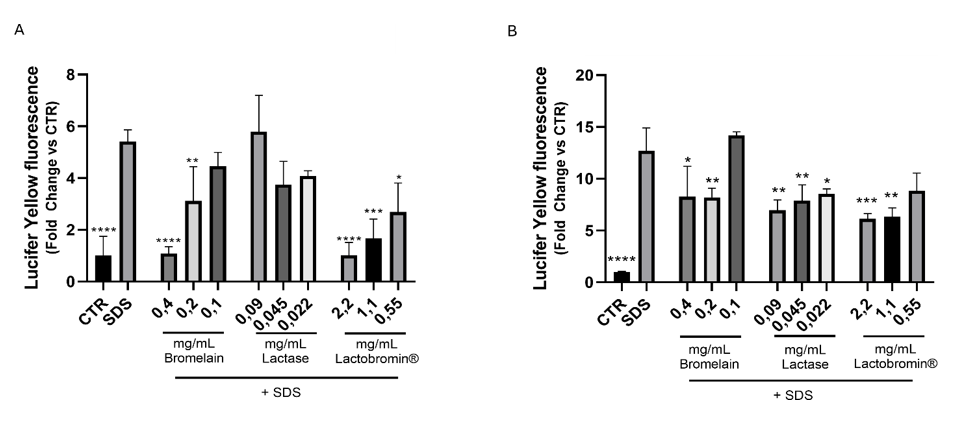
Figure 3: Effects of bromelain, lactase, and Lactobromin® on SDS-induced Lucifer Yellow permeability across differentiated Caco-2 monolayers. Monolayers underwent a single-administration regimen (A) or a double-administration regimen (B) followed by SDS/Lucifer Yellow exposure. Test products were present during the SDS challenge, and Lucifer Yellow was added to the apical compartment. Basolateral fluorescence was expressed as fold change relative to the untreated control. Data are presented as mean ± SD of three technical replicates. Statistical comparisons were performed separately for each panel using one-way ANOVA followed by Dunnett’s multiple-comparisons test versus the corresponding SDS-exposed control. *p < 0.05, **p < 0.01, ***p < 0.001, and ****p < 0.0001.
4. Discussion
The present study was designed to characterize the biological activity of Lactobromin® as a complete formulation, with the aim of evaluating its potential beneficial effects against key alterations associated with pathological conditions affecting the intestinal compartment. In addition, the study investigated whether the combined formulation could provide enhanced biological activity compared with the individual enzyme preparations, thereby assessing the potential added value of their combination. To address this objective, the beneficial effects of Lactobromin® were investigated in the context of intestinal inflammation and epithelial barrier dysfunction, two key features commonly associated with intestinal disorders. Specifically, the anti-inflammatory activity of the formulation was evaluated together with its ability to restore intestinal barrier integrity in an in vitro model of leaky gut.
Within this experimental framework, Lactobromin® showed clear beneficial effects across both investigated models. The complete formulation effectively reduced SDS-induced permeability, supporting its ability to restore intestinal epithelial barrier integrity under damage-induced conditions. In parallel, Lactobromin® at 2.2 mg/mL significantly modulated TNF-α-induced IL-8 secretion, demonstrating relevant anti-inflammatory activity. Overall, these findings provide consistent evidence of the beneficial effects of Lactobromin® on two key features associated with intestinal disorders and support the potential of the combined formulation as a multifunctional approach to promote intestinal homeostasis.
In detail, Lactobromin® induced a concentration-dependent reduction in SDS-induced intestinal permeability following both single and repeated administration. At 2.2 mg/mL, Lucifer Yellow passage was reduced by 81.1% relative to the corresponding SDS-treated controls, reaching values comparable to untreated control.
Bromelain alone also reduced tracer passage, in agreement with previous evidence showing that purified fruit bromelain can counteract epithelial barrier dysfunction and modulate TNF receptor-associated signalling [12], whereas lactase showed a less consistent response. Notably, at several matched enzyme concentrations, Lactobromin® resulted in lower mean tracer passage than either enzyme tested individually, suggesting that, under specific conditions, the complete formulation may provide greater barrier-restoring efficacy than its individual components.
The IL-8 assay provided complementary evidence of the activity of Lactobromin® on intestinal inflammatory responses, with the effects observed under the single-administration condition. Following the applied simplified intestinal digestion procedure, bromelain reduced TNF-α-induced IL-8 secretion at 0.4 and 0.2 mg/mL, while Lactobromin® showed a concentration-dependent response, reaching an approximately 32% IL-8 reduction at 2.2 mg/mL. These findings are consistent with previous experimental and ex vivo evidence describing the ability of bromelain to modulate intestinal inflammatory signalling and inflammatory mediator release [11,12]. Importantly, the present results demonstrate that this anti-inflammatory activity is retained within the complete Lactobromin® formulation following intestinal digestion, supporting the biological efficacy of the enzyme combination rather than bromelain alone. This evidence is further supported by recent clinical findings reporting reduced ulcerative colitis disease activity following bromelain supplementation [13].
The rationale for Lactobromin® extends beyond the individual functions traditionally associated with lactase and bromelain, aiming to provide a combined approach to gastrointestinal function within a single formulation. While exogenous lactase is established for improving lactose digestion and tolerance to lactose-containing foods [1,8,9], and bromelain has been investigated for intestinal proteolytic, barrier-related, and inflammatory activities [10-13], the present findings indicate that Lactobromin® retains relevant epithelial activity as a complete product and, at selected concentrations, may provide greater barrier-restoring effects than the individual enzyme preparations. The observed effects may be relevant to gastrointestinal conditions characterized by the coexistence of digestive impairment and altered epithelial homeostasis. Increased epithelial permeability and mucosal inflammatory signalling have been described in inflammatory bowel disease, celiac disease, and selected IBS phenotypes [2-6], while mucosal injury in active celiac disease can reduce brush-border lactase expression [7]. Within the scope of the present Caco-2 models, the effects of Lactobromin® on both intestinal epithelium permeability and inflammation therefore support the biological relevance of the complete formulation in intestinal settings characterized by impaired barrier integrity and inflammatory responses.
5. Conclusions
Overall, Lactobromin® showed biological activity across two complementary hallmarks of altered intestinal epithelial homeostasis. The formulation produced a concentration-dependent reduction in SDS-induced intestinal epithelial permeability, with greater barrier-restoring activity than the individual enzymes at selected concentrations and reduced intestinal inflammation at a concentration of 2.2 mg/mL under the single-administration condition. Taken together, these findings support the added functional value of the bromelain-lactase combination and provide a rationale for further investigation of Lactobromin® in the context of intestinal epithelial dysfunction.
Acknowledgements:
This study was funded by SSI Pharma s.r.l.
Conflicts of Interest:
Author S.M. has been involved as CEO in Company SSI Pharma s.r.l.
References
- Misselwitz B, Butter M, Verbeke K, et al. Update on lactose malabsorption and intolerance: Pathogenesis diagnosis and clinical management. Gut 68 (2019): 2080-2091.
- Horowitz A, Chanez-Paredes S.D, Haest X, et al. Paracellular permeability and tight junction regulation in gut health and disease. Nat. Rev. Gastroenterol. Hepatol. 20 (2023): 417-432.
- Dolinger M, Torres J, Vermeire S. Crohn’s disease. Lancet 403 (2024): 1177-1191.
- Taraz T, Mahmoudi-Ghehsareh M, Asri N, et al. Overview of the compromised mucosal integrity in celiac disease. J. Mol. Histol. 55 (2024): 15-24.
- Hanning N, Edwinson A.L, Ceuleers H, et al. Intestinal barrier dysfunction in irritable bowel syndrome: A systematic review. Ther. Adv. Gastroenterol. 14 (2021): 1756284821993586.
- Barbaro M.R, Cremon C, Marasco G, et al. Molecular mechanisms underlying loss of vascular and epithelial integrity in irritable bowel syndrome. Gastroenterology 167 (2024): 1152-1166.
- Srinivasan U, Jones E, Weir D.G, et al. Lactase enzyme detected immunohistochemically is lost in active celiac disease but unaffected by oats challenge. Am. J. Gastroenterol. 94 (1999): 2936-2941.
- Montalto M, Nucera G, Santoro L, et al. Effect of exogenous β-galactosidase in patients with lactose malabsorption and intolerance: A crossover double-blind placebo-controlled study. Eur. J. Clin. Nutr. 59 (2005): 489-493.
- Baijal R, Tandon R.K. Effect of lactase on symptoms and hydrogen breath levels in lactose intolerance: A crossover placebo-controlled study. JGH Open 5 (2021): 143-148.
- Hale L.P. Proteolytic activity and immunogenicity of oral bromelain within the gastrointestinal tract of mice. Int. Immunopharmacol. 4 (2004): 255-264.
- Onken J.E, Greer P.K, Calingaert B, et al. Bromelain treatment decreases secretion of pro-inflammatory cytokines and chemokines by colon biopsies in vitro. Clin. Immunol. 126 (2008): 345-352.
- Zhou Z, Wang L, Feng P, et al. Inhibition of epithelial TNF-α receptors by purified fruit bromelain ameliorates intestinal inflammation and barrier dysfunction in colitis. Front. Immunol. 8 (2017): 1468.
- Delgarm P, Mokhtare M, Ebrahimi Daryani N, et al. Effects of bromelain supplementation on disease activity and quality of life in patients with ulcerative colitis: A randomized triple-blind placebo-controlled study. Sci. Rep. 15 (2025): 42799.
- Patent number:102026000022642 A Composition for reducing the intestinal epithelium damage in subjects affected by leaky gut syndrome.
- Sambuy Y, De Angelis I, Ranaldi G, et al. The Caco-2 cell line as a model of the intestinal barrier: Influence of cell and culture-related factors on Caco-2 cell functional characteristics. Cell Biol. Toxicol. 21(2005): 1-26.
- Sonnier D.I, Bailey S.R, Schuster R.M, et al. TNF-α induces vectorial secretion of IL-8 in Caco-2 cells. J. Gastrointest. Surg. 14 (2010):1592-1599.