Serkan Burc Deser*, Mustafa Kemal Demirag
1Department of Cardiovascular Surgery, Medical School, University of Ondokuz Mayis, Samsun, Turkey
*Corresponding Author(s): Serkan Burc Deser, Department of Cardiovascular Surgery, Medical School, University of Ondokuz Mayis, Samsun, Turkey
Received: 10 October 2016; Accepted: 30 October 2016; Published: 1 November 2016
Coronary Artery
Coronary artery disease has been seen much encountered last decades. Despite advances in percutaneous coronary intervention, stent designs, balloon technology and adjunctive medical therapy, restenosis still occurs for long segment stenting of the coronary arteries [1].
A 60 year old male was presented with NYHA class II dyspnea and mild exertion occurring over the preceding week who had a history of percutaneous coronary intervention and stent placement 1 year ago. On admission his vital signs were in normal limits. Electrocardiography and troponin examination were unremarkable. The ejection fraction was revealed 45% by transthoracic echocardiography. Severe long segment stenosis was confirmed by coronary angiography on the Left Anterior Descending Artery (LAD). We decided to perform CABG surgery. Routine preparation for surgery was made and informed consent was taken. Under general anesthesia with cardiopulmonary bypass (CPB) long segment stent was extracted, 10 cm patchplasty and bypass was performed with saphenous vein graft (Figures 1A, 1B). True chronic occlusion is defined as the duration of the lesion more than 6 months and long segment occlusion is defined as more than 50 mm of the lesion [2].
Multiple stent placement for long segment lesions is associated with thrombosis and late restenosis. However, short segment stent placement reduces restenosis rate [3]. Excessive long segment stent placement, distal collateral circulation, degree of the stenosis, diabetes mellitus and plaque volume are the independent predictors. Long segment restenosis after 6 months is 56% [4,5]. Taking into account, placement of multiple and long segment stents may close the tributaries and restenosis rate correlated with the lenght of stent and the lesion. Optimal stent has not yet produced for long segments.
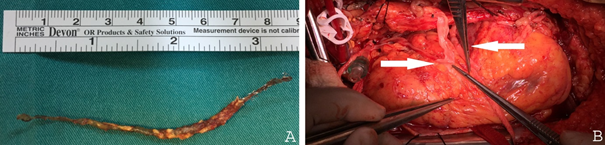
Figures 1: (A) External view of the extracted excessive long segment stent.
(B) Intraoperative image of the LAD patchplasty and bypass with saphenous vein graft showed by white arrow.
Conflicts of interest:
NoneFunding
The authors received no financial support for the research and/or authorship of this article.
References
- Stone GW, Moses JW, Ellis SG, Schofer J, Dawkins KD, et al. Safety and efficacy of sirolimus and paclitaxel-eluting coronary stents. N Engl J Med 356 (2007): 998-1008.
- Wei Liu, Xuming Yang, Pingshuan Dong, Zhijuan Li. Relationship between the total length of the stents and patients quality of life after percutaneous coronary intervention. Int J Clin Exp Med 8 (2015): 11435-11441.
- Campbell PT, Mahmud E, Marshall JJ. Interoperator and intraoperator (in)accuracy of stent selection based on visual estimation. Catheter Cardiovasc Interv 86 (2015): 1177-1183
- Rozenman Y, Mereuta A, Schechter D, et al. Long-term outcome of patients with very long stents for the treatment of diffuse coronary disease. Am Heart J 138 (1999): 441-445.
- Imad Sheiban, Claudio Moretti, Prathap Kumar, Andrea Gagnor, Filippo Leonardo, et al. Immediate and Medium-Term Outcomes Following the Treatment of Very Long (50 mm) Chronic Total Coronary Artery Occlusions. J Invasive Cardiol 16 (2004): 5-9.