Shiri Brook1, , Labib Mireb2,3, Ziv Neeman2,3, Gil Bar-Sela1,3*
1Cancer Center, Emek Medical Center, Afula, Israel
2Radiology department, Emek Medical Center, Afula, Israel
3Bruce Rappaport Faculty of Medicine, Technion-Israel Institute of Technology, Haifa, Israel
* Correspondingauthor: Gil Bar-Sela, Bruce Rappaport Faculty of Medicine, Technion-Israel Institute of Technology, Haifa, Israel.
Received: 29 June 2026; Accepted: 07 July 2026; Published: 09 September 2026
DOI: 10.26502/jbb.2642-91280225
ShareBackground: Hepatic Epithelioid Hemangioendothelioma (EHE) is an extremely rare vascular sarcoma. While complete surgical resection is the standard of care, patients frequently present with multifocal or bilobar disease that precludes surgical intervention. Systemic therapies often lack consistent efficacy and carry systemic toxicity. Selective Internal Radiation Therapy (SIRT) with Yttrium-90 microspheres is an established locoregional treatment for common hepatic malignancies, but its application in rare primary vascular tumors like EHE remains uncommon. Case Presentation: A 61-year-old man presented with progressive, bilobar hepatic lesions that were confirmed to be EHE via targeted biopsy. Due to the diffuse nature of the disease, surgical resection was deemed unfeasible. The patient was successfully treated with SIRT, he received Yttrium-90 therapy to the right hepatic lobe, followed by the left lobe. An 8-month follow-up PET-CT scan revealed a sustained response, characterized by a significant reduction in metabolic intensity and tumor size, alongside the complete disappearance of several lesions. The patient had no acute or delayed adverse events. Conclusion: This case demonstrates the long-term efficacy and safety of SIRT in managing unresectable, liver-limited EHE. Given its high target efficacy and low systemic toxicity, SIRT serves as a valuable treatment modality and should be considered for EHE and for other rare hepatic vascular malignancies.
Hepatic Epithelioid Hemangioendothelioma (EHE); Selective Internal Radiation Therapy (SIRT); vascular tumor; Yttrium-90 microspheres; radioembolization; TARE
Hepatic Epithelioid Hemangioendothelioma (EHE) articles; Selective Internal Radiation Therapy (SIRT) articles; vascular tumor articles; Yttrium-90 microspheres articles; radioembolization articles; TARE articles
Introduction:
Epithelioid hemangioendothelioma (EHE) is an extremely rare, low to intermediate grade malignant vascular sarcoma originating from vascular endothelial cells [1]. With an estimated incidence of approximately one in one million worldwide [2], EHE can manifest in various anatomic locations [3]. The clinical behaviour of hepatic EHE is unpredictable and can range from an asymptomatic condition discovered incidentally on imaging to a highly aggressive malignancy leading to rapid hepatic failure and extrahepatic metastasis [4,5]. Due to the exceptionally low incidence of this malignancy, standardized, evidence-based therapeutic guidelines are limited [6].
Complete surgical resection is the gold standard of care for localized hepatic EHE. However, many patients present with multifocal or bilobar disease, making surgery unfeasible [7]. In these unresectable cases, systemic therapies are usually utilized. Available options include conventional soft tissue sarcoma chemotherapy regiments, mTOR inhibitors like sirolimus, or VEGF inhibitors such as bevacizumab, administered either as monotherapy or in combination with nab-paclitaxel [3,8]. Nevertheless, objective response rates to these agents are highly variable and treatments can be associated with systemic adverse effects.
Selective Internal Radiation Therapy (SIRT), also known as transarterial radioembolization (TARE), is a targeted locoregional therapy that involves intra-arterial infusion of Yttrium-90 loaded microspheres to the hepatic artery [9].
While SIRT is a well established and efficacious treatment for hepatocellular carcinoma, cholangiocarcinoma and colorectal cancer liver metastases [12], literature regarding its utility in rare primary vascular tumors like EHE remains uncommon. we present a case of a 61-year-old man with multifocal hepatic EHE who achieved a significant radiological response following treatment with SIRT, underscoring the potential of radioembolization as a viable and effective alternative to traditional systemic therapy in selected patients.
Case Presentation
A 61-year-old married man, a father of eight and a retired farmer with a history of active smoking, hyperlipedimia, well-controlled diabetes mellitus and a prior cerebrovascular accident (CVA), presented with progressive hepatic lesions.
His notable medical history consists of a long-standing rheumatologic ocular disease which was managed with intravitreal bevacizumab injections and immunosuppressive therapy and recurrent tuberculosis (TB) infections. In 2022, while receiving immunosuppressive treatment, he was admitted to the neurology department presenting with acute left-sided hemiparesis. Brain imaging revealed intracranial tuberculomas, and workup confirmed miliary tuberculosis. He was initiated on an extended course of anti-TB treatment and has since remained under regular neurological surveillance.
During the initial staging and workup for miliary TB in 2022, a total-body CT scan incidentally revealed several nonspecific hepatic lesions. A biopsy of the liver performed at that time demonstrated only nonspecific inflammatory changes, and a conservative observational approach was adopted.
In May 2025, a routine follow-up total body CT scan demonstrated scattered hepatic lesions of varying sizes throughout both lobes of the liver, with some lesions appearing newly formed and others increased in size (Figure 1). The patient was completely asymptomatic at this time, with no abdominal pain and no liver enzymes or bilirubin elevation. Given the radiological progression, a repeat targeted liver biopsy was performed. Histopathological evaluation ruled out TB infection. Immunohistochemical staining revealed a malignant vascular tumor, Epithelioid Hemangioendothelioma (EHE).
Given the presence of numerous, bilobar liver lesions, surgical resection was deemed clinically unfeasible. Interventional radiology options, including thermal ablation and chemoembolization were considered. However, they were determined to be suboptimal due to the diffuse nature of the hepatic disease.
Therefore, when evaluating alternative locoregional modalities, Selective Internal Radiation Therapy (SIRT) utilizing Yttrium-90 microspheres was considered.
In July 2025, the patient underwent treatment with SIRT to the right hepatic lobe (Figure 2), which was tolerated well, without any acute or delayed adverse events. A follow-up CT scan in September 2025, showed stable disease (Figure 3).
PET scan in October 2025 demonstrated similar findings. However, one left lobe lesion was exhibiting increased FDG uptake (Figure 4). Based on these findings, a second dose of Yttrium-90 microspheres was administered to the left hepatic lobe in early December 2025.
In March 2026, a subsequent follow-up PET scan revealed an excellent therapeutic response (Figure 5). Compared to the pre-treatment baseline imaging, there was a significant reduction in both the metabolic intensity and the size of the hepatic tumors, with the complete disappearance of several lesions.
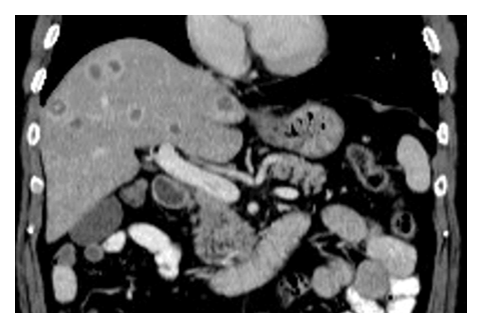
Figure 1: Baseline CT scan on May 25th, 2025, showing multiple bilobar rim-enhancing lesions in the liver representing multifocal malignancy sites.
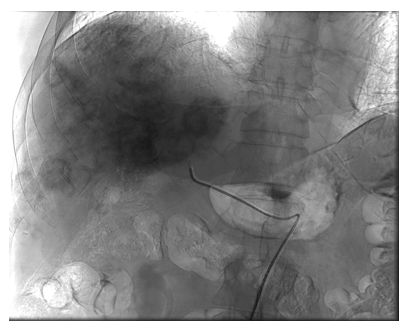
Figure 2: Radioembolization procedure performed on July 16th, 2025, with multiple vascular lesions seen during selective injection.
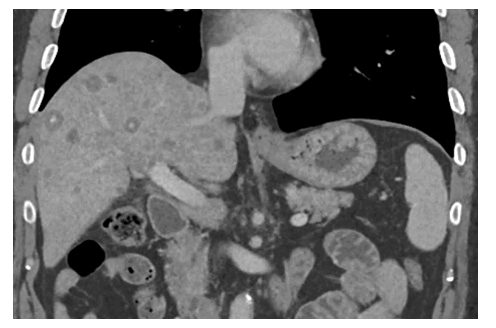
Figure 3: Follow up CT scan on September 28th, 2025, following first radioembolization intervention- showing multiple hepatic lesions that are stable in size with a decrease in rim- enhancement and development of central calcification in some lesions.
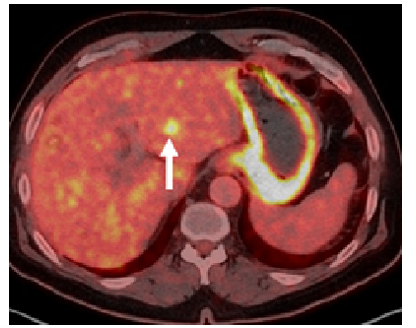
Figure 4: PET CT scan on October 28th, 2025, showing a left lobe lesion with marked FDG uptake.
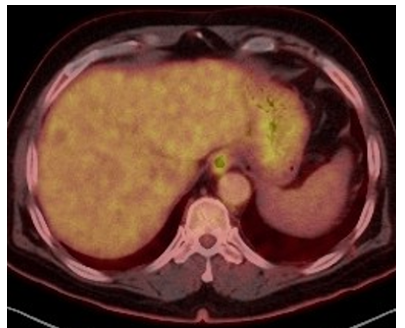
Figure 5: PET CT scan on March 3rd, 2026, demonstrating interval resolution in previously seen marked focal uptake in the left hepatic lobe post-second radioembolization intervention.
Discussion
The optimal management of hepatic epithelioid hemangioendothelioma remains uncertain due to its rarity and unpredictable clinical course [5,6]. While complete surgical resection or liver transplantation represent the primary curative options, most patients present with diffuse, multifocal, and bilobar intrahepatic lesions that preclude upfront surgery [7]. When surgical options are unfeasible, systemic treatments are considered. However, they often lack efficacy and carry toxicity profiles.
Selective Internal Radiation Therapy (SIRT) exploits the unique blood supply of the liver. Hepatic tumors derive most of their blood supply from the hepatic artery, while normal liver parenchyma is primarily supplied by the portal vein. By delivering Yttrium-90 microspheres via the hepatic artery, high doses of radiation are transferred directly to the microvasculature of the malignant lesions while preserving healthy liver tissue [10,11]. This method can be particularly beneficial in managing hypervascular malignancies.
SIRT is most employed in the treatment of hepatic malignancies such as hepatocellular carcinoma and colorectal metastases. However, its application in rare liver tumors is increasingly being explored. There are a few case reports documenting the use of SIRT in primary hepatic sarcomas including isolated cases of epithelioid hemangioendotheliomas [13,14]. In one report, Karaman et al. described a patient with unresectable multifocal liver hemangioendothelioma who was treated with SIRT and demonstrated no pathologic FDG uptake on PET scan 12 weeks following his second treatment [15]. Our case demonstrates the long-term efficacy of this treatment modality. Sustained metabolic improvement over an 8-month follow-up period following the initial SIRT was observed in our case. This prolonged response provides crucial evidence supporting the therapeutic benefits of radioembolization for unresectable EHE.
Despite its localized advantages, SIRT requires procedural planning to minimalize inherent risks. Unintended radiation leakage into adjacent visceral organs such as the stomach, pancreas, or lungs can precipitate severe complications. Furthermore, intrahepatic radiation poses a risk of hepatic complications, such as cirrhosis, portal hypertension and radioembolization-induced liver disease (RILD) which is typically characterized by ascites, hepatomegaly, and elevated bilirubin levels [10]. Minimalizing toxicities relies on cautious patient selection, detailed imaging and a Technetium-99m macroaggregated albumin simulation scan to ensure precise planning.
While the outcome observed in this case highlights the potential of radioembolization as a treatment modality for hepatic EHE, these findings should be approached cautiously. Further research is required to define safety and long-term survival benefits.
Conclusion
This case demonstrates a successful management of liver limited epithelioid hemangioendothelioma with SIRT. Despite the absence of large case studies or extensive literature, the underlying biological advantages of SIRT in hypervascular tumors justify its use in other rare hepatic vascular tumors. Given the high target efficacy and low systemic toxicities profile, SIRT should be considered a viable option in those cases when standard therapies are limited or contraindicated.
References
- Stacchiotti S, Miah AB, Frezza AM, et al. Epithelioid hemangioendothelioma, an ultra-rare cancer: a consensus paper from the community of experts. ESMO Open 6 (2021): 100170.
- Kou K, Chen YG, Zhou JP, et al. Hepatic epithelioid hemangioendothelioma: Update on diagnosis and therapy. World J Clin Cases 8 (2020): 3978-3987.
- Rosenberg A, Agulnik M. Epithelioid Hemangioendothelioma: Update on Diagnosis and Treatment. Curr Treat Options Oncol 19 (2018): 19.
- Yang AH, Urrunaga NH. Hepatic epithelioid hemangioendothelioma: is it actually "indolent"? Transl Gastroenterol Hepatol 8 (2023): 2.
- Uchimura K, Nakamuta M, Osoegawa M, et al. Hepatic epithelioid hemangioendothelioma. J Clin Gastroenterol 32 (2001): 431-434.
- Chu K, Li Z, Tang W, et al. Updated information regarding management of hepatic epithelioid hemangioendothelioma. Intractable Rare Dis Res 11 (2022): 211-214.
- Liu X, Yang P, Liu L, et al. Long-term prognosis and treatment modalities of hepatic epithelioid hemangioendothelioma: a retrospective study of 228 patients. BMC Cancer 24 (2024): 1285.
- Pimenta EM, Goyal A, Farber ON, et al. Epithelioid Hemangioendothelioma: Treatment Landscape and Innovations for an Ultra-Rare Sarcoma. Curr Treat Options Oncol 26 (2025): 516-523.
- Iñarrairaegui M, Sangro B. Selective Internal Radiation Therapy Approval for Early HCC: What Comes Next? Hepatology 74 (2021): 2333-2335.
- Lee EW, Thakor AS, Tafti BA, et al. Y90 selective internal radiation therapy. Surg Oncol Clin N Am 24 (2015): 167-185.
- Liu DM, Leung TW, Chow PK, et al. Clinical consensus statement: Selective internal radiation therapy with yttrium 90 resin microspheres for hepatocellular carcinoma in Asia. Int J Surg 102 (2022): 106094.
- Inchingolo R, Cortese F, Pisani AR, et al. Selective internal radiation therapy segmentectomy: A new minimally invasive curative option for primary liver malignancies? World J Gastroenterol 30 (2024): 2379-2386.
- Testa S, Bui NQ, Wang DS, et al. Efficacy and Safety of Trans-Arterial Yttrium-90 Radioembolization in Patients with Unresectable Liver-Dominant Metastatic or Primary Hepatic Soft Tissue Sarcomas. Cancers (Basel) 14 (2022): 324.
- Miller MD, Sze DY, Padia SA, et al. Response and Overall Survival for Yttrium-90 Radioembolization of Hepatic Sarcoma: A Multicenter Retrospective Study. J Vasc Interv Radiol 29 (2018): 867-873.
- Karaman B, Battal B, Alagoz E, et al. Complete disappearance of uptake of FDG in the multifocal liver hemangioendothelioma after radioembolization therapy using yttrium-90 microspheres. Ann Nucl Med 26 (2012): 525-528.