Aruna Singh MD1, Lokesh Singh MD2*
1Department of Obstetrics and Gynaecology, PGIMER, Chandigarh, India
2Department of Radio diagnosis and Imaging, PGIMER, Chandigarh, India
*Corresponding Author: Lokesh Singh MD, Department of Radio diagnosis and Imaging, PGIMER, Chandigarh, India
Received: 20 October 2020; Accepted: 11 December 2020; Published: 04 January 2021
Ovarian Torsion; Pelvic inflammatory disease; Cystic mass
Case Report
A 20 year unmarried female presented with sudden onset pain in pelvis, predominantly on right side with associated nausea and vomiting. On examination, there was presence of a palpable lump in right iliac fossa with tenderness. Rest of her general physical examination was normal. Her menstrual history was regular. Clinical differential diagnosis of appendicitis, diverticulitis and ovarian torsion were kept. An ultrasound was performed which showed presence of right adnexal cystic mass with engorged vessels suggestive of ovarian torsion. Left ovary was normal.
A pelvic MRI (Figure 1) was performed to confirm the diagnosis which revealed a 7.5 × 6 cm cystic mass in right ovary with T2 shading and Fluid levels. Few follicles were seen at the periphery of the lesion. There was engorgement of pedicle with deviation of uterus towards right side. All these findings confirmed the findings of right ovarian torsion. The classical presentation of ovarian torsion is acute onset colicky pain in pelvis with radiation to the ipsilateral flank or groin [1]. There can be tenderness and presence of a mass on pelvic examination. Sometimes patients can have intermittent history of pain with self limiting course [2].
Imaging features on MRI are presence of an enlarged ovary with or without an underlying mass, twisted pedicle with or without ovarian hematoma and abnormal ovarian enhancement [3, 4]. Some other features include ascites, ipsilateral deviation of the uterus to the side of the twist, vessel and thickening of fallopian tube. Peripheral follicles can be seen on T2w and post contrast sequences. Contrast administration is done to assess for demonstrating abnormal enhancement, detection of mass and visualization of engorged twisted pedicle. Differential diagnoses include appendicitis, diverticulitis, pelvic inflammatory disease, renal colic and endometriosis and laparoscopy may be required for confirmation of diagnosis [5].
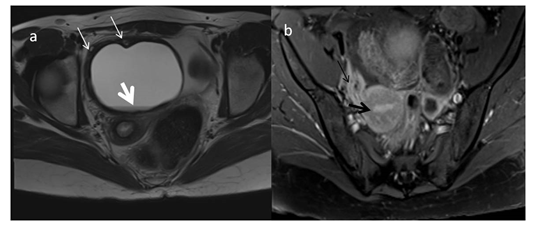
Figure 1: Axial T2w MRI (a) shows presence of cystic right adnexal mass with fluid level (thick white arrow) and presence of peripheral follicles (thin white arrows). Post contrast axial MRI pelvis; (b) shows ipsilateral deviation of uterus (thick black arrow) with engorged pedicle (thin black arrow).
Conflicts of Interests
NIL.
Funding
NIL.
References
- Houry D, Abbot J. Ovarian torsion a fifteen year review. Ann Emerg Med 38 (2001): 156-159.
- Albayram F, Hamper UM. Ovarian and adnexal torsion: spectrum of sonographic findings with pathologic correlation. J Ultrasound Med 20 (2001): 1083-1089.
- Kiumura I, Togashi K, Kawakami S, et al. Ovarian torsion: CT and MRI imaging features. Radiology 190 (1994): 337-341.
- Rha SE, Byun JY, Jung SE, et al. CT and MR imaging features of adnexal torsion. Radio Graphics 22 (2002): 283-294.
- Hibbard LT. Adnexal torsion. Am J Obstet Gynecol 152 (1985): 456-461.