Neviana Petkova ORCID
Web of Science Researcher at Angel Kanchev University of Ruse, Bulgaria.
*Corresponding author: Neviana Petkova, Web of Science Researcher at Angel Kanchev University of Ruse, Bulgaria.
Received: 28 September 2026; Accepted: 01 October 2026; Published: 04 November 2026
Modern times presuppose modern concepts, beliefs and technological solutions. Along with them, transformations occur, which are a natural continuation of changes. The enormous potential accompanying the modern educational sphere predicts the possibility of developing multifacetedness and multi-aspectivity in different contexts on the path of progress. The responsibility of modern educators in the creation and formation of new young people as research personalities is of high intensity of manifestation. The factor predisposition, conditioned by external dynamics, inevitably has a serious impact on the worldview of both educators and students. Therefore, the attention of the educational and scientific community for the last decade has been focused on changing the content and structural characteristics of the educational process in all academic disciplines. Perhaps integration is an appropriate and distinctive method for implementing the curriculum in the subjects of the humanitarian cycle. The present study (survey) will seek the opinion of teachers and students, the degree of their knowledge of the problem, their attitude towards it, as well as establish the extent to which the new opportunities naturally arising from humanitarian integration are highlighted and understood by the students and their teachers.
Humanities, Education, Integration, Technologies
Humanities articles; Education articles; Integration articles; Technologies articles
Introduction
New technologies have the potential to transform history education into a truly engaging experience for today’s students. Given that digital technologies constitute the natural environment in which these young people live and find entertainment, the intersection of technology and education is a particularly close one. Consequently, the study of this area is highly dynamic. The responsibility involved is significant, as new technologies serve as a springboard for preparing young people for life in society. Particular emphasis is placed on the educational potential of technology specifically within history instruction. A balanced presentation of the empirical research findings illustrates the possibilities for adaptation.
This report represents the author's initial attempt to examine the attitudes and satisfaction levels of teachers and students regarding the importance and necessity of integrating new technological solutions into history lessons. While not claiming to be exhaustive, it presents the author's perspective based on an independent study conducted in a Bulgarian city. The aim is to illustrate the attitudes of contemporary educators and students at both the lower and upper secondary school levels.
The primary objectives are:
- To review the scientific literature relevant to the topic.
- To develop a structural framework appropriate to the nature of the subject.
- To analyze the data and summarize the results of the empirical study conducted with teachers and students.
Methodology
This study covers the period of May - June 2026 and takes place in the city of Ruse, involving two Bulgarian secondary schools: "Vasil Levski" and "Hristo Botev." It does not collect personal data and is intended solely for academic purposes. Participation is voluntary and anonymous.
Subject of research: attitudes of students and educators regarding the integration of new technologies into History instruction.
Object of research: students and History teachers.
Study group: 45 students and 20 History teachers.
Survey – a quantitative method for gathering opinions, identifying attitudes, and gauging information; it comprises a varying number of open-ended and/or closed-ended questions and is a widely applicable method that is notably fast, popular, easy to process, and relatively reliable;
Analysis – a quantitative/qualitative method for investigating, examining, and identifying situations, phenomena, objects, or processes; it involves breaking down sources into smaller constituent parts to understand their internal composition and structure; it is characterized by a diagnostic nature;
Induction – a practical research method that proceeds from the particular or constituent element to a general conclusion;
Deduction – the counterpart to induction; it involves moving from a general conclusion or statement to the particular, the individual, or the synthesized; Comparison – involves juxtaposing two or more objects or subjects to identify similarities, resemblances, differences, or distinctive features; leads directly to a conclusion, inference, or finding;
Observation – a practical, visual method; characterized by rationality, a clear purpose, a specific focus, and a determined nature;
Generalization – the synthesis of all researched, analyzed, and processed information regarding various objects or subjects into a single conclusion; characterized by brevity, decisiveness, clarity, intelligibility, accuracy, precision, and logical coherence; depending on the situation, context, and type of text, it may take on the tone of an apotheosis.
Empirical aspects
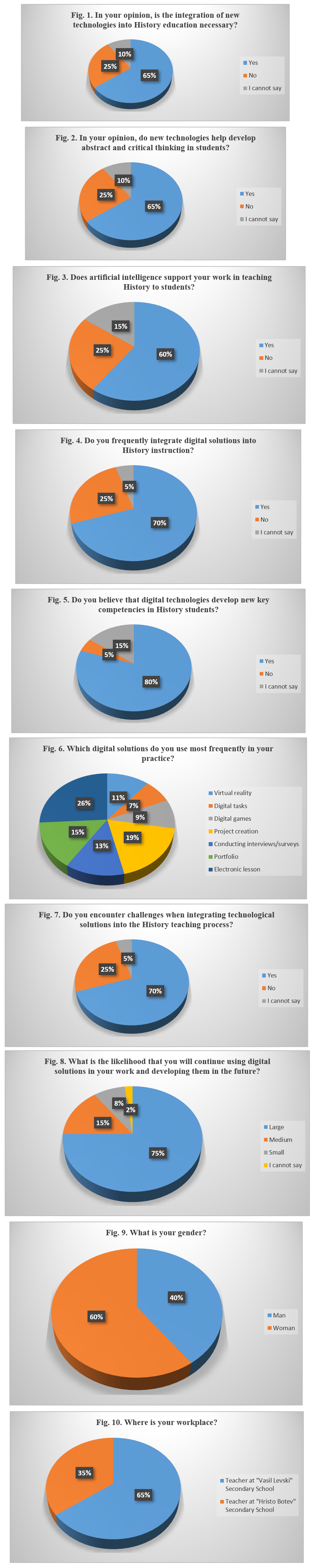
The following section presents a survey of teachers, the results of which reflect their personal stances on integrating innovative technological solutions into history instruction. The data illustrates the topic under discussion from the author's perspective. A random sample of 20 history teachers was surveyed within an e-learning environment. The collected information was processed using Excel and visualized graphically for greater clarity and ease of interpretation.
Student Survey
Discussion
The author's brief study regarding educators' attitudes toward integrating new technological solutions into history instruction reveals a clear and nearly constant trend of approval. Responses to the very first question indicate that a majority - 65% - of those surveyed consider the integration of new technologies into teaching history to be both necessary and imperative. Meanwhile, 25% of respondents deem it unnecessary, given that it is not mandatory. We hypothesize that this significant percentage may stem from traditional views and the specific teaching methods or approaches individual educators have adopted for history instruction. To address this issue more precisely, it is necessary to conduct further information campaigns highlighting the benefits of integrating new technologies into traditional teaching practices. Finally, 10% of respondents were unable to form a definitive assessment of the situation. The second question directly addresses the benefits of new technologies in fostering abstract and critical thinking - skills that are crucial for the development of today's students. A majority of the subjects - specifically 65% - firmly believe that new technologies benefit the intellectual development of the younger generation. The proportion of negative responses mirrors that of the previous question, standing at 25%; this demonstrates a consistent pattern in the substance of the answers provided. The percentage of respondents unable to form an opinion also remained unchanged at 10%. A consistent trend is also observed regarding the third question of the survey: 60% of respondents believe that artificial intelligence has a place and makes a significant positive contribution to the effective instruction of students in History classes. The proportion of those unable to make a definitive assessment is higher here - 15% - while 25% hold a negative view. 70% of those interviewed state that they frequently integrate new technologies into student instruction and their own lesson preparation. We surmise that the increase in positive responses indicates a shared understanding and a readiness to embrace innovation. 25% steadfastly maintain their traditional stance, while only 5% are unable to assess the issue or do not fall into either of the other two categories. The decline in neutral positions represents progress in the general expert outlook on History teaching methodology. The fifth question is precise, aiming to gather information on key student competencies resulting from the use of digital technologies in History instruction. Beyond intellectual functions, 80% of educators believe that new technologies foster the development and refinement of key competencies such as information literacy, teamwork, self-organization, communication and interaction, creative production, environmental awareness, identification and differentiation, and problem-solving. The percentage of those ruling out this possibility drops significantly for this question - to 5% - while as many as 15% of respondents are uncertain about the benefits and the interaction between new technologies and students. This figure should not be underestimated; we surmise that it may stem from a lack of familiarity with how these new technological solutions work in practice. There is a need for more practical workshops and demonstrations involving active pedagogical participation to introduce the subject matter. 26% of respondents use electronic lessons as a digital solution in History instruction. Another 19% favor project-based learning, viewing it as a solid foundation for the psycho-emotional and intellectual development of young learners. 15% believe in the value of portfolios as a form of independent research that fosters cognitive development and encourages self-reflection. 13% teach students how to create electronic historical surveys which enhances their digital literacy and ability to handle various situations, while 11% emphasize virtual reality to maintain students' interest and motivation in learning history. 9% of teachers integrate digital historical games as a means of fostering inquiry and development, and 7% assign digital tasks to their students. The trend observed in the fourth question continues in the seventh, which gathers information from respondents regarding the difficulties educators face when implementing and adapting new technological solutions in history lessons. 70% report encountering such difficulties, yet this does not deter them from continuing to use technology as a pathway to understanding historical material and improving student literacy. 5% are unfamiliar with the issue, while 25% state they face no challenges - a finding that is understandable given that they do not use these technologies at all, or do not use them actively, in their teaching practice. The teachers' readiness to continue working with new technologies is reflected in the responses to the eighth question: 75% express strong agreement (to a very high degree), 15% to a moderate degree, 8% to a small degree, and only 2% are unable to assess the situation. The gender distribution of the surveyed group is unequal: 60% are women and 40% are men. Nevertheless, many respondents are female - a demographic distribution not specifically analyzed for correlations in this study. 65% of the respondents work at the "Vasil Levski" Secondary School, while the remaining 35% work at the "Hristo Botev" Secondary School. We assume this disparity in the number of educators surveyed stems from the fact that "Vasil Levski" is twice the size of "Hristo Botev."
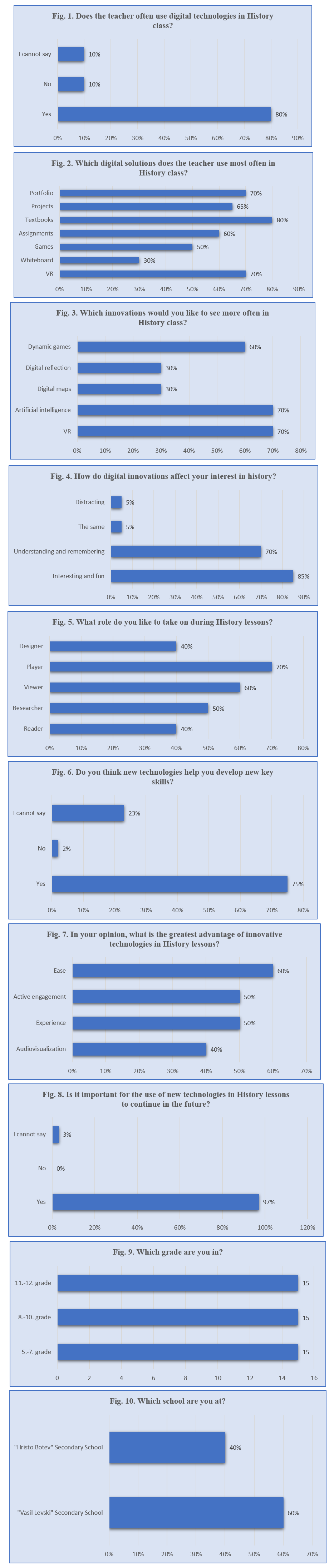
It is interesting to note that the student survey reveals a percentage similarity regarding the information content of questions that are thematically related across both surveys. Specifically, 80% of the students surveyed at both schools indicate that their history teachers use digital technologies to teach new material and reinforce previously learned content. 10% were unable to determine whether this was the case, while another 10% gave a definitive "no." Regarding the second question, the aggregate percentage of responses across all options exceeds 100%, as students were permitted to select more than one answer. The largest group of surveyed students - 80% - believe that teachers primarily use electronic textbooks during History lessons. Virtual reality and portfolios - viewed as opportunities for independent development and personal growth - each received a 70% response rate. Projects were favored by 65% of respondents, while 60% cited assignments. Responses regarding digital games show an even split among students - 50% - while 30% opt for the whiteboard. The third question reveals what the students themselves would like to see as innovative teaching methods in History: artificial intelligence and virtual reality lead the way, with 70% of the surveyed group expressing interest; 60% prefer dynamic games, while 30% favor digital reflection and digital maps. Here again, the total percentage of responses exceeds 100% because students could select more than one option. The fourth question is both direct and cumulative; it gathers information on the direct impact of new technologies on students' engagement with history, and 85% of them believe that digital innovations make history interesting and fun. For another 70%, these technologies help them better understand and retain the study material. Only 5% of students feel that technologies are distracting or no different from traditional methods - implying that new technologies have no positive impact on them. We consider the students' assessment to be valid and insightful. Students may experience some difficulties when taking on the role of project designers, as only 40% responded favorably to this option. Meanwhile, another 40% might find reading boring or too traditional. However, an impressive 70% wish to be players, 60% want to be spectators, and half of the respondents - 50% - want to be researchers. 75% of the students believe that digital technologies develop and shape new key competencies and positive qualities in them. Only 2% state that this is not the case, while 23% are unable to make a clear assessment (it is understandable that students might have only a limited familiarity with the concept of key competencies in schools). The seventh question allowed for multiple choices; taking advantage of this, 60% of students stated that new technologies make learning, memorizing, and taking tests easier for them; Another 50% believe that these tools help bring to life complex historical material related to the past; 50% also feel that, with their help, they can emotionally experience and understand history in order to recreate it; and for 40%, audiovisual elements make a significant contribution to learning history in the classroom. The students respond with genuine enthusiasm and near-total conviction to the eighth question - which gathers information on the future of innovative technologies in history education - with 97% answering "Yes." Only 3% are unable to make a definitive judgment or form a final opinion. The surveyed students are evenly distributed across age categories, with 15 students participating from each grade level between 5th and 12th grade. Of the total group, 60% attend "Vasil Levski" Secondary School, while 40% attend "Hristo Botev" Secondary School in Ruse - a selection made to account for the differences in physical size and technical facilities between the two schools.
Conclusions
Based on the practical research conducted, I draw the following conclusions:
- the students and teachers surveyed have a good understanding of new technologies and their impact on the History teaching and learning process;
- the high percentage of positive responses indicates a favorable reception of new technological solutions and their effective integration into the educational process within the school environment;
- the high percentage of positive responses reflects a relationship of trust and a clear awareness regarding the place, role, and contribution of new technologies to the delivery of History course material;
- the high percentage of positive responses among students demonstrates a strong drive and motivation to utilize digital methods - both currently and in the future;
- the proportion of negative and uncertain responses serves as a strong signal indicating the need to pay closer attention to this area and to explore broader opportunities for implementation.
References
- Aleksieva M. Technologies in Education – Between Innovation and Reality. Yearbook of Burgas Free University (BFU) L (2024).
- Bizhkov G, Kraevski V. Methodology and Methods of Pedagogical Research. "St. Kliment Ohridski" University Press, Sofia – Moscow (1999).
- Zhelev S. Marketing Research. "Stopanstvo" University Press, Sofia (2008).
- Zoneva L. Models for Integrating Information and Communication Technologies into Teaching. "Neofit Rilski" University Press, Blagoevgrad (2021).
- Parizhkova L. Digital Technologies in the Daily Life of Generation Alpha. Education and Technologies 11 (2020).
- Stefanov St. Developing Lessons for Teaching in an Electronic Environment. Lecture Material, University of Ruse, Ruse (2025/2026).
- Stefanov St. Structuring a Lesson in an Electronic Environment – Planning Strategies and Approaches. Lecture Material, University of Ruse, Ruse (2025/2026).
- Haralampiev K. Empirical Methods for Data Collection. Institute for Public Environment Development, Sofia (2017).
- Hristova A, Petrova Sv, Papazova E. Assessment of the Impact of Distance Learning in an Electronic Environment or Other Non-Face-to-Face Forms on the Effectiveness of School Education. IIO, Sofia (2020).
- How to Be Innovative in School. Plovdiv (2019).
- Selwyn N. Education and Technology: Key Issues and Debates. Bloomsbury Academic (2016).