Kaori Ito*,1,2,3, Koki Kato3,4, Misaki Morisaku3, Shigeki Yamada3,4, and Nobuki Hayakawa1
1Faculty of Pharmacy, Meijo University, Nagoya, Aichi, Japan
2Department of Hematology, Fujita Health University School of Medicine, Toyoake, Aichi, Japan
3Department of Pharmacy, Fujita Health University Hospital, Toyoake, Aichi, Japan
4Department of Pharmacotherapeutics and Informatics, Fujita Health University School of Medicine, Toyoake Aichi, Japan
*Corresponding author: Kaori Ito. Faculty of Pharmacy, Meijo University, Nagoya, Aichi, Japan.
Received: 10 August 2026; Accepted: 14 August 2026; Published: 18 August 2026
Background: Burton’s tyrosine kinase inhibitors (BTKis) are used to treat hematological malignancies. However, serious adverse events (AEs)—myelosuppression, bleeding, cardiovascular AEs, and infections including cytomegalovirus (CMV) infection—are of concern in immunocompromised individuals with hematological malignancies and individuals with post-transplant complications. Currently, there is a lack of reports of AEs associated with these novel molecular targeted drugs. We aimed to detect signals of CMV infection in patients treated with BTKis and assess their influence on time-to-onset of the infection using data from the Japanese Adverse Drug Event Report (JADER) database.
Methodology: In this retrospective study, individual reporting odds ratios (RORs) were calculated to assess CMV infection signals in patients receiving ibrutinib, tirabrutinib, or acalabrutinib. A CMV infection signal was considered present when the ROR confidence interval exceeded 1. The duration of CMV infection was determined by calculating the number of days from the onset of the AE to start of drug administration.
Results: There were 13 cases of CMV infection, and AE signals were observed only in patients receiving ibrutinib. In five cases where time-to-onset could be analyzed, the median duration of CMV infection was 154 (72–168) days, with the duration in one case exceeding 200 days. Reported outcomes were improvement in three cases, recovery in six, death in two, and unknown in two.
Conclusion: An AE signal was detected for ibrutinib. However, the low number of events and differing exposure durations among patients receiving BTK inhibitors precluded definitive comparative safety conclusions; further accumulation of AE data is warranted.
adverse-event signal, Bruton’s tyrosine kinase inhibitor, ibrutinib, cytomegalovirus infection
adverse-event signal articles, Bruton’s tyrosine kinase inhibitor articles, ibrutinib articles, cytomegalovirus infection articles
Introduction
Burton’s tyrosine kinase (BTK) is a cytoplasmic receptor protein kinase that acts downstream of membrane receptors such as the B-cell receptor (BCR), Toll-like receptor, and C-X-C chemokine receptor type 4. BTK plays a key role in activating the BCR and nuclear factor kappa-light-chain-enhancer of activated B cells (NFκB) signaling pathways. BTK inhibitors (BTKis) exert antitumor effects by covalently binding to the C481 residue of BTK, thus inhibiting the downstream NFκB pathway, which is constitutively activated by genetic abnormalities [1]. BTKis are effective and indicated for the treatment of chronic lymphocytic leukemia, mantle cell lymphoma, Waldenström macroglobulinemia/lymphoplasmacytic lymphoma, primary central nervous system lymphoma, and other diseases. However, despite their therapeutic benefit, the use of these targeted agents has been associated with an increased risk of invasive infections [2].
Human cytomegalovirus (CMV), a DNA virus belonging to the herpesvirus family, poses a serious threat to specific populations, particularly individuals with immunosuppression or hematological disorders. In these individuals, acute CMV infection substantially increases the risk of morbidity and mortality [3]. Moreover, it has been associated with the development of malignant lymphoma [4,5], occasionally leading to severe outcomes. Therefore, among the various infectious complications that arise early after transplantation, CMV infection warrants particular attention. Although viral detection methods and antiviral therapies have already been established, delayed or missed detection may cause systemic dissemination of CMV infection to multiple organs, such as the liver and lungs, gastrointestinal tract, and retina. Therefore, careful attention and management of CMV infection are required. Recent advances in pharmacovigilance have improved the detection of drug-associated adverse event (AE) signals using data from large databases such as the Japanese Adverse Drug Event Report (JADER), which are based on spontaneous AE reports [6]. Evaluation of drug-associated AE signals involves disproportionality analysis, including the calculation of reporting odds ratios (RORs) and information components (ICs) in pharmacovigilance activity [7]. The JADER, a Japanese nationwide open-access database, compiles spontaneous AE reports from the Pharmaceuticals and Medical Devices Agency (PMDA), a pharmaceutical regulatory authority in Japan.
Although several case reports have described central nervous system aspergillosis and cryptococcosis associated with CMV pneumonia in patients with chronic lymphocytic leukemia treated with acalabrutinib [8], reports of CMV infection in patients receiving BTKis in clinical practice remain limited. Moreover, the occurrence of CMV infection signals in patients treated with BTKis has not been clarified. In addition, the JADER database currently does not contain reports detailing the clinically important interval between BTKi treatment initiation and CMV infection onset. In this study, we aimed to investigate CMV infection signals in patients receiving BTKi therapy using data from the JADER database, further examining the time to CMV infection onset in this population.
Methods
Data source
Data from the JADER database, spanning April 2004 to December 2025, were obtained from the PMDA website [9]. The JADER dataset includes four tables: demographic information ("demo"), drug information ("drug"), AE information ("reac"), and medical history ("Hist"). It contains data on 1,002,922 patients, with 4,879,558 cases and 1,661,502 AEs. The "demo" table presents patient demographic data, including sex and age. Patients with blank or unknown sex or age data in the "demo" table, as well as notifications containing duplicate entries in the "drug," "reac," and "hist" tables, were excluded. The "demo" table data were then linked to data in the "drug," "reac," and "hist" tables using patient identification numbers. After data cleaning, data of 878,971 patients were analyzed in the present study (Fig 1).
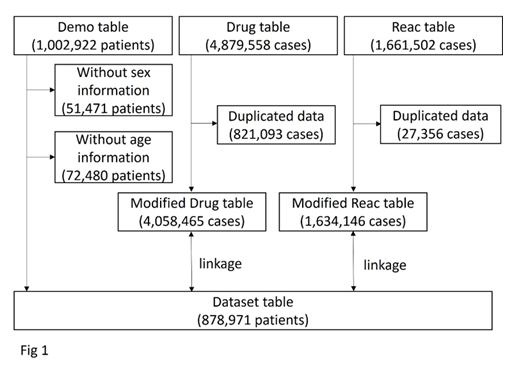
Figure 1: Flow diagram of the study
CMV infections were identified from the "reac" table using preferred terms (PTs) from the Medical Dictionary for Regulatory Activities (MedDRA, 28.1J). Twenty-seven PTs, categorized under the high-level term (HLT) "Cytomegaloviral infections" (HLT code 10011827), were used to define CMV infections (Table 1).
Table 1: Definition of cytomegalovirus infections
|
HLT code |
HLT name |
|
10011827 |
Cytomegaloviral infections |
|
PT code |
PT name |
|
10010430 |
Congenital cytomegalovirus infection |
|
10011830 |
Cytomegalovirus hepatitis |
|
10011831 |
Cytomegalovirus infection |
|
10011834 |
Cytomegalovirus mononucleosis |
|
10014586 |
Encephalitis cytomegalovirus |
|
10035676 |
Pneumonia cytomegaloviral |
|
10048843 |
Cytomegalovirus chorioretinitis |
|
10048983 |
Cytomegalovirus colitis |
|
10049014 |
Cytomegalovirus duodenitis |
|
10049015 |
Cytomegalovirus enterocolitis |
|
10049016 |
Cytomegalovirus gastritis |
|
10049018 |
Cytomegalovirus esophagitis |
|
10049074 |
Cytomegalovirus enteritis |
|
10049075 |
Disseminated cytomegaloviral infection |
|
10049566 |
Cytomegalovirus pancreatitis |
|
10051349 |
Cytomegalovirus gastroenteritis |
|
10051350 |
Cytomegalovirus urinary tract infection |
|
10052817 |
Cytomegalovirus gastrointestinal infection |
|
10056261 |
Cytomegalovirus myocarditis |
|
10056262 |
Cytomegalovirus syndrome |
|
10056721 |
Cytomegalovirus pericarditis |
|
10058666 |
Cytomegalovirus infection reactivation |
|
10058854 |
Cytomegalovirus viraemia |
|
10065036 |
Cytomegalovirus mucocutaneous ulcer |
|
10065621 |
Cytomegalovirus myelomeningoradiculitis |
|
10075619 |
Cytomegalovirus gastrointestinal ulcer |
|
10079095 |
Cytomegalovirus nephritis |
HLT: high level term; PT: preferred term.
Signal detection
This study employed the ROR and IC for CMV infection signal detection, as previously described [10–13]. The ROR serves as an AE signal index, representing the odds of reporting a specific AE versus all other AEs associated with the target drugs compared to the odds for all other drugs. Accordingly, RORs may be inherently unreliable when the sample size is small. Conversely, IC, an adverse drug reaction signal index from Bayesian Confidence Propagation Neural Network analysis, can detect AE signals even with a small sample size [10,14]. Here, RORs, ICs, and their 95% confidence intervals (CIs) were calculated using a two-by-two contingency table (Table 2) and the following equations [15]:
ROR equations:
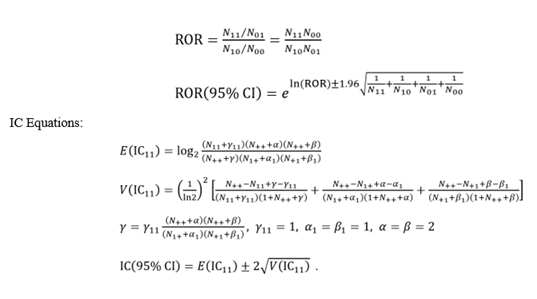
All calculations were performed using Microsoft Excel (Microsoft Japan Co., Ltd Tokyo, Japan). Signals were positive if the 95% CI lower limit of ROR exceeded 1 and IC exceeded 0.
Table 2: Two-by-two contingency table
|
Target AE |
Other AE |
Total |
|
|
Target drugs |
N11 |
N10 |
N1+ |
|
Other drugs |
N01 |
N00 |
N0+ |
|
Total |
N+1 |
N+0 |
N++ |
AE, adverse event; N, number of cases
Time-to-onset analysis
Time-to-onset a1nalysis was performed using data from the point of initial treatment with ibrutinib (IBR), tirabrutinib (TIR), or acalabrutinib (ACR) in the "drug" table to the date of the first CMV infection occurrence in the "reac" table. Patients with missing or inaccurate data on the dates of initial BTKi treatment and CMV infection were excluded. All calculations were conducted using Microsoft Excel (Microsoft Japan Co., Ltd., Tokyo, Japan). CMV infection onset was calculated by subtracting the date of initial treatment commencement from the date of CMV infection onset.
Results
CMV infection signal under BTKi treatment
The RORs and ICs for CMV infections during BTKi treatment are presented in Table 3. All BTKis—IBR, TIR, and ACR—were included in the analysis. Significant AE signals were detected only in the IBR-treated cohort.
Table 3: Reporting odds ratios (RORs) and information components (ICs) of cytomegalovirus (CMV) infections following administration of Bruton’s tyrosine kinase inhibitors.
|
Drug |
CMV infection (cases) |
Total AEs (cases) |
ROR |
95% CI |
IC |
95% CI |
|
Ibrutinib |
13 |
880 |
2.02 |
1.17–3.50 |
0.9 |
0.12 to 1.68 |
|
Tirabrutinib |
0 |
443 |
N.D. |
N.D. |
N.D. |
N.D. |
|
Acalabrutinib |
1 |
115 |
1.18 |
0.16–8.46 |
0.11 |
-1.95 to 2.17 |
CMV, cytomegalovirus; AE, adverse event; ROR, reporting odds ratio; CI, confidence interval; IC, information component, N.D.; not detected.
Patient details, their background, and outcomes of CMV infections
Table 4 presents information on the sex, age, time interval from IBR administration to CMV infection onset date, PT detection date, and clinical outcome for 13 cases of CMV infection defined by PT. Among the 13 cases, the clinical outcomes were improvement, recovery, death, and unknown in 3, 6, 2, and 2 cases, respectively. Although the timing of these complications was unclear, one of the two fatal cases was complicated by CMV pneumonia and CMV pancreatitis.
Time-to-onset analysis
Overall, 13 cases were analyzed, excluding 8 cases with unknown details. In the time-to-onset analysis, the median period [interquartile range] for CMV infection onset in patients receiving IBR treatment was 154 [72–168] days. The detailed time-to-onset data are presented in Table 4.
Table 4: Details of patients with CMV infection treated with ibrutinib and clinical outcomes.
|
No. |
Sex |
Age |
CMV infection onset (days) |
PT |
Outcome |
|
1 |
Female |
60s |
72 |
Cytomegalovirus infection |
Recovery |
|
2 |
Male |
70s |
154 |
Cytomegalovirus infection |
Improvement |
|
3 |
Male |
60s |
168 |
Pneumonia cytomegaloviral |
Recovery |
|
4 |
Male |
70s |
233 |
Cytomegalovirus chorioretinitis |
Recovery |
|
5 |
Male |
80s |
61 |
Cytomegalovirus enterocolitis |
Recovery |
|
6 |
Male |
60s |
unknown |
Cytomegalovirus infection |
Death |
|
7 |
Female |
70s |
unknown |
Pneumonia cytomegaloviral/Cytomegalovirus pancreatitis |
Death |
|
8 |
Male |
20s |
unknown |
Cytomegalovirus infection |
Improvement |
|
9 |
Male |
70s |
unknown |
Cytomegalovirus enterocolitis |
Recovery |
|
10 |
Male |
80s |
unknown |
Cytomegalovirus infection |
Unknown |
|
11 |
Male |
80s |
unknown |
Cytomegalovirus enterocolitis |
Recovery |
|
12 |
Female |
70s |
unknown |
Cytomegalovirus infection reactivation |
Improvement |
|
13 |
Female |
70s |
unknown |
Cytomegalovirus infection reactivation |
Unknown |
PT, preferred term.
Discussion
Among the 13 detected cases in this study, several were classified as serious, including two reported deaths, highlighting the need for careful monitoring of CMV infection in patients treated with IBR, a novel targeted molecular therapy. BTKis exert antitumor effects by covalently binding to the C481 residue of BTK, inhibiting the NFκB pathway constitutively activated by genetic abnormalities. Second-generation and later BTKis, including TIR, ACR, and zanubrutinib, are considered to exhibit greater kinase selectivity than IBR, a first-generation BTKi, resulting in fewer off-target effects [1]. In the present study, CMV infection signals were detected only in patients receiving IBR among all available BTKis. Although CMV infection is not a common infectious complication associated with IBR use, our findings may reflect an adverse consequence of the broad inhibitory activity of IBR against multiple tyrosine kinases. Furthermore, BTKis are novel molecularly targeted agents, and additional accumulation of spontaneously reported AEs is warranted. In addition, the AE profiles of BTKis may include several as-yet unidentified toxicities, underscoring the importance of long-term monitoring. Reddy et al. reported the case of an 88-year-old patient with chronic lymphocytic leukemia receiving IBR therapy who presented with painless hematochezia lasting 2 days, with bright red blood observed on digital rectal examination. Laboratory findings revealed a marked decrease in serum hemoglobin level. Biopsy of a rectal ulcer was positive for CMV immunostaining. The patient was treated with intravenous ganciclovir, followed by a switch to valganciclovir, for a total of 21 days of antiviral therapy. Ultimately, the patient’s symptoms improved, and the clinical outcome was favorable [16].
Patients treated with BTKis are at a high risk of developing hypogammaglobulinemia owing to impairment of the humoral immunity resulting from suppression of B-cell proliferation by BTKis [17–19]. In addition, previous studies have indicated that intracellular Th2 cytokine level decreases during the first 6–12 months after the initiation of IBR treatment, leading to a decrease in regulatory T cell count and a potential increase in opportunistic infection risk during this period [20,21]. CMV infection is a latent herpesvirus infection that can be reactivated in immunosuppressed hosts, such as patients with hematologic malignancies and transplant recipients, increasing the risk of morbidity and mortality. Therefore, early diagnosis of CMV infection and prompt initiation of antiviral therapy are considered essential for preventing clinical deterioration and improving prognosis in these patients and other high-risk groups, such as older adults in their 80s, as observed in our study [21,22]. In our study, there was also a fatal case complicated by CMV pneumonia and pancreatitis. As delayed detection of CMV infection may allow progression to systemic infection involving multiple organs, the early detection of CMV infection should be an important consideration in clinical practice.
In some patients with hematologic malignancies, T-cell function may already be impaired either because of the underlying disease itself or treatment history; this impairment can increase the risk of CMV reactivation. In such patients, administration of agents such as IBR, which may further suppress both B-cell and T-cell functions and thereby alter cellular immunity, is considered likely to further increase CMV infection risk [23]. Our study has some limitations that are worth mentioning. First, the JADER database is a spontaneous reporting system, which is inherently passive and subject to biases, including under-reporting, over-reporting, and confounding by comorbidities. Second, the characteristics of the JADER database make it challenging to assess the number of treatment courses and chemotherapy drug dosage. Finally, the time-to-onset analysis had a small number of CMV infection cases and therefore, caution is required when interpreting the results.
Conclusion
A CMV infection signal was detected in patients receiving IBR; however, the low number of events and differing exposure durations among patients receiving BTK inhibitors precluded definitive comparative safety conclusions. As BTKis are novel targeted therapeutic agents, further accumulation of AE data is warranted.
Acknowledgments
The authors would like to thank Editage (https://www.editage.com/) for English language editing.
Funding statement
This study was supported by research funding from Meijo University.
Conflicts of interest statement
The authors declared no potential conflicts of interest with respect to the research, authorship, and/or publication of this article.
Author contribution statement
Kaori Ito and Koki Kato designed the study. Kaori Ito, Koki Kato, and Misaki Morisaku conducted data analysis. Shigeki Yamada and Nobuki Hayakawa supervised the study. Kaori Ito, Koki Kato, and Misaki Morisaku drafted the manuscript. Shigeki Yamada and Nobuki Hayakawa reviewed and edited the manuscript. All authors approved the final manuscript.
References
- Kozaki R, Yasuhiro T, Kato H, et al. Investigation of the anti-tumor mechanism of tirabrutinib, a highly selective Bruton's tyrosine kinase inhibitor, by phosphoproteomics and transcriptomics. PLoS ONE 18 (2023) e0282166.
- Unterborn R, Brade K, Bair SM, et al. Ganciclovir-resistant CMV encephalitis in a mantle cell lymphoma patient on pirtobrutinib: case report. IDCases 42 (2025) e02396.
- Buchrits S, Trieman G, Giladi O, et al. Infectious complications in CLL/SLL patients receiving Bruton's tyrosine kinase inhibitors - systematic review and meta-analysis of randomized controlled trials. Ann Hematol 104 (2025) 3903-3915.
- Himil M, Ben P, Anuj S. Incidence of pneumonia among Bruton tyrosine kinase inhibitors in chronic lymphocytic leukemia: a systematic review and meta-analysis of clinical trial. Ann Hematol 104 (2025) 2605-2616.
- Phasuk N, Keatkla J, Rattanasiri S, et al. Monitoring of cytomegalovirus infection in non-transplant pediatric acute lymphoblastic leukemia patients during chemotherapy. Medicine 98 (2019) e14256.
- Tsuchiya M, Funakoshi R, Masuyama K, et al. Comparative analysis of the characteristics and trends of adverse drug reaction reports from patients in Japan and the Japanese Adverse Drug Event Report database. Br J Clin Pharmacol 92 (2026) 515-524.
- Ide N, Shibata R, Sako KI, Maeda T. Disproportionality and time-to-onset analyses of drug-induced weight gain using the Japanese Adverse Drug Event Report database. Drug Discov Ther 19 (2026) 389-394.
- Fallin T, Thacker E, Sahra S, et al. CNS aspergillosis and cryptococcosis with cytomegalovirus pneumonia in a patient with chronic lymphocytic leukemia treated with acalabrutinib. J Pharm Pract 37 (2024) 1391-1395.
- Pharmaceuticals and Medical Devices Agency web site. Accessed April 6 (2026).
- Tanaka H, Ohyama K, Horikomi Y, et al. Association between anaphylaxis and anti-influenza drug use: an analysis of the Japanese Adverse Drug Event Report database. Drug Discov Ther 15 (2021) 150-155.
- Hasebe S, Tanaka M, Iwane S, et al. Comprehensive cardiovascular risk profiling in people living with HIV: insights from the Japanese adverse drug event report database. AIDS Res Hum Retrovir 41 (2025) 423-432.
- Xiaojia H, Xinhang L, Yanqin H, et al. Relationship between thromboembolic events and thrombopoietin receptor agonists: a pharmacovigilance analysis of the FDA Adverse Event Reporting System and the Japanese Adverse Drug Event Report. BMJ Open 15 (2025) e099153.
- Liang C, Zhuo P, Zhang Y. Leukotriene receptor antagonists and eosinophilic granulomatosis with polyangiitis: a disproportionality analysis from FAERS, JADER, CVAR databases integrated with network pharmacology. PLOS One 21 (2026) e0343084.
- Noguchi Y, Murayama A, Esaki H, et al. Angioedema caused by drugs that prevent the degradation of vasoactive peptides: a pharmacovigilance database study. J Clin Med 10 (2021) 5507.
- Tunnacliffe A, Sims JE, Rabbitts TH. T3 delta pre-mRNA is transcribed from a non-TATA promoter and is alternatively spliced in human T cells. EMBO J 5 (1986) 1245-1252.
- Reddy Y, Baig M, Kalva N, et al. Cytomegalovirus proctitis in a patient with chronic lymphocytic leukemia on ibrutinib therapy: A Case report. Cureus 12 (2020) e7837.
- Parry HM, Mirajkar N, Cutmore N, et al. Long-term ibrutinib therapy reverses CD8+T cell exhaustion in B cell chronic lymphocytic leukaemia. Front Immunol 10 (2019) 2832.
- Reinwald M, Silva JT, Mueller NJ, et al. ESCMID Study Group for Infections in Compromised Hosts (ESGICH) Consensus Document on the safety of targeted and biological therapies: an infectious diseases perspective (Intracellular signaling pathways: tyrosine kinase and mTOR inhibitors). Clin Microbiol Infect 24 (2018) S53-S70.
- Demitrovicova L, Mikuskova E, Oravcova I, et al. Infectious complications in chronic lymphocytic leukemia- a retrospective analysis: single institution experience. Neoplasma 64 (2017) 474-481.
- Pillet S, Pozzetto B, Roblin X. Cytomegalovirus and ulcerative colitis: place of antiviral therapy. World J Gastroenterol 22 (2016) 2030-2045.
- Brown JR. How I treat CLL patients with ibrutinib. Blood 131 (2018) 379-386.
- Smith LA, Gangopadhyay M, Gaya DR. Catastrophic gastrointestinal complication of systemic immunosuppression. World J Gastroenterol 21 (2015) 2542-2545.
- Jain A, Prakash G, Khadwal A, et al. Bloody diarrhea in a patient of aggressive lymphoma: a diagnostic and therapeutic challenge. Indian J Hematol Blood Transfus 33 (2017) 423-426.