Miranda Rice1, Christine Lucio2, Emily S Bailey1*
1Julia Jones Matthews Department of Public Health, Texas Tech University Health Sciences Center, Abilene, Texas, USA
2Abilene Taylor County Public Health District (ATCPHD), Abilene, Texas, USA
*Corresponding Author: Emily S Bailey, PhD, Assistant Professor Director of Student Success Department of Public Health, Graduate School of Biomedical Sciences (GSBS) Texas Tech University Health Sciences Center, USA
Received: 20 April 2021; Accepted: 27 April 2021; Published: 24 May 2021
We describe coronavirus disease among cookie factory workers in Abilene, Texas during the initial coronavirus outbreak in March 2020. Among 560 factory workers, 57 had confirmed COVID-19 and 1 worker died. This outbreak among high density factory workers highlights the importance of public health intervention and immediate response upon the discovery of cases of an infectious virus.
Additionally, in this working environment, ethnic minorities were disproportionally affected, prompting the need for additional research around the spread of SARS-CoV-2 in these populations.
Occupational health; Worker safety; Respiratory infections; Severe acute respiratory syndrome coronavirus 2; SARS-CoV-2; COVD-19; Zoonoses; Viruses; Coronavirus
1. Introduction
Over the last year, high density workplaces have been associated with high risk transmission of severe acute respiratory disease coronavirus 2 (SARS-CoV-2), the virus which causes the disease COVID-19 [1-4]. In the United States, food processing, manufacturing, and agriculture workplaces employ over 3 million individuals [5]. In Texas alone, that number is nearly 750 million [6]. In these workplaces, there are several factors that contribute to community transmission of SARS-CoV-2 including prolonged close contact and frequent community contact [2, 3]. Previous studies have described COVID-19 outbreaks in meat and poultry processing workers [3]. We describe the initial COVID-19 outbreak in the AbiMar Foods, Inc. cookie company in Abilene, Texas in March 2020.
2. Materials and Methods
On March 30, 2020 the first confirmed case of the novel coronavirus SARS-CoV-2 occurred at the cookie company, AbiMar Foods, Inc. in Abilene, Texas. The case was reported by the by the Abilene Taylor County Public Health District (ATCPHD) and, after several additional positive diagnoses, the ATCPHD declared that an outbreak had occurred at the cookie company. The business closed until further notice on April 13, 2020. By this time, more than 100 employees had been sent home with instructions to quarantine [7].
The Abilene Diagnostic Clinic met with the chief executive officer (CEO) who agreed to pay for testing of all 560 employees at AbiMar Foods Inc. A total of 57 employees tested positive for COVID-19 as of July 23. A case positivity rate of 0.10%. Analysis of de-identified information focused on information regarding demographics, symptoms, date of test, and results.
Data was compiled and analyzed for potential patterns in COVID-19 transmission and to identify any potential commonalities and/or comorbidities among other positive cases. The ATCPHD health department was responsible for conducting contact and social tracing.
3. Results
We describe COVID-19 among workers at a local cookie company in Abilene Texas during the initial outbreak of coronavirus in March 2020. Among the 57 workers who tested positive for SARS-CoV-2, 27 (47.37%) were symptomatic, reporting various symptoms including fever, chills, muscle aches, runny nose, sore throat, cough, shortness of breath, nausea or vomiting, headache, abdominal pain, diarrhea, loss of smell, loss of taste, loss of smell, congestion, and fatigue. Symptomatic and asymptomatic cases occurred in the production areas of the cookie factory. Contact tracing revealed that the source of contagion was external and not from within the plant. It is likely the cases occurred from close contacts such as family, friends, and additional places of work. An epidemic curve representing cases by date of the outbreak is presented in Figure 1. Most individuals who were positive for the virus were Black (52.63%) and not Hispanic or Latino (59.65%). A map of positive cases by zip code is presented in Figure 2. This figure shows that cases were generally spread throughout the city, with some concentration of cases on the West side of the county. The zip code of 79603 had the highest number of reported cases (18); with 13 (72.22%) of those cases indicating their race as Black. Zip code 79605 had the second highest reported number of cases at 16, with 8 (50%) of those cases identifying their race as Black. The highest reported number of cases that identified as Asian was 4 (66.67%) in the 79606 zip code. The US Census bureau reports that the total proportion of Black individuals in Abilene, Texas is approximately 10.6% of the city [8], indicating that in our sample with over 50% of the cases in the black community this is a higher number of cases than what would be expected based on population alone.
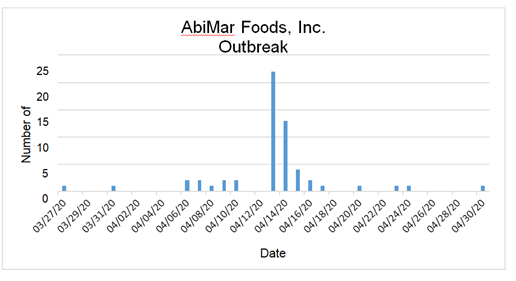
Figure 1: Epidemiologic Curve for AbiMar Foods, Inc. Outbreak.

Figure 2: AbiMar Cookie Factory SARS-CoV-2 Outbreak Cases by Zip Code.
|
Characteristics, No. (%) |
Value |
|
Symptomatic |
27 (47.37) |
|
Asymptomatic |
30 (52.63) |
|
Symptoms Reported, No. (%) |
|
|
Measured Fever |
11 (19.30) |
|
Subjective Fever |
3 (5.26) |
|
Chills |
6 (10.53%) |
|
Muscle Aches |
11 (19.30) |
|
Runny Nose |
8 (14.04) |
|
Sore Throat |
6 (10.53) |
|
Cough |
18 (31.58) |
|
Shortness of Breath |
6 (10.53) |
|
Nausea or Vomiting |
5 (8.77) |
|
Headache |
17 (29.82) |
|
Abdominal Pain |
2 (3.51) |
|
Diarrhea |
6 (10.53) |
|
Loss of Smell |
5 (8.77) |
|
Loss of Taste |
7 (12.28) |
|
Congestion |
1 (1.75) |
|
Fatigue |
2 (3.51) |
|
Other |
5 (8.77) |
Table 1: Asymptomatic vs Symptomatic Responses of the AbiMar Cookie Factory Outbreak. Sample (n=57).
4. Discussion
Our study supports findings from prior reports that part of the disproportionate burden of COVID-19 among some racial minority groups is likely related to occupational risk [9]. These findings should be considered when evaluating intervention strategies for mitigating coronavirus risk in these workplaces.
Additionally, reports on mass testing in US meat processing facilities have revealed high proportions of asymptomatic infections [7, 10]. In our study, over 50% of positive cases reported no symptoms of the virus. This finding supports the need for comprehensive testing strategies, alongside contact tracing, particularly in high density workplaces [11].
This study has several limitations, first this is an evaluation of a small outbreak in one factory, it is not a comprehensive study of multiple sites and we did not follow the workers over time. As SARS-CoV-2 transmission could have been occurring in the community or in the workplace at this time, it is also important to note that the workers may have had other exposures outside of work that may have contributed to their development of COVID-19. Despite this, the ATCPHD, did conduct contract tracing and followed up with each individual with the aim of decreasing the spread of the virus.
The evaluation of viral spread in food processing, manufacturing, and agricultural workplaces is necessary and important to addressing the risk factors for the spread of SARS- CoV-2 among high density workers.
As a result of this outbreak, new personal protective equipment (health screenings, face masks, goggles, social distancing, additional hand washing stations, and alternate shift schedules to avoid gatherings of people, quarantine) have been implemented at the food plant in order to prevent the spread of SARS-CoV-2 in this environment.
As several factors at the community and individual level contribute to the disparate spread of this virus among racial minority workers, the trends in SARS-CoV-2 infection in workplaces will need to be more fully evaluated.
Acknowledgements
We thank the Abilene Taylor County Public Health Department for access to their records and information on this outbreak as well as their support in evaluating this community outbreak, specifically we thank Mrs. Annette Lerma and Mrs. Julia Agawu of the ATCPHD and Mr. Correa, the CEO of AbiMar Foods.
Conflict of Interest
The authors declare that the research was conducted in the absence of any commercial or financial relationships that could be construed as a potential conflict of interest.
References
- Waltenburg MA, et al. Coronavirus Disease among Workers in Food Processing, Food Manufacturing, and Agriculture Workplaces. Emerg Infect Dis 27 (2021).
- Waltenburg MA, et al. Update: COVID-19 Among Workers in Meat and Poultry Processing Facilities - United States, April-May 2020. MMWR Morb Mortal Wkly Rep 69 (2020): 887-892.
- Dyal JW, et al. COVID-19 Among Workers in Meat and Poultry Processing Facilities - 19 States, April 2020. MMWR Morb Mortal Wkly Rep 69 (2020).
- Baker MG, Peckham TK, Seixas NS, Estimating the burden of United States workers exposed to infection or disease: A key factor in containing risk of COVID-19 infection. PLoS One 15 (2020): e0232452.
- Bureau, USC. American Community Survey (2018).
- Bureau F. Agricultural Jobs by State (2021).
- Tyson RM, announces more COVID-19 test results from Arkansas counties. Meat + Poultry. 2020 (2020).
- Bureau, U.C, Quick Facts Abilene city, Texas (2021).
- Hawkins D. Differential occupational risk for COVID-19 and other infection exposure according to race and ethnicity. Am J Ind Med 63 (2020): 817-820.
- Tyson JC, confirms hundreds of COVID-19 cases at Missouri chicken plant. Meat + Poultry. 2020 (2020).
- Prevention, CfDCa. Testing strategy for coronavirus (COVID-19) in high-density critical infrastructure workplaces after a COVID-19 case is identified. . 2020.-19) in high-density critical infrastructure workplaces after a COVID-19 case is identified (2020).