Dr. Kazi Tahmina Akter1, Dr. Nasimul Gani Chowdhury2, Jannatun Noor3, Dr. Tasmin Akter4, Dr. Sharmin Akther4
1Consultant, Department of Cataract, Chittagong Eye Infirmary and Training Complex, Chattogram, Bangladesh
2Professor & Chief Consultant, Department of Paediatric Ophthalmology, Chittagong Eye Infirmary and Training Complex, Chattogram, Bangladesh
3Lecturer, Institute of Community Ophthalmology, Chittagong Eye Infirmary and Training Complex, Chattogram, Bangladesh
4Assistant Surgeon, Department of Paediatric Ophthalmology, Chittagong Eye Infirmary and Training Complex, Chattogram, Bangladesh
*Corresponding Author: Jannatun Noor, Lecturer, Institute of Community Ophthalmology, Chittagong Eye Infirmary and Training Complex, Chattogram, Bangladesh
Received: 10 September 2026; Accepted: 15 September 2026; Published: 21 September 2026
DOI: 10.26502/fjor.2644-002400118
SharePurpose: To report a case of phacoemulsification in rigid pupil. Case report: A 65-year-old man with bilateral cataract and rigid pupil underwent phacoemulsification under local anesthesia. His pre-operative and post-operative vision and intraocular pressure were evaluated. The patient was non-diabetic and non-hypertensive. During surgery, Iris hooks were used in the right eye and a pupil expander was used in the left eye. The surgeries were uneventful and post- operative visual acuity were satisfactory. Result: At final follow-up best-corrected visual acuity was 6/9 in both eyes. IOP was within normal limit. There was no significant corneal edema and intraocular inflammation. Conclusion: Mechanical pupil expansion devices such as iris hooks and pupil expander are effective and safe methods for managing rigid pupils during phacoemulsification.
Rigid pupil; Phacoemulsification; Iris hooks; Pupil expander
Rigid pupil articles; Phacoemulsification articles; Iris hooks articles; Pupil expander articles
1. Introduction
Cataract is identified as the leading cause of moderate to severe vision impairment in adult globally. The small, poorly dilated pupil is one of the most common difficulties faced by cataract surgeons. For safe cataract surgery, adequate pupillary dilation is essential. A rigid pupil limits visualization of the anterior capsule and makes phacoemulsification more challenging technically [1]. Age related changes, persistent inflammation, prior ocular surgery or systemic medications can all lead to poor pupillary dilation. Complications like iris damage, incomplete capsulorhexis, posterior capsule rupture and retained Lens material occur due to inadequate pupillary dilation.
During cataract surgery, a number of techniques have been described for managing a rigid pupil. Topical intracameral mydriatic agents are usually used to dilate the pupil. Iris hooks, pupil expander are examples of mechanical methods. When Pharmacological dilation is inadequate, mechanical methods are often preferred.
2. Case Presentation
A 65-years-old man was seen at the outpatient department of Chittagong Eye Infirmary and Training Complex complaining of progressive, painless vision loss in both eyes over a period of several months. There was no prior history of extra ocular surgery or ocular trauma. The patient was non-diabetic and non-hypertensive.
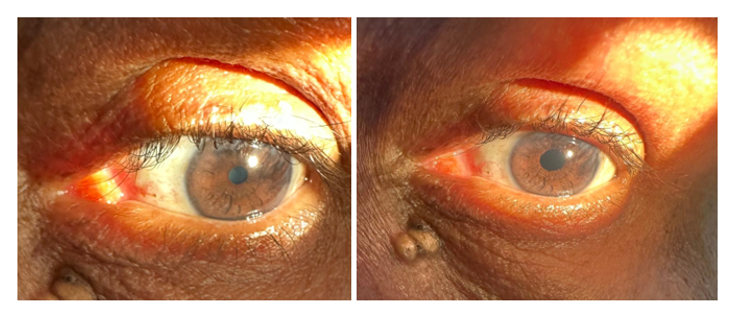
Figure 1: A: Rigid pupil before surgery B: Rigid pupil After surgery
Pre-operatively best corrected visual acuity was 6/60 in right eye and 6/24 in the left eye, pinhole revealed no improvement.
A slit lamp examination showed that the pupil was 3 mm in size with maximum pharmacological dilation, the anterior chamber was quiet and nuclear sclerosis was grade 3 in both eyes. The pupil’s rigidity and inadequate response to mydriatic agents were indicative of a rigid pupil.
Intraocular pressure was within normal limits. Posterior chamber evaluation was unremarkable on fundoscopy. The patient was diagnosed as bilateral senile mature cataract with rigid pupil. Following pre-operative assessment and routine investigation, the patient was recommended for cataract surgery with posterior chamber intra ocular lens implantation. Despite using medications, the pupil in both eyes did not dilate properly during cataract surgery. Iris hooks were placed through peripheral corneal incisions to mechanically expand the pupil in order to improve surgical exposure in right eye. This provides sufficient exposure of the lens capsule, allowing successful capsulorhexis, phacoemulsification of the nuclear cortical aspiration and intra ocular lens implantation.
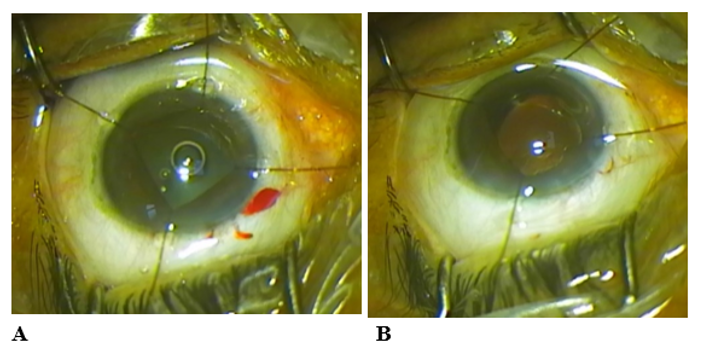
Figure 2: A: Iris hook before IOL placement B: Iris hook after IOL
A pupil expander was utilized to obtain sufficient pupil dilation during cataract surgery in the left eye. Throughout the surgical procedure the device offers pupil expansion.
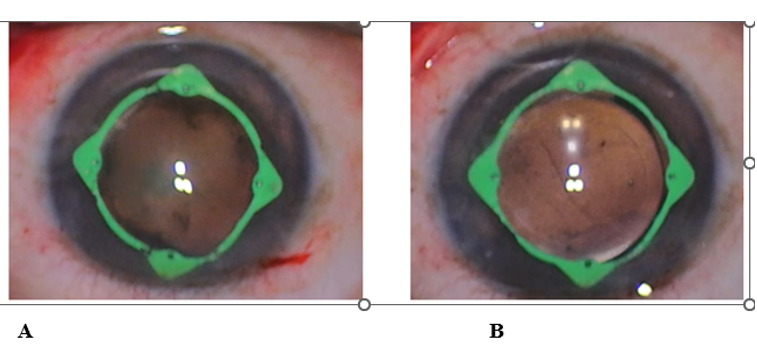
Figure 3: A: Pupil expander before IOL Placement B: Pupil expander after IOL Placement
Phacoemulsification with intra ocular lens implantation were successfully completed. Both eyes had clear cornea and a well centre posterior chamber intra ocular lens on the initial postoperative examination. There is no change in intra ocular pressure. At four-week follow-up, best corrected visual acuity was 6\9 in both eyes. Near add is also provided. No cystoid macular oedema or pigment dispersion was seen at final follow-up.
3. Discussion
A Rigid pupil represents a challenging situation in cataract surgery. Inadequate pupillary dilation can compromise visibility of intra ocular structures and impair intra ocular visualization. Inadequate visualization can results in complications like incomplete capsulorhexis, iris damage or posterior capsule rupture [2].
A number of surgical techniques have been proposed to address this problem. Initially, pharmacological agents are typically used to dilate the pupil. However, mechanical expansion techniques are required when these approaches are unable to provide sufficient dilatation [3].
Iris hooks are commonly used because they are easy to implant and provide controlled, adjustable enlargement of the pupil during phacoemulsification. They enhance lens visibility and provide stable surgical field. However, multiple paracenteses are required and there may be localized iris trauma.
Nevertheless, the pupil expander device maintains pupil stability and consistent circumferential dilation throughout the process, it additionally reduces excessive manipulation of the iris during surgery. These devices are particularly useful in cases of rigid pupil where symmetrical expansion is necessary. They support the iris margin continuously and require fewer incisions than iris hooks [4].
In this case, two different mechanical techniques were used successfully. Iris hooks (Alcon) were used in the right eye, while pupil expander was used in the left eye (I-Ring®). Both techniques provided adequate surgical visualization and allowed safe completion of phacoemulsification. The post-operative outcome was favorable with improved visual acuity and stable intraocular pressure [5].
This case highlights the importance of recognizing rigid pupils preoperatively and being prepared to use mechanical expansion devices when pharmacological dilation is inadequate.
4. Conclusion
A rigid pupil can make cataract surgery more challenging because of inadequate pupillary dilation. Mechanical pupil expansion techniques, such as iris hooks and pupil expander offer effective intraoperative dilation and help achieve successful surgical outcomes.
Financial support:
Nil
Conflicts of interest:
Nil.
References
- NO R. Efficacy of pupil expansion device in small pupil cataract surgery: a one-year prospective interventional study in a tertiary care centre. Doctoral dissertation, KLE Academy of Higher Education and Research, Belagavi.
- Malyugin BO. Complications of small-pupil cataract surgery. Cataract Refr Surg Today Europe 13 (2013): 26-30.
- Alıkma MS, Ünsal E, Çubuk MÖ, et al. Outcomes of Cataract Surgery with Iris Hook: Our Experience. Istanbul Medical Journal 20 (2019).
- Nderitu P, Ursell P. Iris hooks versus a pupil expansion ring: Operating times, complications, and visual acuity outcomes in small pupil cases. Journal of Cataract & Refractive Surgery 45 (2019): 167-173.
- Wang JD, Zhang JS, Li M, et al. Comparison of different pupil dilatation methods for phacoemulsification in eyes with a small pupil. BMC Ophthalmology 22 (2022): 173.