Miguel Quesado*, Joana Pereira, Marcos Silva, João Afonso, João Carvalho, Jorge Alves
Department of Orthopaedics and Traumatology, Centro Hospitalar do Tâmega e Sousa, Penafiel, Portugal
*Corresponding Author: Miguel Quesado, Orthopaedics and Traumatology Resident, Department of Orthopaedics and Traumatology, Centro Hospitalar do Tâmega e Sousa, Penafiel, Portugal
Received: 13 October 2020; Accepted: 20 October 2020; Published: 05 November 2020
The atlantoaxial dislocation associated to odontoid process fracture is a rare injury with a high mortality rate [1, 2]. The authors describe a case of a patient with posterolateral atlantoaxial dislocation with joint block associated to odontoid process fracture, without neurological injury, submitted to closed reduction and fixation of the odontoid with a screw by anterior approach. Due to the few cases described in the literature, the recommended surgical treatment remains controversial, being conditioned by the type and severity of the lesion, patient specificities as well as by the surgeon experience [3].
Fracture, Odontoid, Dislocation, Atlantoaxial
1. Background
The odontoid process is configured as a key element of the atlantoaxial segment, whose stability is conferred by the joint with the atlas and alar and transverse ligaments [3, 4]. Together, they are responsible for maintaining the joint congruence, so an injury to these structures can predispose to C1-C2 instability. In the literature, there were 9 cases described with posterolateral dislocation in articles indexed in the English language [4]. The authors
describe a rare case of posterolateral atlantoaxial dislocation with joint block, associated to odontoid process fracture, without neurological injury, which was successfully treated after closed reduction and fixation of the odontoid fracture with an anterior screw.
2. Case Report
A 65-year-old male patient was admitted to the Emergency Department after a 1-meter fall with trauma to the skull. He reported neck pain, dysphagia and paresthesia of the lower limbs. He also showed depression of the state of consciousness. In the physical
exam he had pain on cervical palpation with limited mobility. Cervical X-rays and CT scan showed a fracture of the base of the odontoid process (type II of the Anderson and D'Alonzo classification) with posterior oblique displacement (type II of the Roy-Camille classification) associated with right posterolateral atlantoaxial dislocation (Figures 1 and 2). He underwent closed reduction of the dislocation under general anesthesia through cranial traction with slight cervical flexion. Then, osteosynthesis of the odontoid fracture was performed with a 3.5 mm cannulated screw using the Smith-Robinson approach and immobilized with a rigid cervical collar (Figure 3). The patient was discharged on the 4th postoperative day, showing clinical improvement and absence of neurological deficits. He has kept the cervical collar and performed serial X-rays for 3 months (Figure 4), after which he started treatment for cervical stiffness. At 7 months postoperatively, cervical CT scan was performed, which demonstrated a complete fracture healing and correct C1-C2 joint congruence (Figure 5). After 1 year of follow-up, he was asymptomatic and had no change in functional status prior to the traumatic event.
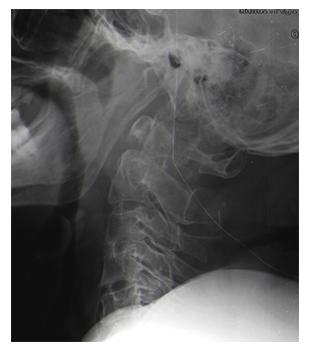
Figure 1: X-ray on admission to the Emergency Department.
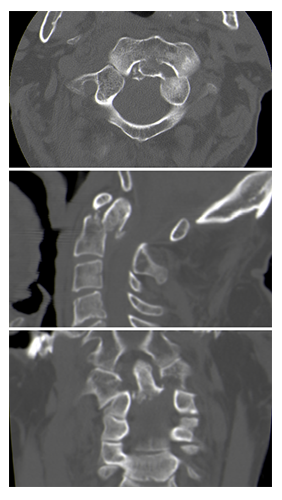
Figure 2: CT scan on admission to the Emergency Department.
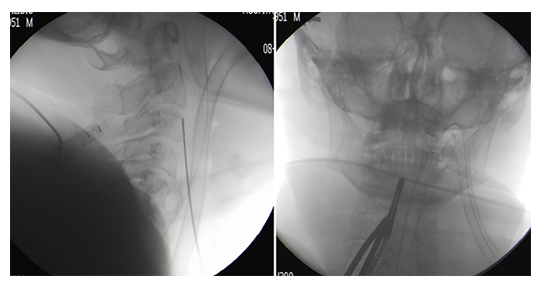
Figure 3: Reduction of atlantoaxial dislocation and fixation of odontoid process fracture.
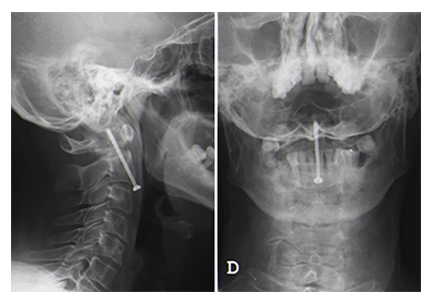
Figure 4: Control X-ray (3rd postoperative month).
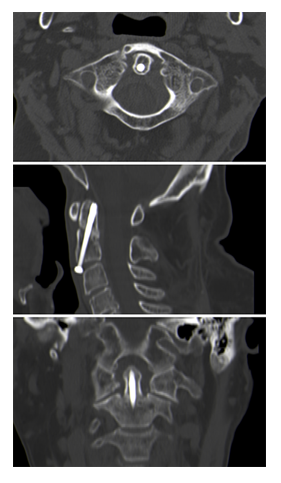
Figure 5: Control CT scan (7th postoperative month).
3. Discussion
C1-C2 dislocation is responsible for about 2.5-10% of cases of cervical dislocation, and odontoid process fracture represents 7-9% of all cervical spine fractures [1, 2, 5, 6]. Atlantoaxial dislocation is a rare entity whose exact incidence is unknown, reflecting a high mortality rate at the time of injury [2, 7]. It usually occurs after high-energy trauma, such as falls and automobile or sports accidents, often complicated by neurological injury [2, 3]. The underlying mechanism of this injury was a forced cervical hyperextension, which resulted in C1-C2 posterolateral displacement with block of the lateral masses of C1 on the upper articular facets of C2, and associated fracture of the odontoid process. The observed injury corresponds to the type V of the Fielding and Hawkins classification for atlantoaxial rotatory dislocation, modified by Levine and Edwards [8]. In the literature, there is no accepted algorithm for the treatment of these injuries. According to the studies by Danta et al, and Steltzlen et al, the approach and fixation with an anterior screw should be the treatment for fractures of the base of the odontoid process with posterior oblique line, allowing an effective reduction and healing of the fracture keeping the mobility of the cervical spine [6, 9]. In this case, the reduction of the atlantoaxial dislocation after fixation of the C2 fracture, throughout the clinical follow-up, eliminated the need of posterior C1-C2 fusion. Inversely, in most of the published series, the use of isolated posterior or even combined approaches predominated after failure of the initial reduction [3, 4]. The anatomical reduction of the fracture with recovery of joint congruence, associated to the support of external immobilization, allowed a capsuloligamentous healing of the atlantoaxial joints, saving the need for a combined approach with increased morbidity and the risks inherent to the posterior approach [5, 9]. The recovery of cervical mobility at the end of the clinical follow-up stands out, namely the preservation of cervical rotations.
5. Conclusion
The authors describe a rare case of traumatic atlantoaxial dislocation associated to fracture of the odontoid process. Surgical fixation by anterior approach proved to be safe and effective, allowing to maintain a long-term stability and restoring cervical mobility.
Conflicts of Interest
The authors have no conflicts of interest to declare.
References
- Riouallon G, Pascal-Moussellard H. Atlanto-axial dislocation complicating a type II odontoid fracture. Reduction and final fixation. Orthopaedics & Traumatology, Surgery & Research (2014): 341-345.
- Spoor AB, Diekerhof CH, Bonnet M, et al. Traumatic complex dislocation of the atlanto-axial joint with odontoid and C2 superior articular facet fracture. Spine 33 (2008): E708-E711.
- Wang L, Liu C, Zhao QH, et al. Outcomes of surgery for unstable odontoid fractures combined with instability of adjacent segments. J Orthop Surg Res 9 (2014): 64.
- He DW, Huang WJ, Sheng XY, et al. Atlantoaxial Joint Interlocking Following Type II Odontoid Fracture Associated with Posterolateral Atlantoaxial Dislocation: a Case Report and Review of Published Reports. Orthop Surg 8 (2016): 405-410.
- Hübner AR, Spinelli LF, Klaus AM. Decisão no tratamento das fraturas do odontoide. Coluna/Columna 9 (2010): 43-48.
- Dantas FLR, Prandini MN, Caíres ACV, et al. Tratamento cirúrgico das fraturas do odontóide tipo II com parafuso anterior: Análise de 15 casos. Arq. Neuro-Psiquiatr 60 (2002): 823-829.
- Zhang K, Xu J, Wang Q, et al. Treatment of dens fractures with posterior atlantoaxial dislocation with transoral atlantoaxial reduction plate surgery: case report and introduction of a novel treatment option. Spine 37 (2012): E451-E455.
- Levine AM, Edwards CC. Treatment of injuries in the C1-C2 complex. Orthop Clin North Am 17 (1986): 31-44.
- Steltzlen C, Lazennec JY, Catonne Y, et al. Unstable odontoid fracture: surgical strategy in a 22-case series, and literature review. Orthop Traumatol Surg Res 99 (2013): 615-623.