Jaya Singh1*, Shruti Singh1, Shaleen Chandra2
1Senior Resident, Department of Oral Pathology and Microbiology, King George's Medical University (KGMU), Lucknow, India
2Professor and Head, Department of Oral Pathology and Microbiology, King George's Medical University (KGMU), Lucknow, India
*Corresponding Author: Jaya Singh, Senior Resident, Department of Oral Pathology and Microbiology, King George's Medical University (KGMU), Lucknow, India
Received: 01 March 2020; Accepted: 10 March 2020; Published: 13 March 2020
Background: Hepatitis B virus (HBV) infection is one of the most common public health issues worldwide that requires a critical consideration. Knowing the prevalence of HBV infection in a geographical area aids in ascertaining the extent of the fatal infection. Hepatitis B surface antigen (HBsAg) positivity is a strong indicator of true HBV infection rate in the community. The current study aims to estimate the prevalence of HBsAg in teaching hospital-based population. Large number of patients from diverse backdrop visit our institution, and hence assist in obtaining a precise representation of the viral prevalence in the community.
Methods: A one step rapid immunochromatographic method for detection of HBsAg was performed to diagnose HBV infection in 11,792 serum samples tested over a period of two years were included in this study.
Result: Out of the 11,792 samples tested for HBsAg, 100 (0.85%) were found to be positive for HBsAg. Rate of positivity was more among males 77 (77%) than females 23 (23%) and the most common age group in males was 31-40 years (21%) and in females, commonest age group was 21-30 years (31%).
Conclusion: The study helps to know the magnitude of viral transmissible infections in North Indian population. In our study the most commonly affected population belonged to the second and third decade. This raises an alarm for more precaution as the presentation is seen in young age group. Rigorous and effective immunization programs need to be implemented and awareness-based campaigns might help in curbing the viral infectivity.
Hepatitis; Seroprevalence; Infection; Geographic Variation; Fatal
Hepatitis articles, Seroprevalence articles, Infection articles, Geographic Variation articles, Fatal articles
Introduction
They say getting diagnosed earlier equals to staying healthy longer. Hepatitis infection is considered more infectious than HIV infection. Up to 75 percent of the cases goes undiagnosed. Educating the common man about the risk factors and health hazards caused by this virus can help us decrease the prevalence of this disease. Dr Baruch Bloomberg in the year 1976 received a Nobel prize for discovering the hepatitis B virus. He also developed a diagnostic test and a vaccine for it.
Viral Hepatitis is causing a major global health peril in the contemporary world. It causes inflammation in the liver. It can present as both acute and chronic forms. The viruses which causes hepatitis are HAV, HBV, HCV, HDV and HEV. Among these HAV and HEV are water borne viruses whereas HBV, HCV and HDV are blood borne viruses.
The number of people infected are over 20 million every year with around 350-400 million chronic carriers of hepatitis B virus [1]. Hepatitis B infection is the tenth most leading cause of death globally, accounting for more than 1.2 million deaths annually [2]. The hepatitis B carriers may differ from region to region and is found to be around 4.7% in India [3,4]. The hepatitis B surface antigen (HBsAg) in serum is indicative of active HBV infection either acute or chronic [5]. It is the first biomarker to be identified in the blood but frequently it goes unidentified. Hepatitis B surface antigen (HBsAg) appears 1-7 weeks before biochemical markers of liver disease become evident and remains in almost half of them even after 3 weeks after the onset of disease [6]. The patients generally do not get completely rid from the virus and become carriers leading to chronic infection. It is the cause of 30% cases of cirrhosis and 60-80% of all primary cancers in the liver [6].
Prevalence of HBV infection varies greatly in different parts of the world. According to World Health Organization (WHO), HBV prevalence can be classified into high, intermediate and low risk areas. India falls in the intermediate range with an estimated 1,00,000 deaths per year [6].
|
WHO classification of Prevalence |
|
|
High Risk Areas |
>8% |
|
Intermediate Risk Areas |
2-7% |
|
Low Endemic Areas |
<2% |
The virus is usually transmitted through contact with infected blood or body fluids. Only tiny amount of blood is needed to transmit because it is very infectious. It can be caused by transfusion of blood and its products, dialysis, pricks by contaminated needles, accidental inoculation of infected blood during surgical and dental procedures, immunization, tattooing, ear/nose pricking etc., perinatal transmission from infected mother to child and sexual transmission [7].
Effective strategies for reducing incidence of chronic infections include screening combined with post exposure prophylaxis consisting of HBV vaccination immediately after detecting HBsAg positivity. But still the prevalence of Hepatitis is increasing in India and globally causing major health hazard. This study therefore aims to detect the current viral load of hepatitis in north Indian population and also to identify the risk factors associated with transmission and help its control and prevention.
Methodology
A retrospective analysis of all the cases visiting the hematology division of Department of Oral and Maxillofacial Pathology, Faculty of Dental Sciences, King George’s Medical University, Lucknow from January 2018 to December 2019 was done. Any patient who undergoes any invasive dental procedure undergoes a routine blood investigation which also includes tests for viral markers. The test was done by rapid card test. A venous blood sample of 5 ml was collected from patients with standard precautions. Universal (standard) safety precautions were observed during collection and handling of the specimen [8]. The blood was allowed to clot for 45 minutes at room temperature and the serum was separated after centrifugation. The serum was then subjected to one step rapid immunochromatographic assay (ICA) kit for detection of HBsAg following the manufacturer’s instructions (ASPEN). The kit has sensitivity of 99.8% & specificity >99%. The following variables were recorded: positivity, gender and age. The test was repeated in duplicates, and the results were reconfirmed in case of reactive positive result. The data was analyzed, and graphs were formulated respectively.
Results
A total number of 11,792 patients were included in this study. 100 out of 11,792 were seropositive for HbsAg. Out of the 100 positive cases, 77 were male and 23 were females. The age range with maximum cases in males was the second, third and fourth decade followed by fifth and sixth decade whereas in females was the third decade followed by fourth and sixth decade.
|
Total number of cases |
Seropositive |
Seronegative |
|
11792 |
100 (0.85%) |
11692 (99.2%) |
Table 1: Seroprevalence of HbsAg
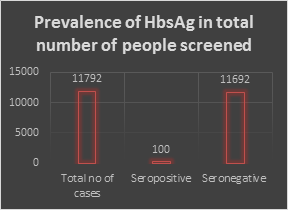
Graph 1: Seroprevalence of HbsAg
|
Gender |
Seropositive cases |
% |
|
Male |
77 |
77% |
|
Female |
23 |
23% |
|
Total |
100 |
100% |
Table 2: Seropositivity for HbsAg according to Gender
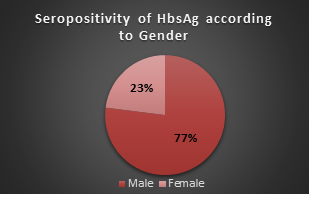
Graph 2: Seropositivity for HbsAg according to Gender
|
Seropositivity of HbsAg According to Age |
||||
|
Age Range |
Male (77) |
Female (23) |
||
|
|
No. |
% |
No. |
% |
|
0-10 |
00 |
0% |
00 |
0% |
|
11-20 |
16 |
21% |
01 |
4% |
|
21-30 |
16 |
21% |
07 |
31% |
|
31-40 |
16 |
21% |
06 |
26% |
|
41-50 |
12 |
15% |
04 |
17% |
|
51-60 |
09 |
12% |
05 |
22% |
|
61-70 |
07 |
9% |
00 |
0% |
|
71-80 |
01 |
1% |
00 |
0% |
Table 3: Seropositivity of HbsAg According to Age
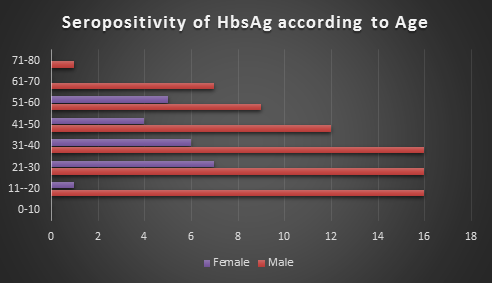
Graph 3: Seropositivity of HbsAg According to Age
Discussion
HBV is the second most common cause of acute viral hepatitis after HEV in India. With a 3.7% point prevalence, that is, over 40 million HBV carriers, India is considered to have an intermediate level of HBV endemicity. According to NCDC newsletter, 2014, every year, one million Indians are at risk for HBV and about 100,000 deaths are reported from HBV infection [10]. It is said that more than 50% of the liver cancer diagnosed is due to chronic Hepatitis B infection [37]. It is a dangerous, life threatening infection and should not be taken lightly.
Certain group of people are more vulnerable to Hepatitis B than the others. These group of people fall under the high-risk category and should be vaccinated at the earliest. The risk factors include people who frequently require blood or blood products, dialysis patients and recipients of solid organ transplantations, people in prisons, people who inject drugs, household and sexual contacts of people with chronic HBV infection, people with multiple sexual partners, healthcare workers and others who may be exposed to blood and blood products through their work and travelers who have not completed their HBV series, who should be offered the vaccine before leaving for endemic areas [11].
In the present study, the seroprevalence was found to be 0.85% (Table 1; Graph1), which comes under low endemicity according to the above-mentioned WHO classification of prevalence of Hepatitis B. We reviewed several papers showing the prevalence of Hepatitis B in various parts of India. Our results were in concordance with G Singh et al. [12], Sood et al. [13], Mathur et al. [10] and Naik et al. [6] which showed a prevalence of 0.40%, 0.87%, 0.94% and 0.56% respectively. Various studies like Ghosh et al. [14], Bhaumik et al. [15], Kanodia et al. [16], Khatoon et al. [17], Sujatha et al. [18], Ramya et al. [19], Latoo et al. [20], Agarwal et al. [21], Wani et al. [22], have categorized HbsAg into a moderate risk infection with a prevalence of 4.94%, 3.6%, 4.13%, 3.9%, 3.7%, 5.10%, 4.4%, 3.9% and 7.86% respectively. Two studies like Sujatha et al., and Sharma et al have shown very high prevalence of 8.6%, and 10.6% respectively putting it under high risk infection. A wide variation in the prevalence of HbsAg is seen in India as well as in different regions of the world. This could be attributed to the genetic make-up, lifestyle habits and the socio-economic status as well. Also, the variability could be due to behavioral environment and host factor [36].
It is lowest in countries or areas with high standard of living like effective vaccination, improved sanitation and safe transfusion measures (e.g. Australia, North America, North Europe) and highest in countries or areas with low socioeconomic levels (e.g. China, South East Asia, South America) [23]. India falls under the category of 2% making it an infection of low-grade prevalence [24].
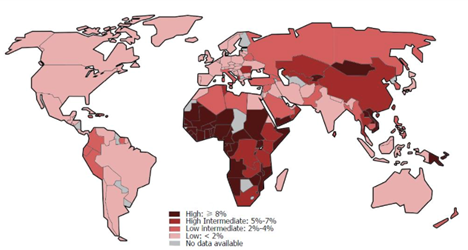
Figure: Distribution of prevalence of HbsAg according to geographic location [24].
In our study, there was an increase in the seroprevalence rate among the male population (77%) as compared to that in female (23%), as shown in Table 2, Graph 2. The gender distribution was seen in accordance with Vazhavandal et al. [23], Kanodia et al. [16], Tripathi P C et al. [25] and Khatoon et al [17]. Higher infection rate in men could be due to their frequent exposure to risk factors such as injecting drug abuse, having multiple sexual partners, unprotected sexual activities, tattooing, etc [26]. Females are thought to clear HBV more swiftly and proficiently.
We also categorized our result on the basis of age range, dividing them in decades. (Table 3, Graph 3) Amongst men the highest percentage of 21% was seen in 2nd, 3rd as well as in the 4th decade followed by 15% in the 5th decade. Various studies like that of Sujatha et al. [18], Vazhavandal et al. [23], Kanodia et al. [16], Sandhu et al. [26], Sood et al. [27], Tripathi P C et al. [25], Khatoon et al. [17], Bulle et al. [28], Patel P H et al. [29], Mathur et al. [10], Gokale et al. [30], Ingale et al. [31], Ramya et al. [19], Bisen VV et al. [32], Naik et al. [6], Narwade et al. [33] showed the highest prevalence in 3rd and 4th decade.
The female group showed a high 31% prevalence in the 3rd decade, followed by 26% in the 4th decade. The other studies showing a predominance in the third decade were Sood et al. [34], Vazhavandal et al. [23], Sandhu et al. [26], Sood et al. [27], Kanodia et al. [16], Tripathi P C et al. [25], Khatoon et al. [17], Bulle et al. [28], Bula et al. [35], Patel P H et al. [29], Gokale et al. [30], Bisen V V et al. [32], Wani et al. [22], Naik et al. [6] and Narwade et al. [33].
The lowest prevalence was seen in children and old age group. The decline in seroprevalence of HBsAg in children is ascribed to the effect of universal immunization programme [16]. The reason attributed to lesser prevalence in old age group could be due to slighter societal interaction [28].
Limitations
The findings in our study was based on rapid card test which can sometimes show false results. More specific tests like radioimmunoassay antigen test or enzyme linked immunosorbent assay should be used for confirmatory results.
Conclusion
We saw a hepatitis B prevalence of 0.85% in apparently healthy individuals. This does not mean that the mortality caused due to hepatitis can be ignored. It indeed remains a fatal infection. Proper immunization and preventive strategies should be applied in our daily clinical practice to reduce its prevalence. These include increasing awareness about the ill-effects of HBV in our community through health education, effective and newer vaccines for HBV, active screening of high-risk groups, provision of safe blood and blood products, awareness about using unsafe sexual practices and unsafe injection practices.
The Indian government needs to initiate new effective programs for the prevention and control for HBV infection. Also, funds should be allocated to community and public health centers for execution and implementation of new schemes. Further screening tests with larger sample size should be carried out to identify and curtail the prevalence of hepatitis B infection in a densely populated country like India.
Source(s) of support:
Self-funded
Conflicting Interest:
None
References
- Alam MM, Zaidi SZ, Malik SA, et al. Serology based disease status of Pakistani population infected with Hepatitis B virus. BMC infectious diseases 7 (2007): 64.
- Rajendiran S, Gopalan U, Jayakumar K. Seroprevalence of hepatitis B infection among pregnant women in South India. Int J Reproduct Contraception Obstet Gynecol 6 (2017): 249-251.
- Lodha R, Jain Y, Anand K, et al. Hepatitis B in India: a review of disease epidemiology. Indian pediatrics 38 (2001): 349-371.
- Batham A, Narula D, Toteja T, et al. Systematic review and meta-analysis of prevalence of hepatitis B in India. Indian pediatrics 44 (2007): 663.
- Horvat RT, Tegtmeier GE. Hepatitis B and D viruses. Manual of Clinical Microbiology.
- Naik TB, Sathish JV, Wadekar MD. Seroprevalence of Hepatitis B Surface Antigen (HBsAg) among Patients Attending a Tertiary Care Hospital at Chamarajanagar, Karnataka, India. Int. J. Curr. Microbiol. App. Sci 7 (2018): 1279-1284.
- Quadri SA, Dadapeer HJ, Arifulla KM, Khan N. Prevalence of hepatitis B surface antigen in hospital based population in Bijapur, Karnataka. Al Ameen J Med Sci 6 (2013): 180-182.
- Clinical Laboratory Standards Institute. Procedures for the collection of diagnostic blood specimens by venipuncture. CLSI H3-A6 document.
- Satsangi S, Chawla YK. Viral hepatitis: Indian scenario. medical journal armed forces india 72 (2016): 204-210.
- Mathur P, Gupta PS, Singh R, et al. Seroprevalence of Hepatitis B Surface Antigen and Anti-hepatitis C Virus Antibody in a Hospital-Based Population in Ajmer, Rajasthan, India. Int J Curr Microbiol App Sci 5 (2016): 1023-1029.
- WHO,Hepatitis B, 18 July 2019; https://www.who.int/news-room/fact-sheets/detail/hepatitis-b
- Singh G, Singh MP, Walia I, et al. Screening for hepatitis B and C viral markers among nursing students in a tertiary care hospital. Indian journal of medical microbiology 28 (2010): 78.
- Sood S, Malvankar S. Seroprevalence of Hepatitis B surface antigen, antibodies to the Hepatitis C virus, and human immunodeficiency virus in a hospital-based population in Jaipur, Rajasthan. Indian journal of community medicine: official publication of Indian Association of Preventive & Social Medicine 35 (2010): 165.
- Ghosh A. Prevalence of hepatitis B infection in a tertiary care hospital, north east region of India. Journal of Evolution of Medical and Dental Sciences 3 (2014): 10413-10419.
- Bhaumik P, Sil SK, Debnath K, Bhattacharjee S. Prevalence Of Hepatitis B In Tripura: A Community Based Study.
- Kanodia V, Yadav M, Bittu R, et al. Seroprevalence of Hepatitis B surface antigen in hospital based population of Jaipur, Rajasthan. MedPulse Int Med J 2 (2015): 123-125.
- Khatoon R, Jahan N. Evaluation of seroprevalence of Hepatitis B virus infection among patients attending a hospital of semi-urban North India using rapid immunoassay test. Nigerian Postgraduate Medical Journal 23 (2016): 209.
- Sujatha R, Pal N. Seroprevalence Of Hepatitis B Surface Antigen Among Patient’s Attending Tertiary Care Center In Kanpur.
- Ramya Dinesh E, Ramalakshmi S. Prevalence of Hepatitis B virus and associated risk factors in Irula tribal Population. Asian J Pham Clin Res 10 (2017): 100-102.
- Latoo S, Shafi M, Nazir H. Sero-prevalence of Hepatitis B and C virus among patients attending Dental clinics in Kashmir Valley. IAIM 4 (2017): 53-59.
- Agarwal L, Singh AK, Agarwal A, Singh RP. Incidental detection of hepatitis B and C viruses and their coinfection in a hospital-based general population in tertiary care hospital of Uttar Pradesh. Journal of family medicine and primary care 7 (2018): 157.
- Wani MI, Rashid A, Tanvir M, Ajaz S. Prevalence of Hepatitis B in Kargil, Ladakh; Community Based study from a Rural area of Jammu and Kashmir. Ann. Int. Med. Dent Res 3 (2015).
- Vazhavandal G, Uma A. Seroprevalence of hepatitis B virus among patients at a rural tertiary health care centre in South India: A four year study. Int J Res Med Sci 2 (2014): 310-313.
- Jefferies M, Rauff B, Rashid H, et al. Update on global epidemiology of viral hepatitis and preventive strategies. World journal of clinical cases 6 (2018): 589.
- Tripathi PC, Chakraverti TK, Khant NR. Seroprevalence of hepatitis B surface antigen and antibody to hepatitis C virus at a tertiary care Centre in Telangana. Int J Res Med Sci 3 (2015): 297-300.
- Sandhu, R., Sharma, G. 2014. Prevalence of Hepatitis B surface antigen as a serological marker in HBV infection. IJPBS 4(1): 19-24.
- Sood S, Malvankar S. Seroprevalence of Hepatitis B surface antigen, antibodies to the Hepatitis C virus, and human immunodeficiency virus in a hospital-based population in Jaipur, Rajasthan. Indian journal of community medicine: official publication of Indian Association of Preventive & Social Medicine 35 (2010): 165.
- Bulle A, Suchita PT, Gedam SS, et al. Prevalence of hepatitis B surface antigen (HBsAg) positivity among general population in Yavatmal (Maharashtra), India. International journal of current microbiology and applied sciences 5 (2016): 513-517.
- Patel PH, Nerurkar AB, Patel MR. Seroprevalence of Hepatitis B Surface Antigen in patients attending a tertiary care hospital Valsad, South Gujarat, India. Int J Med Microbiol Trop Dis 2 (2016): 103-106.
- Gokale SK, Sonth SB, Solabannavar SS. Seroprevalence of Hepatitis B Virus among Patients at a Tertiary Care Centre in North Karnataka, India. Int. J. Curr. Microbiol. App. Sci 6 (2017): 755-757.
- Ingale H, Medhekar P, Hirani N, et al. Seroprevalence of Hepatitis B Surface Antigen (HBsAg) Among Patients at a Tertiary Care Hospital in Mumbai, India. Int. J. Curr. Microbiol. App. Sci 6 (2017): 722-726.
- Bisen VV, Nath D. A Preliminary Prospective Study for Seroprevalance of Hepatitis B Positivity in Hospital-Based Population from Bundelkhand Region of Uttar Pradesh. J Trop Dis 6 (2018): 2.
- Narwade PP, More SR, Kandle SK, et al. Seroprevalence of Hepatitis B Surface Antigen (HBsAg) among Patients Attending a Tertiary Care Hospital. Int. J. Curr. Microbiol. App. Sci 8 (2019): 1014-1018.
- Sood S. Serological Evaluation of Hepatitis B Virus in out patient Department patients of a private Hospital in North–West India. National J of Community Medicine 4 (2013): 485-488.
- Bula A, Gaddam SR. Seroprevalence of Hepatitis B Surface Antigen positive Patients Attending a Tertiary Care Hospital in Srikakulam, Andhra Pradesh. Annals of Pathology and Laboratory Medicine 4 (2017): A96-99.
- Mindolli PB, Salmani MP. Hepatitis B Virus Seroprevalence among Hospital Based General Population in a Tertiary Care Centre. Int. J. Curr. Microbiol. App. Sci 4 (2015): 964-967.
- Available at: https://www.hepb.org/blog/link-hepatitis-b-liver-cancer/, Last seen on: 20/02/202