Frédéric Vangroenweghe1,2* ORCID, Wolter Roorda3
1Elanco Animal Health Benelux – BU Swine & Ruminants, Generaal Lemanstraat, 55/3, 2018 Antwerpen, Belgium
2Ghent University, Faculty of Veterinary Medicine, Dept. Internal Medicine- Reproduction-Population Medicine, Unit of Porcine Health Management, Salisburylaan 133, 9820 Merelbeke, Belgium
3DAP VUG, Evertsenlaan 18, 3781 TB Voorthuizen, The Netherlands
*Corresponding Author: Elanco Animal Health Benelux-BU Swine & Ruminants, Generaal Lemanstraat, 55/3, 2018 Antwerpen, Belgium
Received: 13 July 2026; Accepted: 20 July 2026; Published: XX July 2026
Abstract: During the post-weaning period piglets might undergo infectious challenges such as enterotoxigenic Escherichia coli (ETEC) resulting in post-weaning diarrhea (PWD) and increased piglet variation. To prevent the negative effects of PWD, a preventive vaccination with live non-pathogenic oral E. coli F4F18 vaccine (Coliprotec F4/F18; Elanco AH) was implemented. The objective was to evaluate the effect of E. coli vaccination on PWD-related disease, mortality, number of runt piglets and antimicrobial use (TI100) at the end of the post-weaning period. An 800-sow farm (TN70) in the Netherlands suffered from PWD due to F4-ETEC during the post-weaning period. Following diagnostic confirmation, vaccination with a live, non-pathogenic oral E. coli F4F18 vaccine (Coliprotec F4/F18; Elanco AH) was implemented at 18 days of age. Data capture included number of piglets (d0-40), mortality, number of runt piglets and antimicrobial use (TI100). The trial compared a historical Control group (n = 3 batches, 1,908 piglets) to a Vaccine group (n = 3 batches, 2,254 piglets). Statistical analysis was performed using JMP 17.1. Mortality following E. coli vaccination significantly reduced (7 vs. 19; P = 0.001; 3.1% vs. 0.9%; P = 0.003). Moreover, a significant improvement in the number (55 vs. 6; P = 0.001) and percentage (8.6% vs. 0.9%; P = 0.006) of runt piglets occurred. The number of days on antimicrobial treatment, given as TI100, reduced from 12.5 days to 0 days following E. coli vaccination (P < 0.001). A positive ROI of + 2.06 (vaccine cost included) was generated. For the 800-sow farm, this resulted in an increase income of € 57,771.55. In conclusion, implementation of a preventive vaccination of a live non-pathogenic oral E. coli F4F18 vaccine could reduce mortality and number of runt piglets at the end of the nursery period, while reducing the TI100. Overall, a positive ROI of 2.06 per piglet was obtained.
Post-weaning diarrhea; E. coli vaccination; Runt piglets; Coliprotec F4/F18
Post-weaning diarrhea articles; E. coli vaccination articles; Runt piglets articles; Coliprotec F4/F18 articles
Abbreviations
The following abbreviations are used in this manuscript:
- coli: Escherichia coli
- EU: European Union
- ETEC: Enterotoxigenic Escherichia coli
- LT: Thermolabile toxin
- o: Per os
- PWD: Post-weaning diarrhea
- ROI: Return-on-investment
- SDa: Stichting Diergeneesmiddelen autoriteit
- STa: Thermostabile toxin a
- STb: Thermostabile toxin b
- TI100: Treatment incidence over a 100-day period
Introduction
During the post-weaning period piglets might undergo infectious challenges such as enterotoxigenic Escherichia coli (ETEC) resulting in post-weaning diarrhea (PWD). Besides diarrhea, dehydration, decreased growth and eventually mortality, PWD is frequently associated with increased piglet variation [1]. The clinical problem is associated with fecal shedding of ETEC that proliferates in the small intestine of piglets from 3 days post-weaning [1,2]. The bacteria will adhere to glycoprotein receptors present on the brush border of the enterocytes at the level of the intestinal villi of the small intestine through their fimbriae, namely F4 or F18 [2]. Once attached, ETEC colonizes the small intestine and secrete enterotoxins: heat-labile toxin (LT) and/or heat-stable toxins (STa or STb) [2]. The toxins will induce both an increased secretion of electrolytes and reduced absorption of liquids, resulting in hypersecretion of water and electrolytes into the lumen of the small intestine exceeding the colonic capacity for reabsorption due to post-weaning stress. This eventually leads to clinical diarrhea [3]. This pathology causes significant economic losses as they result in impaired growth, inter-piglet variation, mortality, and increased antimicrobial use [1]. The strongly negative impact of PWD due to E. coli F4/F18 can be managed through various therapeutic and preventive solutions. To prevent the negative effects of PWD, a preventive vaccination with live, non-pathogenic oral E. coli F4/F18 vaccine (Coliprotec F4/F18; Elanco Animal Health; Indianapolis, IN, USA) can be implemented [4], resulting in a strong reduction of fecal shedding and a decrease in clinical severity [5-7]. Vaccination with Coliprotec F4/F18 under field conditions resulted in improved performance [8-10], reduced antimicrobial use [8-11] and reduced occurrence of secondary Streptococcus suis-related meningitis and death [12]. The objective was to evaluate the effect of E. coli vaccination on PWD-related disease, mortality, number of runt piglets and TI100 at the end of the nursery period.
Materials and Methods
Description of farrow-to-wean breeding farm
An 800-sow farrow-to-wean farm in the Netherlands with TN70 (Topigs-Norsvin, Vught, The Netherlands) managed in a 1-week batch management system suffered from PWD due to E. coli during the post-weaning period. Sows were housed individually in a farrowing crate from 5 days prior to farrowing. Five days after birth, piglets were allowed to leave the farrowing pen and explore a common feeding space behind the farrowing crate to commingle with piglets from all 40 farrowed sows within the specific week batch. At 27 days of age, piglets were weaned and transferred into specific post-weaning facilities where they were housed in larger pens (60 piglets per pen) and fed a liquid post-weaning diet 5 times a day. From as early as 2 days post-weaning, piglets started to develop clinical diarrhea which needed a short 5-day treatment p.o. with colistin through the liquid feeding system.
Diagnosis of PWD due to E. coli
The farm suffered for several months from PWD outbreaks due to ETEC in every consecutive weekly batch. Therefore, piglets (n = 5) that remained untreated for a 6-day period with typical clinical signs of PWD, such as watery diarrhea, a thin belly, and signs of dehydration, were sampled using rectal swabs (Sterile Transport Swab Amies with Charcoal medium; Copan Italia S.p.A., Brescia, Italy). All sampled piglets were post-weaned for 3 to 5 days. The diagnostic samples were sent to the laboratory (IZSLER, Brescia, Italy) under cooled conditions for further processing. Specimens were processed using the standard procedures for the isolation and characterization of intestinal E. coli [13]. Briefly, samples were plated on selective media and on tryptose agar medium supplemented with 5% defibrinated ovine blood and incubated aerobically overnight at 37 ◦C. Haemolytic activity was evaluated, and single coliform colonies were further characterized. DNA samples were prepared from one up to five hemolytic and/or non-hemolytic E. coli colonies and used to perform a multiplex PCR for the detection of fimbrial and toxin genes, including those encoding for F4 (K88), F5 (K99), F6 (987P), F18, F41, LT, STa, STb, and Stx2e, but not discriminating between F4ab, F4ac, and F4ad. The methodology used for the identification of these virulence genes has been described previously [13]. All collected samples were positive for F4 in combination with STa, STb, and LT. No other virulence factors could be detected.
Field trial design
To evaluate the potential effect of an E. coli F4/F18 vaccination (Coliprotec F4/F18; Elanco Animal Health), production performance and health data from 3 consecutive Control (= standard treatment with colistin) and 3 subsequent Vaccine batches were compared.
Vaccination protocol
Following confirmation of the E. coli pathotype (F4-ETEC), a vaccination with a live non-pathogenic oral E. coli F4/F18 vaccine (Coliprotec F4/F18) was implemented at 18 days of age through individual drench application with a volume of 2 ml of resuspended vaccine [6,7]. No antimicrobials were administered to the suckling piglets from 3 days prior to 3 days after the oral vaccination.
Data capture of performance and health data
Data capture included number of piglets (d0, at weaning; d40 end of nursery), mortality, number of runt piglets and antimicrobial use (treatment incidence over 100 days in nursery; TI100). The field trial compared a historical Control group (n = 3 batches, 1908 piglets) to a Vaccine group (n = 3 batches, 2254 piglets).
Statistical analysis
Statistical analysis was performed using JMP 17.1.
Results
Mortality following E. coli vaccination significantly reduced (7 vs. 19; P = 0.001; 3.1% vs. 0.9%; P = 0.003) (Table 1, Figure 1). Moreover, a significant improvement in the number (6 vs. 55; P = 0.001) and percentage (0.9% vs. 8.6%; P = 0.006) of runt piglets occurred (Table 1, Figure 2). The number of days on antimicrobial treatment, given as TI100, reduced from 12.5 days to 0 days following E. coli vaccination (P < 0.001) (Table 1). A positive ROI of + 2.06 (vaccine cost included) was generated. For the 800-sow farm, this resulted in an increase in income of € 57771,55 (Table 2).
Table 1: Performance data of post-weaned piglets in Control and Vaccine group with focus on mortality, runt piglets, antimicrobial use and return-on-investment. Significant differences are given by a P-value < 0.05.
|
|
Control |
Vaccine |
P-value |
|
# piglets |
1908 |
2254 |
- |
|
Mortality (%) |
3.09 |
0.93 |
0.0034 |
|
Runt piglets (%) |
8.6 |
0.9 |
0.0069 |
|
TI100 (d) |
12.5 |
0 |
0.0001 |
|
ROI incl. runt piglets |
- |
2.06 |
- |
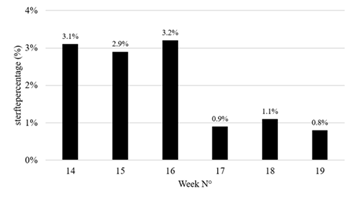
Figure 1: Percentage mortality during the field trial comparing piglets in a Control group to piglets vaccinated with a live, non-pathogenic oral E. coli F4/F18 vaccine (Coliprotec F4/F18; Elanco Animal Health) expressed as percentage per week group. The red dotted line indicates the border between Control and Vaccine group.
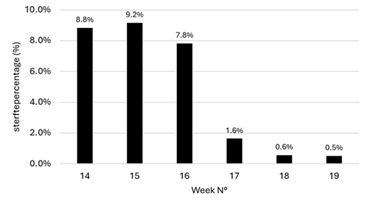
Figure 2: Percentage runt piglets during the field trial comparing piglets in a Control group to piglets vaccinated with a live, non-pathogenic oral E. coli F4/F18 vaccine (Coli Protec F4/F18; Elanco Animal Health) expressed as percentage per week group. The red dotted line indicates the border between Control and Vaccine group.
Table 2: Return-on-investment calculation based on the performance data collected during the field trial comparing piglets in a Control group to piglets vaccinated with a live, non-pathogenic oral E. coli F4/F18 vaccine (Coliprotec F4/F18; Elanco Animal Health).
|
Input variables |
Control |
Vaccine |
|
Weaning weight (kg) |
5.5 |
5.5 |
|
Selling price at 20 kg (€/piglet) |
50.00 € |
50.00 € |
|
Duration post-weaning period (days) |
40 |
40 |
|
Average daily weight gain (g/day) |
348 |
348 |
|
Feed conversion rate (kg feed/kg growth) |
1.91 |
1.91 |
|
Feed cost post-weaning diet (€/tonne) |
324.00 € |
324.00 € |
|
Mortality percentage (%) |
3.07 |
0.93 |
|
Percentage runt piglets at end (%) |
8.6 |
0.9 |
|
Treatment costs (€/day/piglet) |
0.05 € |
0.00 € |
|
Treatment incidence (# days per 100 days pw) |
5 |
0 |
|
Vaccine cost (€/dose) |
1.00 € |
1.00 € |
|
Number of sows at farm |
800 |
800 |
|
Number weaned piglets per sow per year |
35 |
35 |
|
ROI calculation |
||
|
Weight at end pw (kg) |
22.41 |
22.96 |
|
Total feed intake (kg) |
32.3 |
31.95 |
|
Total feed cost (€/piglet) |
10.47 € |
10.35 € |
|
Treatment costs (€/piglet) |
0.05 € |
0.00 € |
|
Supplement piglet selling (+20 kg) (€/piglet) |
2.41 € |
2.96 € |
|
Opportunity cost for mortality (€/piglet) |
1.54 € |
0.47 € |
|
Opportunity cost for runt piglets (€/piglet) |
1.43 € |
0.15 € |
|
Vaccine cost (€/piglet) |
0.00 € |
1.00 € |
|
Margin per piglet (€/piglet) |
38.93 € |
40.99 € |
|
Extra margin per piglet vaccine (€/piglet) |
2.06 € |
|
|
ROI |
2.06 |
|
|
Impact Coli Protec F4F18 at farm level |
||
|
Total number of weaned piglets per year |
|
28 |
|
Vaccine costs (€/year) |
|
28,000.00 € |
|
Extra margin through vaccination (€/year) |
|
57,771.55 € |
Discussion
The current field study on vaccination of piglets pre-weaning to protect against PWD due to F4-ETEC clearly demonstrates that performance and health parameters significantly improved in the vaccinated piglets. In addition, the overall ROI of the preventive approach was quite positive, based on the improved mortality rate, the reduction of the number of runt piglets at the end of the post-weaning period and the reduction in antimicrobial treatment. Although the average daily gain remained similar in both groups, the weight at the end of the post-weaning period was slightly increased in the vaccinated group, mainly due to the decrease in piglet variation following the E. coli vaccination. This observation is in line with a previous study by Correa et al. [5]. The decrease in the percentage of runt piglets from 8,6% to 0,9% was the most remarkable effect following oral E. coli vaccination. This might be explained by the fact that under field conditions PWD due to E. coli does not affect all piglets in a pen or compartment [2-14]. In most cases between 20 to 50% of all weaned piglets may be affected by the clinical condition. Following vaccination, this specific group of piglets at risk mount a local mucosal immunity based on secretory IgA antibodies that prevent the pathogenic F4- and F18-ETEC from attaching to the mucosal F4 and F18 receptors and subsequently producing their enterotoxins that disrupt the electrolyte balance in the small intestine [1-7]. The current field study was carried out using a historical Control group which could be considered as a minor negative aspect. However, from a practical point of view, the current farm did not allow us to run concurrent treatment groups at the same time due to several practical constraints. Per week batch, only one post-weaning compartment was available for the post-weaned piglets. Therefore, standard antimicrobial treatment in the Control group distributed through the wet feeding system could not be discontinued in only one part of the room. In addition, the construction of the barn did not efficiently allow to separate both treatment groups with a sufficient level in internal biosecurity to omit the spread of pathogens between both treatment groups. A third practical issue was that piglets had to be vaccinated pre-weaning, since onset of immunity of the oral live non-pathogenic E. coli vaccine is 7 days, and piglets of different litters are commingled according to weight and general condition at weaning. Changes in these day-to-day routine management aspects would complicate the set-up and performance of this practical field trial and might lead to unvoluntary and non-detectable errors that might have blurred the results and conclusions. Using the current study design allow us to only change one specific parameter i.e., vaccination of piglets prior to weaning and evaluate the effects of this implemented strategy with changes in any other management practices. In the Netherlands, antimicrobial use at farm and animal category level (sows, piglets, fattening pigs) are registered in a central database (SDa, www.autoriteitdiergeneesmiddelen.nl) per veterinarian on a quarterly basis. Based on these registrations and the on-farm registration of the antimicrobial products, we could analyze the TI100 and details of all administered products for PWD. The current study demonstrated a drastic decrease in antimicrobial use following implementation of an oral live non-pathogenic E. coli vaccine in piglets to prevent the clinical signs of PWD due to F4-ETEC. Indeed, both the overall TI100 and the more detailed antimicrobial use data per weekly batch showed a marked decrease in antimicrobial use following vaccination. The number of days that antimicrobials were administered for treatment of PWD decreased from 5 to 0 days, immediately following the start of the implementation of the preventive E. coli vaccinationThese results are in accordance with previous studies using the E. coli vaccine [8-12] where similar reduction of approximately 80-99% could be observed. In the current study, TI100 total number of treatment days per 100 days in nursery – could be reduced to 0, meaning a total stop of antimicrobial treatment for PWD following the E. coli vaccination. Mortality data were recorded in detail keeping track of number of dead piglets. A significant reduction of mortality (-2.16%) was observed in the Vaccine-treated group as compared to the Control group. On the total number of weaned piglets (2254 piglets in the Vaccine group) 49 extra piglets could move to the next phase, which could also be considered an important economic benefit following E. coli vaccine implementation. Based on our previously published ROI calculator [10], we could calculate that improved performance and health in the E. coli vaccinated group resulted in a net ROI of 2.06 as compared to the Control group. The main economic drives for this positive result were the reduced mortality and number of runt piglets, combined with the reduction in cost of antimicrobial treatment. These results are in line with previous field studies demonstrating that vaccination has a decent ROI [10].
Conclusion
The current study reported efficacy of an oral live non-pathogenic E. coli vaccine for active immunization of piglets against PWD due to F4-ETEC under field conditions. Vaccine-treated groups showed an improvement in several economically important performance parameters such as mortality and piglet variation (measured by percentage of runt piglet end of nursery), while reducing overall antimicrobial use. Therefore, vaccination against PWD may be considered a valuable alternative to consolidate piglet performance while meeting the new EU requirements concerning prudent use of antimicrobials in intensive pig production. Overall, implementation of the E. coli vaccination resulted in a positive ROI of 2.06 per piglet when taking the reduction of the percentage of runt piglets into account.
Ethical approval statement
No ethical approval was needed for field study since there were no specific invasive interventions on the study animals during the study period to obtain the required data.
Informed consent
The farmer agreed with the collection of required data during the field trial.
Author contribution statement
Conceptualization, F.V. and W.R; methodology, F.V; formal analysis, F.V; investigation, F.V. and W.R; resources, F.V; data curation, F.V; writing, original draft preparation, F.V; writing, review and editing, F.V. and W.R; visualization, F.V; supervision, F.V. All authors have read and agreed to the published version of the manuscript.
Supplementary Materials
No additional supplementary materials are available.
Finding
This research received no external funding.
Data Availability Statement
Data can be obtained after contact with the authors.
Acknowledgments
The authors greatly acknowledge the farmer for his diligent registration of all required data in the field study.
Conflicts of Interest
The authors declare no conflicts of interest.
References
- Fairbrother J.M, Nadeau E, Gyles Carlton L. Escherichia coli in postweaning diarrhea in pigs: an update on bacterial types, pathogenesis and prevention strategies. Anim. Health Res. Rev 6 (2005): 17-39.
- Fairbrother J.M, Gyles L.G. Colibacillosis. In: Diseases of Swine. Zimmerman JJ, Karriker LA, Ramirez A, Schwartz KJ and Stevenson GW Editors. 10th Edition. John Wiley and Sons, Inc 53 (2012): 723-749.
- Boudry G, Peron V, Le Huerou-Luron I, Lalles J. P, Seve B. Weaning induces both transient and long-lasting modifications of absorptive, secretory, and barrier properties of piglet intestine. J. Nutr 134 (2004): 2256-2262.
- European Commission, 2024. Public Health - Union Register of Medicinal Products 2 (2026).
- Correa F, Luise D, Amatucci L, et al. Effect of an Escherichia coli F4/F18 bivalent oral live vaccine on gut health and performance of healthy weaned pigs. Animal 16 (2022): 100654.
- Fairbrother J.M, Nadeau E, Bélanger L, et al. Immunogenicity and protective efficacy of a single-dose live non-pathogenic Escherichia coli oral vaccine against F4-positive enterotoxigenic Escherichia coli challenge in pigs. Vaccine 35 (2017): 353-360.
- Nadeau E, Fairbrother J.M, Zentek J, et al. Efficacy of a single oral dose of a live bivalent coli vaccine against post-weaning diarrhea due to F4 and F18-positive enterotoxigenic E. coli. Vet. J 226 (2017): 32-39.
- Vangroenweghe F, Thas O. Improved piglet performance and reduced antibiotic use following oral vaccination with a live avirulent Escherichia coli F4 vaccine against post-weaning diarrhea. J. Clin. Res. Med 3 (2020): 1-8.
- Vangroenweghe F, Thas O. Application of high energy and protein ciets in combination with a live avirulent Escherichia coli F4 vaccine against post-weaning diarrhea. Vacc. Res 7 (2020): 1-9.
- Vangroenweghe F. Improved piglet performance and reduced mortality and antimicrobial use following oral vaccination with a live non-pathogenic Escherichia coli F4/F18 vaccine against post-weaning diarrhoea. Aust. J. Infect. Dis 8 (2021): 1048-1053.
- Vangroenweghe F, Matthijs T, Sinnaeve M. Vaccination with a live avirulent coli vaccine resulted in improved production performance combined with a significant reduction in antimicrobial use. Antibiotics 14 (2025): 547-563.
- Vangroenweghe F, Boone M. Vaccination with an Escherichia coli F4/F18 vaccine improves piglet performance combined with a reduction in antimicrobial use and secondary infections due to Streptococcus suis. Animals 12 (2022): 2231-2243.
- Luppi A, Gibellini M, Gin T, et al. Prevalence of virulence factors in enterotoxigenic Escherichia coli isolated from pigs with post-weaning diarrhea in Europe. Porcine Health Manag 2 (2016): 20-25.
- Taylor DJ. Post-weaning enteritis. In: Pig diseases. 7th Edition (1999): 143-144.