Mutsumi Takahashi1*, Yogetsu Bando2, Takuya Fukui3,4
1Department of Physiology, The Nippon Dental University School of Life Dentistry at Niigata 951-8580, Japan
2Bando Dental Clinic, Ishikawa 920-0922, Japan
3Department of Sport Science, Kanazawa Gakuin University of Sport Science, Ishikawa 920-1392, Japan
4Japan Gymnastics Association Trampoline Committee, Tokyo 160-0013, Japan
*Corresponding Author: Mutsumi Takahashi, Department of Physiology, The Nippon Dental University School of Life Dentistry at Niigata 951-8580, Japan.
Received: 18 July 2026; Accepted: 24 July 2026; Published: 31 July 2026
Purpose: The purpose of the present study was to clarify the relationship between predictive postural control function and visual function by performing an occlusal intervention involving an intraoral appliance in trampoline gymnasts.
Method: Participants were 12 male trampoline gymnasts (mean age 17.8±2.1 years). Predictive postural control function was evaluated using the R/E value calculated by a cross-test using a center of gravity sway meter. Visual function was assessed by measuring depth perception and dynamic visual acuity. For occlusion intervention, custom mouthguards were fabricated for participants, and predictive postural control function and dynamic visual acuity were measured under two conditions: with and without the mouthguard. The correlation between the R/E value and each visual function was analyzed using Pearson’s product-moment correlation coefficient or Spearman’s rank correlation coefficient. Differences in R/E values and dynamic visual acuity due to occlusal intervention were analyzed using a paired t-test or Wilcoxon signed-rank test. The correlation between the rate of change in R/E value and the rate of change in dynamic visual acuity due to mouthguard wearing was analyzed using Spearman’s rank correlation coefficient.
Results: A significant negative correlation was observed between the R/E value and depth perception (P<0.05). No significant correlation was found between R/E values and dynamic visual acuity. The R/E value and dynamic visual acuity were affected by the occlusal intervention, and both were improved (P<0.01). A significant correlation was found between the rate of change in R/E value and dynamic visual acuity due to occlusal intervention (P<0.05).
Conclusion: The results of this study revealed that the predictive postural control function assessed by the cross-test is related to depth perception, and that occlusal intervention improves predictive postural control function and dynamic visual acuity, with a correlation being found between the two.
Trampoline Gymnast; Predictive postural control; Visual function; Sports vision; Mouthguard; Occlusion
Trampoline Gymnast articles; Predictive postural control articles; Visual function articles; Sports vision articles; Mouthguard articles; Occlusion articles
1. Introduction
The human postural control system consists of predictive postural control and reactive postural control [1]. Predictive postural control is a feed-forward type of postural control in which postural maintenance muscles activate before agonist muscles in situations where predictable external disturbances are present or during voluntary movements, thereby buffering postural sway. In contrast, reactive postural control is a feedback mechanism that regulates postural disturbances caused by external disturbances, such as rapid reflexes to unexpected changes. Normal function of these postural control systems enables movements that adapt to the external environment.
The three main sensory inputs for postural control are vision, somatosensation, and vestibular sensation. The information received from these sensory inputs in response to changes in posture is sent to the central nervous system, which integrates it and sends motor commands to the skeletal muscles, thereby maintaining postural stability [1-3]. Postural stability can be broadly divided into static balance and dynamic balance, both of which have a variety of evaluation methods [2]. The evaluation method is selected according to the subject’s age and whether or not they have any musculoskeletal or nervous system disorders, In the case of athletes, the characteristics of their sport or event are also considered.
We have previously investigated occlusion, which can affect somatosensory and vestibular sensory input, examining its effects on postural control and motor function. Those studies have revealed that the static and dynamic center-of-gravity sway measured by a center of gravity sway meter is affected by the left–right balance of occlusal contact (occlusal balance); that badminton and handball players with good occlusal balance have high agility; and that improving occlusal balance with an intraoral appliance contributes to improving trunk stability and dynamic balance when clenching [4-8].
The purpose of the present study was to clarify the relationship between predictive postural control function and visual function by performing an occlusal intervention involving an intraoral appliance in trampoline gymnasts, for whom balance ability is critical. The null hypothesis was that the relationship between predictive postural control function and visual function would not be affected by occlusal intervention.
2. Materials and Methods
2.1. Ethical approval of studies and informed consent
This study was conducted with the approval of the Ethics Committee of The Nippon Dental University School of Life Dentistry at Niigata (approval no. ECNG-R-443). The study aims and procedures were fully explained to all participants, and written informed consent was obtained from all individuals before their participation.
2.2. Participants
The participants were 12 male trampoline gymnasts (mean age 17.8±2.1 years) who had no subjective or objective morphological or functional abnormalities in the stomatognathic system. The average length of competitive experience was 11.8 ± 2.0 years.
2.3. Fabrication of Custom Mouthguard
Custom mouthguards were fabricated for each gymnast, using a 2.0-mm-thick ethylene-vinyl acetate thermoplastic elastomer (Sports Mouthguard; Keystone Industries, Cherry Hill, NJ) and a pressure molding machine (Model Capture Try; Shofu Inc., Kyoto, Japan). After correction of the shape and polishing, the mouthguard was fitted into each gymnast’s mouth and adjusted so that all teeth were in even contact with light clenching [6-8]. The state of the occlusal contact of the mouthguard was confirmed by occlusal examination using blue silicone (Bite Eye; GC Co., Tokyo, Japan).
2.4. Measurement of predictive postural control function
Predictive postural control function was evaluated by a cross-test using a center of gravity sway meter (GRAVICORDER GS-7; Anima Corp., Tokyo, Japan) [9-11]. Participants were asked to stand upright with the inner sides of their feet 5 cm from the reference line on the measuring table, and in a natural standing position with both upper limbs touching the sides of their bodies. Participants were instructed to focus their gaze on a target object 2 m in front of them at eye level. For the measurement, participants were instructed to start from a stationary standing position and slowly move their upper body forward, to the reference position, backward, to the reference position, to the left, to the reference position, to the right, and back to the reference position, over a period of 3 s for each movement. During the measurement, participants were instructed to not let the soles of their feet leave the measurement table. There were two measurement conditions: mouthguard (MG) and no mouthguard (NMG). No instructions were given regarding occlusion or clenching during the measurements. The rectangular area obtained by multiplying the distance traveled by the center-of-foot pressure in the forward and backward directions as well as the left and right directions was calculated; the value obtained by dividing this value by the peripheral area (i.e., the R/E value) was used as an index of predictive postural control function [9,10].
2.5. Measurement of visual function
Visual function was assessed by measuring depth perception (DP) and two types of dynamic visual acuity. DP was measured under the NMG condition, while dynamic visual acuity was measured under both the MG and NMG conditions.
DP was measured using an electric depth perception meter (AS-7JS1; Kowa Co. Ltd., Aichi, Japan). The measuring device consists of two fixed rods and one movable rod. Participants were positioned 2.5 m away from the measuring device, with their eyes at the same height as the measuring device. Participants were instructed to press the stop button when the moving rod, moving at 50 mm/s, appeared to be aligned horizontally with the fixed rod. The error (in millimeters) of the movable rod from the fixed rod was displayed on the position indicator of the control box and recorded.
Kinetic visual acuity (KVA) was measured using a dynamic visual acuity monitor (AS-4A; Kowa Co. Ltd.). The measuring device was designed to correspond to a static visual acuity of 1.0 when the participant was 30 m away from the Landolt ring. The Landolt ring traveled in a straight line at 30 km/h from 50 m to 2 m in front of the participant. Participants pressed the switch button the moment they identified the gap in the Landolt ring. When the orientation of the gap in the Landolt ring was correct, the value converted from the distance was recorded.
Dynamic visual acuity (DVA) was measured using a different dynamic visual acuity monitor (HI-10; Kowa Co. Ltd.). The Landolt ring of the measuring device moves horizontally from left to right across a 90-degree hemispherical screen. Participants tracked the Landolt ring, using eye movements alone as it gradually decelerated from 40 rpm/min. Participants pressed a switch button the moment they identified a gap in the Landolt ring and answered the direction of the gap. The value when the answer was correct was recorded.
2.6. Statistical analysis
Statistical analyses were performed using SPSS 17.0 software (SPSS Japan Inc., Tokyo, Japan). The significance level was set at P<0.05. Normality was analyzed using the Shapiro–Wilk test.
Because normality was not observed in DP, the correlation between R/E value and DP was analyzed using Spearman’s rank correlation coefficient. Regarding the relationship between R/E values and dynamic visual acuity, normality was observed at both levels except for DVA. The correlation between R/E value and KVA was analyzed using Pearson’s product–moment correlation coefficient, and the correlation between R/E value and DVA was analyzed using Spearman’s rank correlation coefficient.
Regarding the effect of occlusal intervention on R/E values and dynamic visual acuity, normality was not observed for each variable of the DVA measurement. Therefore, R/E values and KVA were analyzed using a paired t-test, while DVA was analyzed using the Wilcoxon signed-rank test.
Finally, we calculated the rate of change in R/E values and dynamic visual acuity due to wearing the mouthguard, and analyzed the correlation between the two. Because normality was not observed at any level, correlation analysis was performed using Spearman’s rank correlation coefficient.
3. Results
The results of the correlation analysis between R/E value and DP is shown in Figure 1. A significant negative correlation was found between the two; specifically, the higher the R/E value, the lower the DP value (R=-0.689, P<0.05).
The results of the correlation analysis between R/E values and dynamic visual acuity are shown in Figure 2. There was a tendency for KVA to increase as the R/E value increased, but the correlation was not significant (R=0.473, P=0.120). Similarly, the higher the R/E value, the higher the DVA tended to be, but the correlation was not significant (R=0.491, P=0.105).
Figure 3 shows the difference in R/E values due to occlusal intervention. The R/E value was significantly higher under the MG condition (P<0.01).
Figure 4 shows the difference in dynamic visual acuity due to occlusal intervention. Both KVA and DVA were significantly higher under the MG condition (P<0.01).
Figure 5 shows the analysis results of the correlation between the rate of change in R/E value and the rate of change in dynamic visual acuity due to occlusal intervention. The greater the rate of change in the R/E value, the higher the rate of change in KVA, and the correlation was significant (R=0.603, P<0.05). The greater the rate of change in the R/E value, the higher the rate of change in DVA, and the correlation was significant (R=0.627, P<0.05).
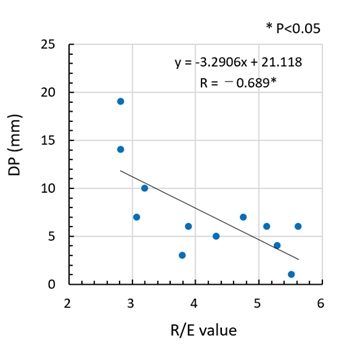
Figure 1: Correlation between R/E value and depth perception (DP).
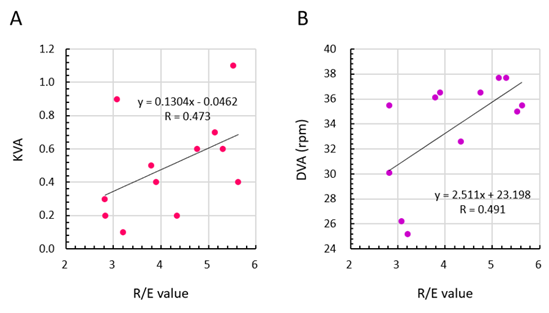
Figure 2: Correlation between R/E value and dynamic visual acuity. A; KVA, B; DVA.
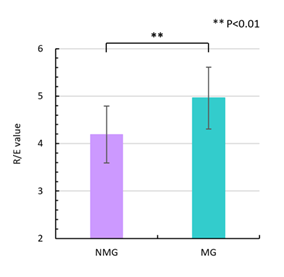
Figure 3: Differences in R/E values due to occlusal intervention.
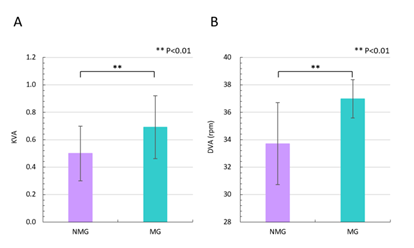
Figure 4: Differences in dynamic visual acuity due to occlusal intervention. A; KVA, B; DVA.
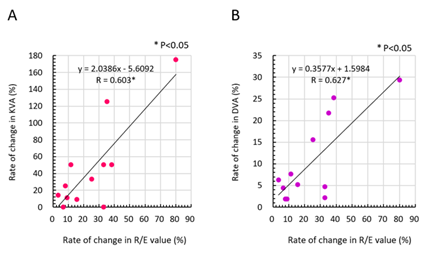
Figure 5: Correlation between the rate of change in R/E value and the rate of change in dynamic visual acuity due to occlusal intervention. A; KVA, B; DVA.
4. Discussion
The results of this study revealed that the predictive postural control function evaluated by cross-test was correlated with DP, and that occlusal intervention improved predictive postural control function and dynamic visual acuity, with a correlation being found between the two. Therefore, the null hypothesis was rejected.
There are two main reasons why trampoline gymnasts were selected as participants in this study. First, it has been reported that the weighting of sensory input in sports adapts to the characteristics of the sport [3,12-17]. Gymnasts focus on balance training, and their balance ability tends to be superior to that of the general population as well as athletes in other sports [14]. Second, because postural control function is reflected in performance ability in trampoline gymnastics competition, the results of this study can be expected to contribute to the training and development of trampoline gymnasts as well as the prevention and reduction of sports injuries.
In this study, the R/E value was used as an index of predictive postural control function. The R/E value is obtained by dividing the rectangular area by the peripheral area in the cross-test and is used to evaluate dynamic postural control [9,10]. The larger the R/E value, the clearer the cross on the center-of-gravity trajectory diagram [10], which enables participants to easily visually judge whether their dynamic balance is good or bad. We have previously reported that dynamic balance, evaluated using the R/E value as an index, improves with improved occlusal contacts [18]. Changes in occlusion affect somatic sensations mainly from temporomandibular joint receptors, periodontal mechanoreceptors, and muscle spindles in the jaw and neck muscles [19]. Signals from somatosensory receptors project to the vestibular nucleus and are involved in reflexes that regulate vision and neck movement. From this, it can be inferred that intervention in somatosensory input related to occlusion affects vision, vestibular sensation, and the postural control system that integrates these. Therefore, in this study, we investigated the relationship between predictive postural control function and visual function by performing an occlusal intervention involving an intraoral appliance.
DP is an index that evaluates stereoscopic ability to recognize the relative positional relationship of objects [20]. Trampoline competitions require the skill to instantly recognize the center of the bed while in the air and adjust one’s posture in preparation for landing. Therefore, it is inferred that DP is one of the sports vision skills required for trampoline competitions. The cross-test begins with the participant’s gaze fixed on a marker 2 m away (reference position), and the upper body moves in each direction—forward, backward, left, and right—always returning to the reference position. If the marker is followed when moving the upper body, it is possible to maintain posture using visual information. The visual instructions to the participants were to assume a reference position at the start of the measurement and to keep their eyes open during the measurement. A questionnaire survey administered after the measurement was performed confirmed that most participants followed the markers while moving their upper bodies. This would be considered vestibular eye movement, a type of rotational eye movement [21,22]. Rotating eye movement is driven primarily by the vestibulo-oculomotor reflex and is characterized by fast control, which is a feed-forward control in which a fixed eye-rotation angle is already set relative to the head-rotation angle calculated by the semicircular canals [21,22]. In other words, it is highly likely that the R/E value was an evaluation that placed emphasis on vision among the sensory inputs related to postural control. The upper body movement in the cross-test is a slow movement that takes 3 s in one direction, while the moving rod in the DP moves at a slow speed of 50 mm/s. Therefore, it is assumed that the correlation was observed because the way the visual functions are used is similar for both. Given that DP is a visual function that can be improved through training [20,22], it is expected that improving this function will have a positive effect on the performance of trampoline gymnasts.
Dynamic visual acuity was assessed using two methods, both of which involve distinguishing between gaps in the Landolt ring. KVA is the ability to recognize an object approaching in a straight line from a distance, while DVA is the ability to recognize an object moving sideways at high speed in front of the eyes. Both DP and KVA move in the forward and backward directions, but the object moves at a faster speed of 8.3 m/s in KVA compared with just 50 mm/s in DP. In addition, both KVA and DVA have in common the fact that the target object is a rapidly moving Landolt ring, and the speed at which the gap can be identified is recorded. In terms of eye movement patterns, KVA is likely to be involved in pursuit eye movements, in which the eyes follow an object while keeping the gaze fixed on it, whereas DVA is likely to be involved in saccadic eye movements, in which the eye recognizes a moving object or an object that moves suddenly when shifting the gaze to several objects [22]. A positive correlation between the R/E value and KVA and between DVA was observed, although it was not significant. The R/E value might be a predictive postural control function that reflects the contribution of visual function, but the small number of participants in this study might have been one factor in why a significant correlation was not observed.
The effect of occlusal intervention on R/E values showed a trend similar to that of previous studies investigating the effects of occlusal balance and mouthguard intervention [10,23]. Furthermore, the effect of occlusal intervention on dynamic visual acuity is thought to be due in part to the mutual influence of signals from each sensory input projected to the vestibular nucleus in the postural control system. The fact that a correlation was found between the rate of change in R/E value and the rate of change in dynamic visual acuity following occlusion intervention also suggests a relationship between somatosensory input and visual input.
The main limitations of this study are that participants were limited to male gymnasts and the sample size was small. Postural control ability tends to vary depending on the sport, gender, and level of competition [6], so further research is needed in these areas. It has also been reported that sports vision can be improved through vision training and reaction-speed training [24], although the sports vision required varies depending on the sport or event. In the future, we would like to investigate the effects of vision training and the relationship between sports vision and competitive performance, and use this information to support athlete development.
5. Conclusions
The results of this study revealed that the predictive postural control function assessed by the cross-test is related to depth perception, and that occlusal intervention improves predictive postural control function and dynamic visual acuity, with a correlation being found between the two.
Acknowledgments
This work was supported by JSPS KAKENHI Grant Number JP23K10617.
Conflicts of interest statement
The authors have no conflicts of interest relevant to this article.
References
- Saito H. Mechanism of Posture Retention. General Rehabil 24 (1996): 699-703.
- Nishimori T. Evaluation of Postural Stability. Kansai Physic 3 (2003): 41-47.
- Itaya A. Feedback System for Sensory and Postural Control. J Biomech 39 (2015): 197-203.
- Bando Y, Takahashi M, Kitayama Y. Relationship between Oral Function and Motor Ability of Top Japanese Junior Badminton Players. J Sports Dent 21 (2018): 23-30.
- Bando Y, Takahashi M, Fukui T, et al. Relationship between Occlusal State and Posture Control Function of Trampoline Gymnasts. J Sports Dent 23 (2019): 14-20.
- Takahashi M, Bando Y, Fukui T, et al. Equalization of the Occlusal State by Wearing a Mouthguard Contributes to Improving Postural Control Function. Appl Sci 13 (2023): 4342.
- Takahashi M, Bando Y, Fukui T, et al. Influence of Occlusion on Flight Time in Trampoline Competition. Int J Dent Oral Health 9 (2023): 405.
- Takahashi M, Bando Y, Kitaoka K, et al. Effect of Wearing a Mouthguard on Physical Ability Is Dependent on Occlusal Contact State: A Study Involving Elite Level Female Handball Players. Dent Res Oral Health 6 (2023): 88-94.
- Fukuyama K, Maruyama H. Relationships between the Cross Test and Other Balance Tests. Phys Ther Sci 25 (2010): 79-83.
- Takahashi M, Bando Y, Fukui T. Verification of Relationship between Static and Dynamic Balance Using Cross Test Trajectory Diagram as Indicator. Advances in Physical Education 14 (2024): 119-130.
- Takahashi M, Bando Y, Fukui T. Impact of Improved Feedforward Control on Flight Time in Trampoline Competitions. Advances in Physical Education 15 (2025): 187-196.
- Perrin PP, Deviterne D, Hugel F, et al. Judo, Better than Dance, Develops Sensorimotor Adaptabilities Involved in Balance Control. Gait Posture 15 (2002): 187-194.
- Paillard T, Noé F. Effect of Expertise and Visual Contribution on Postural Control in Soccer. Scand J Med Sci Sports 16 (2006): 345-348.
- Asseman FB, Caron O, Crémieux J. Are There Specific Conditions for Which Expertise in Gymnastics Could Have an Effect on Postural Control and Performance? Gait Posture 27 (2008): 76-81.
- Lion A, Gauchard GC, Deviterne D, et al. Differentiated Influence of Off-Road and On-Road Cycling Practice on Balance Control and the Related Neurosensory Organization. J Electromyogr Kinesiol 19 (2009): 623-630.
- Paillard T, Margnes E, Portet M, et al. Postural Ability Reflects the Athletic Skill Level of Surfers. Eur J Appl Physiol 111 (2011): 1619-1623.
- Takahashi M, Bando Y, Fukui T, et al. Equalization of the Occlusal State by Wearing a Mouthguard Contributes to Improving Postural Control Function. Appl Sci 13 (2023): 4342.
- Takahashi M, Bando Y, Fukui T. Research on Jumping Height of Straight Jumps and Barani Jumps in Competitive Trampoline Gymnasts: Influence of Occlusal Correction. Fortune Journal of Health Sciences 8 (2025): 803-808.
- Uchida M. Sensory Receptors on Oral Thickness Sensation. J Stomatol Soc Jpn 66 (1999): 1-7.
- Machida N, Ueno K, Isomura N, et al. Effects of Standardized Bilberry Extract (SBE) Intake on Kinetic Visual Acuity, Depth Perception, and Night Vision after Information Device Tasks. Jpn Pharmacol Ther 52 (2024): 1205-1217.
- Basic Dental Physiology. 7th ed. Ishiyaku Publishing Inc., Tokyo (2020): 232.
- The Relationship between Vision and Exercise, and Training Methods. Accessed 27 Oct 2024.
- Takahashi M, Bando Y, Fukui T, et al. Light Clenching Differentially Affects Balance Ability According to Occlusal Contact Stability. Appl Sci 14 (2024): 10314.
- Faure C, Limballe A, Bideau B, et al. Virtual Reality to Assess and Train Team Ball Sports Performance: A Scoping Review. J Sports Sci 38 (2020): 192-205.