Xiaoyong Duan1,2*and Yanxia Li3
1Key Laboratory of Marine Hydrocarbon Resources and Environmental Geology, Ministry of Land and Resources, Qingdao Institute of Marine Geology, Qingdao, China
2Laboratory for Marine Mineral Resources, Qingdao National Laboratory for Marine Science and Technology, Qingdao, China
3Qingdao National Laboratory for Marine Science and Technology, Qingdao 261000, China
*Corresponding Author: Xiaoyong Duan, Key Laboratory of Marine Hydrocarbon Resources and Environmental Geology, Ministry of Land and Resources, Qingdao Institute of Marine Geology, Qingdao, China, Tel: +86-532-85720830;
Received: 26 June 2017; Accepted: 24 July 2017; Published: 07 August 2017
Benzene, toluene, ethylbenzene and xylene (BTEX) are the most abundant volatile organic compounds (VOCs) in the urban atmosphere. In this paper, fates and possible sources of BTEX in general atmosphere were reviewed. A fairly comprehensive review of BTEX in atmosphere of China’s coastal cities was presented. In the general environment, BTEX partitions mainly into air. Higher atmospheric concentrations of BTEX were observed in the cities of south China than in north China and in winter than in summer. The atmospheric BTEX concentrations were significantly reduced over the past two decades. Vehicle emission and coal burning were the most important sources in North China. In south China, the other sources could make remarkable contribution to atmospheric BTEX concentrations.
Benzene compounds, temporal variation, spatial variation, source, Fate
- Introduction
China is facing serious air pollution [1]. Ozone has been the second most important cause of air pollution after PM2.5 in recent years. Over high ozone content in the lower atmosphere has a significantly negative effect on the human-living environment [2]. The ozone formation was closely related to the anthropogenic volatile organic chemicals (VOCs) that were originated from vehicle exhaust, industrial emission, petroleum and its products, coal and biomass burning [3].
Benzene, toluene, ethylbenzene and xylene (collectively called BTEX) are typical VOCs. They have been identified as potent carcinogens by World Health Organization. BTEX, the indispensable industrial materials, are used widely in building material, rubber and as additive in paint, dyestuff and pesticide [4]. BTEX in the industrial products can easily enter the environment [5]. And now they can be widely found in the general environment [6]. BTEX were the most abundant VOCs species in the atmosphere and surface water [4, 7, 8].
BTEX in coastal cities of China have been widely studied [4, 7, 8]. There were big differences in the BTEX concentrations, sources and variations between different regions, especially between north and south. Therefore, this review was focused on the regional and temporal distribution patterns of BTEX on a large scale. A fairly comprehensive review of BTEX in atmosphere of Chinese coastal cities was presented. Fates and possible sources of BTEX in urban atmosphere were also reviewed.
- Sources and Fates of BTEX in the Environment
VOCs in the environment were generally originated from the leakage of petroleum and its products, vehicle exhaust, coal and biomass burning, painting and petrochemical industry [4, 9]. BTEX were the most abundant species in the emissions (Table 1).
Source |
VOCs species |
|
Vehicle exhaust |
Pentane?2-methylpentane?3-methylpentane ethylene?acetylene, ethane, 1,3-butadiene*, Ethylene, propylene*, n-heptane, methylcyclohexane, n-nonane, n-decane, n-undecane, benzene*?toluene*?m,p-xylene |
|
Painting |
Benzene*?toluene*?ethylbenzene*, m,p-xylene*?o-xylene*?propane?pentane, n-butane |
|
Gasoline/ Diesel fuel evaporation |
iso-pentane, isobutene, pentane*, propane, n-butane*,trans-2-pentene, cis-2-pentene, 2-methyl-1-butene, n-heptane, methylcyclohexane, benzene, toluene, m,p-xylene |
|
Coal/Biomass burning |
Ethylene*, acetylene*, ethane, propane*, naphthalene, Methyl chloride, ethylene, ethane, acetylene, propylene, 1,3-butadiene, benzene*?toluene*?ethylbenzene* |
|
Petrochemical industry |
benzene?toluene*?ethylbenzene*, m,p-xylene*?o-xylene*, 1,2,4,-trimethylbenzene*, 3-methylheptane |
Table 1: The potential VOCs tracers for various emission sources (“*”indicate the relatively abundant VOCs species, “_”indicate the relatively abundant BTEX species [4, 7-9].
-
- Leakage of Petroleum and its Products
During the Deepwater Horizon oil spill in 2010, concentrations of mono-aromatic hydrocarbon in samples collected from within the plume was ?50 ?g/L. This means about 5.5 tons mono-aromatic hydrocarbons were input to the region per day, which is more than double the total source rate of the mono-aromatic hydrocarbons all natural seeps in the northern Gulf of Mexico [10]. The most abundant petroleum hydrocarbons larger than C1-C5 in the water samples collected within the hydrocarbon-enriched plume were BTEX at concentrations up to 78 ?g/L [11]. And the background BTEX concentrations in the surface coastal waters of the Gulf of Mexico have been reported in the range of 0.02 to 0.45 µg/L [12]. Concentrations of BTEX in the oilfield produced water in the State of Sergipe ranged from 96.7 to 1397?g/L [13]. Therefore, natural and man-made oil seeps were important sources of BTEX in the environment. And BTEX contents were important indicators of oil exploration and petroleum source identification [14].
BTEX concentrations ranged from 0 to 169.5mg/kg in petroleum products (gasoline, diesel and etc. [15]). They dominated the water-soluble fraction of crude oil and their derivatives products [16]. Therefore, BTEX was abundant in the groundwater of sites near gasoline station [15] and in the waters with very heavy traffic.
-
- Vehicle exhaust
Vehicle emissions were considered the major contributor to ambient VOCs in urban areas. Ethylene, benzene, and toluene were the main species in exhaust emissions [4]. According to Oudejans et al. [17], diesel generator cold start-ups and warm restarts resulted in sharp peak emissions (such as benzene) that were up to a factor of 90 and 2.5 higher than the predominately constant concentrations observed during steady-state operation, respectively. According to Gullett et al.[18], emissions (e.g., benzene) of cold- and warm-start from a medium duty diesel engine exceed 15 times their steady state levels. In urban areas of Bari (Italy), vehicular traffic was the top source of BTEX in ambient air [19]. Nearly half of the total non-methane hydrocarbons mass concentration measured at Hong Kong were originated from vehicle emissions [20].
In HoChiMinh, high correlations between BTEX concentrations and the volume of on-road motorcycles indicate that the motorcycle-exhaust was the source of BTEX species [21]. According to Lan and Binh [22], Vietnam and Malaysia were more polluted by BTEX than China, Japan and Singapore. High BTEX levels in Vietnam and Malaysia (87, 52, 32, 23, 13, 12 and 48 µg/m3 for benzene in HoChiMinh, Hanoi, Cantho, Danang, Hue, Vung Tau and Kuala Lumpur, respectively) were due to high number and high emission factor of motorcycles. BTEX levels were significantly higher at garages where only natural ventilation was used (e.g. 127?1101 µg/m3 for toluene), the higher BTEX levels posed a potential risk for the workers [23]. In addition, concentrations of benzene were 29-99 mg/L, and those of other BTEX compounds were higher (500-2000 mg/L) in used motor oil [24].Therefore, used motor oil was also an important source of BTEX to the environment.
The use of biofuel as an alternative fuel has a promising potential worldwide. The results using compression ignition engine with the addition of an alternative biofuel (biodiesel) to a traditional fuel (diesel) showed a reduction in the pollutants emissions (14.5?24.5%). BTEX emissions were also lower with ethanol blends compared to the traditional fuel [25]. Therefore, push to expand the use of biofuels might help to reduce the air pollution.
-
- Painting and printing
The aromatics benzene, toluene and m,p-xylene were the most important VOC species emitted from architectural or furnishing coatings [4, 9], accounting for 7%, 19% and 13% of total VOCs (wt.%) from building coatings in China, respectively [4]. In printing factory of Beijing, 31.6% of the VOC emissions were aromatic compounds [26]. Some consumer products, such as whiteout, oil-based ballpoint pen, shoe polish and leather cleaner, were also contained higher levels BTEX [27]. BTEX were detected at high levels in workplaces such as photocopy centers and automotive paint shops [28]. Toluene was the most abundant species among BTEX in paint [8, 9]. Therefore, toluene was always present in indoor air in detectable levels caused by indoor source emissions (such as paint organic solvent and household cleaning chemicals), which range from 1.3 to 75.6µg/m3 in living room [29]. In Spain, the indoor concentrations of BTEX were approximately 2.5 times higher than those observed outdoors [30]. According to the national wide survey in Canada conducted in 2009-2011, the mean level of BTEX in Canadian residences was 43.8 µg/m3 (2.0 µg/m3, 19.2 µg/m3, 4.1 µg/m3, 14.4 µg/m3 and 4.2 µg/m3 for benzene, toluene, ethylbenzene, m,p-xylenes, and o-xylene, respectively), renovation in the past month, use of paint remover and use of fragrance were the significant predictors of BTEX presence [31].
-
- Coal and biomass burning
Coal combustion contributed 28%?39% to ambient VOCs during winter in Beijing [32]. BTEX accounted for about 61.1%-94.8% in total mass of VOC discharged from coal or wood incomplete combustion [33]. In rural sites of the North China Plain, the outdoor and indoor concentrations of BTEX were 25.8?236.0 ?g/m3 and 254.5?1552.9 ?g/m3 during winter in 2011, respectively [34]. The indoor concentrations far exceeded the limit levels of Chinese Indoor Air Quality Standard (110 µg/m3, 200 µg/m3 and 200 µg/m3 for benzene, toluene and xylenes, respectively). The serious BTEX pollution was mainly ascribed to domestic coal combustion for heating during the winter season.
Toluene was one of the most abundant specie in the coal-burning factories (such as thermal power plant and coke production) in the Liaoning Province, China [35]. And in heating station, approximately 70.0% of non-methane hydrocarbons were contributed by trimethylbenzene, n-propylbenzene and o,m-ethyltoluene [35]. In previous studies [8, 9, 36, 37], benzene was identified as the most abundant VOC specie from coal-burning. The ratios of benzene/toluene (B/T) in most case of coal combustions were found to be greater than 1[8, 9, 34, 36, 37], which was considered as the marker of coal-burning emissions.
-
- Petrochemical industry
In Daegu, Korea [38], residential and commercial areas have high BTEX concentrations during daytime, while industrial areas have high concentrations during nighttime. And the highest toluene concentration was in the industrial areas. BTEX levels in the downwind ambient air of petrochemical industrial areas were higher. This indicated that the sources of BTEX in industrial areas were totally different from sources in other areas. The study in a petrochemical plant in Kaohsiung, Taiwan showed that 12% VOCs contributed by aromatics [39]. More than 90% of VOCs came from 10% equipment components [39]. In the oily sewerage system and tank farm area of an oil refinery [40], most of VOCs were BTEX. In the boundaries of industrial parks in southern Taiwan, VOCs were dominated by benzene and toluene [41]. In the urban area of Shanghai, ~36% VOCs contributed by aromatics, chemical and petrochemical industry contributed 22.3% of the VOCs [42].
- Environmental Fate of BTEX
BTEX were easily transported to the atmosphere due to the high vapor pressure [43]. According to currently published papers [44-46], the fate of BTEX in the general environment can be summarized as Figure 1.
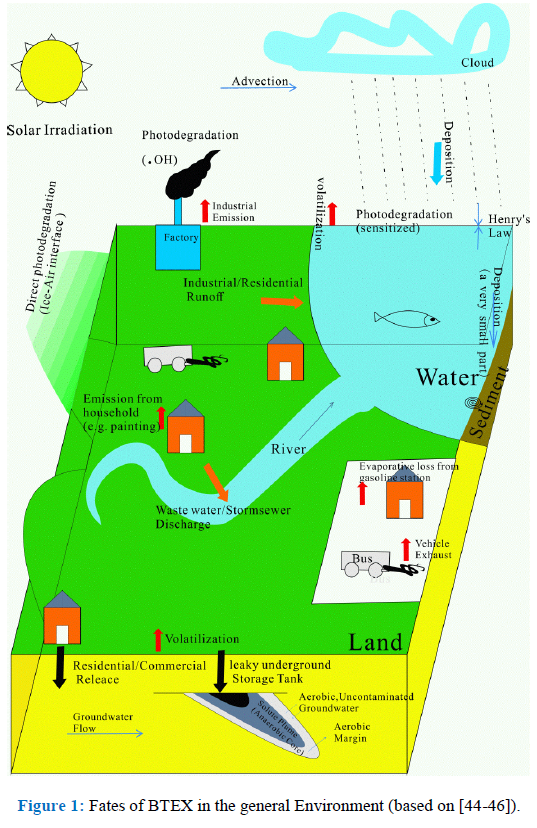
3.1 BTEX in soil
Soil and sediment were considered as the most important reservoirs of some semi- and non-volatile pollutants. However, only a very small percentage of VOCs, including BTEX of course, released into the environment were stored in soil and sediment [43].
In natural environment, BTEX compounds can migrate quickly through soil, with benzene being the fastest followed by toluene, m-, p- and o-xyienes and ethylbenzene [47]. According to Tan et al. [48], benzene were not detected in soil samples around three representative pesticide factories collected in Hebei Province, China. And there was an increasing trend of BTEX from soil to dust, and from living area to production area in the factories [49]. In Amman?Zarqa Basin [50], concentrations of BTEX in groundwater varied between no-detection to 6.6mg/L. BTEX group tend to partition between sediments and soil rather than leach into groundwater. They tend as well to volatize to atmosphere rather than stick to soil particles.
In a gasoline-contaminated aquifer [51], BTEX biodegradation appears to be occurring using both oxygen and nitrate as terminal electron acceptors. Toluene, ethylbenzene, and m-, p-xylenes were removed very rapidly and o-xylene and benzene were removed much slower.
3.2 BTEX in water
Oil leak, sewage discharge and water transport were the most important sources of BTEX in natural waters. The levels of BTEX in natural waters were influenced by many factors. In waters of Mediterranean coast [52], temperature and precipitations were related on the BTEX levels. Lower levels of contaminants were observed when the discharges of water and temperatures increased. In surface waters of Irish Sea [53], the highest concentrations were found near the river mouths and close to the port activities. BTEX concentrations were highly variable in the same station between different times, the highest concentrations of BTEX were coincident with high solar irradiation and low wind speeds. According to the results of long-term observation in the southern North Sea [54], the occurrence of BTEX in the surface waters was attributed to anthropogenic emissions and discharges from shipping and oil-related activities in coastal areas.
BTEX were nearly impossible to sorb onto suspended particulate matter. In an oil impacted river of State Nigeria [55], the concentration of BTEX markedly decreases as time increases due to evaporation and other factors. In the Scheldt Estuary and the Southern North Sea [56], VOC levels in many sediment samples were at or below the detection limits. According to the study conducted at a former coke plant [57], benzene concentrations decreased almost five orders of magnitude 70 m downgradient the source. Benzene could never be detected near the river which is about 160 m downgradient the main source. Within the water column, at most 5% of BTEX was predicted to be adsorbed under the most favorable environmental conditions [58].
Based on mesocosm experiments with 14C-model compounds [59], aromatic hydrocarbons in seawater were subject to both volatilization and biodegradation, with mineralization dominating in summer. BTEX do not undergo direct photolysis in natural waters. However, direct photolysis could be an important removal pathway for BTEX in snow-covered regions because they undergo significant red-shifts in their absorption spectra when they were present at air-ice interfaces [46]. In groundwater, dispersion is not a very effective natural attenuation process. Because of the relative abundance of anaerobic electron acceptors (such as Fe3+, NO3-) as compared with dissolved oxygen, most of BTEX in groundwater is attenuated by anaerobic biodegradation [45].
Therefore, BTEX levels in natural water were highly variable between different times or locations. And surely, BTEX dispersion was mainly controlled by volatilization and degradation rather than sedimentation.
3.3 BTEX in atmosphere
In the general environment, benzene partitions mainly into air (99.9%; [60]). The levels were influenced by several factors, such as distance from sources, ambient temperature and air diffusive condition. Similar diurnal and seasonal profiles were presented by different researchers of the world. In Windsor (Canada; [61]), lower concentrations were observed in the warmer months. Similar seasonal profiles were also observed in Beijing [62] and Delhi [63]. The average concentrations of BTEX in the upper atmosphere around Beijing in November were about 1.5 times larger than those in July [64]. The daily variations were also evident. In Beijing, BTEX concentrations in the morning and evening were higher than that at noontime [65]. The peaks were mainly contributed by the emissions from vehicles. And more notably, BTEX can be easily accumulated in the air due to the weak photochemical reaction with lower temperature and low light intensity in cloudy day. In comparison with non-haze days, remarkable accumulation of BTEX was found under haze days, with enhancement factors of 1.9-5.7 [66].
In urban storm water in the United States [67], toluene and total xylene were the most frequently detected BTEX compounds and the most frequently detected VOCs in the investigations during 1991-1995. However, BTEX did not show any correlation between rainfall amount and concentrations. Rainwater was not an effective removal mechanism of BTEX, only 0.1% of BTEX in the atmosphere was removed by rainwater [68]. But the amount of BTEX species retained in water were significantly higher than suggested by theoretical predictions indicating that dissolution is not the major mechanism of gaseous BTEX uptake in aqueous phase [69].
Their results indicated that the main atmospheric sink for these mono-aromatic hydrocarbons was chemical oxidation primarily by the ·OH radical rather than wet depositional removal by precipitation. In waters of Mediterranean coast [52], BTEX levels were influenced by temperature and precipitations. In surface waters of Greece, not only industrial and agricultural activity within the Greek territory, but also transboundary pollution deriving from neighbouring countries consisted important sources of VOCs [70].
In conclusion, atmospheric BTEX was probably an important source of BTEX in the surface waters. But surely, most of BTEX were probably ended in the atmosphere rather in other medium.
- BTEX in the Ambient Air of China
4.1 Spatial and seasonal variation
The temporal and spatial distribution patterns of atmospheric BTEX in coastal cities of China were shown in Figure 2. The locations of Chinese cities mentioned in this paper were given in supplemental material Figure S1.
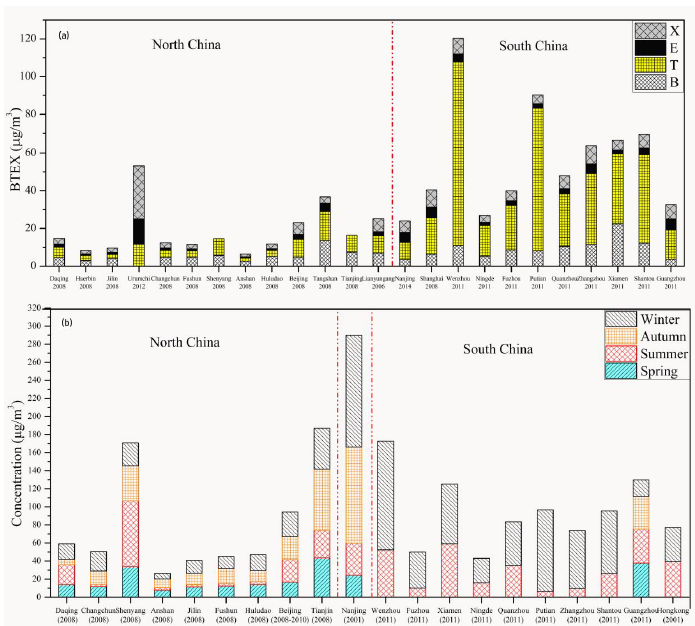
Figure 2: Spatial (a) and temporal (b; BTEX concentrations in some coastal cities during spring and autumn were not available) distribution patterns of atmospheric BTEX in coastal cities of China (listed in order of decreasing latitude; data are from [7, 71-87]).
As shown in Figure 2a, the composition characteristics of BTEX in different regions were significantly different. Generally, high atmospheric concentrations of BTEX were observed in the cities of south China. The annual average atmospheric BTEX concentration was 20.0 ?g/m3 and 46.7 ?g/m3 for the cities in north and south China, respectively. Toluene was the most abundant species varying from 21.8?81.3% (accounted for an average 33.8% and 17.3% of the total BTEX in the north and south, respectively) of the total BTEX followed by benzene (8.9?44.8%; accounted for an average 35.6% and 59.9% of the total BTEX in the north and south, respectively). The concentrations of BTEX measured in Shenyang, Tianjin, Nanjing and Wenzhou were higher than in other cities (Figure 2). Those cities are important industrial cities in China. Therefore, industrial emissions played important roles on maintaining high BTEX levels in those cities.
There was marked seasonal changes of atmospheric BTEX concentrations (Figure 2b). The atmospheric concentrations of BTEX were higher in winter than in summer. The lowest BTEX levels related to summer with a mean concentration of 24.5 ?g/m3. On the other hand, the highest levels of BTEX compounds were measured in winter, with a mean concentration of 44.6 ?g/m3. The difference was more apparent in south than in north, as in average 29.8?g/m3 in summer and 64.0?g/m3 in winter was reported in cities of south China versus 18.1?g/m3 in summer and 20.3?g/m3 in winter was reported in north China (Figure 2b).
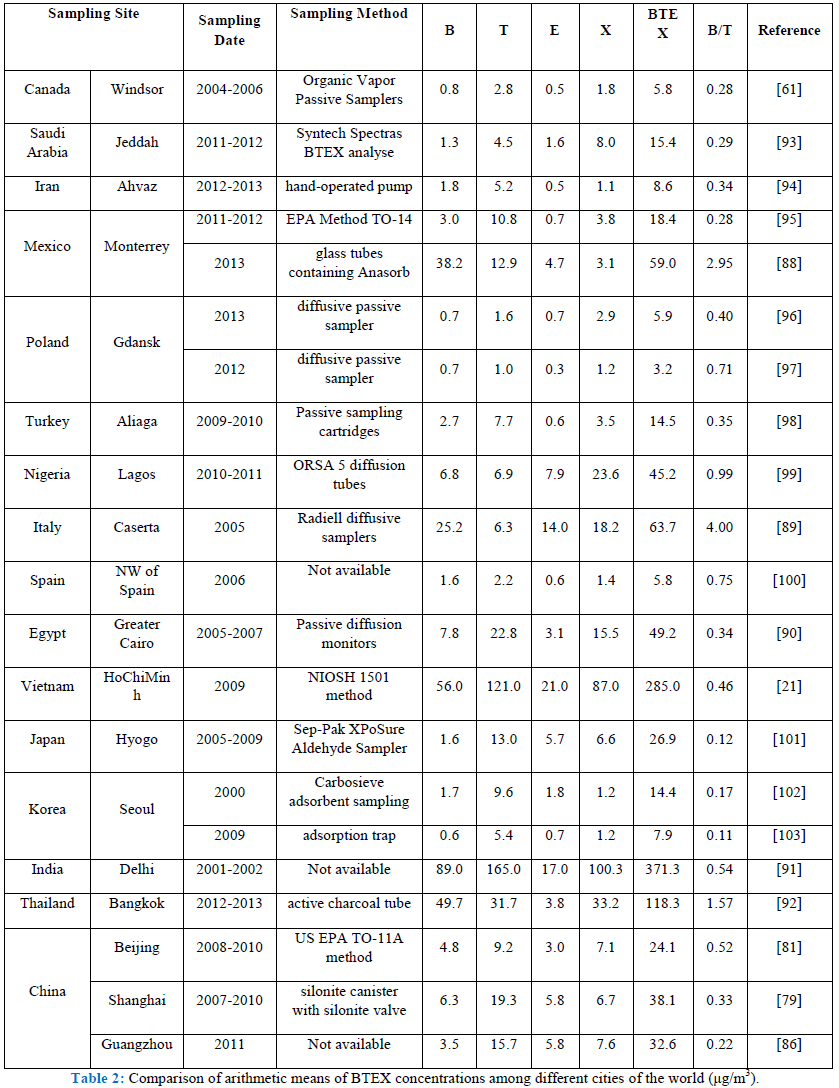
As shown in Table 2, the reported BTEX levels in China were comparable with the concentrations observed in Mexico (59.0 ?g/m3;[88]), Italy (63.7 ?g/m3; [89]) and Egypt (49.2 ?g/m3; [90]),but much lower than the concentrations observed in HoChiMinh (285.0 ?g/m3; [21]), Delhi (371.3 ?g/m3; [91]) and Bangkok (118.3 ?g/m3; [92]), and much higher than the concentrations observed in developed countries such as Korea and Canada (Table 2). This might reveal that atmospheric BTEX concentrations were influenced by the social and economic development of the country. Although domestic airs of China were less contaminated with BTEX than some Southeast Asian countries, this problem should not be ignored.
As found in many studies [66, 94], several factors, such as photochemical removal, atmospheric dispersion and sources, affect the seasonal and regional variations of BTEX in the atmosphere.
4.1.1 Photochemical removal:The chemical removal by OH radical in the atmosphere is the most important degradation pathway of VOCs in the environment. There was a significant association between BTEX atmospheric concentration and atmosphere oxidizing capacity. In central Tokyo [104], the average concentrations of OH in summer is at least five times the concentrations in winter. According to Su et al. [105], up to ~30% of the primary OH radical production is attributed to the photolysis of nitrous acid (released from soil nitrite) in the lower atmosphere. Thus, agricultural activities and land-use changes may strongly influence the oxidizing capacity of the atmosphere. In general, higher OH radical concentration resulted by more sunlight and higher temperatures in warmer seasons. Agricultural activities in warmer season are also playing a big role. Therefore, the low atmospheric BTEX levels in summer can be attributed to the fast chemical removal in summer caused by high OH radical concentration. OH radical reactions were also the major removal pathway for persistent organic pollutants from the atmosphere [106].
4.1.2 Atmospheric dispersion: The atmospheric levels also can be significantly influenced by the atmospheric mixing. The mixing layer in warmer seasons is much higher than in cooler seasons [107]. The dilution of airborne pollutants from ground source emissions in warmer seasons is stronger than in cooler seasons. Based on previous studies [108-110], atmospheric particles collected in Hawaii, Korea and Japan reveal strong influxes of Asian dust in the spring of each year. Therefore, the wind directions may influence atmospheric pollutant levels. Generally, the wind was blowing from ocean to land and land to ocean in summer and winter, respectively [111]. Thus, polluted air in coastal cities was continuously blown away by the wind from the South China Sea and the west Pacific Ocean in summer. The meteorological conditions were advantageous for mixing and dissipation of the pollutants leading to lower BTEX levels in the atmosphere in summer. However, in winter, only heavily polluted air from inland areas can reach this region.
Although coal-fired heating was an important source of BTEX in north China, the concentrations during winter and summer were comparable in some cities of north China, such as Beijing and Tianjin (Figure 2b). In Beijing [112], the highest wind speeds occur in the spring (~3m/s), with slightly weaker winds in the winter and significantly lower wind speeds in the summer and autumn (?2m/s). Therefore, the atmospheric BTEX can easily spread in north China during winter.
4.1.3 Changes of emission sources: In North China, the high BTEX concentration in winter also is because the emissions associated with coal-fired heating. In Beijing [64],the average concentrations of BTEX after 15 November (winter heating season began in 15 November) were about 1.5 times larger than those in July and before 15 November, indicating extra sources (coal-fired heating) in late November.
Another factor to consider is the influence of rainfall on atmospheric pollutants concentrations. The rainy days are mainly concentrated in summer. Although rainwater was not considered as an effective removal mechanism of BTEX in atmosphere [68], the fates of pollutants in the land surface were strongly impacted by rainfall, such as leaching to deep layer or washing into river [113]. Therefore, the emissions of BTEX to atmosphere may reduce in summer.
4.2 Yearly variation
During the past decades, Chinese environment has changed significantly, such as air pollution was getting more and more serious. Here, we summarized the reported BTEX concentrations in the urban atmosphere of China (Figure 3). As far as we know, the highest BTEX concentration was observed in in Guangzhou in 2002 (285 ?g/m3 [73]). In 1996, the reported concentration was 218.2 ?g/m3in urban atmosphere of Guangzhou [71]. However, the reported peak concentrations in other cities were only about 100 ?g/m3 (Figure 3). Generally, a significant decreasing trend was presented in Figure 3. In recent years, Chinese government has adopted a range of policies to narrow the gap between different cities in the level of industrialization and urbanization. Accordingly, the regional differences were significantly reduced and the concentrations were stay at lower levels (~30 ?g/m3). This phenomenon may associate with China's economic development.
Although the BTEX concentrations were significantly reduced, the concentrations were still well above levels observed in urban atmosphere of developed countries (such as Canada and Korea; showed in Table 2).
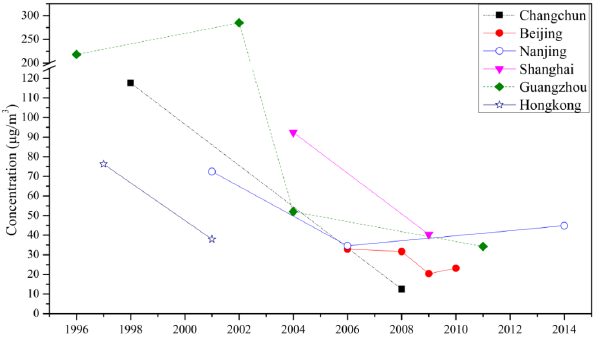
Figure 3: Yearly variation of BTEX in urban atmosphere of China (average annual time-weighted
- concentration; Data are from [7, 71-81, 83, 85-87].
- Source Identification
The ratio of B/T has been widely used as an indicator to provide information about the different emission sources. According to the VOC source profiles [8, 9], benzene was the dominant species in vehicle emissions and toluene was the dominant species in biomass and coal burning. A B/T ratio of around 0.6 has been considered to be characteristic of traffic-originated emission sources, and values ?1 have been considered as signal for coal and biofuel burning [34].
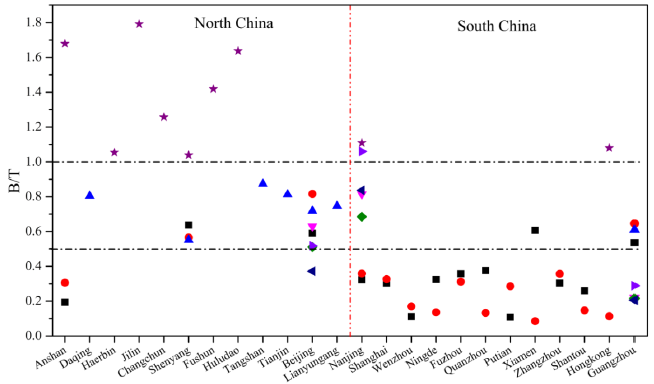
Figure 4: Ratios of B to T in atmosphere of China’s coastal cities, the atmospheric samples were collected in 2008 for Anshan, Daqing, Haerbin, Jilin, Changchun, Fushun and Huludao; in 2011 for Wenzhou, Ningde, Fuzhou, Quanzhou, Putian, Xiamen, Zhangzhou and Shantou; in 1996, 1997, 2002, 2004 and 2011for Guangzhou; in 2001, 2006, 2007 and 2014 for Nanjing; in 2004 and 2007-2010 for Shanghai; in 2006,2009 and 2008-2010 for Beijing; in 1997, 2001 and 2002 for Hongkong; in 2006 for Lianyungang (Data are from [7, 62, 71-80, 82-87, 114-118].
Figure 4 showed that observed higher B/T ratios in the North and lower in the South. The low B/T values in South implied that the sources other than vehicle emission (such as evaporation of solvents and paints and emissions from factories and other stationary sources) could make remarkable contribution to atmospheric BTEX concentrations. In north China, the B/T values were larger than 1 in some cities [85]. This means that coal and biofuel burning could make noticeable contribution to atmospheric BTEX concentrations in some cities in North China [32, 119].
Many studies have been conducted in Beijing urban area [62, 119], the results suggested that the vehicle exhaust was the major source of BTEX. Vehicle emissions play important roles in sustaining the atmospheric BTEX levels in cities of North China. However, other sources, such as evaporation of solvents, were more important in south China. The sources are usually irregular emissions (except vehicle emissions), their seasonally and yearly emissions must vary notably and might be also partially responsible for the source variation of atmospheric BTEX.
- Conclusion
- A fairly comprehensive review of potential sources and fates of BTEX in the general environment and its distribution in atmosphere of China’s coastal cities was presented. Based on the discussion above, the following conclusions can be drawn:
- BTEX concentrations in the general environment were closely related to the human activities.
- Based on recent published results, the annual average atmospheric BTEX concentration was 20.0 ?g/m3 and 46.7 ?g/m3 for the cities in north and south China, respectively. Toluene was the most abundant species followed by benzene. The atmospheric BTEX concentrations were significantly reduced during the past decades.
- The atmospheric concentrations of BTEX were higher in winter than in summer. The main factors controlling the seasonal change are meteorological conditions, including temperature, wind direction and speed, intensity of the sunlight and precipitation.
- Acknowledgments
This study was supported by Natural Science Foundation of Shandong Province, China (Grant No. ZR2014DQ020). We also want to thank the editor and the reviewers.
References
- Chan C K, Yao X. Air pollution in mega cities in China[J]. Atmospheric environment 42 (2008): 1-42.
- Matus K, Nam K M, Selin N E, et al. Health damages from air pollution in China[J]. Global environmental change 22 (2012): 55-66.
- Wei W, Cheng S, Li G, et al. Characteristics of ozone and ozone precursors (VOCs and NOx) around a petroleum refinery in Beijing, China[J]. Journal of Environmental Sciences 26 (2014): 332-342.
- Liu Y, Shao M, Fu L, et al. Source profiles of volatile organic compounds (VOCs) measured in China: Part I[J]. Atmospheric Environment 42 (2008): 6247-6260.
- Zalel A, Broday D M. Revealing source signatures in ambient BTEX concentrations[J]. Environmental pollution 156 (2008): 553-562.
- Horemans B, Worobiec A, Buczynska A, et al. Airborne particulate matter and BTEX in office environments[J]. Journal of Environmental Monitoring 10 (2008): 867-876.
- Liu Y, Shao M, Lu S, et al. Volatile organic compound (VOC) measurements in the Pearl River Delta (PRD) region, China[J]. Atmospheric Chemistry and Physics 8 (2008): 1531-1545.
- Liu Y, Shao M, Lu S, et al. Source apportionment of ambient volatile organic compounds in the Pearl River Delta, China: Part II[J]. Atmospheric Environment 42 (2008): 6261-6274.
- Liu Y, Shao M, Zhang J, et al. Distributions and source apportionment of ambient volatile organic compounds in Beijing city, China[J]. Journal of Environmental Science and Health 40 (2005): 1843-1860.
- Camilli R, Reddy C M, Yoerger D R, et al. Tracking hydrocarbon plume transport and biodegradation at Deepwater Horizon[J]. Science 330 (2010): 201-204.
- Reddy C M, Arey J S, Seewald J S, et al. Composition and fate of gas and oil released to the water column during the Deepwater Horizon oil spill[J]. Proceedings of the National Academy of Sciences 109 (2012): 20229-20234.
- Sauer T C, Sackett W M, Jeffrey L M. Volatile liquid hydrocarbons in the surface coastal waters of the Gulf of Mexico[J]. Marine Chemistry 7 (1978): 1-16.
- Dórea H S, Bispo J R L, Aragão K A S, et al. Analysis of BTEX, PAHs and metals in the oilfield produced water in the State of Sergipe, Brazil[J]. Microchemical Journal 85 (2007): 234-238.
- Wang Z, Fingas M F. Development of oil hydrocarbon fingerprinting and identification techniques[J]. Marine Pollution Bulletin 47 (2003): 423-452.
- Pinedo J, Ibanez R, Lijzen J P A, et al. Assessment of soil pollution based on total petroleum hydrocarbons and individual oil substances [J]. Journal of environmental management 130 (2013): 72-79.
- Rodrigues R V, Miranda-Filho K C, Gusmão E P, et al. Deleterious effects of water-soluble fraction of petroleum, diesel and gasoline on marine pejerrey Odontesthes argentinensis larvae[J]. Science of the Total Environment 408 (2010): 2054-2059.
- Oudejans L, Touati A, Gullett B K. Real-time, on-line characterization of diesel generator air toxic emissions by resonance-enhanced multiphoton ionization time-of-flight mass spectrometry[J]. Analytical chemistry 76 (2004): 2517-2524.
- Gullett B K, Touati A, Oudejans L, et al. Real-time emission characterization of organic air toxic pollutants during steady state and transient operation of a medium duty diesel engine[J]. Atmospheric Environment 40 (2006): 4037-4047.
- Caselli M, de Gennaro G, Marzocca A, et al. Assessment of the impact of the vehicular traffic on BTEX concentration in ring roads in urban areas of Bari (Italy)[J]. Chemosphere 81 (2010): 306-311.
- Guo H, Wang T, Louie P K K. Source apportionment of ambient non-methane hydrocarbons in Hong Kong: Application of a principal component analysis/absolute principal component scores (PCA/APCS) receptor model[J]. Environmental Pollution 129 (2004): 489-498.
- Lan T T N, Minh P A. BTEX pollution caused by motorcycles in the megacity of HoChiMinh[J]. Journal of Environmental Sciences 25 (2013): 348-356.
- Lan T T N, Binh N T T. Daily roadside BTEX concentrations in East Asia measured by the Lanwatsu, Radiello and Ultra I SKS passive samplers[J]. Science of the Total Environment 441 (2012): 248-257.
- Badjagbo K, Loranger S, Moore S, et al. BTEX exposures among automobile mechanics and painters and their associated health risks[J]. Human and Ecological Risk Assessment: An International Journal 16 (2010): 301-316.
- Baker R J, Best E W, Baehr A L. Used motor oil as a source of MTBE, TAME, and BTEX to ground water[J]. Groundwater Monitoring and Remediation 22 (2002): 46-51.
- Karavalakis G, Durbin T D, Shrivastava M, et al. Impacts of ethanol fuel level on emissions of regulated and unregulated pollutants from a fleet of gasoline light-duty vehicles[J]. Fuel 93 (2012): 549-558.
- Yuan B, Shao M, Lu S, et al. Source profiles of volatile organic compounds associated with solvent use in Beijing, China[J]. Atmospheric Environment 44 (2010): 1919-1926.
- Lim S K, Shin H S, Yoon K S, et al. Risk assessment of volatile organic compounds benzene, toluene, ethylbenzene, and xylene (BTEX) in consumer products[J]. Journal of Toxicology and Environmental Health, Part A 77 (2014): 1502-1521.
- Vitali M, Ensabella F, Stella D, et al. Exposure to organic solvents among handicraft car painters: a pilot study in Italy[J]. Industrial health 44 (2006): 310-317.
- Liu Q, Liu Y, Zhang M. Source apportionment of personal exposure to carbonyl compounds and BTEX at homes in Beijing, China[J]. Aerosol and Air Quality Research 14 (2014): 330-337.
- Esplugues A, Ballester F, Estarlich M, et al. Indoor and outdoor air concentrations of BTEX and determinants in a cohort of one-year old children in Valencia, Spain[J]. Science of the total environment 409 (2010): 63-69.
- Wheeler A J, Wong S L, Khoury C, Zhu J. Predictors of indoor BTEX concentrations in Canadian residences[J]. Statistics Canada (2013).
- Wang M, Shao M, Lu S H, et al. Evidence of coal combustion contribution to ambient VOCs during winter in Beijing[J]. Chinese Chemical Letters 24 (2013): 829-832.
- Wang S, Wei W, Li D, et al. Air pollutants in rural homes in Guizhou, China?Concentrations, speciation, and size distribution[J]. Atmospheric Environment 44 (2010): 4575-4581.
- Liu K, Zhang C, Cheng Y, et al. Serious BTEX pollution in rural area of the North China Plain during winter season[J]. Journal of Environmental Sciences 30 (2015): 186-190.
- Shi J, Deng H, Bai Z, et al. Emission and profile characteristic of volatile organic compounds emitted from coke production, iron smelt, heating station and power plant in Liaoning Province, China[J]. Science of The Total Environment 515 (2015): 101-108.
- Garcia J P, Beyne-Masclet S, Mouvier G, et al. Emissions of volatile organic compounds by coal-fired power stations[J]. Atmospheric Environment. Part A. General Topics 26 (1992): 1589-1597.
- Dos Santos C Y M, de Almeida Azevedo D, de Aquino Neto F R. Atmospheric distribution of organic compounds from urban areas near a coal-fired power station[J]. Atmospheric Environment 38 (2004): 1247-1257.
- Choi S W, Park S W, Lee C S, et al. Patterns of VOC and BTEX concentration in ambient air around industrial sources in Daegu, Korea[J]. Journal of Environmental Science and Health, Part A 44 (2009): 99-107.
- Chen C L, Fang H Y, Shu C M. Mapping and profile of emission sources for airborne volatile organic compounds from process regions at a petrochemical plant in Kaohsiung, Taiwan[J]. Journal of the Air & Waste Management Association 56 (2006): 824-833.
- Pandya G H, Gavane A G, Bhanarkar A D, et al. Concentrations of volatile organic compounds (VOCs) at an oil refinery[J]. International journal of environmental studies 63 (2006): 337-351.
- Hsieh L T, Yang H H, Chen H W. Ambient BTEX and MTBE in the neighborhoods of different industrial parks in Southern Taiwan[J]. Journal of Hazardous Materials 128 (2006): 106-115.
- Wang H L, Chen C H, Wang Q, et al. Chemical loss of volatile organic compounds and its impact on the source analysis through a two-year continuous measurement[J]. Atmospheric Environment 80 (2013): 488-498.
- Mackay D, Wanying S, Ma K C, et al. Handbook of physical-chemical properties and environmental fate for organic chemicals[M]. Boca Raton: CRC Press 1: (2006).
- Rathbun R E. Transport, behavior, and fate of volatile organic compounds in streams[J]. Critical Reviews in Environmental Science and Technology 30 (2000): 129-295.
- Seagren E A, Becker J G. Review of natural attenuation of BTEX and MTBE in groundwater[J]. Practice periodical of hazardous, toxic, and radioactive waste management 6 (2002): 156-172.
- Kahan TF, Donaldson DJ. Benzene photolysis on ice: implications for the fate of organic contaminants in the winter.[J]. Environmental Science and Technology 44 (2010): 3819-3824.
- Zytner R G. Sorption of benzene, toluene, ethylbenzene and xylenes to various media[J]. Journal of Hazardous Materials 38 (1994): 113-126.
- Tan B, Wang T Y, Qi-Feng L I, et al. [Risk assessment and countermeasures of BTEX contamination in soils of typical pesticide factory].[J]. Environmental Science 35 (2014): 2272-2280. (In Chinese)
- Wang T, Bo P, Bing T, et al. Benzene homologues in environmental matrixes from a pesticide chemical region in China: Occurrence, health risk and management[J]. Ecotoxicology and environmental safety 104 (2014): 357-364.
- Mustafa A K, Ghazi S, Najal Y, et al. Potential Occurrence of MTBE and BTEX in Groundwater Resources of Amman?Zarqa Basin, Jordan[J]. Clean - Soil Air Water 40 (2012): 808-816.
- Borden R C, Daniel R A, LeBrun L E, et al. Intrinsic biodegradation of MTBE and BTEX in a gasoline?contaminated aquifer[J]. Water Resources Research 33 (1997): 1105-1115.
- Moliner-Martínez Y., R. Herraez-Hernandez, J. Verdú-Andres, et al. Study of the influence of temperature and precipitations on the levels of BTEX in natural waters[J]. Journal of Hazardous Materials 263 (2013): 131-138.
- Bravo-Linares C M, Mudge S M, Loyola-Sepulveda R H. Occurrence of volatile organic compounds (VOCs) in Liverpool Bay, Irish Sea.[J]. Marine Pollution Bulletin 54 (2007): 1742-1753.
- Huybrechts Tom, Jo Dewulf, Herman Van Langenhove. Priority volatile organic compounds in surface waters of the southern North Sea. Environmental Pollution[J] 133 (2005): 255-264.
- Osu Charles I, Okoro I A. Distribution Of Organic Compounds (PAHs and BTEX) And Heavy Metals (Pb, Zn, Fe, Cd) in An Oil Impacted Soils, Rivers State Nigeria[J]. Journal of Applied Sciences in Environmental Sanitation 6 (2014): 73-78.
- Roose P, Dewulf J, Brinkman U A T, et al. Measurement of Volatile Organic Compounds in Sediments of the Scheldt Estuary and the Southern North Sea[J]. Water Research 35 (2001): 1478-1488.
- Batlle-Aguilar J, Brouyère S, Dassargues A, et al. Benzene dispersion and natural attenuation in an alluvial aquifer with strong interactions with surface water[J]. Journal of Hydrology 361 (2009): 305-317.
- Bianchi A P, Varney M S. Volatile organic compounds in the surface waters of a British estuary. Part 2. Fate processes[J]. Water Research 32 (1998): 371-379.
- Wakeham S G, Canuel E A, Doering P H. Geochemistry of volatile organic compounds in seawater: Mesocosm experiments with 14 C-model compounds[J]. Geochimica Et Cosmochimica Acta 50 (1986): 1163-1172.
- Hattemer-Frey HA, Travis CC, Land ML. Benzene: environmental partitioning and human exposure.[J]. Environmental research 53 (1990): 221-232.
- Miller L, Xu X, Grgicak-Mannion A, et al. Multi-season, multi-year concentrations and correlations amongst the BTEX group of VOCs in an urbanized industrial city[J]. Atmospheric Environment 61 (2012): 305-315.
- Zhang Y, Mu Y, Liang P, et al. Atmospheric BTEX and carbonyls during summer seasons of 2008?2010 in Beijing[J]. Atmospheric Environment 59 (2012): 186-191.
- Hoque R R, Khillare P S, Agarwal T, et al. Spatial and temporal variation of BTEX in the urban atmosphere of Delhi, India.[J]. Science of the Total Environment 392 (2008): 30-40.
- Liu K, Quan J, Mu Y, et al. Aircraft measurements of BTEX compounds around Beijing city[J]. Atmospheric Environment 73 (2013): 11-15.
- Li L, Hong L, Zhang X, et al. Pollution characteristics and health risk assessment of benzene homologues in ambient air in the northeastern urban area of Beijing, China.[J]. Journal of Environmental Science 26 (2014): 214-223.
- Zhang Y, Mu Y, Fan M, et al. The pollution levels of BTEX and carbonyls under haze and non-haze days in Beijing, China[J]. Science of the Total Environment 490 (2014): 391-396.
- Delzer GC, JS Zogorski, TJ Lopez, et al. Occurrence of the Gasoline Oxygenate MTBE and BTEX Compounds in Urban Stormwater in the United States, 1991-95[R]. U.S. Geological Survey, Water-Resources Investigations Report 96-4145 (1996).
- Mullaugh K M, Hamilton J M, Avery G B, et al. Temporal and spatial variability of trace volatile organic compounds in rainwater.[J]. Chemosphere 134 (2015): 203-209.
- ?o?tari? A, Stoji? A, Stoji? S S, et al. Quantification and mechanisms of BTEX distribution between aqueous and gaseous phase in a dynamic system[J]. Chemosphere 144 (2016): 721-727.
- Nikolaou A D, Golfinopoulos S K, Kostopoulou M N, et al. Determination of volatile organic compounds in surface waters and treated wastewater in Greece[J]. Water Research 36 (2002): 2883-2890.
- Wang X, Sheng G, Fu J, et al. The feature of volatile organic component in Guangzhou’s atmosphere [J]. Guangzhou Environmental Science 02 (1998): 6-9.(In Chinese)
- Liu C, Xu Z, Du Y, et al. Analyses of volatile organic compounds concentrations and variation trends in the air of Changchun, the northeast of China[J]. Atmospheric Environment 34 (2000): 4459-4466.
- Zou S C, Lee S C, Chan C Y, et al. Characterization of ambient volatile organic compounds at a landfill site in Guangzhou, South China[J]. Chemosphere 51 (2003): 1015-1022.
- Miao X, Sun C, Wang Y, et al. Study on the Volatile Organic Compounds in Atmospher ic Environment by Truck Road in Nanjing [J]. Environmental protection science 05 (2003): 6-9. (In Chinese)
- Ho K F, Lee S C, Guo H, et al. Seasonal and diurnal variations of volatile organic compounds (VOCs) in the atmosphere of Hong Kong[J]. Science of the Total Environment 322 (2004): 155-166.
- Tang X, Xiu G, Zhang A, et al. Characterization of BTEX in Shanghai Campus Ambient Air in Winter [J]. Environmental Science and Management 02 (2006): 46-49. (In Chinese)
- Wang P, Zhao W. Assessment of ambient volatile organic compounds (VOCs) near major roads in urban Nanjing, China[J]. Atmospheric Research, 89 (2008): 289-297.
- Zhang J, Wang Y, Wu F, et al. Difference between workday and non-workday of BTEX concentration in Beijing Urban area[J]. Environmental Chemistry 01 (2009): 112-116. (In Chinese)
- Cai C, Geng F, Tie X, et al. Characteristics and source apportionment of VOCs measured in Shanghai, China[J]. Atmospheric Environment 44 (2010): 5005-5014.
- Wang Y, Zhang Y, Liu J, et al. Pollution level and variation of BTEX in Beijing in 2009 [J]. Environmental Chemistry 02 (2011): 412-417. (In Chinese)
- Zhang Y, Mu Y, Liu J, et al. Levels, sources and health risks of carbonyls and BTEX in the ambient air of Beijing, China[J]. Journal of Environmental Sciences 24 (2012): 124-130.
- Cao W, Shi J, Han B, et al. Composition and distribution of VOCs in the ambient air of typical cities in Northern of China [J]. China Environmental Science 02 (2012): 200-206. (in Chinese)
- Cao H, Pan Y, Wang H, et al. Concentrations and Ozone Formation Potentials of BTEX During 2008-2010 in Urban Beijing, China [J]. Environmental Science 06 (2013): 2065-2070. (in Chinese)
- Tong L, Liao X, Chen J, et al. Pollution characteristics of ambient volatile organic compounds (VOCs) in the southeast coastal cities of China[J]. Environmental Science and Pollution Research 20 (2013): 2603-2615.
- Zhang Z, Han B, Shi J, et al. Spatial and Temporal Distribution Character of BTEX in the Ambient Air of Northeast China [J]. Environmental Monitoring in China 01 (2013): 1-7. (In Chinese)
- Zou Y, Deng X, Li F. Health risk assessment of atmospheric benzene compounds in Guangzhou [J]. Journal of Environment and Health 12 (2014): 1079-1081. (In Chinese)
- Sun Y, Lu J, Zhao X, et al. Atmospheric VOCs Pollution Level and Its Diurnal Variation in Typical Urban Traffic Area and Background Area of Nanjing of China in Spring[J]. Journal of Ecology and Rural Environment 02 (2015): 151-157. (In Chinese)
- Cerón-Bretón J G, Cerón-Bretón R M, Kahl J D W, et al. Diurnal and seasonal variation of BTEX in the air of Monterrey, Mexico: preliminary study of sources and photochemical ozone pollution[J]. Air Quality, Atmosphere & Health (2014): 1-14.
- Iovino P, Salvestrini S, Capasso S. Background atmospheric levels of BTEX in a medium-sized city and surrounding area in Southern Italy[J]. Air Pollution XIV 86 (2007): 611-618.
- Matysik S, Ramadan A B, Schlink U, et al. Spatial and temporal variation of outdoor and indoor exposure of volatile organic compounds in Greater Cairo[J]. Atmospheric Pollution Research 1 (2010): 94-101.
- Raza Rafiqul H, Khillare P S, Tripti A, et al. Spatial and temporal variation of BTEX in the urban atmosphere of Delhi, India[J]. Science of the Total Environment 392 (2008): 30-40.
- Tunsaringkarn T, Prueksasit T, Morknoy D, et al. Seasonal and spatial variation of ambient air volatile organic compounds in pathumwan district,Bangkok, Thailand[J]. J Health Res 29 (2015): 135-142.
- Alghamdi M A, Khoder M, Abdelmaksoud A S, et al. Seasonal and diurnal variations of BTEX and their potential for ozone formation in the urban background atmosphere of the coastal city Jeddah, Saudi Arabia[J]. Air Quality, Atmosphere & Health 7 (2014): 467-480.
- Rad H D, Babaei A A, Goudarzi G, et al. Levels and sources of BTEX in ambient air of Ahvaz metropolitan city[J]. Air Quality, Atmosphere & Health 7 (2014): 515-524.
- Menchaca-Torre H L, Mercado-Hernández R, Mendoza-Domínguez A. Diurnal and seasonal variation of volatile organic compounds in the atmosphere of Monterrey, Mexico[J]. Atmospheric Pollution Research 6 (2015): 1073-1081.
- Mar? M, Bielawska M, Wardencki W, et al. The influence of meteorological conditions and anthropogenic activities on the seasonal fluctuations of BTEX in the urban air of the Hanseatic city of Gdansk, Poland[J]. Environmental Science and Pollution Research (2015): 1-15.
- Mar? M, Namie?nik J, Zabiega?a B. BTEX concentration levels in urban air in the area of the Tri-City agglomeration (Gdansk, Gdynia, Sopot), Poland[J]. Air Quality Atmosphere & Health 7 (2014): 489-504.
- Dumanoglu Y, Kara M, Altiok H, et al. Spatial and seasonal variation and source apportionment of volatile organic compounds (VOCs) in a heavily industrialized region[J]. Atmospheric Environment 98 (2014): 168-178.
- Ojiodu C C. Seasonal and Temporal Variation of Volatile Organic Compounds (VOCs) Pollution in Isolo Industrial Areas of Lagos State, Southwestern-Nigeria[J]. Ethiopian Journal of Environmental Studies and Management 7 (2014): 65-72.
- Débora P R, Purificación L M, Soledad M L, et al. Temporal distribution, behaviour and reactivities of BTEX compounds in a suburban Atlantic area during a year.[J]. Journal of Environmental Monitoring 11 (2009): 1216-25.
- Okada Y, Nakagoshi A, Tsurukawa M, et al. Environmental risk assessment and concentration trend of atmospheric volatile organic compounds in Hyogo Prefecture, Japan[J]. Environmental Science and Pollution Research 19 (2012): 201-213.
- Kim K H, Kim M Y. The distributions of BTEX compounds in the ambient atmosphere of the Nan-Ji-Do abandoned landfill site in Seoul[J]. Atmospheric Environment 36 (2002): 2433-2446.
- Anthwal A, Park C G, Jung K, et al. The temporal and spatial distribution of volatile organic compounds (VOCs) in the urban residential atmosphere of Seoul, Korea[J]. Asian Journal of Atmospheric Environment 4 (2010): 42-54.
- Kanaya Y, Cao R, Akimoto H, et al. Urban photochemistry in central Tokyo: 1. Observed and modeled OH and HO2 radical concentrations during the winter and summer of 2004[J]. Journal of Geophysical Research: Atmospheres (1984?2012) 112 (2007): D21.
- Su H, Cheng Y, Oswald R, et al. Soil nitrite as a source of atmospheric HONO and OH radicals[J]. Science 333 (2011): 1616-1618.
- Anderson P N, Hites R A. OH radical reactions: The major removal pathway for polychlorinated biphenyls from the atmosphere[J]. Environmental science & technology 30 (1996): 1756-1763.
- Saxena P, Ghosh C. A review of assessment of benzene, toluene, ethylbenzene and xylene (BTEX) concentration in urban atmosphere of Delhi[J]. International Journal of the Physical Sciences 7 (2012): 850-60.
- Parrington J R, Zoller W H, Aras N K. Asian dust: Seasonal transport to the Hawaiian Islands[J]. Science 220 (1983): 195-197.
- Yang X Y, Okada Y, Tang N, et al. Long-range transport of polycyclic aromatic hydrocarbons from China to Japan[J]. Atmospheric Environment 41 (2007): 2710-2718.
- Tamamura S, Sato T, Ota Y, et al. Long-range transport of polycyclic aromatic hydrocarbons (PAHs) from the eastern Asian continent to Kanazawa, Japan with Asian dust[J]. Atmospheric Environment 41 (2007): 2580-2593.
- He Q, Cai X, Song Y, et al. Diagnostic Analysis of Atmospheric Transport and Diffusion Characteristics over the Pearl River Delta [J]. Acta Scientiarum Naturalium Universitatis Pekinensis 49 (2013): 945-954.
- Zhao X, Zhang X, Xu X, et al. Seasonal and diurnal variations of ambient PM 2.5 concentration in urban and rural environments in Beijing[J]. Atmospheric Environment 43 (2009): 2893-2900.
- Li Y, Duan X. Polycyclic aromatic hydrocarbons in sediments of China Sea[J]. Environmental Science and Pollution Research 22 (2015): 15432-15442.
- Liu G, Sheng G, Fu J, et al. Hazardous volatile organic compounds in ambient air in Hong Kong [J]. Environmental Chemistry 01 (2000): 61-66. (In Chinese)
- Sun J, Wang Y, Wu F, et al. Concentration and Change of VOCs in Summer and Autumn in Tangshan [J]. Environmental Science 07 (2010):1438-1443. (In Chinese)
- Sun J, Wang Y, Wu F, et al. Analysis on Status Pollution and Variation of BTEX in Beijing[J]. Environmental Science 12 (2011): 3531-3536. (In Chinese)
- Wei E, Wang Y, Shi T, et al. Study on the pollution characteristic of VOCs in ambient air of Anshan [J]. Environmental pollution and prevention 06 (2011): 61-64. (In Chinese)
- Pang M, Pa L, Gao F. The comparative study on active sampling and passive sampling of monitoring BTEX in Urumqi [J]. Environmental Engineering 08 (2014): 131-134. (In Chinese)
- Liu J, Mu Y, Zhang Y, et al. Atmospheric levels of BTEX compounds during the 2008 Olympic Games in the urban area of Beijing[J]. Science of the Total Environment 408 (2009): 109-116.