Ahmad Basho1, Samir E Alam2*
1Department of Internal Medicine, American University of Beirut Medical Center (AUBMC), Riad El Solh, Beirut, Lebanon American University of Beirut, Lebanon
2Division of Cardiology, American University of Beirut Medical Center (AUBMC), Riad El Solh, Beirut, Lebanon American University of Beirut, Lebanon
*Corresponding Author: Samir E Alam, Division of Cardiology, American University of Beirut Medical Center (AUBMC), Riad El Solh, Beirut, Lebanon American University of Beirut, Lebanon
Received: 31 May 2026; Accepted: 06 June 2026; Published: 18 September 2026
Hypertrophic cardiomyopathy (HCM) is commonly associated with dynamic left ventricular outflow tract (LVOT) obstruction and mitral regurgitation (MR) mediated by systolic anterior motion (SAM) of the anterior mitral leaflet. However, intrinsic mitral valve pathology can coexist with or independently drive MR in this population, creating diagnostic and therapeutic complexity. We report a 68-year-old man with obstructive HCM who presented with complete resolution of LVOT obstruction alongside severe MR due to chordal rupture. This case illustrates how chordal rupture in obstructive HCM can simultaneously abolish dynamic LVOT obstruction—by reducing SAM through loss of subvalvular tension—while precipitating acute, severe, structurally mediated MR and unmasking valvular obstruction.
Hypertrophic cardiomyopathy; Ventricular; Mitral regurgitation
Hypertrophic cardiomyopathy articles; Ventricular articles; Mitral regurgitation articles
Introduction
In approximately 70% of patients with hypertrophic cardiomyopathy (HCM), left ventricular outflow tract (LVOT) obstruction results from septal hypertrophy combined with a pressure drop above the aortic valve, generating drag forces that draw the anterior mitral leaflet (AML) toward the septum and often cause significant mitral regurgitation (MR) (1). This mechanism, known as systolic anterior motion (SAM)–dependent MR, is the most common form associated with HCM. However, SAM-independent MR occurs in about 10–20% of patients and is caused by intrinsic mitral valve abnormalities (2). This case highlights a complex interaction between fixed anatomic factors, dynamic LVOT obstruction, and the mitral valve apparatus.
Case Presentation
A 68-year-old man with known chronic kidney disease and obstructive hypertrophic cardiomyopathy was evaluated after acute pulmonary edema and new-onset atrial fibrillation. His most recent transthoracic echocardiogram before presentation showed dynamic LVOT obstruction with a resting gradient of 53 mmHg, increasing to 70 mmHg with Valsalva (Figures A-D), along with mild-to-moderate MR. On admission, transthoracic echocardiography demonstrated resolution of the dynamic LVOT obstruction along with severe MR (Figures E-H). Transesophageal echocardiography identified an elongated anterior mitral leaflet and prolapse of the posterior mitral leaflet caused by ruptured chordae (Supplementary Video 1 and Figure I). The MR was severe and eccentric, with both anteriorly and posteriorly directed jets (Supplementary Video 2 and Figure J). These findings were consistent with structural failure of the mitral apparatus rather than isolated SAM-related MR.
Coronary angiography showed non obstructive coronary artery disease. Cardiac hemodynamic assessment demonstrated significant aortic valve stenosis, resolution of dynamic LVOT obstruction, and absence of the Brockenbrough-Braunwald phenomenon (Figure K). The reduction of SAM and LVOT obstruction after chordal rupture suggested that the subvalvular apparatus contributed substantially to obstructive physiology.
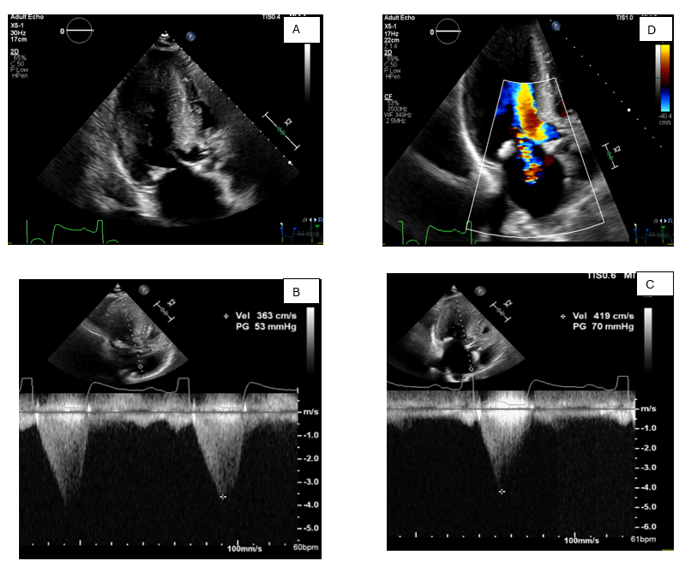
Figures A-D:Preoperative transthoracic echocardiography showing dynamic LVOT obstruction (A) with resting gradient (B) and provocation-induced increase (C), together with mild-to-moderate mitral regurgitation (D).
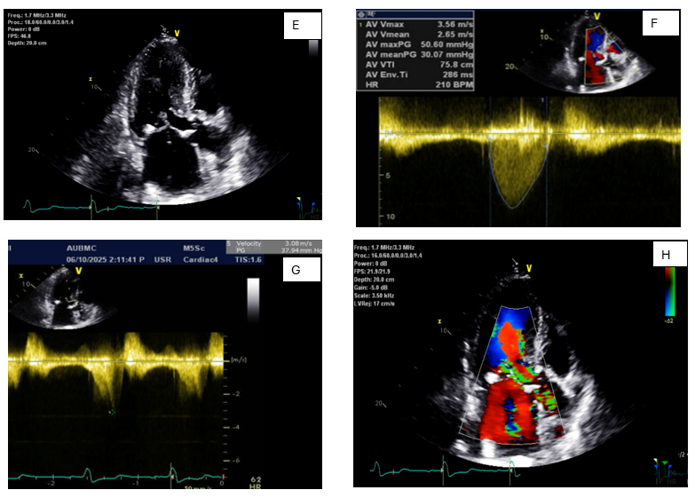
Figures E-H: Transthoracic echocardiogram showed resolution of dynamic LVOT obstruction (E, F,G) and severe mitral regurgitation (H).
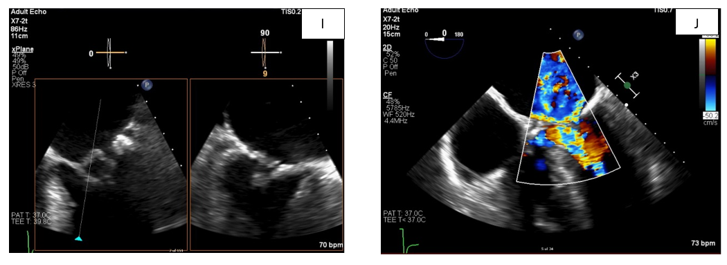
Figures I-J: Transesophageal echocardiography revealed an elongated anterior mitral leaflet and prolapse of the posterior mitral leaflet with ruptured chordae (I), resulting in severe mitral regurgitation (MR) characterized by eccentric anterior and posterior jets (J).
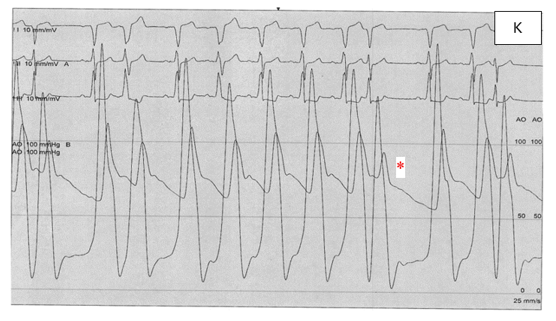
Figure K: absence of the Brockenbrough–Braunwald phenomenon. (*) resembles PVC.
Discussion
This case illustrates the complex interaction between obstructive HCM, dynamic LVOT obstruction, and structural mitral valve disease. SAM-dependent MR typically produces a posteriorly directed jet due to anterior leaflet displacement toward the septum, whereas posterior mitral leaflet flail from chordal rupture produces an anteriorly directed jet (Figure L and M).
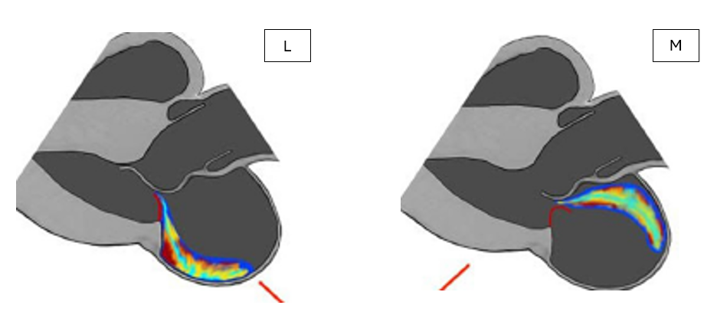
Figure L and M (3): A schematic parasternal long-axis view illustrates two distinct MR mechanisms: SAM-related (L) and flail-related (M)
In this patient, the coexistence of severe MR and loss of dynamic obstruction supports a structural mechanism of regurgitation superimposed on pre-existing obstructive physiology. Chordal rupture in HCM may have two opposing consequences. On one hand, it can precipitate acute severe MR and hemodynamic deterioration requiring urgent intervention. On the other hand, it may reduce LVOT obstruction by diminishing SAM, which can transiently improve symptoms despite worsening valvular insufficiency. Ventricular dilatation secondary to severe MR may further enlarge the outflow tract and reduce drag forces.
This case emphasizes the need for careful preoperative imaging and multidisciplinary decision-making. Cardiac MRI and echocardiography may help identify anatomical and functional features that influence whether mitral valve repair or replacement is most appropriate. In selected patients, mitral valve repair may be a viable alternative to replacement when the structural abnormality is localized (4).
Conclusion
In obstructive HCM, severe MR is not always SAM-mediated. Chordal rupture with posterior mitral leaflet flail may abolish LVOT obstruction while causing severe eccentric MR and acute heart failure. Detailed echocardiographic and hemodynamic evaluation is essential to define the dominant mechanism and guide surgical management.
References
- Anwar MA. Mitral regurgitation in hypertrophic cardiomyopathy: a narrative review of mechanism and current management. Int J Clin Cardiol 9 (2022): 248.
- Anwar AM, tenCate FJ. Echocardiographic evaluation of hypertrophic cardiomyopathy: a review of up-to-date knowledge and practical tips. Echocardiography 38 (2021): 1795-1808.
- Molisana M, Selimi A, Gizzi G, et al. Different mechanisms of mitral regurgitation in hypertrophic cardiomyopathy: a clinical case and literature review.Front Cardiovasc Med 9 (2022): 1020054.
- Ahmed EA, Schaff HV, Geske JB, et al. Optimal Management of Mitral Regurgitation Due to Ruptured Mitral Chordae Tendineae in Patients With Hypertrophic Cardiomyopathy. Semin Thorac Cardiovasc Surg 35 (2023): 476-482.