DeCarolis Mara1, Tessler Madison1, DeCarolis Emidio1, Rampakakis Emmanouil2*
1Evidence-Based Practices Strategies, Montreal, Canada
2Medical Affairs, Clinfo Health Research, Montreal, Canada
*Corresponding Author: Rampakakis Emmanouil, 9400 Henri-Bourassa Blvd. West, H4S1N8, Saint-Laurent, QC, Canada
Received: 03 September 2019; Accepted: 17 September 2019; Published: 23 September 2019
DOI: 10.26502/jfsnr.2642-11000025
SharePrevious studies have suggested synergistic effects between manuka honey and different antibiotics against Staphylococcus aureus. In the present study we have tested in vitro the antibacterial efficacy against Escherichia coli of manuka honey with or without ampicillin and penicillin using the disc diffusion method. Similar synergistic effects of manuka honey with ampicillin and penicillin were observed, particularly in early phases of treatment. Overall, these results support the potential use of natural antimicrobials such as manuka honey either alone or in combination with synthetic agents to lower their therapeutic dose and prevent antibiotic resistance.
Antibiotics, Antibiotic resistance, Natural, Synthetic, Manuka honey
1. Introduction
Although the therapeutic properties of honey have been known for centuries, its antiseptic and antimicrobial properties have been discovered recently. Consisting mainly of carbohydrates, honey also contains several enzymes, proteins, aminoacids, vitamins, lipids, minerals, and phytochemicals which vary considerably by type of honey and are believed to exert health benefits [1, 2]. The antibacterial activity of honey has been attributed to different factors, including hydrogen peroxide, low pH, high osmolarity, and methylglyoxal (MGO) [3-6]. Among the different types of honey, manuka honey has attracted attention for its antimicrobial effects in numerous bacterial pathogens [7] receiving regulatory approvals for clinical use as a wound care agent in the European Union, the USA, New Zealand and others. Of particular interest is that, despite attempts to induce bacterial resistance to manuka honey in the laboratory, there has been no such report which may be due to the complex composition of honey and the multiple active components [8]. Furthermore, multi-resistant bacterial strains have been shown to remain sensitive to manuka honey suggesting a broad spectrum of action and highlighting its potential clinical usefulness [9]. With increasing concerns over antimicrobial resistance worldwide [10], there has been much focus on the potential use of natural antimicrobials [11, 12]. The objective of this study was to compare the antibiotic activity of manuka honey with commonly used synthetic antibiotics, specifically ampicillin and penicillin, as well as to explore any synergistic effects.
2. Materials and Methods
2.1 Inoculum and plate preparation
Commercially available agar plates were spread-plated with approximately 200 µl suspension from an overnight liquid culture of Escherichia coli (E. coli) incubated at 37°C for 48 hours.
2.2 Antimicrobial susceptibility test
Antimicrobial susceptibility test was done using the disc diffusion method as previously described [13]. In each plate six discs were placed, one each containing ampicillin (10 μg), penicillin (10 units), and manuka honey (1 drop), two containing manuka honey with ampicillin or penicillin, respectively, and an empty disc (negative control). The plates were then incubated immediately at 37°C and the diameters of the inhibition zones were measured every 24 hours.
2.3 Data analysis
Data-driven simulation was used to generate 100 observations per treatment group at each timepoint using the SAS procedure PROC SIMNORMAL and the parameters of the input data set. Subsequently, mixed models with repeated measures taking into consideration the correlation of iterations over time were used to compare the antimicrobial activity of ampicillin, penicillin, manuka honey and their combinations. The least square mean estimates were plotted against time. Statistical analyses were performed using SAS version 9.4.
3. Results and Discussion
Using the disc diffusion method all tested treatments exhibited significant (p<0.0001) antibacterial activity against E. coli (Figure 1). By Day 1, the antibacterial effects exerted by ampicillin were more potent, as demonstrated by larger inhibition zones, compared to the effects of penicillin (p<0.0001) or manuka honey (p<0.0001), while penicillin and manuka honey had comparable efficacy. On Day 2, ampicillin and manuka honey had comparable antibacterial activities which were significantly higher than penicillin (p=0.0103 and p=0.0011, respectively). Whereas, on Day 3, Manuka honey was most potent, followed by ampicillin and penicillin.
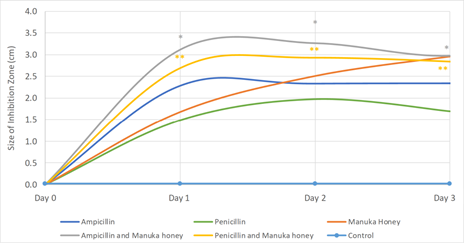
Figure 1: Antimicrobial activity of manuka honey, synthetic antibiotics and combinations thereof.
*p<0.0001 compared to ampicillin alone; **p<0.0001 compared to penicillin alone
In regard to combination treatments, on both Days 1 and 2, combination of manuka honey with ampicillin (manuka honey + ampicillin) or with penicillin (manuka honey + penicillin) resulted in significantly greater inhibition of bacterial growth compared to ampicillin alone (p<0.0001), penicillin alone (p<0.0001), or manuka honey (both p<0.0001). By Day 3, the antibiotic activity of all treatments had reached a plateau with maximal effects observed with manuka honey alone, manuka honey + ampicillin, and manuka honey + penicillin which were comparable. Overall, these results suggest a synergistic effect of manuka honey with ampicillin and penicillin, particularly in early phases of treatment. Similar synergistic effects in vitro were previously reported for manuka honey with antibiotics from the same class (oxacillin) and different classes (tetracycline, imipenem, mupirocin, rifampicin) against Staphylococcus aureus increasing the external validity of our findings [14, 15]. Further investigation will be needed to confirm whether the combinations identified here are effective against clinical isolates and biofilms. In the context of recommended antibiotic stewardship programs, aimed at improving antibiotic use to conserve effectiveness and reduce emergence of resistant strains [16], the results of our study suggest that use of manuka honey either alone or in combination with synthetic agents to lower their therapeutic dose in E. coli-related infections, merits further consideration.
Acknowledgments
Not applicable
Declaration of Interest Statement
None declared
Appendices
Not applicable
References
- Bogdanov S, Jurendic T, Sieber R, et al. Honey for nutrition and health: a review. J Am Coll Nutr 27 (2008): 677-689.
- Cornara L, Biagi M, Xiao J, et al. Therapeutic Properties of Bioactive Compounds from Different Honeybee Products. Front Pharmacol 8 (2017): 412.
- Adams CJ, Boult CH, Deadman BJ, et al. Isolation by HPLC and characterisation of the bioactive fraction of New Zealand manuka (Leptospermum scoparium) honey. Carbohydr Res 343 (2008): 651-659.
- Anthimidou E, Mossialos D. Antibacterial activity of Greek and Cypriot honeys against Staphylococcus aureus and Pseudomonas aeruginosa in comparison to manuka honey. J Med Food 16 (2013): 42-47.
- Brudzynski K, Abubaker K, Wang T. Powerful bacterial killing by buckwheat honeys is concentration-dependent, involves complete DNA degradation and requires hydrogen peroxide. Front Microbiol 3 (2012): 242.
- Mavric E, Wittmann S, Barth G, et al. Identification and quantification of methylglyoxal as the dominant antibacterial constituent of Manuka (Leptospermum scoparium) honeys from New Zealand. Mol Nutr Food Res 52 (2008): 483-489.
- Carter DA, Blair SE, Cokcetin NN, et al. Therapeutic Manuka Honey: No Longer So Alternative. Front Microbiol 7 (2016): 569.
- Cooper RA, Jenkins L, Henriques AF, et al. Absence of bacterial resistance to medical-grade manuka honey. Eur J Clin Microbiol Infect Dis 29 (2010): 1237-1241.
- George NM, Cutting KF. Antibacterial Honey (Medihoney): in-vitro Activity Against Clinical Isolates of MRSA, VRE, and Other Multiresistant Gram-negative Organisms Including Pseudomonas aeruginosa. Wounds 19 (2007): 231-236.
- Global Antimicrobial Resistance Surveillance System (GLASS) Report Early Implementation (2017).
- Pejin B, Iodice C, Tommonaro G, et al. Further in vitro evaluation of antimicrobial activity of the marine sesquiterpene hydroquinone avarol. Curr Pharm Biotechnol 15 (2014): 583-588.
- Pejin B, Savic A, Sokovic M, et al. Further in vitro evaluation of antiradical and antimicrobial activities of phytol. Nat Prod Res 28 (2014): 372-376.
- Bauer AW, Kirby WM, Sherris JC, et al. Antibiotic susceptibility testing by a standardized single disk method. Am J Clin Pathol 45 (1966): 493-496.
- Jenkins R, Cooper R. Improving antibiotic activity against wound pathogens with manuka honey in vitro. PLoS One 7 (2012): e45600.
- Muller P, Alber DG, Turnbull L, et al. Synergism between Medihoney and rifampicin against methicillin-resistant Staphylococcus aureus (MRSA). PLoS One 8 (2013): e57679.
- Barlam TF, Cosgrove SE, Abbo LM, et al. Implementing an Antibiotic Stewardship Program: Guidelines by the Infectious Diseases Society of America and the Society for Healthcare Epidemiology of America. Clin Infect Dis 62 (2016): 51-77.