Sylvia Adipah*
Department of Environmental Engineering and Science, Chongqing University, Chongqing, China
*Corresponding Author: Sylvia Adipah, Department of Environmental Engineering and Science, Chongqing University, Chongqing, China
Received: 30 October 2018; Accepted: 05 November 2018; Published: 16 November 2018
Petroleum spills and other sources of hydrocarbons contamination represent risks for society. Regardless of whether oil is stranded on a shoreline, spilled from a pipeline, or leaked from underground storage tanks, the same physical and chemical properties characterize exposure level of contaminants. Many microorganisms have evolved the ability to feed on naturally occurring petroleum hydrocarbons, which they use as sources of carbon and energy to make new microbial cells. Bacterial population indigenous to marine ecosystems can attack most of the tens and thousands of chemical compounds that make up crude oil. Different bacterial species rather than any single species act together to break hydrocarbons into carbon dioxide, water, and inactive residues. Even toxic oil residues, including highly toxic hydrocarbon polycyclic aromatic hydrocarbons (PAH), can be detoxified. Microorganisms do not accumulate hydrocarbons as they consume and degrade them, so they are not conduit for transferring hydrocarbons into the food web. In fact, microorganisms grown on hydrocarbons can be a potential source of protein for animals and human food. In this study, the purpose is to show factors affecting persistence and environmental risk.
Environmental protection, Ecological risk, Oil spill, Oil residues
Untitled Document
1. Introduction
Scientists studied the relationship between shoreline type, oil penetration, persistence and long term monitoring at a sites of major spills before 1989 [1-5]. Physical process and geomorphological features of the shoreline contributed to oil sequestration and long-term persistence [5]. Physical and (bio) chemical processes were used to remove persistence oil residues. A significant laboratory observation was made in the late 1989 to early 1990, it was observed that oil residues were transformed somehow in a manner that enhanced their removal from shorelines even with only gentle water movements. Laboratory tests of bioremediation in column packed with oil sediments from PWS showed that the physical appearance of oil residue immersed in seawater changed and much of the residue ceased to stick to sediments [6]. After being immerse in seawater within few hours, oil on sediment appear no longer to adhere to sediments but instead to exists as loosely aggregate, fuzzy droplets typical of a flocculated emulsion. Example found when oil residue could be washed from hands and boots with cold water instead of kerosene or other cleaners. These flocs or slightly buoyant droplets tended to concentrate at the upper interstitial contact points in pores. The oil again appeared as black and sticky when water was drained at low tide. Closer examination revealed that the modified oil had been transformed into a water external emulsion (Figure 1).
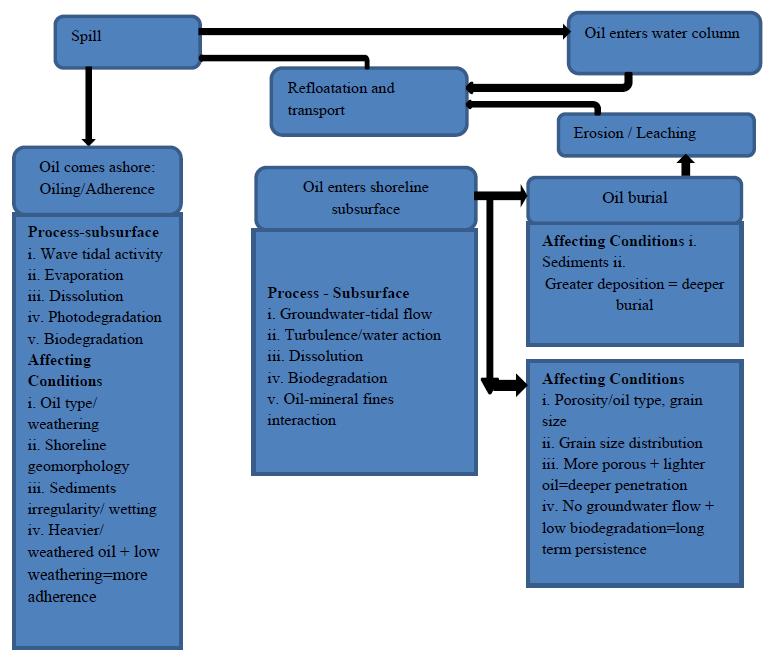
Figure 1: Major processes affecting the fate of oil on shorelines.
A drop of oil actually consisted of thousands of loosely flocculated, individual micron-sized oil droplets, and the oil in water emulsion was stabilized by fine minerals particles. Analyses by electron microscope and X-ray diffraction showed that the mineral fines where mostly 1?m or less in size and consisted of clays, quartz, and feldspar. Microbial oil degradation increased the concentrations of polar compounds in the residual oil, thereby helping the formation of mineral particles-oil flocs [6]. Most of the flocs exhibited almost neutral buoyancy since they contained 60%-80% water by volume.
2. Fate of Oil on Shorelines
The amount and form of shoreline oil change during weathering, as more volatile components evaporate and less volatile residues on shore dissolve, disperse, biodegrade, and photo-oxidize [7]. Oil weathering begins with the rapid evaporation or dissolution of more volatile and water-soluble components, particularly from the slicks on the water surface. Biodegradation is slower, first affecting the linear alkanes and then branched alkanes. For polycyclic aromatic hydrocarbons (PAH), biodegradable deceases with increasing ring numbers and degrees of alkylation, causing the absolute concentrations of all PAH to decease during weathering. Because weathering caused a net decrease in the concentration of both the total and the most toxic PAH, The toxicity of oil decreases as it weathers. This was confirmed by the decreasing toxicity of intertidal sediments from spill sites in Prince William Sound [8] between 1990 and 1993.
3. Mineral Particle Oil Flocculation and Biodegradable
A significant laboratory observation was made in the late 1989 to early 1990; it was observed that oil residues were transformed somehow in a manner that enhanced their removal from shorelines even with only gentle water movements. Laboratory tests of bioremediation in column packed with oil sediments from PWS showed that the physical appearance of oil residue immersed in seawater changed and much of the residue ceased to stick to sediments [6]. After being immerse in seawater within few hours, oil on sediment appear no longer to adhere to sediments but instead to exists as loosely aggregate, fuzzy droplets typical of a flocculated emulsion. Example found when oil residue could be washed from hands and boots with cold water instead of kerosene or other cleaners. These flocs or slightly buoyant droplets tended to concentrate at the upper interstitial contact points in pores. The oil again appeared as black and sticky when water was drained at low tide. Closer examination revealed that the modified oil had been transformed into a water external emulsion (Figure 1). A drop of oil actually consisted of thousands of loosely flocculated, individual micron-sized oil droplets, and the oil in water emulsion was stabilized by fine minerals particles. Analyses by electron microscope and X-ray diffraction showed that the mineral fines where mostly 1um or less in size and consisted of clays, quartz, and feldspar. Microbial oil degradation increased the concentrations of polar compounds in the residual oil, thereby helping the formation of mineral particles-oil flocs [6]. Most of the flocs exhibited almost neutral buoyancy since they contained 60%-80% water by volume.
4. To determine the Impact, Effect, and Injury of Oil Mitigation
To determine whether oil has a long term or short term environmental consequences requires clear, operational definitions of terms. Impact, effect and injure are the main examples that conjure different images and can influence how hypotheses are framed. Impact, effect, and injury have been used to describe the consequences of an oil spill. Impact is the physical contact between spilled and the environment, as when oil is deposited on the water, shoreline or organisms which is the first stage leading to consequences of the spill. The consequences on the field are known as the effects of the spill. For they’re to be effects on biological resources there must be a pathway either direct or indirect. Direct pathway may be the exposure of organisms to the oil while indirect is through disruption of the abundance or availability of prey for forages resulting from the spill. Computer models rather than field studies of biological effect are used as part of the natural resource damage assessment (NRDA) process to determine indirect effect. As defined by the Environmental response, Compensation, and Liability Act (CERCLA) and the NRDR regulations effects may be positive, negative, or neutral (no effects), the focus is on negative effects (injuries) rather than positive effects. Injury means a measurable adverse change, either long or short term, in the chemical or physical quality or the viability of a natural resource resulting either directly or indirectly from exposure to discharge oil or release of a hazardous substance. For an injury to be caused by an oil spill there must be a direct exposure pathway, a measurable effects on organisms, populations, or ecosystems; and these effects must meet or exceed some threshold of what is considered harmful.
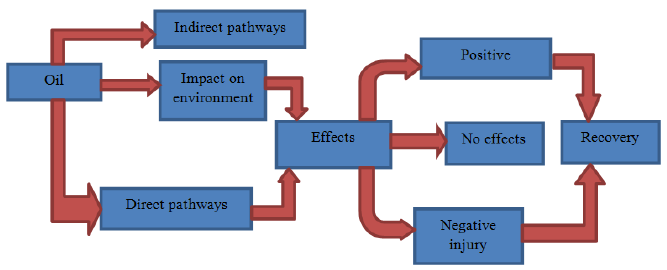
Figure 2: Sequences between the release of oil into the environment and potential consequences and recovery. To illustrate how terms impact, injury and recovery are used.
5. Assessing Ecological Recovery
Assessing ecological recovery from oil or chemical spill is complicated by the lack of steady-state endpoints that results because of succession and because of other changes that may occur in the ecosystem over time and space that are cause by other anthropogenic and natural stressors. Many studies of the restoration and recovery across a broad diversity of ecosystem and stressor types illustrate this point, including: the restoration of the Everglades [9], and upper Mississippi River [10]; re-establishment of threatened/endangered species [11] and recovery from catastrophic natural events, such as Hurricane Andrew [12-13] and the eruption of Mount St, Helens [14-15]. Lessons from these examples are (1). The need to focus recovery assessments on carefully selected VECs (valued ecosystem components) that capture the diversity of the ecosystems. (2). The importance of understanding the complexities of ecological stress-response relationships; and (3). The central roles of spatial, temporal variability, cumulative stress and multiple stressors on ecosystem recovery, for each factor can confound the determination of the ecosystem recovery. Natural variability across time is also important. For example, the large interannual variability in populations of many PWS species, such as fish storage, is driven by variability in dominant climatic and oceanographic factors controlling the ecosystem. This also determining the baseline conditions very difficult and greatly affects the ability to detect ecologically significant effects and established goals for recovery. This issue becomes more problematic over time as uncertainty of natural variability remains unabated while the signal of the effects remains of the spill continuously diminishes. Eventually the point is reached where any residual effects from the oil spill are lost in the noise of natural variability, and risks can no longer be attributed to the spill.
6. Importance of Environmental Risk Assessments
The integrated environmental assessments process has particular utility and value because it is comprehensive, robust, systematic, risk-based, transparent, and based on sound ecosystem science. The integrated environmental risk assessments framework can identify what is at risk, define how risks should be characterized and quantified, and suggest how information should be interpreted and used in decision making in the presence of uncertainty. Problem formulation constitutes the essential first step in an integrated assessment, in which the nature and scope of the problem are defined, questions regarding what is at risk are articulated, essential data are identified, research is initiated, and science based plans are laid for remediation, assessments, recovery, and restoration. Early applications of problem formulation and development of an initial conceptual ecosystem model incorporating appropriate VECs to guide the assessments process could have prevented later misperceptions that residual effects attribute to the oil spill continued to affect PWS natural resources, even when the stressors of concern had long since return to background levels. The individual based models developed a comprehensive understanding of the risk regime following a disturbance were effective tools are used to evaluate risk hypothesis and insights on attributed risk. Qualitative conceptual ecosystem models provide a systematic, weight of evidence methodology that applies objective criteria to compare natural and anthropogenic stressors and assign relative risks in a multi stressor environment. Quantitative models can be used to reach definitive conclusion on risks, ecological significance, recovery, and uncertainties. Variability across space and time makes determining baseline conditions very difficult and greatly affects the ability to detect ecological significant effects and established goals for recovery. This issue only becomes more problematic over time as natural variability remains unabated while the remnant exposures and associated effects of the spill continue to diminish. Eventually the point is reached where the risks from the oil spill are lost in the noise of the variability of natural processes, and the ecological risk can no longer be attributed to spill.
7. Conclusion
Remediation of hydrocarbons sites often includes complex processes that incorporate geological heterogeneities, multiphase flow, and biological and chemical processes. Scientists are studying the basic methodology that applies to different characteristics hydrocarbons spill sites, although each site will have unique characteristics and risks. Critical questions and important measurements to answer these questions can be identified according to site-specific needs. Conceptualization methods, however, are adaptable and can be applied to many problems regarding of scale, and they can be updated. Risk assessment frameworks have been developed to specifically to determine the human health risks from chemical exposure. Assessing ecological risks however are subject to multiple natural and anthropogenic stressors, each potential causing many different effects on many different ecological attributes.
References
- Gundlach ER, Hayes MO. Classification of coastal environments in terms of potential vulnerability to oil spills damage. Marine technology society journal 12 (1978): 18-27.
- Gundlach ER, Hayes MO. Investigation of beach processes. In the Amoco Caldiz Oil Spill, A preliminary Scientific Report. Eds. : Hess WN. National Oceanic and Atmospheric Administration and US Environmental Protection Agency, Boulder, CO, USA. Environmental Research Laboratories 4 (1978): 85-196.
- National Research Council. Oil in the Sea: Inputs, Fates, and Effects. Washington DC, USA: National Research Council, National Academy of Press (1985).
- Hayes MO, Michel J. Factors determining the long-term persistence of Exxon Valdez Oil in gravel beaches. Marine Pollution Bulletin 38 (1999): 92-101.
- Owens EH, Taylor E, Humphrey B. The persistence and character of stranded oil on coarse sediments beaches. Marine Pollution Bulletin 56 (2008): 14-26.
- Bragg JR, Prince RC, Atlas RM. Effectiveness of bioremediation for oiled intertidal shorelines. Nature 368 (1994): 413-418.
- Wolfe DA, Hameedi MJ, Galt JA, et al. The fate of oil spilled from the Exxon Valdez. Environmental Science and Technology 28 (1994): 561-568.
- Page DS, Boehm PD, Stubblefield WA, et al. Hydrocarbon composition and toxicity of sediments following the Exxon Valdez Oil spill in Prince William Sound, Alaska. Environmental Toxicology and Chemistry 21 (2002): 1438-1450.
- Ogden JC, Davis SM, Brandt LA. Science strategy for a regional ecosystem monitoring and assessment program: the Florida Everglades example. In Monitoring Ecosystems: Interdisciplinary Approaches for Evaluating Eco regional Initiatives. Eds. : Busch D, Trexler JC. Washington DC, USA. Island Press (2002): 135-166.
- Upper Mississippi River Basin Association. Forging a New Framework for the Future: A report to the Governors on State and Federal Management of the Upper Mississippi River. St. Paul, MN, USA. Upper Mississippi River Basin Association (1995).
- National Marine Fisheries Service. Interim Endangered and Threatened Species Recovery Planning Guidance. Version 1. 3. June 2010. Silver Spring, MD, USA: National Oceanic and Atmospheric Administration, National Marine Fisheries Service (2010).
- Lirman D, Fong. The effects of Hurricane Andrew and Tropical Storm Gordon on Florida reefs. Coral reefs 14 (1995): 172.
- Lovelace JK, McPherson BF. Restoration, Creation, and Recovery: Effects of Hurricane Andrew (1992) on Wetlands in Southern Florida and Louisiana. Washington DC, USA: United States of Geological Survey. National Water Summary on Wetland Resources, USGS Water Supply Paper 2425 (1996).
- Dale VH, Swanson FJ, Crisafulli CM. Ecological Responses to the 1980 Eruption of Mount St. Helens. New York, NY, USA. Springer (2005).
- Dale VH, Swanson FJ, Crisafulli CM. Ecological perspectives on management of the Mount St. Helens landscape. In Ecological Responses to the 1980 Eruption of Mount St. Helens. Eds. : Dale VH, Swanson FJ, Crisafulli CM. New York, NY, USA. Springer (2005): 277-286.
- Hayes MO, Michel J, Betenbaugh DV. The intermittently exposed, coarse-grained gravel beaches of Prince William Sound, Alaska: Comparison with open ocean gravel beaches. Journal of Coastal Research 26 (2010): 4-30.
- Wang Z, Fingas M, Blenkinsopp S, et al. Comparison of oil composition changes due to biodegradation and physical weathering in different oils. Journal of Chromatography A 809 (1998): 89-107.
- Zhu X, Venosa AD, Suidan T, et al. Guidelines for the Bioremediation of Marine Shorelines and Freshwater Wetlands. Cincinnati, OH, USA: US Environmental Protection Agency, Office of Research and Development, National Risk Management Research Laboratory, Land Remediation and Pollution Control Division (2001).
- Atlas R, Bragg J. Assessing the long-term weathering of petroleum on shorelines: Uses of conserved components for calibrating loss and bioremediation potential. In Proceedings of the Thirtieth Arctic and Marine Oil spill Program (AMOP) Technical Seminar, June 5-7, Edmonton, Alberta, Canada. Ottawa, ON, Canada: Environment Canada (2007): 263-290.
- Prtchard PH, Mueller JG, Rogers JC, et al. Oil spill bioremediation. Experiences, Lessons, and results from the Exxon Valdez oil spill in Alaska. Biodegradation 3 (1992): 315-335.
- Prince RC, Elmendorf DL, Lute JR, et al. Conserved internal marker for estimating the biodegradation of crude oil. Environmental science and technology 28 (1994): 142-145.
- Venosa AD, Suidan MT, King DW, et al. Use of hopane as a conservative biomarker for monitoring the bioremediation effectiveness of crude oil contaminating a sandy beach. Journal of Industrial Microbiology and Biotechnology 18 (1997): 131-139.
- U. S Environmental Protection Agency. Guidelines for conducting remedial investigations and feasibility studies under CERCLA. US Environmental Protection Agency, Office of Emergency and Remedial Response, Final Interim, Washington DC, USA. October (1988).
- Saenton S, Illangasekare TH, Soga K, et al. The effects of source zone heterogeneity on surfactant enhanced NAPL dissolution and resulting remediation end points. Journal of Contaminant Hydrology 59 (2002): 27-44.
- Schwille F. Groundwater pollution by mineral oil products. In Groundwater Pollution Symposium, Proceedings of the Moscow Symposium, August 1971. International Association of Hydrological Sciences, Washington D. C, USA. IAHS-AISH Publications 103 (1975): 226-240.
- Mercer JW, Cohen RW. A review of immiscible fluids in the subsurface properties, models, characterization and remediation. Journal of contaminant hydrology 6 (1990): 107-163
- Newell CJ, Acree SD, Ross RR, et al. Light Non-Aqueous Phase Liquids. Ada, OK, USA: US Environmental protection agency, office of research and development, Robert S. Kerr Environmental Research Laboratory (1995).
- Cygan RT, Stevens CT, Puls RW, et al. Research activities at US government agencies in subsurface reactive transport modeling. Vadose zone journal 6 (2007): 805-822.
- Charbeau RJ. Groundwater Hydraulics and Pollutant Transport. Upper Saddle River, NJ, USA: Prentice-Hall (2002).
- Anderson MP, Woessner WW. Applied Groundwater Modeling. San Diego, CA, USA: Academic Press (1992).
Citation: Sylvia Adipah. The Ecological Effects of Oil Mitigation Associated with Environmental Risk. Journal of Environmental Science and Public Health 2 (2018): 160-167.