Angelos E Kyranoudis1*, Ioannis Mylonas1, Efstratios Kyranoudis1, Athanasios Chatzinikolaou1, Ioannis Ispyrlidis1, Thomas Metaxas2
1Democritus University of Thrace, School of Physical Education & Sports Science, Komotini, Greece
2Aristotle University of Thessaloniki, School of Physical Education & Sports Science, Thessaloniki, Greece
*Corresponding author: Angelos E Kyranoudis, Democritus University of Thrace, School of Physical Education & Sports Science, Campus, SPESS, Komotini 69100, Komotini, Greece
Received: 07 June 2020; Accepted: 16 June 2020; Published: 17 June 2020
A series of exercises with the use or not various instruments is applied before soccer players warm-up. The aim of this study was to examine the effect of these exercises in combination with classic soccer warm-up on ROM and jumping ability performance. Sixteen (n=16) semi-professional soccer players executed two warm-up protocols. The control protocol (CONTROL) was the classic soccer warm-up and the experimental one (EXPER) included pre-warm-up actions using foam rolling, static stretching, neuromuscular control exercises on unstable surfaces and muscle activation exercises accompanied by the classic warm-up of soccer players. The participants executed hip flexion Range of Motion (ROM) measurement and two Countermovement Jump with Arm Swing (CMJAS). Two-Way ANOVA revealed significant main effect of “time” on ROM (p<0.05) in both protocols, but no differences on CMJAS (p=0.10). Results show that pre-warm-up actions do not add further benefit in performance in ROM and CMJAS in relation to classic soccer warm-up.
ROM, Countermovement Jump, Warm-Up, Soccer
ROM articles, Countermovement Jump articles, Warm-Up articles, Soccer articles
Abbreviations:
FRs-Foam Rollers; ROM-Range of Motion; CMJAS-Countermovement Jump with Arm Swing; CMJ-Countermovement Jump; EXPER-Experimental Protocol; CONTROL-Control Protocol; PAP-Post-Activation Potentiation
1. Introduction
Warm-up in various sports in general, but also more specific in soccer, is a process that prepares the athlete for the requirements of training or competition [1], through a variety of mechanisms related to body temperature or other independent from it [2]. The structure of a typical soccer warm-up consists of the general part, muscle stretching and the specific part which includes actions and movements related to the sport [3], while its duration ranges between 25 and 30 minutes [4], although recent research suggests shorter warm-up [5]. In recent years, with the rapid soccer development but also the more detailed study by the research community, coaches and fitness experts in soccer use various exercises that are performed, mainly, in the gym (pre warm-up actions) with various instruments (Foam Rollers-FRs, BOSU ball, resistance elastic bands, etc.) [6, 7, 8], functional exercises [9] or even special warm-up programs , such as FIFA 11+ and Harmoknee [10, 11] in order to optimize performance in fitness skills such as flexibility (ROM) and lower limb power (jumping ability) . These exercises replace part or all of the general warm-up in soccer. There is growing interest in studying the acute effect of FRs on the lower extremities ROM, either individually or in combination with stretching [12, 13, 14, 15, 16]. Although Skarabot et al.[16] did not show an improvement in ankle dorsiflexion after the application of 3 sets of X 30 sec FRs in the gastrocnemius, they recorded a significant improvement of 9.1% after a combination of FRs with static stretching of a total duration of 3 minutes (90 sec FRs and 90 sec static stretching). Similarly, Kyranoudis et al. [12] found improvement in hip flexion ROM after the application of a combined program of 10 seconds static stretching and 30 seconds FRs in the lower extremities. Improvement in lower extremities ROM can be observed even after the application of core stability exercises which are similar, in terms of body positioning, with those of FRs [6].
The power of the lower extremities, as expressed by the players’ jumping ability, seems to show conflicting results after the application of individual exercises or instruments [6, 12, 17, 18], mainly due to the different intervention protocols, participants, but also the different tests used [19]. Kyranoudis et al. [12] recorded significant improvement in the countermovement jump with the hands in the hip (CMJ) by 3.8% after a combination of static stretches lasting 10 seconds and FRs 30 seconds in the lower extremities muscles, but no improvement in the countermovement jump with arm swing (CMJAS). Andersen et al. [17] recorded an improvement in women's handball athletes in lower limb power compared to the control group, both in CMJ (10% vs -2%) and CMJAS (10% vs -6%) after a 6-exercises program with elastic bands resistance (3 sets X 6-10 explosive repetitions) performed 3 times a week for 9 weeks. Finally, Healey et al. [6] did not record significant differences in CMJAS after core stability and FRs exercises. The technique of jump with the arms swing (CMJAS) is similar to the technique of jump preparation for heading in soccer. Jump performance is greater when the hands are used in relation to the CMJ and this difference exceeds 10% [20]. However, to the authors’ knowledge, there is little research on the evaluation of CMJAS in soccer after a comprehensive soccer warm-up [21]. At the same time, although there is extensive research on ROM evaluation, there does not appear to be relevant research on the effect of a combination warm-up program, which includes pre-warm-up actions performed in combination rather than individually, with the classic warm-up followed by fitness soccer experts. The purpose of this study was to examine the effect of a warm-up program that included pre-warm-up actions using foam rolling, static stretching, neuromuscular control exercises on unstable surfaces and muscle activation exercises accompanied by the classic warm-up of soccer players on ROM and lower limbs power.
2. Materials and Methods
2.1 Participants
Sixteen (n=16) male soccer players (age: 22,06 ± 3,27 years, height: 176 ± 0,72cm and weight: 74,14 ± 7,62 kg) from the 3rd Greek Division participated voluntarily in this study. They had no recent musculoskeletal injuries or any medication, they participated in, at least, four training sessions/week, 90 min each and in one game/week. Participants were informed, in writing, of the purpose of the study and signed the consent form for their participation in the research. The study was approved by the university’s institutional review board and ethics committee. All the procedures were in accordance with the Helsinki’s declaration.
2.2 Experimental process
The process included four visits to the field. On the first day, the anthropometric measurements and the familiarization with the protocols were made. Two days later the participants performed the baseline measurements and randomly divided into 4 different groups of 4 players each, for the most effective control of process. The next two visits, which were 72 hours apart, included protocols’ execution. Participants performed the protocols in two groups, but always at the same hour of the day. One group performed the experimental protocol (EXPER) that included the program with pre-warm-up actions performed in the gym followed by the specific part of classic warm-up on the field, lasting a total of about 22 minutes, and the other group performed the control protocol (CONTROL), which included only warm-up on the FIELD, lasting about 26 minutes. The other two groups followed. On the fourth visit, the groups performed the opposite protocol. When one group performed pre-warm-up actions, the other group remained inactive and as soon as the first group completed the exercises, they started warming up on the field together (CONTROL). The experimental design was implemented in a field with natural grass and the ambient temperature was 25.50 C ± 1.40 C, the relative humidity 65.8 ± 10.7% and the air 2.3 ± 1.2 m / sec .
2.3 Protocols’ description
The (EXPER) protocol initially included FRs exercises in the lower limbs muscles (quadriceps, hamstrings, gastrocnemius, abductors and adductors) for 30 sec. Participants performed rolling on both legs simultaneously for 30 sec in quadriceps, hamstrings, gastrocnemius using a larger Foam Roller (Power Force FR 60x14cm- BR-2010), while in abductors and adductors they performed for 30 sec alternately on each leg with smaller Foam Roller (Amila 33x13cm, FR-48197). After completing the FRs, they performed 10 sec static stretching alternately on each leg in the quadriceps, hamstrings, gastrocnemius and adductors and then "planking" for 20 sec (prone, supine and both sides planking). Participants then performed dynamic leg crossings over 5 hurdles, resistance bands exercises for quadriceps, hamstrings, gastrocnemius, adductors and peroneus for 15 repetitions per leg and completed pre-warm-up actions with BOSU exercises (balance, alternative leg lifts and half-squats). After a 1 min break, participants performed the warm-up on the field, starting by playing passes each other in pairs, performing gymnastic exercises, dynamic stretching and coordination exercises. This was followed by 3 sets of 1 min Small Sided Games (4v4) in a 25x20m area with 30 sec break between them, 4 minutes of technical and tactical exercises and the protocol completed with 4 sprints of 5m each in a straight line and with change of direction. The detailed description of the protocols (not included breaks) is shown in Table 1. Two minutes after the completion of warm-up protocols the participants were measured in hip flexion ROM and immediately after, they executed 2 CMJAS with 30 sec break between them. The measurement of hip flexion was done with the Myrin goniometer (Lic. Rehab. 17183 Solna, Sweden), while the OptoJump photoelectric cells system (Microgate, Bolzano, Italy) was used for the CMJAS. The description of the test is mentioned in our previous study (Kyranoudis et al, 2019).
2.4 Statistical analysis
All results are reported as mean ± SD and seem in Τable 2. Two-Way repeated measures ANOVA were used for the statistical analysis. The level of significance was set as p <0.05. Jamovi 1.2.17 software was used for statistical analysis [22].
3. Results
ANOVA analysis of variance did not show a significant interaction between two factors (program X time) in both variables (ROM: F1.15 = 3.97, p = 0.06 and CMJAS: F1.15 = 2.14, p = 0.16). A significant main effect of the "time" factor, however, was observed only in ROM (F1.15 = 20.98, p <0.001) (Figure 1).
|
Exercises |
Repetition (rep) |
Duration |
|
Foam Roller |
30 sec/leg |
7 min |
|
Static Stretching |
10 sec/leg |
1 min |
|
Planking (“bridges”) |
20 sec |
2 min |
|
Dynamic passages of the hurdles |
5 rep/leg |
2 min |
|
Resistance elastic bands |
15 rep/leg |
3 min |
|
BOSU: Balance Alternative leg lifts Half-squats |
15 sec/leg 10 rep/leg 12 rep |
4 min |
|
Passing |
3 min |
|
|
Gymnastic exercises in movement |
3 min 20 sec |
|
|
Dynamic stretching |
4 min |
|
|
Coordination |
3 min 30 sec |
|
|
Small Sided Games 4ν4 |
4 min |
|
|
Technical and tactical exercise |
4 min |
|
|
Sprints |
90 sec |
|
|
Total duration EXPER |
~ 48 min |
|
|
Total duration CONTROL |
~ 26 min |
Table 1: Protocols’ description. The whole protocol concerns the EXPER warm-up program, while the bold letters concerns the CONTROL.
|
Group |
ROM |
CMJAS |
||
|
Pre |
After |
Pre |
After |
|
|
EXPER |
99.7 ± 11.7 |
108 ± 8.6* |
41.2 ± 5.45 |
41 ± 4.5 |
|
CONTROL |
99.7 ± 11.7 |
112 ± 11.8* |
41.2 ± 5.45 |
39.7 ± 5.7 |
Table 2: Results for hip flexion Range of Motion (ROM) and Counter Movement Jump with Arms Swing (CMJAS)(means ± SD). *p<0.05.
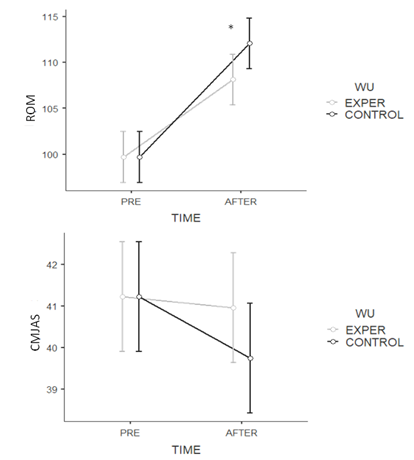
Figure 1: Means and SD in hip flexion Range of Motion (ROM) and Counter Movement Jump with Arms Swing (CMJAS). * p<0.05.
4. Discussion
The results of the present study showed that the warm-up that includes exercises using or not various instruments (pre-warm-up actions) is used by fitness soccer experts as part or by completely replacing the general part of the warm-up, in combination with the specific part of classic warm-up does not offer any additional benefit in relation to its classic form on hip flexion ROM and CMJAS.
Hip flexion ROM appears to be positively affected by the application of both warm-up protocols. Mechanisms related to body and muscle temperature have been reported to improve performance after warm-up [2]. Increased body temperature observed after the completion of two active warm-up protocols combined with the increased heart rate of the participants (82%), probably led to an improvement in hip flexion ROM.
According to Bishop [2], active warm-up leads to muscle stiffness reduction due to the constant movement of muscles. This results in the stable bonds of actin-myosin filaments’ breakdown, which may be present due to immobility, leads to an increase in ROM. At the same time, a decrease in muscles viscosity is observed after the use of FRs, which helps to release stiff muscles tension and the fascia that surrounds them [6, 23], due to increased blood flow to the soft tissues, thus leading to an increase in ROM [13]. However, FRs use contained only one warm-up protocol (EXPER). The content of the second protocol (CONTROL), however, included exercises in which participants were in constant motion (gymnastic exercises, dynamic stretching, Small Sided Games, technical and tactical actions and sprints), which may helped to improve hip flexion ROM, due to body temperature maintaining at high levels, as shown by the temperature and Heart Rate measurements of the participants after the end of warm-up protocols. At the same time, the use of dynamic stretching included in the specific part of both warm-up protocols, seems to have positively affected the performance in hip flexion ROM [24].
In contrast, no significant difference (positive or negative) was observed in the CMJAS jump height after the two warm-up protocols application. This finding is in agreement with previous studies [6, 12, 25]. Jones et al. [25] did not show a significant change in CMJAS after different warm-up protocols, as, also, Healey et al. [6] after 30 sec FRs in the lower limbs muscles. Similarly, Kyranoudis et al. [12] did not find a significant difference in jump height in their research when they applied 30 sec FRs and 10 sec static stretching to the lower extremities muscles of amateur soccer players.
The lack of significant differences between the measurements before and after two protocols may be due to the fatigue of the players. An important factor likely to increase performance after warm-up is Post-Activation Potentiation (PAP) [2]. It is known that high-intensity actions, such as sprints and maximal voluntary contractions [26], as well as dynamic stretches [27] can introduce PAP. On the other hand, PAP and fatigue coexist in skeletal muscle [28] as any muscular action can activate both of these mechanisms. The content of the stimulus can determine which of two mechanisms will prevail. In increased exercise volume, fatigue appears to predominate over PAP [28]. In the present study, the total duration of EXPER was approximately 48 minutes and that of CONTROL was 22 minutes. It is possible that the footballers reached a state of fatigue with the result that the performance in explosive actions, such as jumping, was reduced [29]. Zois et al. [21] also report similar fatigue in their study, in which the duration of classic warm-up was 23 minutes versus only 12 minutes of warm-up that included only Small Sided Games, which probably introduced more fatigue and suspended the central and peripheral mechanisms responsible for muscle contraction [21]. Also, the time between stimulus and test is considered an important factor in PAP introduction. Gouvea et al. [30] report that a period of 8-12 minutes between stimulus and jump test is considered to be able to improve jump performance. However, in the present study, the jumps were performed 3-4 minutes after the completion of the protocols, with the result fatigue probably prevailed over the PAP.
Performance in arm swing jump is higher than the one with hand in the middle [20]. Hara et al. [31] report that 66% of the total jump height increase comes from the lower limbs joints and the rest from the upper extremities. Thus, the role of arms in CMJAS is considered important, as its movement store extra energy in the descend phase of jump when the trunk tilts forward [31] and transfers this energy to the rest of the body during the last stages of the jump. This energy comes mainly from the shoulders and elbows, while additional work is done on the hips [32]. Because there was no hands or shoulders intervention in any protocol, it is possible that they did not work in addition to jump performance and therefore no significant differences in jump height were observed after the CMJAS test.
5. Conclusions
Coaches and soccer fitness experts apply exercises, using or not various instruments, before players warm up on the field, either as part of general warm-up section, or by replacing this, in order to increase footballers’ performance. From the present study results, however, there does not seem to be any additional improvement in the hip flexion ROM performance and jumping ability, as expressed by CMJAS, in relation to the classic soccer warm-up. Shorter warm-up, possible modification of the range of exercises and activation of the upper limbs, but also longer recovery time after the end of the warm-up may have better effect on the above physical performance abilities.
References
- Swanson J. A functional approach to warm up and flexibility. Strength and Conditioning Journal 28 (2006): 30-36.
- Bishop D. Warm up I: Potential mechanisms and the effects of passive warm up on exercise performance. Sports Medicine 33 (2003): 439-454.
- Behm DG, Chaouachi A. A review of the acute effects of static and dynamic stretching on performance. European Journal of Applied Physiology 111 (2011): 2633-2651.
- Towlson C, Midgley A, Lovell R. Warm-up strategies of professional soccer players: practitioners’ perspectives. Journal of Sports Sciences 31 (2013): 1393-1401.
- Yanci J, Itturi J, Castillo D, et al. Influence of warm-up duration on perceived exertion and subsequent physical performance of soccer players. Biology of Sport 36 (2019): 125-131.
- Healey KC, Hatfield DL, Blanpied P, et al. The effects of myofascial release with foam rolling on performance. Journal of Strength and Conditioning Research 28 (2014): 61-68.
- Madoni NS, Costa BP, Coburn WJ, et al. Effects of foam rolling on range of motion, peak torque, muscle activation and the Hamstrings-to-quadriceps strength ratios. Journal of Strength and Conditioning Research, 32 (2018): 1821-1830.
- Wallace BJ, Winchester JB, McGuigan M. Effects of elastic bands on force and power characteristics during the back squat exercise. Journal of Strength and Conditioning Research 20 (2006): 268-272.
- Sander A, Keiner M, Schlumberger A, et al. Effects of functional exercises in the warm-up on sprint performances. Journal of Strength and Conditioning Research 27 (2013): 995-1001.
- Bizzini M, Impellizzeri F, Dvorak J, et al. Physiological and performance responses to the “FIFA 11+” (part 1): is it an appropriate warm-up? Journal of Sports Sciences 31 (2013): 1481-1490.
- Daneshjoo A, Mokhtar AH, Rahnama N, et al. The effects of injury preventive warm-up programs on knee strength ratio in young male professional soccer players. PLoS One 7 (2012).
- Kyranoudis A, Arsenis S, Ispyrlidis I, et al. The acute effects of combined foam rolling and static stretching program on hip flexion and jumping ability in soccer players. Journal of Physical Education and Sport Art 169 (2019): 1164-1172.
- MacDonald GZ, Penney MD, Mullaley ME, et al. An acute bout of selfmyofascial release increases range of motion without a subsequent decrease in muscle activation or force. Journal of Strength and Conditioning Research 27 (2013): 812-821.
- Mohr AR, Long BC, Goad CL. Effect of Foam Rolling and static stretching on passive hip-flexion range of motion. Journal of Sport Rehabilitation 23 (2014): 296-299.
- Murray AM, Jones WT, Horobeanu C, et al. Sixty seconds of foam rolling does not affect functional flexibility or change muscle temperature in adolescent athletes. International Journal of Sports and Physical Therapy 11 (2016): 765-776.
- Škarabot J, Beardsley C, Štirn I. Comparing the effects of self-myofascial release with static stretching on ankle range-of-motion in adolescent athletes. International Journal of Sports and Physical Therapy 10 (2015): 203-212.
- Andersen V, Fimland MS, Cumming KT, et al. Explosive resistance training using elastic bands in \young female team handball players. Sports Medicine International Open 2 (2018): 171-178
- Smith JC, Pridgeon B, Hall Acute effect of foam rolling and dynamic stretching on flexibility and jump height. Journal of Strength and Conditioning Research 32 (2017): 2209-2015.
- Wiewelhove T, Döweling A, Schneider C, et al. A meta-analysis of the effects of foam rolling on performance and recovery. Frontiers in Physiology 10 (2019): 376.
- Harman EA, Rosenstein MT, Frykman PN, et al. The effects of arms and countermovement on vertical jumping. Medicine and Science in Sports and Exercise 22 (1990): 825-833.
- Zois J, Bishop DJ, Ball K, et al. High-Intensity warm-ups elicit superior performance to a current soccer warm-up routine. Journal of Science and Medicine in Sport 14 (2011): 522-528.
- The jamovi project. jamovi. (Version 1.2) [Computer Software] (2020).
- Cheatham SW, Kolber MJ, Cain M, et al. The effects of selfmyofascial release using a foam roll or roller massager on joint range of motion, muscle recovery, and performance: a systematic review. International Journal of Sports and Physical Therapy 10 (2015): 827-838.
- Οpplert J, Babault N. Acute effects of dynamic stretching on muscle flexibility and performance: An analysis of the current literature. Sports Medicine 48 (2017): 299-325.
- Jones A, Brown LE, Coburn JW, et al. Effects of Foam Rolling on vertical jump performance. International Journal of Kinesiology &Sports Science 3 (2015): 38-42.
- Bishop D. Warm up II: Performance changes following active warm up and how to structure the warm up. Sports Medicine 33 (2003b): 483-498.
- Tillin N A, Bishop D. Factors modulating post-activation potentiation and its effect on performance of subsequent explosive activities. Sport Medicine 39 (2009): 147-166.
- Xenofondos A, Laparidis K, Kyranoudis A, et al. Post-activation potentiation: factors affecting it and the effect on performance. Journal of Physical Education and Sport 28 (2010): 32-38.
- Golas A, Maszczyk A, Zajac A, et al. Optimizing post activation potentiation for explosive activities in competitive sports. Journal of Human Kinetics 52 (2016): 95-106.
- Gouvea AL, Fernandes IA, Cezar EP, et al. The effects of rest intervals on jumping performance: A meta-analysis on post-activation potentiation studies. Journal of Sports Sciences 31 (2013): 459-467.
- Hara M, Shibayama A, Takeshita D, et al. The effect of arm swing on lower extremities in vertical jumping. Journal of Biomechanics 39 (2006): 2503-2511.
- Lees A, Vanrenterghem J, Clercq DD. Understanding how an arm swing enhances performance in the vertical jump. Journal of Biomechanics 37 (2004): 1929-1940.