Yanyan Piao1,2, Chunqin Li3, Qinyu Ge1,2, Yuzhou Wu2,4,5, Huazheng Liang2,4,5,6,*
1State Key Laboratory of Digital Medical Engineering, School of Biological Science and Medical Engineering, Southeast University, Nanjing 210096, PR China
2Southeast University-Monash University Joint International School (Suzhou), Suzhou 215125, PR China
3Faculty of Pharmacy and Pharmaceutical Science, Monash University, Melbourne, VIC 3052, Australia.
4Suzhou Industrial Park Monash Research Institute of Science and Technology, Monash University Suzhou 215000, PR China
5Australian Regenerative Medicine Institute, Monash University, Clayton, VIC 3800, Australia
6Shanghai Key Laboratory of Anesthesiology and Brain Functional Modulation; Clinical Research Center for Anesthesiology and Perioperative Medicine; Translational Research Institute of Brain and Brain-Like Intelligence; Department of Anesthesiology and Perioperative Medicine, Shanghai Fourth People's Hospital, School of Medicine, Tongji University, Shanghai 200092, PR China
*Corresponding Author: Prof./Dr. Huazheng Liang, Suzhou Industrial Park Monash Research Institute of Science and Technology, Level 9, Building 2, No. 1 Huayun Road, Suzhou 215000, PR China.
Received: 27 September 2026; Accepted: 05 October 2026; Published: 22 October 2026
DOI: 10.26502/jppd.2572-519X0284
ShareAim: To evaluate the efficacy and safety of tonifying kidney decoction (TKD) in adults with mild-to-moderate Alzheimer’s disease (AD). Methods: Chinese and international databases were searched for randomized controlled trials published from January 2010 to August 23, 2026. TKD administered alone or with conventional Western medicine (CWM) was compared with eligible control interventions. End-of-treatment outcomes were pooled using random-effects models. Risk of bias, subgroup effects, sensitivity, publication bias, and certainty of evidence were assessed using Cochrane methods and GRADE. Data were pooled using Review Manager (RevMan 5.4). Results: Twenty-one trials involving 1,708 participants were included. Compared with control interventions, TKD-based therapy improved Mini-Mental State Examination scores (mean difference (MD) 2.49, 95% confidence interval (CI) 1.84–3.15; I² = 86%), activities of daily living scores (MD −2.75, 95% CI −4.07 to −1.43; I² = 71%), and Alzheimer’s Disease Assessment Scale–Cognitive Subscale scores (MD −5.20, 95% CI −6.75 to −3.66; I² = 91%). Benefits were also observed for traditional Chinese medicine syndrome scores, Modified Barthel Index scores, and clinical response. MMSE improvement was greater with TKD plus CWM than with TKD monotherapy, whereas treatment duration did not significantly modify the effect. Sensitivity analyses supported the direction of the MMSE result, although funnel-plot asymmetry was detected and trim-and-fill adjustment reduced its magnitude. Evidence certainty ranged from moderate to very low. Conclusion: TKD-based therapy may improve cognitive performance in patients with mild-to-moderate AD. However, substantial heterogeneity, methodological limitations, and insufficient safety reporting preclude firm conclusions. Larger, rigorously designed trials with standardized interventions and longer follow-up are required.
Alzheimer's disease, Tonifying kidney decoction, Traditional Chinese medicine, Meta-analysis.
Alzheimer’s disease articles; Tonifying kidney decoction articles; Traditional Chinese medicine articles; Meta-analysis articles.
1. Introduction
Alzheimer's Disease (AD) is a progressive neurodegenerative disease characterized by deterioration in memory and other cognitive domains, ultimately leading to impaired daily functioning and loss of independence [1]. Patients commonly experience progressive memory loss, disorientation, language difficulties, impaired judgement, behavioral changes, and declining ability to perform daily activities. With global population ageing, the prevalence of AD continues to increase, imposing substantial psychological, caregiving, healthcare, and socioeconomic burdens on patients, families, and society [2]. According to the China Alzheimer Report 2025, approximately 16.99 million people were living with Alzheimer’s disease and related dementias (ADRD) in China in 2021, corresponding to a crude prevalence of 1,194.2 per 100,000 population and accounting for 29.8% of all ADRD cases worldwide [3].
From the perspective of modern medicine, Alzheimer’s disease (AD) is a multifactorial neurodegenerative disorder involving amyloid-β deposition, abnormal hyper-phosphorylated tau aggregation, synaptic and neuronal dysfunction, neuroinflammation, and interactions among genetic, vascular, metabolic, and lifestyle factors [4-7]. Current pharmacological management includes symptomatic treatments, principally cholinesterase inhibitors such as donepezil, rivastigmine, and galantamine, as well as the N-methyl-D-aspartate receptor antagonist memantine. These agents may provide modest benefits in cognition and daily functioning but do not halt the underlying disease process [8-10]. More recently, anti-amyloid monoclonal antibodies, including lecanemab and donanemab, have been shown to reduce cerebral amyloid burden and modestly slow cognitive and functional decline in selected patients with early AD [11, 12]. Nevertheless, these treatments do not cure AD or completely prevent further deterioration, and their clinical applicability may be limited by safety concerns, treatment burden, individual variability, and the multifactorial nature of the disease. Further investigation of complementary or adjunctive approaches to preserving cognitive and functional abilities is therefore warranted.
Traditional Chinese medicine has long been used in the clinical management of cognitive impairment and AD dementia [13-15]. Within the TCM theoretical framework, cognitive decline is frequently associated with deficiency of kidney essence; accordingly, herbal prescriptions based on the therapeutic principle of tonifying the kidney and replenishing essence (bushen yijing) have been used in an attempt to alleviate cognitive and functional deterioration [16, 17]. Preclinical evidence suggests that herbs commonly used in these prescriptions may influence biological processes related to synaptic plasticity, oxidative stress, neuroinflammation, and amyloid metabolism. For example, recent research indicates that Rhizoma Acori Tatarinowii (Shi Chang Pu) can enhance cognition and improve intellectual functions [18, 19]. Specifically, in a mouse model of attention deficit induced by amyloid-beta (Aβ) deposition, both the soluble and essential oil components of Shi Chang Pu were shown to significantly enhance learning and memory, an effect thought to be related to a reduction in nitric oxide synthase (NOS) [20]. Additionally, Yuan Zhi has been shown to significantly improve learning and memory and promote long-term potentiation (LTP) in the hippocampus, with an assumed mechanism related to enhanced neurogenesis [20].
In this meta-analysis, Chinese herbal formulae sharing this principal therapeutic approach were collectively termed tonifying kidney decoctions (TKDs), although their specific compositions and dosage forms varied among studies. Clinical trials have evaluated TKD either alone or in combination with conventional Western medicine, but its overall efficacy remains uncertain. Based on the National Institute on Aging and the Alzheimer’s Association (NIA–AA) framework, the target population comprised patients with MCI due to AD, mild AD dementia, or moderate AD dementia. This systematic review and meta-analysis therefore aimed to evaluate the efficacy and safety of TKD across this defined symptomatic AD spectrum.
2. Methods
2.1 Registration and Reporting Guidelines
This meta-analysis was registered with the International Prospective Register of Systematic Reviews (PROSPERO; registration number CRD420251031965). The registered protocol specified the review objectives, eligibility criteria, search strategy, data extraction procedures, risk-of-bias assessment, and methods for data synthesis. The study was conducted and reported in accordance with the Preferred Reporting Items for Systematic Reviews and Meta-Analysis (PRISMA) 2020 statement and the PRISMA extension for Chinese Herbal Medicines (PRISMA-CHM 2020) [21] (Supplementary Tables S1-S3).
2.2 Search Strategy
A comprehensive literature search was conducted in PubMed, China National Knowledge Infrastructure (CNKI), Wan Fang Data, Cochrane Central Register of Controlled Trials (CENTRAL) and Web of Science for studies published between January 1, 2010 and August 23, 2026. ClinicalTrials.gov was searched to identify registered or unpublished trials. Google Scholar and the reference lists of relevant eligible studies were additionally searched to identify potentially relevant studies not captured by the database searches. Searches were restricted to publications in Chinese or English. Database-specific search filters and limits were applied where appropriate.
The search strategy combined controlled vocabulary, including Medical Subject Headings (MeSH), with free-text terms relating to Alzheimer’s disease, MCI due to AD, traditional Chinese herbal medicine, and kidney-tonifying therapy. To improve retrieval sensitivity, the principal search was supplemented with specific formula names and related intervention terms, including Guilingji, Cistanche, Yangxue Qingnao, Wujia Yizhi, Smart Soup, Cong Ming Tang, Rehmannia, Fuzhisan, Huangnao, Jianmao, Yishen, Jiedu, Congrong, Dihuang Yinzi, Yi-Zhi-An-Shen, Shenwu, and Naohuan. Search terms and syntax were adapted to the indexing system and technical requirements of each database. For Google Scholar, the first 200 results ranked by relevance were screened for each query unless fewer than 200 records were retrieved, in which case all results were examined. Forward and backward citation searching was also performed. The complete database-specific search strategies, applied filters, search dates, and numbers of records retrieved are provided in Supplementary Text S1.
2.3 Inclusion Criteria
- Randomised Control Trials;
- Participants aged > 50 years;
- Participants in studies should have a diagnosis of mild-to-moderate AD, according to recognized diagnostic criteria, including the NINCDS-ADRDA criteria, the NIA-AA clinical criteria [22], the DSM-III-R, DSM-IV, or nationally recognized Chinese medicine diagnostic criteria for AD [23].
- Participants with syndromes lasting for at least 3 months before enrolment;
- The intervention consisted of a tonifying kidney decoction (TKD), administered either alone or in combination with conventional Western medicine (CWM);
- Mini-Mental State Examination (MMSE) score 11 to 26 [24], and/or a Clinical Dementia Rating Global Score (CDR-GS) of 0.5–2;
- Participants had a Hachinski Ischemic Scale (HIS) score ≤4, where reported; and
- The study reported sufficient data for at least one prespecified outcome.
2.4 Exclusion Criteria
- Non-randomized studies, including observational studies, case reports, case series, or studies without an eligible control group;
- Reviews, meta-analysis articles, conference abstracts without sufficient data, commentaries, or other non-original research articles;
- Studies that did not evaluate an eligible TKD intervention, either alone or in combination with conventional Western medicine;
- Studies involving participants with MCI or dementia attributable to causes other than AD, including vascular dementia, dementia with Lewy bodies, Huntington’s disease, or other identifiable neurological or medical conditions;
- Patients have drug or alcohol abuse history;
- Animal experiments, in vitro studies, or other preclinical research; or
- Studies that did not report sufficient quantitative data for at least one prespecified outcome and for which the required data could not be obtained or derived.
2.5 Data Extraction
Two reviewers independently extracted data from the included studies using a standardized and pre-piloted data extraction form. The extracted information included: (1) study characteristics, including the first author, publication year, study design, study setting and treatment duration; (2) participant characteristics, including diagnostic criteria, disease stage and severity, eligibility criteria, sample size in each group, age, sex, and baseline cognitive status; (3) intervention characteristics, including the name, composition, dosage form, dose, administration frequency, treatment duration, and permitted modifications of the tonifying-kidney decoction (TKD), as well as any concomitant conventional medication; (4) comparator characteristics, including the name, dose, frequency, and duration of conventional medication or other control treatments; and (5) reported outcome measures, including MMSE score, activities of daily living (ADL), Alzheimer’s Disease Assessment Scale–Cognitive Subscale (ADAS-Cog), TCM symptom scores, clinical response rates, and other relevant outcomes.
2.6 Risk of Bias Assessment
The risk of bias of the included studies was evaluated by the Cochrane Risk of Bias tool. Seven domains were evaluated: (1) random sequence generation; (2) allocation concealment; (3) blinding of participants and personnel; (4) blinding of outcome assessors; (5) incomplete outcome data; (6) selective outcome reporting; and (7) other potential sources of bias. Each domain was judged as having a low, high, or unclear risk of bias, according to the information reported in the original publication. A domain was rated as unclear when the available information was insufficient to support a definitive judgment. Other potential biases included concerns regarding the definition of clinical response, baseline comparability, and inappropriate or insufficiently reported analytical procedures.
2.7 Statistical Analysis
Statistical analyses were performed using Review Manager (RevMan, version 5.4; Cochrane, London, UK). Treatment effects were evaluated using outcome data measured at the end of treatment. Continuous outcomes, including MMSE, ADL, ADAS-Cog, TCM syndrome, and Modified Barthel Index (MBI) scores, were collected as mean differences (MD) with 95% confidence intervals (CI) using the inverse-variance (IV) method. Positive MDs favored TKD-based therapy for MMSE and MBI scores, for which higher values indicate better cognitive or functional performance. Negative MDs favored TKD-based therapy for ADL, ADAS-Cog, and TCM syndrome scores, for which lower values indicate better outcomes. Because the included studies used different instruments to assess activities of daily living, the ADL analysis was restricted to studies using the comparable 20-item ADL scale, on which lower scores indicate better functional ability. MBI scores were analyzed separately.
For the dichotomous outcome of clinical response, treatment effects were expressed as risk ratios (RRs) with 95% CIs and pooled using the Mantel–Haenszel method. An RR greater than 1 favored TKD-based therapy. Random-effects models were used because clinical and methodological heterogeneity was anticipated across studies, including differences in disease stage, TKD formulation, concomitant conventional treatment, and treatment duration. Statistical heterogeneity was assessed using Cochran’s Q test and quantified using the I² statistic. I² values of approximately 25%, 50%, and 75% were interpreted as indicating low, moderate, and substantial heterogeneity, respectively. A two-sided P value < 0.05 was considered statistically significant.
2.8 Subgroup and Sensitivity Analysis
Subgroup analyses were conducted for the MMSE outcome according to intervention type, disease stage, and treatment duration. Intervention type was categorized as TKD monotherapy versus conventional Western medicine (TKD vs CWM) or TKD combined with conventional Western medicine versus conventional Western medicine alone (TKD + CWM vs CWM). Disease stage was categorized as MCI due to AD, mild AD, moderate AD, or mixed mild-to-moderate AD. Treatment duration was classified as <12 weeks, 12 weeks, or >12 weeks. Pooled MDs and 95% CIs were calculated within each subgroup using an inverse-variance random-effects model. Differences between subgroup effects were evaluated using the chi-square test for subgroup differences and are presented as and . A two-sided was considered statistically significant. Subgroup findings were interpreted cautiously when individual categories contained few studies.
Sensitivity analysis was conducted for the MMSE outcome to assess the robustness of the pooled effect. The pooled estimate obtained using the inverse-variance random-effects model was first compared with that obtained using a fixed-effect model. Analyses were then repeated by restricting the dataset to studies judged to be at low risk of bias in each methodological domain. In addition, a leave-one-out analysis was performed under the random-effects model by sequentially excluding each study and recalculating the pooled MD, 95% CI, and heterogeneity statistics. Robustness was determined by examining changes in the magnitude, direction, and statistical significance of the pooled effect.
2.9 Publication Bias Assessment
Publication bias and small-study effects were assessed for outcomes reported by at least 10 studies. Funnel plots were visually inspected for asymmetry. Egger’s regression test was used for continuous outcomes, and Harbord’s test was applied to the dichotomous clinical response rate. A two-sided p < 0.05 was considered indicative of statistically significant funnel-plot asymmetry. If an outcome showed statistically significant asymmetry, the trim-and-fill procedure with the L-estimator was applied to estimate potentially missing studies and recalculate the pooled effect. The imputed data points generated by this procedure were regarded as hypothetical estimates rather than actual unpublished studies.
2.10 Grading of Recommendations, Assessment, Development, and Evaluation (GRADE) Assessment
The certainty of evidence for each outcome was assessed using the Grading of Recommendations, Assessment, Development, and Evaluation (GRADE) approach. As all included studies were randomized controlled trials, the certainty of evidence initially began as high and was subsequently downgraded according to five domains: risk of bias, inconsistency, indirectness, imprecision, and publication bias. The certainty was downgraded by one level for serious on these assessments and by two levels for very serious concerns within each domain. Based on these assessments, the certainty of evidence was classified as high, moderate, low or very low. Two reviewers independently performed the assessments, and disagreements were resolved through discussion or consensus.
3. Results
3.1 Study Selection
A total of 1,374 records were identified through database, register, and supplementary searches. After 1,043 duplicate or otherwise ineligible records were removed before screening, 331 records underwent title and abstract screening, of which 261 were excluded. Full-text retrieval was sought for 70 reports; 19 could not be retrieved, leaving 51 reports for eligibility assessment. Thirty reports were excluded because of an ineligible population or diagnosis (n = 7), ineligible disease type or severity (n = 2), ineligible intervention (n = 15), ineligible comparator or unbalanced co-interventions (n=3), incomplete outcome data (n = 2), or absence of a prespecified outcome of interest (n = 1). Ultimately, 21 studies were included in the systematic review and meta-analysis (Figure 1).

Figure 1: PRISMA 2020 flow diagram of the literature search and study selection process.
3.2 Study Characteristics
Twenty-one randomized controlled trials were included, comprising 1,708 participants: 867 in the TKD-based intervention groups and 841 in the control groups. Individual study sample sizes ranged from 30 to 144 participants, and the reported mean ages of the treatment groups ranged from 55.38 to 83.32 years. Two studies enrolled participants with MCI due to AD, whereas the remaining studies included patients with mild, moderate, or mixed mild-to-moderate AD. Diagnostic criteria varied across studies and primarily included the NINCDS–ADRDA criteria, DSM-IV, NIA–AA criteria, and nationally recognized Chinese diagnostic guidelines or consensus criteria.
TKD was administered as monotherapy in nine studies and as an adjunct to conventional Western medicine in 12 studies. Control interventions included donepezil, rivastigmine, piracetam, aniracetam, sodium oligomannate, Ginkgo preparations, and other conventional treatments, with donepezil being the most frequently used comparator. Treatment duration ranged from 4 weeks to 12 months. All 21 studies reported MMSE scores, making MMSE the most consistently assessed cognitive outcome. Other outcomes included ADL, ADAS-Cog, MoCA, MBI, TCM syndrome scores, clinical response rates, neuropsychiatric assessments, biochemical markers, and adverse events. Detailed characteristics of the included studies are presented in Table 1.
3.3 Details of TKD Interventions
In this meta-analysis, TKD collectively referred to Chinese herbal formulae based primarily on the TCM therapeutic principle of tonifying the kidney and replenishing essence. In this context, “kidney” refers to the broader functional concept within TCM theory rather than solely to the anatomical organ. Although the included prescriptions differed in name and composition, they shared this central therapeutic principle and were sometimes combined with additional approaches, such as promoting blood circulation, resolving phlegm, opening the orifices, calming the mind, or unblocking the collaterals.
The formula names, dosage forms, herbal compositions, and administration regimens varied across the 21 included studies (Table 2). Fourteen studies administered the intervention as a decoction, three used granules, three used capsules, and one used pills. Most decoctions were prepared as one daily dose and administered orally in two divided doses, although the reported volumes and dosing frequencies varied. Complete compositions were not reported for two proprietary capsule preparations and one pill preparation; their manufacturers and prescribed dosages are therefore provided instead.
Despite variation among prescriptions, several herbs appeared repeatedly. Common kidney-tonifying or essence-nourishing components included Rehmanniae Radix Praeparata (Shudihuang), Epimedii Folium (Yinyanghuo), Polygoni Multiflori Radix Praeparata (Zhiheshouwu), Lycii Fructus (Gouqizi), Corni Fructus (Shanzhuyu), and Cistanches Herba (Roucongrong). These were frequently combined with Acori Tatarinowii Rhizoma (Shichangpu), Polygalae Radix (Yuanzhi), Salviae Miltiorrhizae Radix et Rhizoma (Danshen), and Astragali Radix (Huangqi) to address accompanying syndrome manifestations. Several studies also reported modifying the prescription according to individual syndrome manifestations, reflecting the individualized nature of TCM treatment.
3.4 Risk of Bias
The risk-of-bias assessment revealed several recurring methodological limitations among the 21 included studies (Figure 2A). For random sequence generation, 15 studies explicitly reported using either a random-number table or a computer-generated randomization procedure and were therefore rated as low risk. Six studies merely stated that allocation was randomized without describing the method and were rated as unclear risk. Allocation concealment was rarely reported: only one study described an adequate procedure, 19 provided insufficient information, and one was judged to be at high risk.
Blinding represented the most prominent methodological limitation. Blinding of participants and personnel was rated as high risk in 19 studies, while the remaining two studies were rated as low risk. Double-blinding is rarely implemented in trials of individualized TCM interventions because the distinctive appearance, taste, odor, and administration of herbal decoctions make treatment allocation readily identifiable. In addition, syndrome differentiation requires practitioners to assess each patient and tailor or modify the prescription accordingly, making practitioner blinding difficult. Developing a credible matched placebo that reproduces the sensory characteristics of a complex herbal decoction without exerting pharmacological effects also presents substantial technical and practical challenges. Blinding of outcome assessors was also inadequately reported, with 18 studies rated as having an unclear risk and three as having a low risk. Incomplete outcome data were generally well addressed: 18 studies were rated as low risk, one as unclear risk, and two as high risk. For selective reporting, six studies were rated as low risk, while the remaining 15 were rated as unclear risk because prospective protocols or trial registrations were unavailable. Regarding other potential biases, one study was rated as low risk, 17 as unclear risk, and three as high risk because of insufficient methodological reporting or concerns regarding the definitions of clinical response and analytical procedures.
As summarized in Figure 2B, low-risk judgments predominated for random sequence generation (71.4%) and incomplete outcome data (85.7%). By contrast, 90.5% of the studies were judged to be at high risk for blinding of participants and personnel. Unclear-risk judgments predominated for allocation concealment (90.5%), blinding of outcome assessors (85.7%), selective reporting (71.4%), and other potential biases (81.0%). Overall, inadequate reporting of allocation concealment and outcome-assessor blinding, together with the inherent difficulty of blinding participants and personnel in individualized TCM interventions.
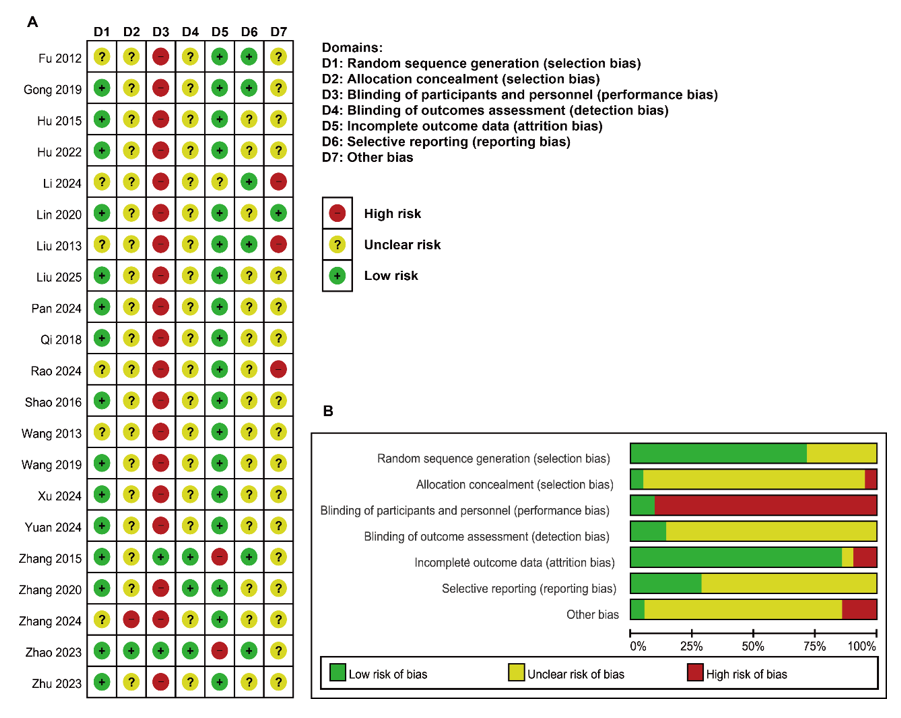
Figure 2: Risk-of-bias assessment of the included studies. (A) Study-level risk-of-bias judgements across seven domains. (B) Summary of risk-of-bias judgements for each domain across the 21 included studies. Risk of bias was assessed using the Cochrane Risk of Bias tool. Green indicates low risk, yellow indicates unclear risk, and red indicates high risk. D1, random sequence generation; D2, allocation concealment; D3, blinding of participants and personnel; D4, blinding of outcome assessment; D5, incomplete outcome data; D6, selective reporting; and D7, other bias.
Table 1: Characteristics of the included studies
|
Study |
Diagnostic criteria |
AD severity |
Sample size, M/F & Mean age (yrs) |
Intervention |
Control |
Treatment Duration |
Outcome measures |
|
Fu 2012 [25] |
NINCDS-ADRDA, DSM-IV; |
Mild AD |
TG: 6/9, 70.50 ± 6.40 CG: 8/7, 71.10 ± 5.60 |
TKD |
Donepezil |
24 weeks |
(1) MMSE scores; (2) ADL scores; (3) Clinical response rates |
|
Liu 2013 [20] |
NINCDS-ADRDA, DSM-IV; |
Moderate AD |
TG: 18/12, 74 ± 5 CG: 19/11. 75 ± 6 |
TKD |
Piracetam |
12 weeks |
(1) MMSE scores; (2) ADL scores; (3) Clinical response rates |
|
Wang 2013 [26] |
NINCDS-ADRDA; |
Moderate AD |
Total: 21/19, 67.20 ± 3.60 |
TKD |
Donepezil |
24 weeks |
(1) MMSE scores; (2) ADL scores – 100; (3) Clinical response rates; |
|
Hu 2015 [27] |
NINCDS-ADRDA |
Moderate AD |
TG: 26/14, 69.20 ± 6.40 CG: 25/15, 68.40 ± 7.20 |
TKD + Donepezil + Piracetam |
Donepezil + Piracetam |
12 weeks |
(1) MMSE scores; (2) ADL scores; (3) ADAS-cog; (4) Clinical response rates |
|
Zhang 2015 [28] |
DSM-IV |
Mild AD |
TG: 26/46, 72.79 ± 6.76 CG: 29/43, 72.97 ± 6.59 |
TKD + Donepezil |
Donepezil |
24 weeks |
(1) MMSE scores; (2) ADL scores; (3) ADAS-cog; (4) Reported adverse events; |
|
Shao 2016 [29] |
NINCDS-ADRDA, DSM-IV; |
Moderate AD |
TG: 14/10, 70.80 ± 7.27 CG: 11/13, 70.24 ± 7.31 |
TKD + Donepezil |
Donepezil |
8 weeks |
(1) MMSE scores; (2) ADL scores; (3) TCM syndrome scores; (4) Clinical response rates |
|
Qi 2018 [30] |
Chinese medicine syndrome of kidney deficiency and marrow depletion; |
Moderate AD |
TG: 24/11, 68.60 ± 7.20 CG: 25/10, 68.50 ± 7.40 |
TKD + Rivastigmine |
Rivastigmine |
24 weeks |
(1) MMSE scores; (2) ADL scores; (3) Individual TCM syndrome scores; (4) ADAS-Cog scores; (5) Clinical response rates; |
|
Gong 2019 [31] |
NINCDS-ADRDA, Chinese medicine diagnostic criteria for senile dementia; |
Mild and moderate AD |
TG: 16/14, 73.32 CG: 17/13, 72.46 |
TKD |
Piracetam |
12 weeks |
(1) MMSE scores; (2) ADL scores; (3) FAQ scores; (4) Clinical response rates; |
|
Wang 2019 [32] |
NINCDS-ADRDA |
Moderate AD |
TG: 14/16, range: 63-79 CG: 13/17, range: 65-78 |
TKD |
Donepezil |
8 weeks |
(1) MMSE scores; (2) MBI scores; (3) Clinical response rates; |
|
Lin 2020 [33] |
Chinese medicine diagnostic criteria for senile dementia |
MCI due to AD |
TG: 23/21, 68.34 ± 7.13 CG: 21/18, 69.54 ± 6.06 |
TKD |
Donepezil |
12 weeks |
(1) MMSE score; (2) MoCA score; (3) TCM syndrome scores; (4) CM dementia syndrome |
|
Zhang 2020 [34] |
NIA-AA 2011, DSM-IV; |
MCI due to AD |
TG: 50, 69.62 ± 4.95 CG: 51, 67.66 ± 5.26 |
TKD |
Aniracetam |
48 weeks |
(1) MMSE scores; (2) ADL scores; (3) MoCA scores; (4) ADAS-Cog scores; (5) TCM syndrome scores |
|
Hu 2022 [35] |
Chinese medicine diagnostic criteria for senile dementia |
Moderate AD |
TG: 25/20, 69.31 ± 6.59 CG: 23/20, 70.26 ± 6.91 |
TKD + Donepezil |
Donepezil |
24 weeks |
(1) MMSE scores; (2) ADAS-Cog scores; (3) Clinical response rates; (4) CDR scores; |
|
Zhao 2023 [36] |
NIA-AA; |
Mild and moderate AD |
TG: 58, 70 ± 6 CG: 51, 70 ± 7 |
TKD |
Gingko |
24 weeks |
(1) MMSE scores; (2) ADL scores; (3) ADAS-Cog scores; (4) CM-SS scores; |
|
Zhu 2023 [37] |
Chinese AD dementia diagnostic criteria |
Moderate AD |
TG: 19/12, 72.56 ± 9.47 CG: 22/9, 73.28 ± 10.03 |
TKD + Donepezil + Idebenone |
Donepezil + Idebenone |
12 weeks |
(1) MMSE scores; (2) MBI scores; (3) ADAS-Cog scores; (4) Clinical response rates; |
|
Li 2024 [38] |
NIA-AA |
Mild and moderate AD |
TG: 19/21, 67.18 ± 8.28 CG: 10/15, 72.08 ± 6.78 |
TKD |
Donepezil |
24 weeks |
(1) MMSE scores; (2) ADL scores; (3) ADAS-Cog scores; (4) AVLT score; |
|
Pan 2024 [39] |
Chinese medicine diagnostic criteria for AD |
Mild AD |
TG: 29/33, 83.32 ± 5.16 CG: 27/35, 83.16 ± 5.09 |
TKD + Sodium oligomannate |
Sodium oligomannate |
12 weeks |
(1) MMSE scores; (2) ADAS-Cog scores; (3) Clinical Response rates; |
|
Rao 2024 [40] |
Chinese medicine diagnostic criteria for AD |
Mild and moderate AD |
TG: 15/15, 69.30 ± 5.90 CG: 14/16, 68.40 ± 6.50 |
TKD + Donepezil |
Donepezil |
12 weeks |
(1) MMSE scores; (2) ADL scores - 100; (3) TCM syndrome scores; (4) Clinical response rates; |
|
Xu 2024 [41] |
Chinese AD dementia diagnostic criteria |
Mild and moderate AD |
TG: 30/18, 65.62 ± 7.09 CG: 29/19, 65.43 ± 7.16 |
TKD + Donepezil + Montessori |
Donepezil + Montessori |
8 weeks |
(1) MMSE scores; (2) ADAS-Cog scores; (3) TCM syndrome scores; (4) Clinical response rates; |
|
Yuan 2024 [42] |
Chinese medicine diagnostic criteria for AD |
Moderate AD |
TG: 39/28, 55.38 ± 5.73 CG: 37/30, 59.53 ± 5.43 |
TKD + Rivastigmine |
Rivastigmine |
12 weeks |
(1) MMSE scores (2) ADAS-Cog scores (3) TCM syndrome scores; (4) Clinical response rates; |
|
Zhang 2024 [43] |
2018 Chinese Guidelines for the Diagnosis and Treatment of Dementia and Cognitive Impairment |
Moderate AD |
TG: 31/25, 67.95 ± 5.24 CG: 27/29, 68.43 ± 5.17 |
TKD + Donepezil |
Donepezil |
4 weeks |
(1) MMSE scores; (2) ADAS-Cog scores; (3) Clinical response rates; |
|
Liu 2025 [44] |
Chinese AD dementia diagnostic criteria |
Mild and moderate AD |
TG: 22/18, 70.12 ± 6.21 CG: 24/16, 69.87 ± 5.69 |
TKD + Donepezil |
Donepezil |
24 weeks |
(1) MMSE scores; (2) ADL scores – 100; (3) ADAS-Cog scores; (4) Clinical response rates; (5) Adverse events; |
Abbreviations: AD, Alzheimer’s disease; ADAS-Cog, Alzheimer’s Disease Assessment Scale–Cognitive Subscale; ADL, activities of daily living; AVLT, Auditory Verbal Learning Test; CDR, Clinical Dementia Rating; CG, control group; DSM-IV, Diagnostic and Statistical Manual of Mental Disorders, fourth edition; FAQ, Functional Activities Questionnaire; M/F, male/female; MBI, Modified Barthel Index; MCI, mild cognitive impairment; MMSE, Mini-Mental State Examination; MoCA, Montreal Cognitive Assessment; NIA–AA, National Institute on Aging–Alzheimer’s Association; NINCDS–ADRDA, National Institute of Neurological and Communicative Disorders and Stroke–Alzheimer’s Disease and Related Disorders Association; NPI, Neuropsychiatric Inventory; TCM, traditional Chinese medicine; TG, treatment group; TKD, tonifying kidney decoction.
Table 2: Characteristics of TKD interventions
|
Study |
Formula name |
Dosage form |
Herbal composition (Daily dose) |
Administration |
|
Fu 2012 [25] |
Yishen Huazhuo Formula |
Granules |
Epimedii Folium (Yinyanghuo) 9 g, Psoraleae Fructus (Buguzhi) 10 g, Polygoni Multiflori Radix Praeparata (processed Heshouwu) 10 g, Ligustri Lucidi Fructus (Nüzhenzi) 9 g, Astragali Radix (Huangqi) 10 g, Chuanxiong Rhizoma (Chuanxiong) 6 g, and Acori Tatarinowii Rhizoma (Shichangpu) 6 g. |
1 packet daily |
|
Liu 2013 [20] |
Bushenhuatanyizhi Formula |
Granules |
Polygoni Multiflori Radix (Heshouwu), Panacis Japonici Rhizoma (Zhujieshen), Acori Tatarinowii Rhizoma (Shichangpu), Bambusae Caulis in Taenias (Zhuru), Pinelliae Rhizoma (Banxia), Poria (Fuling), and Polygalae Radix (Yuanzhi) |
6 g, twice daily |
|
Wang 2013 [26] |
Bushen Huoxue Formula; |
Decoction |
Salviae Miltiorrhizae Radix et Rhizoma (Danshen) 20 g; Chuanxiong Rhizoma (Chuanxiong) 20 g; Dioscoreae Rhizoma (Shanyao) 15 g; Rehmanniae Radix Praeparata (Shudihuang) 10 g; Cervi Cornus Colla (Lujiaojiao) 10 g; Lycii Fructus (Gouqizi) 15 g; Achyranthis Bidentatae Radix (Niuxi) 15 g; Cuscutae Semen (Tusizi) 10 g; Corni Fructus (Shanzhuyu) 10 g |
100 mL, three times daily |
|
Hu 2015 [27] |
Bushen Tongluo Decoction |
Decoction |
Polygonati Rhizoma (Huangjing) 30 g; Rehmanniae Radix Praeparata (Shudihuang) 30 g; Polygoni Multiflori Radix Praeparata (Zhiheshouwu) 10 g; Epimedii Folium (Yinyanghuo) 15 g; Cuscutae Semen (Tusizi) 20 g; Ginseng Radix et Rhizoma (Renshen) 10 g; Salviae Miltiorrhizae Radix et Rhizoma (Danshen) 15 g; Notoginseng Radix et Rhizoma (Sanqi) powder 3 g; Polygalae Radix (Yuanzhi) 15 g; Chuanxiong Rhizoma (Chuanxiong) 15 g; Citri Reticulatae Pericarpium (Chenpi) 15 g; Ginkgo Folium (Yinxingye) 15 g |
1 dose daily, administrated in two divided doses |
|
Zhang 2015 [28] |
Yishen Huazhuo Formula |
Granules |
Epimedii Folium (Yinyanghuo) 10g, Ligustri Lucidi Fructus (Nüzhenzi) 9 g, Psoraleae Fructus (Buguzhi) 10 g, Polygoni Multiflori Radix Praeparata (processed Heshouwu) 10 g, Astragali Radix (Huangqi) 10 g, Chuanxiong Rhizoma (Chuanxiong) 6 g, and Acori Tatarinowii Rhizoma (Shichangpu) 6 g |
1 packet daily |
|
Shao 2016 [29] |
Bushen Jianpi Formula |
Decoction |
Codonopsis Radix (Dangshen) 20 g; Astragali Radix (Huangqi) 30 g; Atractylodis Macrocephalae Rhizoma (Baizhu) 20 g; Epimedii Folium (Yinyanghuo) 15 g; Rehmanniae Radix Praeparata (Shudihuang) 20 g; Cistanches Herba (Roucongrong) 30 g; Poria (Fuling) 20 g; Citri Reticulatae Pericarpium (Chenpi) 12 g; Glycyrrhizae Radix et Rhizoma (Gancao) 6 g |
200 mL, twice daily |
|
Qi 2018 [30] |
Bushen Yizhi Decoction |
Decoction |
Rehmanniae Radix Praeparata (Shudihuang) 10 g; Morindae Officinalis Radix (Bajitian) 10 g; Cistanches Herba (Roucongrong) 10 g; Lycii Fructus (Gouqizi) 10 g; Epimedii Folium (Yinyanghuo) 10 g; Dendrobii Caulis (Shihu) 10 g; Ophiopogonis Radix (Maidong) 10 g; Poria (Fuling) 10 g; Salviae Miltiorrhizae Radix et Rhizoma (Danshen) 10 g; Pheretima (Dilong) 10 g; Corni Fructus (Shanzhuyu) 6 g; Acori Tatarinowii Rhizoma (Shichangpu) 6 g; Polygalae Radix (Yuanzhi) 6 g; Schisandrae Chinensis Fructus (Wuweizi) 6 g; Chuanxiong Rhizoma (Chuanxiong) 6 g; Hirudo (Shuizhi) 3 g; Glycyrrhizae Radix et Rhizoma Praeparata cum Melle (Zhigancao) 10 g |
1 dose daily, administrated orally in two divided doses |
|
Gong 2019 [31] |
Bushen Huayu Formula |
Decoction |
Alpiniae Oxyphyllae Fructus (Yizhiren) 15 g; Polygoni Multiflori Radix Praeparata (Zhiheshouwu) 20 g; Acori Tatarinowii Rhizoma (Shichangpu) 12 g; Ginseng Radix et Rhizoma (Shengshaishen) 10 g; Epimedii Folium (Yinyanghuo) 15 g; Puerariae Lobatae Radix (Gegen) 15 g; Paeoniae Radix Rubra (Chishao) 10 g; Salviae Miltiorrhizae Radix et Rhizoma (Danshen) 15 g |
100 mL, three times daily |
|
Wang 2019 [32] |
Yizhi Anshen Decoction |
Decoction |
Rehmanniae Radix Praeparata (Shudihuang) 15 g; Alpiniae Oxyphyllae Fructus (Yizhiren) 15 g; Astragali Radix Praeparata cum Melle (Zhihuangqi) 20 g; Polygoni Multiflori Radix Praeparata (Zhiheshouwu) 15 g; Dioscoreae Rhizoma (Shanyao) 15 g; Corni Fructus (Shanzhuyu) 15 g; Lycii Fructus (Gouqizi) 15 g; Ziziphi Spinosae Semen (Suanzaoren) 15 g; Fossilia Ossis Mastodi (Duanlonggu) 20 g; Polygoni Multiflori Caulis (Yejiaoteng) 15 g; Polygalae Radix Praeparata (Zhiyuanzhi) 10 g; Albiziae Cortex (Hehuanpi) 15 g; Acori Tatarinowii Rhizoma (Shichangpu) 10 g; Alismatis Rhizoma (Zexie) 10 g; Poria (Fuling) 15 g; Moutan Cortex (Mudanpi) 15 g |
1 dose daily (400mL), administrated in two divided doses |
|
Lin 2020 [33] |
Tiaobu Xinshen Recipe |
Decoction |
Polygoni Multiflori Radix (Heshouwu) 15 g; Polygonati Rhizoma (Huangjing) 15 g; Astragali Radix (Huangqi) 15 g; Angelicae Sinensis Radix (Danggui) 10 g; Lycii Fructus (Gouqizi) 15 g; Schisandrae Chinensis Fructus (Wuweizi) 9 g; Polygalae Radix (Yuanzhi) 6 g; Corni Fructus (Shanzhuyu) 15 g; Salviae Miltiorrhizae Radix et Rhizoma (Danshen) 12 g; Acori Tatarinowii Rhizoma (Shichangpu) 6 g; Paeoniae Radix Rubra (Chishao) 9 g |
1 dose daily (300mL), administrated in two divided doses |
|
Zhang 2020 [34] |
Dihuang Yizhi Formula |
Decoction |
Rehmanniae Radix Praeparata (Shudihuang) 15 g; Salviae Miltiorrhizae Radix et Rhizoma (Danshen) 15 g; Alpiniae Oxyphyllae Fructus (Yizhiren) 6 g; Acori Tatarinowii Rhizoma (Shichangpu) 9 g; Poria cum Radice Pini (Fushen) 9 g; Corni Fructus (Shanzhuyu) 9 g; Testudinis Carapacis et Plastri Colla (Guijiajiao) 3 g |
1 dose daily (300mL), administrated in two divided doses |
|
Hu 2022 [35] Li 2024 [38] |
Congrong Yizhi Capsule |
Capsules |
Not reported (Manufacturer: Anhui Leiyunshang Pharmaceutical Co., Ltd.) |
4 capsules (0.3g), three times daily |
|
Zhao 2023 [36] |
Guilingji Capsule |
Capsules |
Not reported (Manufacturer: Shanxi Guangyuyuan Sinopharm Co., Ltd., Jinzhong, China) |
2 capsules, once daily |
|
Zhu 2023 [37] |
Bushen Yizhi Formula |
Decoction |
Poria (Fuling) 30 g; Acanthopanacis Senticosi Radix et Rhizoma seu Caulis (Ciwujia) 30 g; Astragali Radix (Huangqi) 15 g; Epimedii Folium (Yinyanghuo) 15 g; Dendrobii Caulis (Shihu) 10 g; Pheretima (Dilong) 10 g; Salviae Miltiorrhizae Radix et Rhizoma (Danshen) 10 g; Ophiopogonis Radix (Maidong) 10 g; Ginseng Radix et Rhizoma Rubra (Hongshen) 5 g; Modified according to individual syndrome manifestations. |
1 dose daily (300mL), administrated in two divided doses |
|
Pan 2024 [39] |
Bushen Shengsui Yizhi Decoction |
Decoction |
Lycii Fructus (Gouqizi) 15 g; Spatholobi Caulis (Jixueteng) 15 g; Massa Medicata Fermentata cum Aquilariae (Chenxiangqu) 15 g; Rehmanniae Radix Praeparata (Shudihuang) 12 g; Atractylodis Macrocephalae Rhizoma (stir-fried Baizhu) 12 g; Astragali Radix (Huangqi) 10 g; Citri Reticulatae Pericarpium (Chenpi) 9 g; Fermentum Rubrum (Hongqu) 9 g; Codonopsis Radix (Dangshen) 6 g; Polygonati Rhizoma (processed Huangjing) 6 g; Jujubae Fructus (Dazao) 6 g |
1 dose daily (300mL), administrated in two divided doses |
|
Rao 2024 [40] |
Liuwei Dihuang Pills |
Pills |
Not reported (Manufacturer: Changsha Jiuzhitang Group Co., Ltd.) |
8 pills, three times daily |
|
Xu 2024 [41] |
Bushen Tiansui Yizhi Formula |
Decoction |
Astragali Radix (Huangqi) 30 g; Rehmanniae Radix Praeparata (Shudihuang) 20 g; Ligustri Lucidi Fructus (Nüzhenzi) 20 g; Codonopsis Radix (Dangshen) 15 g; Cervi Cornus Colla (Lujiaojiao) 12 g; Dioscoreae Rhizoma (Shanyao) 12 g; Lycii Fructus (Gouqizi) 12 g; Salviae Miltiorrhizae Radix et Rhizoma (Danshen) 12 g; Testudinis Carapax et Plastrum (Guijia) 10 g; Corni Fructus (Shanzhuyu) 10 g; Polygalae Radix (Yuanzhi) 10 g; Acori Tatarinowii Rhizoma (Shichangpu) 10 g; Achyranthis Bidentatae Radix (Huainiuxi) 9 g; Glycyrrhizae Radix et Rhizoma Praeparata cum Melle (Zhigancao) 6 g |
1 dose daily (400mL), administrated in two divided doses |
|
Yuan 2024 [42] |
Huangqi Xuming Decoction |
Decoction |
Astragali Radix (Huangqi) 45 g; Puerariae Lobatae Radix (Gegen) 30 g; Ephedrae Herba (Mahuang) 12 g; Cinnamomi Ramulus (Guizhi) 18 g; Paeoniae Radix Alba (Baishao) 18 g; Armeniacae Semen Amarum (stir-fried Kuxingren) 10 g; Glycyrrhizae Radix et Rhizoma Praeparata cum Melle (Zhigancao) 10 g; Angelicae Sinensis Radix (Danggui) 12 g; Chuanxiong Rhizoma (Chuanxiong) 18 g; Saposhnikoviae Radix (Fangfeng) 10 g; Stephaniae Tetrandrae Radix (Fangji) 10 g; Ginseng Radix et Rhizoma (Renshen) 12 g; Scutellariae Radix (Huangqin) 12 g; Aconiti Lateralis Radix Praeparata (Fuzi) 12 g; Spatholobi Caulis (Jixueteng) 45 g; Salviae Miltiorrhizae Radix et Rhizoma (Danshen) 30 g; Achyranthis Bidentatae Radix (Niuxi) 30 g; Mori Ramulus (Sangzhi) 30 g; Zingiberis Rhizoma Recens (Shengjiang) 20 g; Jujubae Fructus (Dazao) 20 g |
1 dose daily (300mL), administrated in two divided doses |
|
Zhang 2024 [43] |
Bushen Yizhi Formula |
Decoction |
Rehmanniae Radix Praeparata (Shudihuang) 25 g; Polygalae Radix (Yuanzhi) 20 g; Acori Tatarinowii Rhizoma (Shichangpu) 20 g; Testudinis Carapax et Plastrum (Guijia) 20 g; Salviae Miltiorrhizae Radix et Rhizoma (Danshen) 12 g; Lycii Fructus (Gouqizi) 12 g; Poria (Fuling) 12 g; Chuanxiong Rhizoma (Chuanxiong) 12 g; Corni Fructus (Shanzhuyu) 12 g; Alpiniae Oxyphyllae Fructus (Yizhiren) 12 g; Angelicae Sinensis Radix (Danggui) 12 g; Astragali Radix (Huangqi) 12 g; Hirudo (Shuizhi) 12 g; Glycyrrhizae Radix et Rhizoma Praeparata cum Melle (Zhigancao) 6 g |
1 dose daily (200mL), administrated in two divided doses |
|
Liu 2025 [44] |
Bushen Yizhi Formula |
Decoction |
Rehmanniae Radix Praeparata (Shudihuang) 15 g; Corni Fructus (Shanzhuyu) 15 g; Cistanches Herba (Roucongrong) 15 g; Polygoni Multiflori Radix (Heshouwu) 15 g; Epimedii Folium (Yinyanghuo) 15 g; Ophiopogonis Radix (Maidong) 10 g; Poria (Fuling) 10 g; Chuanxiong Rhizoma (Chuanxiong) 10 g; Angelicae Sinensis Radix (Danggui) 10 g; Acori Tatarinowii Rhizoma (Shichangpu) 8 g; Polygalae Radix (Yuanzhi) 6 g; Hirudo (Shuizhi) 3 g; Glycyrrhizae Radix et Rhizoma (Gancao) 6 g |
1 dose daily (200mL), administrated in two divided doses |
3.5 Effects of Interventions
3.5.1 MMSE score
MMSE scores at the end of treatment were reported by all 21 studies, involving 1,708 participants, and selected as the important outcome assessed consistently across the subsequent analysis. The random-effects meta-analysis showed that TKD-based therapy produced a significantly greater improvement in MMSE scores than the control intervention (MD = 2.49, 95% CI 1.84 to 3.15; P < 0.001; Figure 3A). As higher MMSE scores indicate better cognitive function, the positive pooled estimate suggests a beneficial effect of TKD-based therapy on global cognitive performance. MMSE was also the principal cognitive outcome reported in most of the included studies. However, considerable between-study heterogeneity was observed (I² = 86%).
3.5.2 ADL score
Ten studies involving 767 participants reported ADL score. Because the included studies used different ADL instruments and scoring directions, our meta-analysis was restricted to studies using the 20-item ADL scale, on which lower scores indicate better functional ability. Results obtained using other, clinically incompatible ADL measures were not pooled. The pooled analysis demonstrated a significantly greater reduction in ADL scores with TKD-based therapy than with the control intervention (MD = −2.75, 95% CI −4.07 to −1.43; P < 0.001; Figure 3B). Given that lower scores on the included ADL scale indicate better functional ability, this result suggests that TKD-based therapy may improve patients’ ability to perform daily activities. Substantial heterogeneity was observed across studies (I² = 71%), indicating variability in the magnitude of the effect. This variation may be related to differences in participants’ baseline functional status, treatment regimens, intervention duration, etc.
3.5.3 ADAS-Cog score
Twelve studies involving 1,187 participants evaluated cognitive function using the ADAS-Cog. Most study-specific estimates favored TKD-based therapy, and the pooled analysis showed a significant reduction in ADAS-Cog scores compared with the control intervention (MD = −5.20, 95% CI −6.75 to −3.66; P < 0.001; Figure 3C). As lower ADAS-Cog scores indicate less severe cognitive impairment, this finding supports a beneficial effect of TKD-based therapy on cognitive symptoms. However, considerable heterogeneity was detected (I² = 91%), reflecting substantial variation in the magnitude of the observed effects. Accordingly, although the direction of the pooled effect favored TKD-based therapy, its magnitude should be interpreted cautiously.
3.5.4 TCM syndrome score
TCM syndrome scores at the end of treatment were reported in six studies involving 522 participants. The random-effects meta-analysis demonstrated a significantly greater reduction in TCM syndrome scores with TKD-based therapy than with the control intervention (MD = −3.81, 95% CI −4.69 to −2.94; P < 0.001; Supplementary Figure S1A). Because lower scores indicate less severe TCM syndrome-related symptoms, the negative pooled estimate favored TKD-based therapy. Although the study-specific estimates generally showed the same direction of effect, substantial between-study heterogeneity was observed (I² = 80%).
3.5.5 MBI score
Five studies involving a total of 302 participants assessed functional independence using the MBI. The pooled analysis showed significantly higher MBI scores with TKD-based therapy than with the control intervention (MD = 7.16, 95% CI 0.80 to 13.52; P = 0.027; Supplementary Figure S1B). As higher MBI scores indicate greater independence in activities of daily living, the result suggests a potential beneficial effect of TKD-based therapy on functional ability. Considerable heterogeneity was detected (I² = 96%), and the individual estimates varied markedly in both magnitude and direction. Together with the relatively wide confidence interval and small evidence base, this finding should be interpreted cautiously.
3.5.6 Clinical response rate
Clinical response rates were reported in 15 studies involving 1,146 participants. The pooled analysis showed that participants receiving TKD-based therapy were significantly more likely to achieve a clinical response than those receiving the control intervention (RR = 1.23, 95% CI 1.16 to 1.31; P < 0.001; Supplementary Figure S2). This corresponds to an approximately 23% higher probability of achieving the predefined clinical response in the TKD-based therapy groups. No statistical heterogeneity was detected (I² = 0%), indicating that the direction and magnitude of the relative effects were broadly consistent across the included studies. Nevertheless, the result should be understood in relation to the response criteria adopted by the original studies.
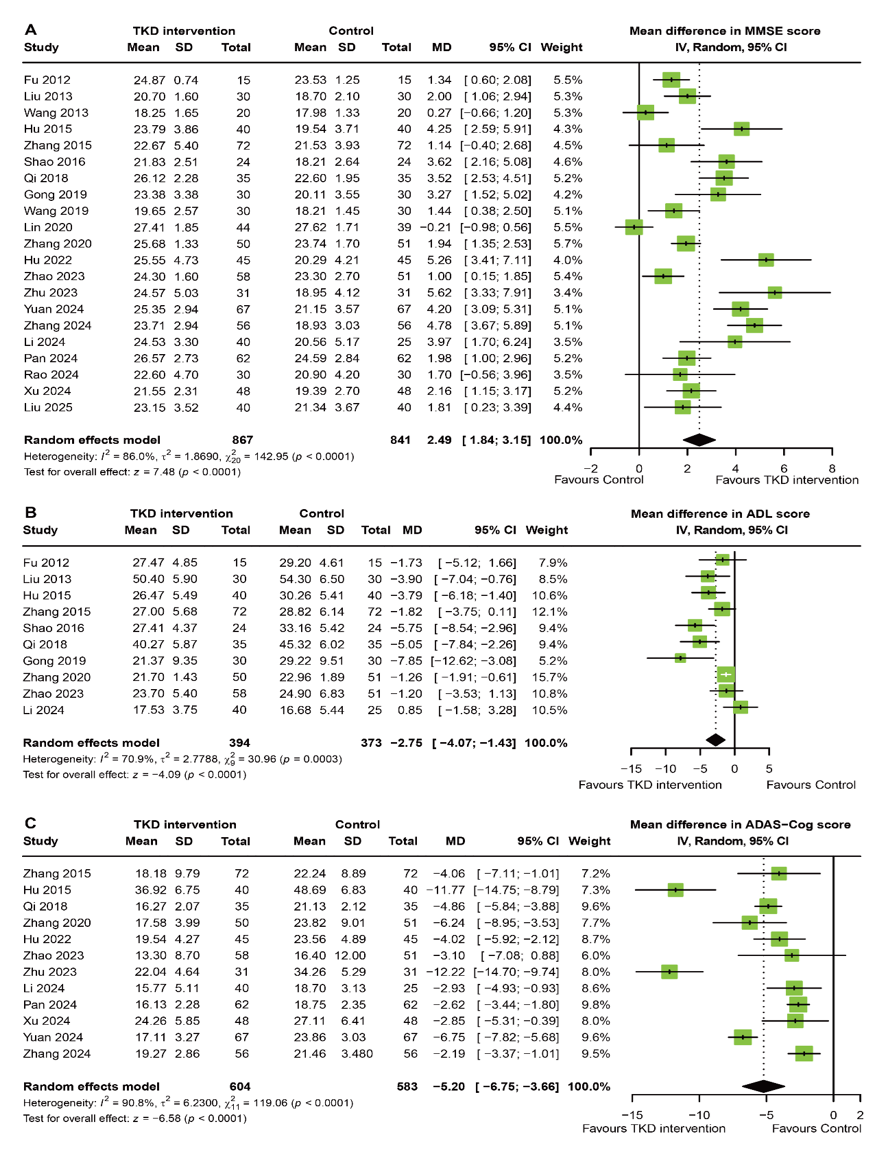
Figure 3: Forest plots of the effects of TKD-based therapy on cognitive function and activities of daily living at the end of treatment. (A) MMSE score; (B) ADL score; and (C) ADAS-Cog score. Pooled mean differences and 95% confidence intervals were calculated using an inverse-variance random-effects model. Squares represent the effect estimates of individual studies, with their sizes proportional to study weights; horizontal lines represent 95% confidence intervals; and diamonds represent pooled estimates. ADAS-Cog, Alzheimer’s Disease Assessment Scale–Cognitive Subscale; ADL, activities of daily living; CI, confidence interval; IV, inverse variance; MD, mean difference; MMSE, Mini-Mental State Examination; TKD, tonifying kidney decoction.
3.6 Subgroup Analysis
Given the substantial heterogeneity observed in the pooled analysis of MMSE scores, subgroup analyses were conducted according to intervention type, disease stage, and treatment duration to explore potential sources of heterogeneity (Table 3; Supplementary Figures S3–S5). The test for subgroup differences according to intervention type was statistically significant ( , ). TKD combined with CWM produced a larger pooled effect (MD 3.29, 95% CI 2.48 to 4.11; 12 studies, 1,100 participants) than TKD monotherapy (MD 1.45, 95% CI 0.73 to 2.17; 9 studies, 608 participants). Following stratification by intervention type, heterogeneity decreased slightly but remained substantial in both subgroups ( for TKD vs CWM and for TKD + CWM vs CWM). Treatment effects also differed significantly across disease stages ( , ). The largest pooled effect was observed in patients with moderate AD (MD 3.25, 95% CI 2.26 to 4.24), followed by mixed mild-to-moderate AD (MD 1.93, 95% CI 1.01 to 2.84) and mild AD (MD 1.57, 95% CI 0.97 to 2.18). No statistically significant effect was observed in the MCI due to AD subgroup (MD 0.88, 95% CI −1.23 to 2.99). Nevertheless, the MCI due to AD and mild AD subgroups each contained only two studies, limiting the reliability of comparisons across disease stages.
Subgroup analysis according to treatment duration showed significant improvements in MMSE scores for treatment periods of <12 weeks (MD 2.79, 95% CI 1.44 to 4.13), 12 weeks (MD 2.33, 95% CI 1.37 to 3.29), and >12 weeks (MD 2.54, 95% CI 1.22 to 3.86). However, the test for subgroup differences was not statistically significant ( , ), indicating no evidence that the treatment effect differed according to treatment duration. Overall, intervention type and disease stage may partly explain variation in MMSE effects, whereas treatment duration did not appear to account for the observed heterogeneity.
Table 3: Subgroup analysis of the TKD intervention on MMSE scores at the end of treatment.
|
Subgroup |
Studies |
Participants |
MD (95% CI) |
I2 |
Pinteraction |
I2between |
|
|
Intervention type |
TKD vs CWM TKD + CWM vs CWM |
9 12 |
608 1100 |
1.45 [0.73, 2.17] 3.29 [2.48, 4.11] |
78% 75% |
<0.001 |
91.90% |
|
Disease stage |
MCI due to AD Mild AD Moderate AD Mild and moderateAD |
2 2 11 6 |
184 154 852 518 |
0.88 [-1.23, 2.99] 1.57 [0.97, 2.18] 3.25[2.26, 4.24] 1.93 [1.01, 2.84] |
95% 5% 87% 50% |
0.03 |
66.80% |
|
Treatment duration |
< 12 weeks = 12 weeks > 12 weeks |
5 9 7 |
376 816 516 |
2.79 [1.44, 4.13] 2.33 [1.37, 3.29] 2.54 [1.22, 3.86] |
82% 87% 88% |
0.86 |
0.00% |
Abbreviations: AD, Alzheimer’s disease; CI, confidence interval; CWM, conventional Western medicine; MCI, mild cognitive impairment; MD, mean difference; MMSE, Mini-Mental State Examination; TKD, tonifying kidney decoction. Pinteraction and I2between represent the test for differences between subgroups.
3.7 Sensitivity Analysis
Sensitivity analyses indicated that the beneficial effect of TKD on MMSE scores was generally robust (Table 4). The random-effects model yielded a pooled MD of 2.49 (95% CI 1.84 to 3.15), whereas the fixed-effect model produced a slightly smaller estimate of 2.01 (95% CI 1.78 to 2.24). Both estimates remained statistically significant. Restriction to studies at low risk in individual risk-of-bias domains produced pooled MDs ranging from 1.00 to 2.60, and all corresponding 95% CIs remained above the null value. In particular, restricting the analysis to studies at low risk for random sequence generation produced an estimate similar to the primary analysis (MD 2.59, 95% CI 1.82 to 3.36). However, the analyses based on allocation concealment and blinding included only one to three studies and should therefore be interpreted cautiously.
The leave-one-out analysis further supported the stability of the overall effect (Supplementary Figure S6). Sequential omission of individual studies produced pooled MDs ranging from 2.35 to 2.63, and none of the recalculated 95% CIs crossed the null value. Heterogeneity remained considerable, with values ranging from 82.3% to 86.7% and τ2 ranged from 1.77 to 2.27. These findings indicate that no single study materially altered the direction or statistical significance of the pooled MMSE effect, although the substantial between-study heterogeneity was not attributable to any individual study.
Table 4: Sensitivity analysis of the pooled effect of TKD intervention on MMSE scores
|
Sensitivity analysis |
Studies |
Participants |
Statistical Method |
MD (95% CI) |
I2 (%) |
τ2 |
|
All studies |
21 |
1708 |
IV, Random effects |
2.49 [1.84, 3.15] |
86 |
1.87 |
|
All studies |
21 |
1708 |
IV, Fixed effect |
2.01 [1.78, 2.24] |
86 |
N/A |
|
Low risk in random sequence generation |
15 |
1341 |
IV, Random effects |
2.59 [1.82, 3.36] |
86 |
1.89 |
|
Low risk in allocation concealment |
1 |
109 |
IV, Random effects |
1.00 [0.15, 1.85] |
N/A |
N/A |
|
Low risk in blinding of participants and personnel |
2 |
253 |
IV, Random effects |
1.03 [0.29, 1.78] |
0 |
0 |
|
Low risk in blinding of outcome assessment |
3 |
354 |
IV, Random effects |
1.48 [0.79, 2.17] |
43 |
0.16 |
|
Low risk in incomplete outcome data |
19 |
1390 |
IV, Random effects |
2.60 [1.88, 3.33] |
87 |
2.00 |
|
Low risk in selective reporting |
6 |
468 |
IV, Random effects |
1.79 [1.08, 2.50] |
55 |
0.40 |
|
Leave-one-out analysis |
20 |
Varied by omitted study |
IV, Random effects |
MD range: 2.35 – 2.63; all 95% CIs excluded 0 |
82.3 -86.7 |
1.77 -2.27 |
3.8 Publication Bias
Funnel plots and regression-based tests were used to assess publication bias and small-study effects for the four outcomes reported by at least 10 studies (Figure 4). The MMSE funnel plot showed apparent asymmetry, which was supported by Egger’s regression test (t = 2.64, p = 0.016). By contrast, no statistically significant asymmetry was detected for ADL (t = -2.19, p = 0.060), ADAS-Cog (t = -1.22, p = 0.249), or the clinical response rate based on Harbord’s test (t = 0.05, p = 0.960).
Given the significant asymmetry observed for MMSE, a trim-and-fill sensitivity analysis was performed. The procedure imputed seven hypothetical studies on the left side of the funnel plot (Figure 5). After incorporating these data points, the pooled effect decreased from an MD of 2.49 (95% CI 1.84 to 3.15) to 1.58 (95% CI 0.88 to 2.29), while remaining statistically significant. Heterogeneity remained considerable and increased slightly from I2 = 86.0% to 89.9%. These findings suggest that the original analysis may have overestimated the magnitude of the MMSE effect; however, the direction and statistical significance of the treatment effect remained unchanged after adjustment. Detailed results of the trim-and-fill analysis and the seven imputed data points are presented in Supplementary Tables S5.1 and S5.2.
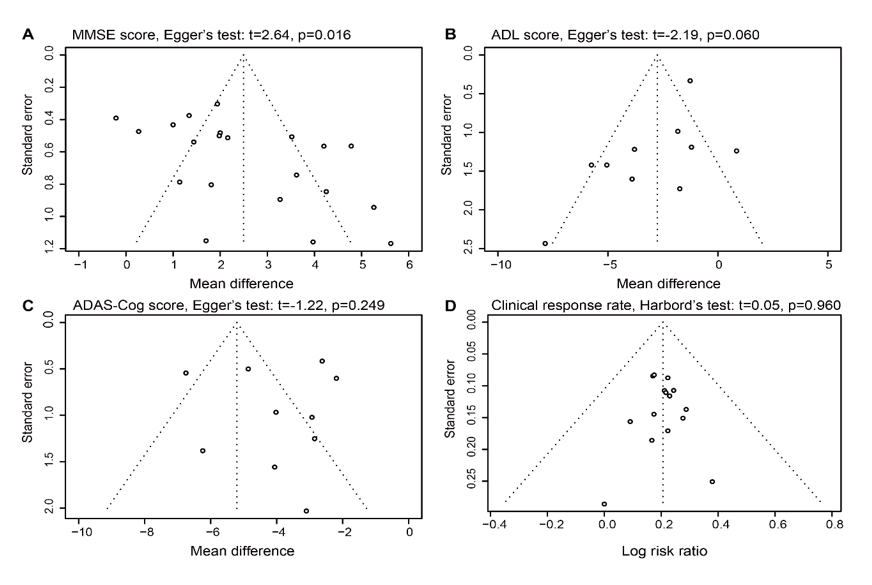
Figure 4: Funnel plots and regression tests for funnel-plot asymmetry. (A) MMSE score; (B) ADL score; (C) ADAS-Cog Score; (D) clinical response rate. Egger’s regression test was used for continuous outcomes, and Harbord’s test was used for the clinical response rate. The vertical dotted lines represent the pooled effect estimates, and the diagonal dotted lines indicate the pseudo 95% confidence limits. MD, mean difference; RR, risk ratio; SE, standard error.
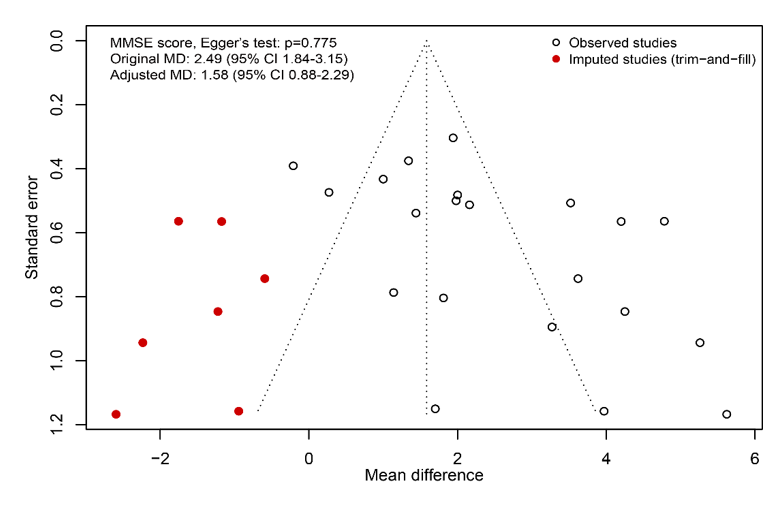
Figure 5: Trim-and-fill-adjusted funnel plot for the MMSE outcome. Open circles represent the 21 observed studies, and red circles represent the seven hypothetical studies imputed using the trim-and-fill procedure with the L-estimator. The pooled mean difference decreased from 2.49 (95% CI 1.84 to 3.15) in the original analysis to 1.58 (95% CI 0.88 to 2.29) after adjustment. The vertical dotted line represents the trim-and-fill-adjusted pooled effect estimate, and the diagonal dotted lines indicate the pseudo 95% confidence limits. CI, confidence interval; MD, mean difference; SE, standard error.
3.9 Certainty of Evidence
The certainty of evidence for six outcomes was assessed using the GRADE approach (Table 5). Among the six outcomes, certainty was rated as moderate for ADL and the clinical response rate, low for MMSE, ADAS-Cog, and the TCM syndrome score, and very low for MBI. All outcomes were downgraded by one level for serious risk of bias. Most studies were judged to have high or unclear risk of bias in domains D3 and D4, mainly because of the inherent difficulty of blinding participants, personnel, and outcome assessors in individualized TCM interventions (Supplementary Table S5). The ADAS-Cog and MBI evidence was further downgraded for serious inconsistency because of substantial heterogeneity (I2 = 91% and 96%, respectively). The TCM syndrome score and MBI evidence was downgraded by one additional level for serious imprecision because these outcomes were informed by relatively few studies and participants, resulting in limited information sizes. Publication bias was assessed using Egger’s regression test for continuous outcomes and Harbord’s test for the dichotomous outcome. MMSE was the only outcome showing statistically significant funnel plot asymmetry and was therefore downgraded by one level for strongly suspected publication bias.
Table 5: Summary of findings and GRADE certainty assessment for each outcome.
|
Outcomes |
Studies |
Participants |
Effect estimate (95% CI) |
I2 (%) |
Certainty |
|
MMSE |
21 |
1708 |
MD 2.49 [1.84, 3.15] |
86 |
Lowa,d |
|
ADL |
10 |
707 |
MD -2.51 [-3.80, -1.22] |
71 |
Moderatea |
|
ADAS-Cog |
12 |
1187 |
MD -5.20 [-6.75, -3.66] |
91 |
Lowa, b |
|
TCM syndrome score |
6 |
522 |
MD -3.80 [-4.69, -2.94] |
80 |
Lowa, c |
|
MBI |
5 |
302 |
MD 16 [0.80, 13.52] |
96 |
Very lowa, b, c |
|
Clinical response rate |
11 |
1146 |
RR 1.23 [1.16, 1.31] |
0 |
Moderatea |
aDowngraded 1 level due to risk of bias.
bDowngraded 1 level due to inconsistency.
cDowngraded 1 level due to imprecision.
dDowngraded 1 level due to publication bias.
4. Discussion
4.1 Summary of Main Findings
This meta-analysis of 21 RCTs involving 1,708 participants found that TKD-based therapy, alone or combined with CWM, improved MMSE, ADAS-Cog, ADL, TCM syndrome, and MBI scores, as well as the clinical response rate. Subgroup analysis suggested greater MMSE improvement when TKD was used as an adjunctive treatment, whereas treatment duration did not significantly modify the effect. Sensitivity analyses supported the robustness of the MMSE result. However, substantial heterogeneity was present in most continuous outcomes. According to GRADE, the certainty of evidence was moderate for ADL and clinical response rate, low for MMSE, ADAS-Cog, and TCM syndrome scores, and very low for MBI. Although MMSE was reported by all included studies and its pooled result remained robust in sensitivity analyses, its certainty was rated as low because of methodological limitations and suspected publication bias. Therefore, although the findings generally favor TKD-based therapy, the magnitude of its benefits should be interpreted cautiously.
4.2 Comparisons with Previous Studies
Previous evidence syntheses have evaluated TCM interventions for AD using varying inclusion criteria and definitions of treatment. Cui et al. mapped broad evidence base encompassing RCTs and systematic reviews of herbal medicine, proprietary Chinese medicines, acupuncture, moxibustion, and other TCM therapies, without restricting participant characteristics or adjunctive treatments [45]. Lee et al. focused on orally administered East Asian herbal medicines but included diverse formulae regardless of their therapeutic principles, dosage, treatment duration, or disease severity [46]. Similarly, Wang et al. compared various Chinese herbal compounds with Western medicines without classifying the included formulae according to a shared TCM treatment strategy [47]. By contrast, two systematic reviews published in 2023 evaluated Dihuang Yinzi alone or in combination with Western medicine, thereby providing evidence for a single classical kidney-tonifying formula [48,49].
The present review occupies a more focused position between broadly defined herbal medicine and a single fixed prescription. The eligible prescriptions differed in their ingredients and preparations but shared a primary aim of tonifying the kidney and replenishing essence. Eligibility was restricted to RCTs involving adults aged over 50 years with symptomatic AD, encompassing MCI due to AD and mild-to-moderate AD diagnosed according to recognized criteria. TKD was evaluated either as monotherapy or as an adjunct to conventional Western medicine, with balanced co-interventions required between groups. Furthermore, subgroup analyses were conducted according to intervention strategy, disease stage, and treatment duration. This treatment-principle-based framework provides a more clinically focused synthesis of TKD while retaining greater applicability than reviews limited to a single herbal formula.
4.3 Clinical and Research Implications
The present findings suggest that TKD-based therapy may have potential as a complementary approach for patients with mild-to-moderate AD, particularly when used alongside CWM. The greater improvement in MMSE observed in the add-on subgroup supports further investigation of TKD as an adjunctive rather than replacement therapy. Such an approach may also have practical relevance in settings where access to newer anti-amyloid therapies is limited by cost, availability, or logistical requirements. Nevertheless, these implications should be interpreted cautiously because most outcomes were supported by low-to-moderate-certainty evidence, and substantial heterogeneity was observed across studies.
The potential effects of TKD may involve multiple biological processes implicated in AD. Preclinical studies suggest that kidney-tonifying formulae may modulate amyloid-β metabolism by regulating amyloid precursor protein processing and enhancing amyloid-β degradation. Other proposed mechanisms include the inhibition of neuronal apoptosis, regulation of calcium homeostasis, attenuation of oxidative stress and neuroinflammation, and increased expression of neurotrophic factors such as brain-derived neurotrophic factor and nerve growth factor. Collectively, these actions may contribute to neuronal survival and synaptic plasticity. However, because TKD represents a group of formulae with varying herbal compositions, mechanistic findings obtained from individual prescriptions or experimental models cannot be directly generalized to all TKD interventions.
Future RCTs should adopt standardized diagnostic and syndrome-differentiation criteria, provide detailed information on herbal composition and quality control, and use adequately concealed randomization and blinded outcome assessment whenever feasible. Trials should also include larger samples, longer follow-up periods, and consistently defined cognitive, functional, and safety outcomes. Incorporating biomarkers related to amyloid pathology, neuroinflammation, and neurodegeneration may further clarify the biological mechanisms underlying any observed clinical effects and help identify the patients most likely to benefit.
4.4 Strengths and Limitations
Several methodological features enhance the rigor and clinical relevance of this review. A comprehensive search of Chinese and international databases was conducted using both general treatment terms and specific formula names. We selected randomized trials in symptomatic AD and grouped interventions by their shared aim of tonifying the kidney and replenishing essence. Subgroup analyses examined intervention strategy, disease stage, and treatment duration, while sensitivity analyses tested the stability of the MMSE estimate. Formal assessments of publication bias and outcome-specific GRADE ratings provided further context for interpreting the findings.
The findings should be interpreted in light of several methodological and evidential limitations. First, adequate methods of generating random sequences were reported in most trials, but concealment of allocation was seldom documented. The recognizable properties of herbal preparations also made blinding of participants and practitioners difficult. Blinding of outcome assessors was also insufficiently reported, while the absence of accessible protocols or trial registrations made selective reporting difficult to exclude. Inadequately reported blinding of outcome assessors could also have affected MMSE scoring and may have led to an overestimate of the pooled benefit. These concerns led to a reduction in GRADE certainty across all evaluated outcomes. Second, most trials had relatively small sample sizes, and treatment duration ranged from 4 weeks to 12 months, with relatively few studies providing extended treatment or post-treatment follow-up. Consequently, the durability of the observed effects and the long-term safety of TKD remain uncertain. Third, substantial heterogeneity was observed for most continuous outcomes. Potential sources included differences in disease stage, herbal composition, dosage form, treatment duration, concomitant therapy, and outcome assessment. Although subgroup analyses examined intervention strategy, disease stage, and treatment duration, the limited number of studies within some subgroups restricted the reliability of these comparisons. Fourth, the treatment context of the included trials may not fully reflect the evolving therapeutic landscape of AD. Most studies evaluated TKD either alone or in combination with conventional symptomatic medications, such as piracetam or donepezil. None directly compared TKD with anti-amyloid therapies, such as lecanemab or donanemab or evaluated TKD in combination with these agents. Consequently, the comparative efficacy of TKD, its potential additional benefits, and the safety of combining it with anti-amyloid therapies remain unknown. Future trials are needed to clarify the role of TKD alongside emerging disease-modifying treatments, particularly in patients with early symptomatic AD. Fifth, reporting of adverse events varied in completeness and details between trials. Differences in the types of events recorded and the level of details provided made it difficult to pool these data and draw reliable conclusions about safety. Finally, all included studies were conducted in China, which may limit generalizability, and potential publication bias identified for MMSE suggests that the magnitude of cognitive benefit may have been overestimated. These limitations, together with the low-to-moderate certainty of most outcomes, necessitate cautious interpretation of the pooled estimates.
4.5 Conclusions
This meta-analysis suggests that TKD-based therapy may improve cognitive function, activities of daily living, TCM syndrome scores, and clinical response in patients with mild-to-moderate AD. TKD used alongside CWM may provide additional cognitive benefits; however, this finding should be interpreted cautiously because of substantial heterogeneity, methodological limitations, and the low-to-moderate certainty of the evidence. Current evidence therefore supports TKD as a potential complementary treatment rather than a replacement for established AD therapies. Larger, rigorously designed and prospectively registered RCTs with standardized herbal interventions, adequate quality control, longer follow-up, and comprehensive safety reporting are required to confirm its clinical effectiveness and long-term safety.
Declarations
HL conceived of the research hypothesis, designed the study, performed the meta-analysis and reviewed the manuscript. CL and YP conducted the literature search, data extraction, statistical analysis, quality assessment and the original manuscript. QG performed supervision, methodological guidance, and statistical validation. YW performed the data curation, validation, supervision and manuscript revision guidance. All authors have reviewed and approved the published version of the manuscript.
Availability of Data and Materials
Not applicable.
Financial Support and Sponsorship
This work was supported by Suzhou Industrial Park (start-up grants MSRI8001019 and MSRI8001027; Centre of Excellence for Antimicrobial Therapeutics Discovery and Innovation MSRI8002003; translation platform MSRI8002004), and the National Key Research and Development Program of China (No. 2022YFF0710800).
Conflicts of Interest
All authors declared that there are no conflicts of interest.
Ethical Approval and Consent to Participate
Not applicable.
Consent for Publication
Not applicable.
References
- Scheltens P, De Strooper B, Kivipelto M, et al. Alzheimer's disease. Lancet 397 (2021): 1577-1590.
- Rajan KB, Weuve J, Barnes LL, et al. Population estimate of people with clinical Alzheimer's disease and mild cognitive impairment in the United States (2020–2060). Alzheimer's & dementia 17 (2021): 1966-1975.
- Zhi N, Ren RJ, Qi JL, et al. The China Alzheimer Report 2025. Gen Psychiatr 38 (2025): e102020.
- Liu N, Liang X, Chen Y, et al. Recent trends in treatment strategies for Alzheimer's disease and the challenges: A topical advancement. Ageing Research Reviews 94 (2024): 102199.
- Sehar U, Rawat P, Reddy AP, et al. Amyloid beta in aging and Alzheimer’s disease. International journal of molecular sciences 23 (2022): 12924.
- Viola KL, Klein WL. Amyloid β oligomers in Alzheimer’s disease pathogenesis, treatment, and diagnosis. Acta neuropathologica 129 (2015): 183-206.
- Angelopoulou E, Paudel YN, Papageorgiou SG, et al. APOE genotype and Alzheimer’s disease: the influence of lifestyle and environmental factors. ACS chemical neuroscience 12 (2021): 2749-2764.
- Kim AY, Al Jerdi S, MacDonald R, et al. Alzheimer’s disease and its treatment–yesterday, today, and tomorrow. Frontiers in pharmacology 15 (2024): 1399121.
- Gharbiya M, Visioli G, Trebbastoni A, et al. Beta-amyloid peptide in tears: an early diagnostic marker of Alzheimer’s disease correlated with choroidal thickness. International Journal of Molecular Sciences 24 (2023): 2590.
- Roda AR, Serra-Mir G, Montoliu-Gaya L, et al. Amyloid-beta peptide and tau protein crosstalk in Alzheimer’s disease. Neural regeneration research 17 (2022): 1666-1674.
- van Dyck CH, Swanson CJ, Aisen P, et al. Lecanemab in Early Alzheimer's Disease. N Engl J Med 388 (2023): 9-21.
- Sims JR, Zimmer JA, Evans CD, et al. Donanemab in Early Symptomatic Alzheimer Disease: The TRAILBLAZER-ALZ 2 Randomized Clinical Trial. Jama 330 (2023): 512-527.
- Chen Y, Zhang D, Chen T, et al. Traditional Chinese Medicine for Alzheimer’s Disease: A Systematic Review and Meta-Analysis. The American Journal of Chinese Medicine 53 (2025): 1-15.
- Qu Y, Ding M, Zhang M, et al. Iridoid Glycosides in Kidney-Tonifying Chinese medicinal herbs: Mechanisms and Implications for Alzheimer’s Disease Therapy. Journal of Ethnopharmacology (2025).
- Dai R, Sun Y, Su R, et al. Anti-Alzheimer's disease potential of traditional chinese medicinal herbs as inhibitors of BACE1 and AChE enzymes. Biomedicine & Pharmacotherapy 154 (2022): 113576.
- Yan H, Feng L, Li M. The role of Traditional Chinese Medicine Natural Products in β-amyloid deposition and tau protein hyperphosphorylation in Alzheimer’s disease. Drug Design, Development and Therapy (2023).
- Chiu Y-J, Lin C-H, Lee M-C, et al. Formulated Chinese medicine Shaoyao Gancao Tang reduces NLRP1 and NLRP3 in Alzheimer’s disease cell and mouse models for neuroprotection and cognitive improvement. Aging (Albany NY) 13 (2021): 15620.
- Li J, Shan X, Gao Y, et al. Acori Tatarinowii Rhizoma regulates OCT3/OATP2 and P-gp/MRP1 to “guide medicines upwards” in Kai-Xin-San to treat Alzheimer's disease. Journal of Ethnopharmacology 343 (2025): 119484.
- Bu Y, Li S, Ye T, et al. Volatile oil of Acori tatarinowii rhizoma: potential candidate drugs for mitigating dementia. Frontiers in Pharmacology 16 (2025): 1552801.
- Liu P, Kong MW, Liu SL, et al. Effect of reinforcing kidney-essence, removing phlegm, and promoting mental therapy on treating Alzheimer's disease. J Tradit Chin Med 33 (2013): 449-454.
- Page MJ, Moher D, Bossuyt PM, et al. PRISMA 2020 explanation and elaboration: updated guidance and exemplars for reporting systematic reviews. BMJ 372 (2021): 160.
- McKhann GM, Knopman DS, Chertkow H, et al. The diagnosis of dementia due to Alzheimer's disease: recommendations from the National Institute on Aging-Alzheimer's Association workgroups on diagnostic guidelines for Alzheimer's disease. Alzheimers Dement 7 (2011): 263-269.
- Tian J, Xie H, Wang L, et al. Chinese guideline for the diagnosis and treatment of Alzheimer's disease dementia (2020). Chin J Geriatr 40 (2021): 269-283.
- Kennedy RE, Cutter GR, Wang G, et al. Using baseline cognitive severity for enriching Alzheimer's disease clinical trials: How does Mini-Mental State Examination predict rate of change? Alzheimers Dement (N Y) 1 (2015): 46-52.
- Fu KL, Lin CR, Zhang YL, et al. Clinical Study on the Treatment of Mild Alzheimer's Disease with the "Yishen Huazhuo Formula" (15 Cases). Jiangsu J Tradit Chin Med 44 (2012): 28-29.
- Wang EL. Using Herbs of Reinforcing Kidney and Activating Blood to Treat AD. Liaoning J Tradit Chin Med 40 (2013): 1867.
- Hu XJ, Yu CJ, Li J, et al. Clinical Analysis of Bushen Tongluo Decoction in Treating 40 Patients with Alzheimer Disease. Chin J Exp Tradit Med Formulae 21 (2015): 182-185.
- Zhang YL, Lin CR, Zhang LL, et al. Cognitive Improvement during Treatment for Mild Alzheimer's Disease with a Chinese Herbal Formula: A Randomized Controlled Trial. PLoS One 10 (2015): 0130353.
- Shao Q. Clinical observation of kidney and spleen in treatment of senila dementia (spleen and kidney deficiency). [Master's Thesis], Henan University of Chinese Medicine, Zhengzhou, China (2016).
- Qi AQ, Zhu JL, Lyu LF, et al. Effects of bushen yzhi decoction combined with heavy tartaric acid carberlatin hydrochloride in treatment of patients with Alzheimer's Disease and influence on serum bradykinin Chin Arch Tradit Chin Med 36 (2018): 1252-1255.
- Gong WL, He JH, Mei JY, et al. Clinical observation on the treatment of senile dementia by tonifying the kidney and resolving blood stasis method. Hubei J Tradit Chin Med 41 (2019): 33-34.
- Wang ZW, Hu GH. Clinical Observation of 30 Cases of Alzheimer's Disease in Elderly Patients Treated with Yizhi Anshen Soup for Kidney Deficiency and Marrow Insufficiency. Hunan J Tradit Chin Med 35 (2019): 43-44.
- Lin ZY, Huang TW, Huang JS, et al. Tiaobu xinshen recipe (调补心肾方) improved mild cognitive impairment of Alzheimer’s disease patients with Xin (Heart) and Shen (Kidney) deficiency. Chin J Integr Med 26 (2020): 54-58.
- Zhang LM, Shen T, An HM, et al. Clinical study on decreasing occurance of Alzheimer's Disease through intervention on amnestic Mild Cognitive Impairment with Di-Huang-Yi-Zhi formula in Shigatse, Tibet. Research Square (2020).
- Hu J, Tu GY, Li SJ, et al. Clinical effect of Donepezil combined with compound congrong Yizhi capsules on senile dementia and its influence on autophagy activity. Med Innov China 19 (2022): 87-90.
- Zhao M, Luo YM, Wang HC, et al. Guilingji capsule for Alzheimer's disease: secondary analysis of a randomized non-inferiority controlled trial. J Tradit Chin Med 43 (2023): 1019-1025.
- Zhu JB, Chen L. Clinical study on Bushen Yizhi prescription combined with routine western medicine for Alzheimer Disease. J New Chin Med 55 (2023): 95-98.
- Li MY, Sun JP, Sun W, et al. Clinical study of Compound Congrong Yizhi Capsule in treating mild to moderate Alzheimer's Disease. J Beijing Univ Tradit Chin Med 47 (2024): 1145-1151.
- Pan YP, Shen XK, Wei HH, et al. Clinical study on Bushen Shengsui Yizhi Decoction combined with Sodium Oligomannate Capsules for senile dementia caused by Alzheimer's Disease of insufficiency in sea of marrow type J New Chin Med 56 (2024): 73-76.
- Rao GL, Peng Y, Zhang ZQ, et al. Clinical effect of Liuwei Dihuang pills combined with donepezil hydrochloride in treatment of mild-to-moderate AD-An analysis of 30 cases. Hunan J Tradit Chin Med 40 (2024): 6-9.
- Xu LY, Ye LW, Zeng FF, et al. Clinical study on Bushen Tiansui Yizhi Prescription combined with routine therapy for Alzheimer's Disease of liver-kidney deficiency type. J New Chin Med 56 (2024): 184-189.
- Yuan Y, Tao LL, Zhang JK. Effect of Huangqi Xuming Decoction on Norepinephrine, Hypersensitive C-reactive Protein, Superoxide Dismutase and Activities of Daily Living of Patients with Alzheimer's Disease of Spleen and Kidney Deficiency Type. J Guangzhou Univ Tradit Chin Med 41 (2024): 1416-1422.
- Zhang WR, Zhao YM, Wang ZH. Clinical study on Bushen Yizhi Prescription combined with Donepezil Hydrochloride for Alzheimer's Disease. J New Chin Med 56 (2024): 35-40.
- Liu YQ, Jin J, Li JX. Efficacy of Bushen Yizhi Decoction combined with donepezil in the treatment of Alzheimer's Disease in the treatment of Alzheimer's disease and its effect on cognitive function and serum inflammatory factors. J Clin Exp Med 24 (2025): 2465-2468.
- Cui S, Zhao Y, Wang X, et al. Evaluating the clinical evidence of TCM in Alzheimer’s disease: an evidence map perspective. Frontiers in Neurology 16 (2025).
- Lee J, Kwon S, Jin C, et al. Traditional East Asian Herbal Medicine Treatment for Alzheimer’s Disease: A Systematic Review and Meta-Analysis. Pharmaceuticals 15 (2022): 174.
- Wang Q, Wang D-L, Zhang X-C, et al. Efficacy and safety of traditional Chinese medicine and Western medicine in Alzheimer’s disease: a systematic review and meta-analysis. Frontiers in Neurology 16 (2025).
- Kim JY, Lee JY, Jung JH, et al. The effectiveness and safety of Jihwang-eumja (Dihuang Yizi) compared to Western medications in patients with Alzheimer's disease: A systematic review and meta-analysis. Complement Ther Clin Pract 51 (2023): 101746.
- Zhang Z, Zhu Y, Zhu C, et al. Effects of Dihuang Yinzi Decoction on Alzheimer’s Disease: A Systematic Review and Meta-Analysis. Complementary Medicine Research 30 (2023): 440-452.