Dousi M1,2*, Sotirakou K3, Fatsi A3
1MSc Radiographer, General Hospital “Elpis”, Athens, Greece
2University of West Attica, Athens, Greece
3Radilogist, General Hospital “Elpis”, Athens, Athens, Greece
*Corresponding Author: Dousi M, MSc Radiographer, General Hospital “Elpis”, Athens, Greece
Received: 13 January 2020; Accepted: 21 January 2020; Published: 30 January 2020
Purpose: Τo investigate via ultrasound whether the prophylactic use of acetylsalicylic acid 9 days after coronary angiography with transradial access reduces the incidence of radial occlusion.
Material and Methods: Between March 2016 to September 2017 we studied 100 patients (64 male, 36 females and mean age of 60.5 years) who underwent coronary angiography with transradial (TRA) access. Patients after coronary angiography were divided into 2 equal groups with similar characteristics (mean age, mean BMI) were the Group A received for 9 days acetylsalicylic acid 100 mg while the Group B was untreated. All patients were tested with Doppler ultrasound 1 month after coronary angiography. Statistical analysis was performed with SPSS (Version 25).
Results: Statistical analysis of ultrasound data showed that there is a statistically significant difference between patients receiving acetylsalicylic acid as a precautionary measure for radial artery occlusion after catheterization for coronary angiography and non-treated patients X2 (2, N=100) 24.04, p < 0.05).
Conclusion: The results of the study suggest that use of acetylsalicylic acid following coronary artery angiography with TRA technique may reduce the risk of the radial artery occlusion and its complications. Doppler ultrasound is an easy and reliable method for assessing the flow of the radial artery.
Radial artery; Coronary angiography; Ultrasound; Acetylsalicylic acid; Stenosis; Occlusion
1. Introduction
Introduction of coronary angioplasty through the catheterization of the radial artery was made by Campeau et al. in 1989 [1], but the first documentation of angioplasty and stenting via the transradial approach (TRA) was made by Kiemeneij et al. in 1993 [2]. The transfemoral approach (TFA) remains the most common method for coronary angiography and angioplasty. However more and more interventional cardiologists perform interventions via the radial artery [3-6].
The hand receives a double arterial supply from the radial and ulnar artery. Therefore, the radial artery is not an end artery, such as the femoral or brachial artery, and for this reason any possible occlusion does not compromise the vascular delivery to the hand. Moreover, the course of distal radial artery is superficial and its easy for compression, so that patients can be mobilized once the arterial sheath is removed after completion of the procedure [7]. Therefore, radial access to patients undergoing coronary angiography and angioplasty has largely replaced femoral artery technique [2, 8-13]. Multiple studies have demonstrated significant benefit with TRA. Advantages of this approach are: reduce the incidence of access site complications, shorter patient ambulation, and lower potential for access site bleeding, improve patient comfort/satisfaction, high procedural success rate and lower costs [2, 8-22]. However, the increasing use of radial access can lead to more vascular complications for femoral access due to experience loss among operators. This phenomenon is called “Campeau Radial Paradox” [23].
Radial artery occlusion is the most common complication of radial access, with a frequency ranging from 1% to 10% [24]. 5% of patients experience temporary, asymptomatic radial artery occlusion after radial access, with persistent obstruction in half of them [25, 26]. The preservation of normal flow in the radial artery has a significant impact on the quality of life of patients as decreases pain, edema and ensures a radial artery which is readily accessible for future coronary angiography as well as for use in case of coronary bypass [24].
The purpose of this study is to investigate via doppler ultrasound whether the prophylactic use of acetylsalicylic acid for 9 days after coronary angiography reduces the incidence of radial occlusion.
2. Materials and Methods
Between March 2016 to September 2017 we studied 100 patients (64 male, 36 females, and mean age of 60.5 years) who underwent coronary angiography with transradial (TRA) access. All patients have been informed about the steps and risks of the procedure, and gave their written informed consent. All patients during procedure received nitrite and verapamil as a vasodilator as well as 5.000 unfractionated heparin units according to the laboratory protocol. Inclusion criteria in the study were A) patients not receive anticoagulant or antiplatelet therapy, B) patients have not previously been subjected to coronary angiography with transradial approach, and C) there was no contraindication to antiplatelet therapy.
2.1 Statistical analysis
Statistical analysis was performed with SPSS Statistics for Windows (Version 25.0. Armonk, NY: IBM Corp).
2.2 Group’s homogeneity
Patients after coronary angiography were divided into 2 equal groups with similar characteristics. 32 males and 18 females were included in the group Α and exactly the same number of males and females were included in group Β. The homogeneity of the two groups was evaluated comparing mean age and mean BMI (Body Mass Index) of the patients. For the age factor the normal distribution test with the Shapiro-Wilk test (p=0.005 for Group A and p=0.013 for Group B), histograms, Q-Q plots and boxplots showed that the age variable does not follow a normal distribution for the 2 groups at a 5% significance level and observations with extreme values occur according to the charts (Figure 1). Therefore, the non-parametric control of Mann-Whitney was used, which is equivalent to the control of Mean Values for two independent samples.
The mean age in Group A was 61,5 years, while in Group B was 60 years. Mann Whitney's statistical test showed that there is no statistically significant difference between the mean age of the two groups (p>0.05) (Table 1).
For the ΒΜΙ factor τhe normal distribution test with the Shapiro-Wilk test (p=0.004 for Group A and p=0.035 for Group B), histograms, Q – Q plots and boxplots showed that BMI variable does not follow a normal distribution for the 2 groups at a 5% significance level and observations with extreme values occur according to the charts (Figure 2). Therefore, the non-parametric control of Mann-Whitney for two independent samples was used. The mean BMI in Group A was 23.9, while in Group B was 23.6. Mann Whitney's statistical test showed that there is no statistically significant difference between the mean age of the two groups (p>0.05) (Table 2). Group Α received for 9 days acetylsalicylic acid 100 mg while the Group Β was untreated. All patients were tested with doppler ultrasound 1 month after coronary angiography.
|
Test Statisticsa |
Age |
|
Mann-Whitney U |
1245,500 |
|
Wilcoxon W |
2520,500 |
|
Z |
-,031 |
|
Asymp. Sig. (2-tailed) |
,975 |
Table 1: The results of Mann Whitney's statistical test showed that there is no statistically significant difference between the mean age of the two groups.
|
Chi-Square Test |
Value |
df |
Asymptotic Significance (2-sided) |
|
Pearson Chi-Square |
24,044a |
2 |
,000 |
|
Likelihood Ratio |
25,306 |
2 |
,000 |
|
Linear-by-Linear Association |
20,699 |
1 |
,000 |
|
N of Valid Cases |
100 |
- |
- |
Table 2: The results of Mann Whitney's statistical test showed that there is no statistically significant difference between the mean BMI of the two groups.
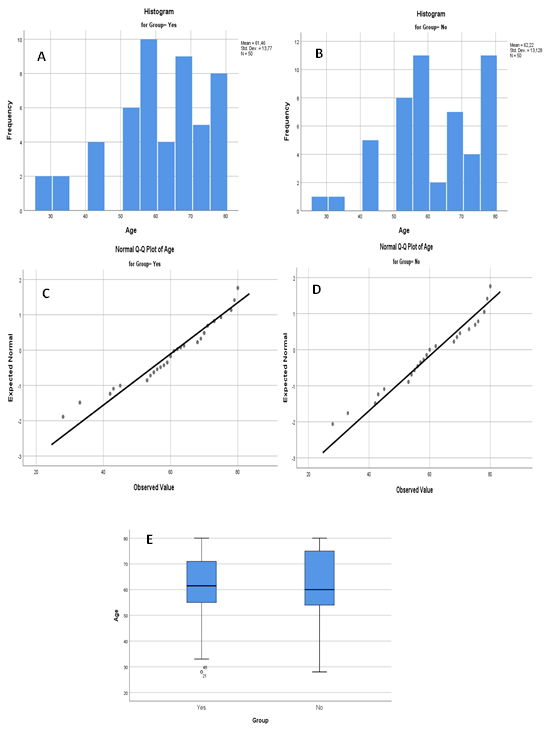
Figure 1: The results of normal distribution test for age factor. A) Histogram for Group A B) Histogram for Group B C) Q – Q Plot for Group A D) Q – Q Plot for Group B E) Boxplot for Group A and B.
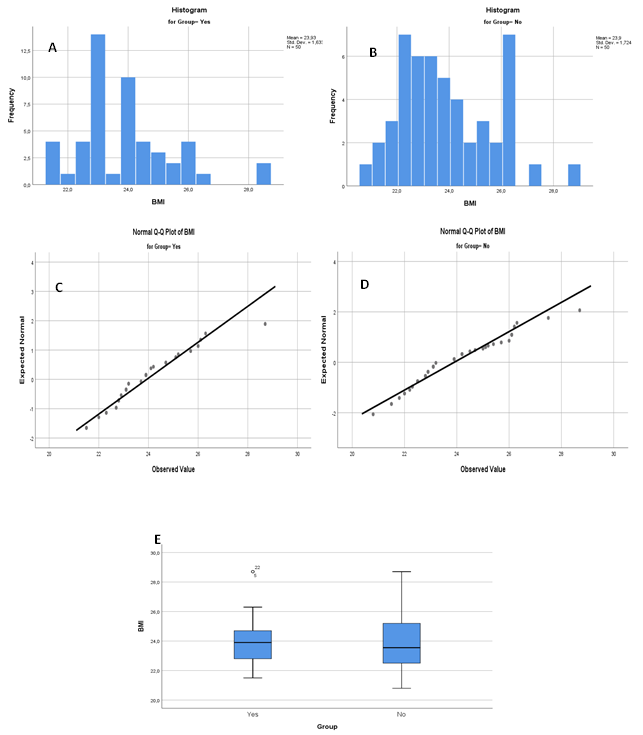
Figure 2: The results of normal distribution test for BMI factor. A) Histogram for Group A B) Histogram for Group B C) Q – Q Plot for Group A D) Q – Q Plot for Group B E) Boxplot for Group A and B.
3. Results
Because there were 2 categorical variables (use or not of acetylsalicylic acid and blood flow), we performed chi – square test in order to determine whether there is a real association between these 2 variables in the sample.
In the Group A receiving acetylsalicylic acid, 33 patients had triphasic flow in radial artery ultrasound (normal flow), 12 had biphasic flow (moderate stenosis) and 5 patients had monophasic flow (significant narrowing) or radial artery occlusion. In Group B, 9 patients had triphasic flow, 25 patients had biphasic flow, 16 patients had monophasic flow or radial artery occlusion (Table 3). Statistical analysis of ultrasound data showed that there is a statistically significant difference between patients who received acetylsalicylic acid as a precautionary measure for radial artery occlusion and non-treated patients X2 (2, N=100)=24.04, p < 0.05) (Table 4, Figure 3). Patients who did receive acetylsalicylic acid prophylaxis for radial arterial catheterization are more likely to experience severe stenosis or occlusion of the artery (Figures 4 and 5).
|
Results of Radial Artery Ultrasound |
Group |
Total |
|||
|
Yes |
No |
||||
|
Bloodflow |
Normalflow |
Count |
33 |
9 |
42 |
|
Expected Count |
21,0 |
21,0 |
42,0 |
||
|
Modaratestenosis |
Count |
12 |
25 |
37 |
|
|
Expected Count |
18,5 |
18,5 |
37,0 |
||
|
Significant stenosis/Occlusion |
Count |
5 |
16 |
21 |
|
|
Expected Count |
10,5 |
10,5 |
21,0 |
||
|
Total |
Count |
50 |
50 |
100 |
|
|
Expected Count |
50,0 |
50,0 |
100,0 |
||
Table 3: The results of radial artery ultrasound in the two groups of patients who were subjected to coronary angiography with TRA technique. 1st group received for 9 days acetylsalicylic acid 100 mg and 2nd group was untreated.
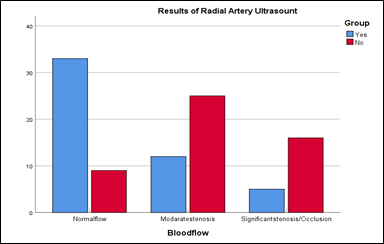
Figure 3: The results of radial artery ultrasound in the two groups of patients who were subjected to coronary angiography with TRA technique. Group 1 received 9 days acetylsalicylic acid of 100 mg as treatment after the angiography procedure while Group 2 was untreated.
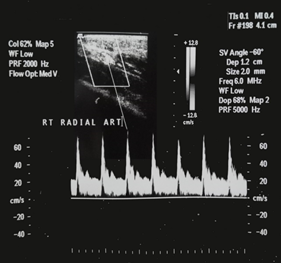
Figure 4: Male patient of group B. Moderate narrowing of 20-30% in the right radial artery, with two-phase inverted flow of the diastolic phase. The picture indicative moderate stenosis more centrally. Endothelial thickness as 0.08 cm.
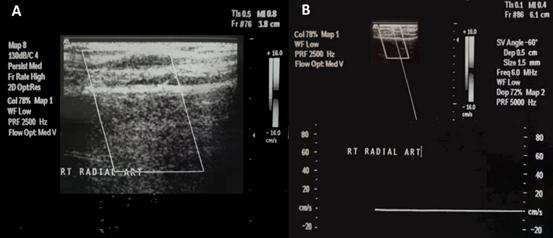
Figure 5: Male patient of group B. (Α) Right radial artery has no blood flow, which is indicative of occlusion. (Β) Image with no signal in spectroscopic control.
4. Conclusions
The results of the above study suggest that use of acetylsalicylic acid following coronary artery angiography with TRA technique may reduce the risk of the radial artery occlusion and its complications. Ultrasound is an easy and reliable method for assessing the flow of the radial artery.
5. Limitation
Limitation of the study was the small volume of patients.
Acknowledgments
None.
Conflicts of Interest
There is no conflict of interest.
References
- Campeau L. Percutaneous radial artery approach for coronary angiography. Cathet Cardiovasc Diagn 16 (1989): 3-7.
- Kiemeneij F, Laarman GJ, de Melker E. Transradial artery coronary angioplasty. Am Heart J 129 (1995): 1-7.
- Rao SV, Ou FS, Wang TY, et al. Trends in the prevalence and outcomes of radial and femoral approaches to percutaneous coronary intervention: a report from the National Cardiovascular Data Registry. JACC Cardiovasc Interv 1 (2008): 379-386.
- Asrar Ul Haq M, Tsay IM, Dinh DT, et al. Prevalence and outcomes of trans-radial access for percutaneous coronary intervention in contemporary practise. Int J Cardiol 221 (2016): 264-268.
- Baklanov DV, Kaltenbach LA, Marso SP, et al. The prevalence and outcomes of transradial percutaneous coronary intervention for ST-segment elevation myocardial infarction: analysis from the National Cardiovascular Data Registry (2007 to 2011). J Am Coll Cardiol 61 (2013): 420-426.
- Gutierrez A, Tsai TT, Stanislawski MA, et al. Adoption of Transradial Percutaneous Coronary Intervention and Outcomes According to Center Radial Volume in the Veterans Affairs Healthcare System Insights from the Veterans Affairs Clinical Assessment, Reporting, and Tracking (CART) Program. Circ Cardiovasc Interv 6 (2013): 336-346.
- Archbold RA, Robinson NM, Schilling RJ. Radial artery access for coronary angiography and percutaneous coronary intervention (Clinical review). BMJ 329 (2004): 443-446.
- Lotan C, Hasin Y, Mosseri M, et al. Transradial approach for coronary angiography and angioplasty. Am J Cardiol 76 (1995): 164-167.
- Mann 3rd JT, Cubeddu MG, Schneider JE, et al. Right radial access for PTCA: a prospective study demonstrates reduced complications and hospital charge. J Invas Cardiol 8 (1996): 40D-44D.
- Hildick-Smith DJR, Ludman PF, Lowe MD, et al. Comparison of radial versus brachial approaches for diagnostic coronary angiography when the femoral approach is contraindicated. Am J Cardiol 81 (1998): 770-772.
- Saito S. Transradial approach. Catheter Cardiovasc Interv 53 (2001): 269-270.
- Hamon M, Sabatier R, Zhao Q, et al. Mini-invasive strategy in acute coronary syndromes: direct coronary stenting using 5 Fr guiding catheters and transradial approach. Catheter Cardiovasc Interv 55 (2002): 340-343.
- Stella PR, Kiemeneij F, Laarman GJ, et al. Incidence and outcome of radial artery occlusion following transradial artery coronary angioplasty. Cathet Cardio- vasc Diagn 40 (1997): 156-158.
- Doyle BJ, Rihal CS, Gastineau DA, et al. Bleeding, blood transfusion, and increased mortality after percutaneous coronary intervention: implications for contemporary practice. J Am Coll Cardiol 53 (2009): 2019-2027.
- Jolly SS, Amlani S, Hamon M, et al. Radial versus femoral access for coronary angiography or intervention and the impact on major bleeding and ischemic events: a systematic review and meta-analysis of randomized trials. Am Heart J 157 (2009): 132-140.
- Agostoni P, Biondi-Zoccai GG, De Benedictis ML, et al. Radial versus femoral approach for percutaneous coronary diagnostic and interventional procedures: systematic overview and meta-analysis of randomized trials. J Am Coll Cardiol 44 (2004): 349-356.
- Jolly SS, Yusuf S, Cairns J, et al. Radial versus femoral access for coronary angiography and intervention in patients with acute coronary syndromes (RIVAL): a randomised, parallel group, multicentre trial. Lancet 37 7 (2011): 1409-1420.
- Romagnoli E, Biondi-Zoccai G, Sciahbasi A, et al. Radial versus femoral randomized investigation in ST-segment elevation acute coronary syndrome: the RIFLE-STEACS (Radial Versus Femoral Randomized Investigation in ST-Elevation Acute Coronary Syndrome) study. J Am Coll Cardiol 60 (2012): 2481-2489.
- Valgimigli M, Gagnor A, Calabró P, et al. Radial versus femoral access in patients with acute coronary syndromes undergoing invasive management: a randomised multicentre trial. Lancet 385 (2015): 2465-2476.
- Komócsi A, Aradi D, Kehl D, et al. Meta-analysis of randomized trials on access site selection for percutaneous coronary intervention in ST-segment elevation myocardial infarction. Arch Med Sci 10 (2014): 203-212.
- Bertrand OF, De Larochelliere R, Rodes-Cabau J, et al. Early Discharge After Transradial Stenting of Coronary Arteries Study Investigators A randomized study comparing same-day home discharge and abciximab bolus only to overnight hospitalization and abciximab bolus and infusion after transradial coronary stent implantation. Circulation 114 (2006): 2636-2643.
- Cooper CJ, El-Shiekh RA, Cohen DJ, et al. Effect of transradial access on quality of life and cost of cardiac catheterization: a randomized comparison. Am Heart J 138 (1999): 430-436.
- Azzalini L, Tosin K, Chabot-Blanchet M, et al. The Benefits Conferred by Radial Access for Cardiac Catheterization Are Offset by a Paradoxical Increase in the Rate of Vascular Access Site Complications with Femoral Access: The Campeau Radial Paradox. JACC Cardiovasc Interv 8 (2015): 1854-1864.
- Avdikos G, Karatasakis A, Tsoumeleas A., et al. Radial artery occlusion after transradial coronary catheterization. Cardiovascular diagnosis and therapy 3 (2017): 305-316.
- Kiemeneij F, Laarman GJ, Odekerken D, et al. A randomised comparison of percutaneous transluminal coronary angioplasty by the radial, brachial and femoral approaches: the access study. J Am Coll Cardiol 29 (1997): 1269-1275.
- Archbold RA, Robinson NM, Schilling RJ. Radial artery access for coronary angiography and percutaneous coronary intervention. BMJ: British Medical Journal 329 (2004): 443-446.