Matteo Cati
Department of Economics, University of Bologna, Bologna, Italy
*Corresponding author: Matteo Cati, Department of Economics, University of Bologna, Bologna, Italy.
Received: 14 March 2022; Accepted: 22 March 2022; Published: 28 March 2022
The Covid – 19 pandemic has become in a few time a syndemic, or in other words a complex of patholgies that not only is harming the health but also the economic, social, cultural and relational fabric of the nation’s hit by it. It is the first time in a century that the fate of many nations, not only in terms of collective health but also of economic performance and social stability, is closely linked to the identification and to the ability to produce and distribute enough doses of an effective, and affordable for all, vaccine. This article addresses an important question: in such a scenario is the scarcity in the vaccine, particularly at the initial stage, inevitable? The answer is that it is not and that its shortage is itself derived from a number of what Calabresi and Bobbit, in their masterpiece Tragic Choices name “first order” decisions, made by the various nations in their dealing with the relevant pharmaceutical companies. In other words scarcity is the result of a ‘domino effect’, a chain of decisions taken in succession whose dynamics is difficult to control and of which only upon the manifestation of the effects, in this case deleterious, does one realize the gravity of the situation. In doing so some remedy to the 'domino effect' is prospected and the italian scenario is described.
tragic choices, law and economics, public choices
1. Introduction
There are many reasons why the world rejoices or suffers [1], but lately there have been more reasons to listen to the sounds and also the silences of the suffering of the world and of its population hard hit by the Covid – 19 pandemic and by its economic and social devastating effects.
Its sudden outbreak seems to have highlighted, in many countries, the criticalities of their respective health systems, often due to past short-sighted investment choices. Since the very beginning of the ‘war against the world epidemic’, it was immediately clear to the global scientific community that there was no precise cure for the virus and that the world was not prepared for the events that were taking place. The emergency measures [2], such as lockdowns and curfews, issued by most part of the governments around the world to safeguard public health not only represented a limitation of rights and of personal freedoms but also a limitation of freedom of economic initiative that unfortunately determined the ongoing dramatic economic and social crisis.
The problem is that while the virus has hitted the population symmetrically, the taken measures (lockdowns…) have hitted the population asymmetrically, aggravating the already existing social and economic inequalities and creating new ones. Furthermore due to the pandemic the set of basic values that each society seems to have as a reference (such as the pricelessness of life, freedom, and essential rights) are at stake.
It was evident to everyone that the situation, which precipitated rapidly, was going to lead to dramatic choices: who should be treated and who not in the case of scarcity of intensive care units and of ventilators, who should risk to be infected in going to work and who not, what is best: to re - open and safeguard the economic system or to close and safeguard national health? Can a compromise be found? The answer to many of these questions and in particular to the last one is clearly represented by the discovery of an antidote to the virus. Now that more than one effective vaccine has been identified, there is an important question that at this stage arises and that this article addresses: the ability of governments to provide enough doses of the available vaccines for everyone in a short time has to be taken for granted or it is inevitable that there could be problems of unavailability of the vaccine?
All these dilemmas have a common denominator, in that they all imply a tragic choice. But when a decision can be defined tragic, what determines the emergence of such choices in a society and what is the role of public choice? As we will see, there are not easy and univocal answers to those questions.
2. Tragic choices in the making of public policy and the ‘domino effects’
As Calabresi and Bobbit (1978) in their masterpiece “Tragic Choices” show, even if it is not possible to precisely define a tragic choice, its insurgance depends on one side on the relative scarcity of the resources for which a society must decide their allocation and on the other side weather such decision is in a way or in another linked to values that for the society at that time are considered fundamental and that the society thinks to be repugnant to violate if the decision to be taken directly or indirectly implies so.
In other words Calabresi and Bobbit developed a logical connection between the notions of ‘tragic choices’, ‘scarcity of relevant resources’, ‘methods for their allocations’ and 'fundamental values of a society’, that can be summarized as follows:
- tragic choices are the consequence of scarcity of relevant resources linked to values that the society consider of vital importance and inviolable;
- scarcity of relevant resources implies the need of identifying methods for their allocation and such decision is extremely important as it can involve social costs;
- the chosen methods reveals the fundamental values of the society itself (in a kind of parallelism with the so called economic theory of revealed preferences that states that consumers choices are the best indicators of their preferences. Similarly the allocation methods of scarce resources chosen by a society defines the society itself).
But there is another problem that Calabresi and Bobbit consider and that is that the scarcity of relevant resources at the base of tragic choices can be the result of an incorrect decision-making mechanism on the part of policymakers in designing behavioral rules of public policy whose object must be:
“therefore, to define with respect to each particular tragic choice, that combination of approaches which most limits tragedy and which deals with that irreducible minimum in the least offensive way. Of course, that combination will vary, not only over time,…,but also from society to society, since the object is to find the approach which is less destructive of values fundamentally held in each society” [3].
The ways in which society treats tragic choices can be described by two ‘moving progressions’ [4] consisting of a:
- two stage choice used in order to allocate the scarce resources involved in tragic choices;
- and a succession of behaviors and feelings that characterize the aforementioned decision-making process, “when the society evades, confronts, and remakes the tragic choice” [5].
In particular the first ‘moving progression’ is described by ‘two kinds of determinations’:
- first stage, that Calabresi and Bobbit refer to as ‘first order determination’, expressed by the decision of how much to produce;
- second stage, namely ‘second order determination’, i.e. the decision of who receives what is produced.
- It is the interaction between the two stages with which the decision-making process is divided in tragic situations that may determine the arise of high social costs.
But there is another element that can affect greatly “the decision making apparatus” [6] i.e. the nature of the scarce resources that has to be distributed. What matters is how the resources considered became scarce and the “perceived cause of scarcity” [7], that has to be studied in the “stream of events” [8] within which scarcity occurs, is fundamental since it affects “the scope of the first order decision” [9] and its relationship with the second order decisions. In other words “scarcity cannot simply be assumed as given” [10], but it is necessary to examine retrospectively its genesis, ascertain the cause and effect chain that originated it and see if something could have been done to avoid those events.
One of the example that it can be found in “Tragic Choices” is about famine, which well describes the consequential chain of events and decisions that can give rise to what I define as ‘domino effect’, i.e. a chain of events in succession whose dynamics are difficult to control and of which only upon the manifestation of the effects, in this case deleterious, do one realize the gravity of the situation. As Calabresi and Bobbit, explain, it makes a lot of difference whether the famine was caused by a natural pestilence or drought, as the pestilence or drought may be viewed as caused by previous decisions made by society, as well as the fact that food shortages may be the result of a series of deliberate or random decisions that have shifted the workforce from agricultural to non-agricultural sectors.
In all possible situations, the scarce resource is food, but the nature of the good, which partly depends on the perception of the causes that led to its tragic scarcity, varies a lot and the formatting [11] of the 'first order decisions' in response to scarcity depends on what is the perception of the aforementioned causes. And still the features [12] of each individual tragic good are going to detect the factors at the base of the second order allocations of the tragically scarce resource.
Another element that affects how the first and the second order determinations are taken is the nature of the society making the tragic choice. As a matter of fact the same tragic choice can be treated differently by different societies on the basis of their economic, societal and cultural environment.
3. Tragic choices and the Covid – 19 vaccine
At the very beginning of the pandemic the sudden and unexpected surge in the number of Covid – 19 patients caused the shortage of medical and nursing personnel, of intensive care units, of respirators and of other equipment. In many cases and in different regions of the world such circumstances forced local and central authorities, hospital staff and others to take tragic decisions [13] (e.g. who to treat and who not), also to the disadvantage of patients with other pathologies.
The fluctuating trend of infections, due to the succession of the tightening and easing of emergency measures (in particular of total or partial lockdowns and curfews), made the management of the balance between the health emergency and the economic and social crisis rather a difficult task.
At this stage, when the global endemic in several countries of the world is worsening and no one is able to exactly forecast how many waves there are going to be and how long the pandemic will last, more than one effective vaccines, subject to scrutiny by the World Health Organization (WHO) and by other agencies such as the European Medicines Agency (EMA) and the US Food and Drug Administration (FDA), have been found. The matter now, see table 1, is to produce and distribute to the population enough doses of a Covid – 19 vaccine, affordable for everyone, as soon as possible in order to reach the herd immunity.

If we now apply the reasoning of Calabresi and Bobbit to the production and distribution of the Covid – 19 vaccine, see the table 2, we may divide the overall vaccine procurement and distribution mechanism into two distinct, but strictly linked between each other, decisions:
- the ‘first order decision’ that corresponds to the decision of how much doses of the vaccine to produce;
- the ‘second order decision’ that is the decision of what criterium to use in order to distribute the vaccine to the population
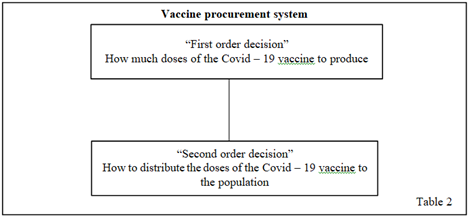
An efficient mechanism should be able to produce enough and affordable doses of the vaccine for everyone and to distribute them to all the population in a brief period of time i.e. to satisfy all the demand of the vaccine. On the contrary an inefficient mechanism is unable to do so i.e. to satisfy the existing demand giving rises to a shortage of the vaccine supply.
This simply means that the system described by the two – stage process of the first and second order decisions breaks down – see table 3 - due to the shortage of the vaccine supply.
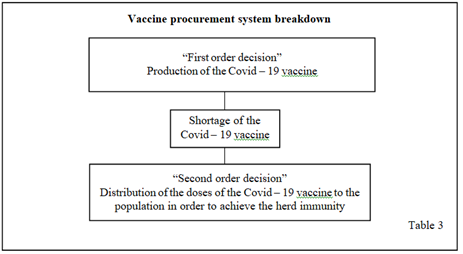
A question arises spontaneously: is the shortage of the vaccine inevitable?
As far as we are convinced that reality is not simply a set of random events, but is composed of an articulated succession of events, some of which are linked together by a cause - effect relationship, clearly in this perspective, the scarcity of vaccines is not an inevitable fact, but the result of a chain of events in which some initial decisions may have been fatal and at the basis of a real ‘domino effect’. The provision of the vaccines is itself derived from a number of “first order” decisions made by the various nations in their dealing with the relevant pharmaceutical companies, that have already developed a Covid – 19 vaccine [14].
The decision of how much doses of the vaccine to produce by the pharma companies depends, given the particular nature of the good and the urgency with which it must be available, on:
- technical issues that affect the ability of such companies to meet promptly the vaccine demand. In other words the production capacity of the pharmaceutical companies' plants is not sufficient to satisfy all the demand in a short time and this means on one side that the production of all the amount of vaccines will require more time then the one forecasted and on the other one the need for the pharmaceutical companies to increase the number of
- the fact that the production of the vaccines by the pharmaceutical companies is protected by international patents that give to the companies that discovered them the exclusive right to produce the
There is another element that affect the availability of vaccines linked to each individual country approval system of a new vaccine. Countries such as the United States and Britain act autonomously based on the decisions made respectively by the Food and Drug Administration and the Medicines and Healthcare products Regulatory Agency, while European countries are subject to the decisions of the European Medicine Agency that seems to act more slowly with respect the other agencies.
4. The role of patents for the Covid – 19 vaccines
The existence of patents, protecting the developers of the Covid – 19 vaccines, means that the vaccine cannot be produced locally by other pharmaceutical companies to meet the huge demand and solve the problem of its undersupply. As a result patents are at the base of the persistence of the vaccine shortage as it slows down the adaptation of supply to demand. From an economic perspective, the shortage of a good (a situation where the supply of the good is less than its demand) brings with itself, in the standard markets, an increase in the price of the good to fill the gap between supply and demand. This is a relevant issue since, even if it is linked to the vaccine distribution (second order decision), it may determine an unfair competition among its users (mainly different nations) on the basis of the willingness to pay.
The problem is that free markets clearly do not seem the right allocation method of the vaccine, since they could determine a biased and unfair distribution of the vaccine toward the nations that can afford it or, within the same nation, toward the parts of the population that can pay for it. Even if the idea of recognizing the intellectual property of those who produce new products is right, the situation changes drastically as the nature of the product produced and of which the developers have the patent is linked to the life expectancy of the population as in the case of a vaccine.
The reason for that is obviously linked to the enormous profits which the pharmaceutical companies that have discovered the various vaccines can obtain from their production and sale in international markets and to the fact an increase of the vaccine supply would determine a drop of its price and in the companies profits. These are essential problems, as many people's lives can depend on their solution. As a matter of fact the criteria chosen by the policymakers could determine an involuntary darwinian selection within the population that the pandemic seems to have already carried out, affecting more certain segments of the population.
What would be a solution to the vaccine patent problem? Apart from the possibility of increasing the budget for the purchase of vaccines (in order to try to overcome the tricks of some clauses of the contracts drawn up by pharmaceutical companies such as the best reasonable effort clause), another possible alternative could be the application of the so called Trips agreements of 2006, which in the event of public health emergencies allow States to resort to compulsory licensing, compensating pharmaceutical companies that developed vaccines.
Both these strategies would, although in different ways, solve the problem of vaccine shortages.
5. The Italian Case
In the opening of the Leviathan (1668), Hobbes personifies the state through the imaginary figure of the Leviathan
‘Art goes yet further, imitating that rational and most excellent work of Nature, man. For by art is created that great LEVIATHAN called a COMMONWEALTH, or STATE (in Latin, CIVITAS), which is but an artificial man, though of greater stature and strength than the natural, for whose protection and defence it was intended…(and (n.a.)) the salus populi (the people's safety) (is (n.a.)) its business’
The actions taken (as the declaration of the state of emergency and the imposition of strict lockdown measures) by many governments, and particularly by the Italian one, as a consequence of the sudden outbreak of the coronavirus epidemic have been considered by many observers as typical acts of a Leviathan State, that cares about its inhabitants so to consider the ‘salus populi’ to be the ‘suprema lex’, as Cicero stated in his opera De Legibus.
If we consider those actions from another perspectives, we may notice the establishment of a relationship of mutual trust between the government which imposes restrictive measures to the limit of unconstitutionality (such as the limitations of personal freedoms enforced by the lockdown), in exchange for the preservation of national health [15]. The problem is that the events that occurred in the worst months of the pandemic have undermined the confidence of the population by raising a series of questions relating to the choices made, for example by many hospitals. In addition, the resulting economic and social crisis that is materializing as a result of the restrictive measures of the lockdown has already given rise to protests in many countries and in Italy many observers fear that an aggravation of the social situation might happen, if the pandemic crisis were to return and that economic worsen.
The effects of the still ongoing pandemic around the world are in many expects devastating, not only because of the death toll’s, but also for the economic and social impact that is materializing and that resembles the eras of the war (but of a particular type, i.e. a war against a virus). The current state of the art in Italy, that was the first European country and one of the first country in the world severely hitted by the virus (particularly in the Northern regions) can be compared to 'the calm after the storm', recalling the famous poem by Giacomo Leopoardi (1829) [16], one of the most famous Italian poets. But what about what happened during the storm (and before it?). What if there will be a worsening off of the pandemic and a re – imposition of the lockdown?
Even though the kind of war that the world is facing is of another type, i.e a war against a virus and its devastating effects on the people’s health and of the nations’ economic system, it is rather intuitive to recall the description made by Bobbit (2002) [17], ‘The shield of Achilles: War, Peace and the Course of History’ (book I and II) of a ‘period where the constitutional order will be altered by new forms of warfare’ (Patterson 2003) [18]. What decisions were taken during the recent storm caused by the coronavirus that can be thought as exceptional? If not all, some of them were not only exceptional but also tragic.
Calabresi and Bobbit suggest in their famous opera ‘Tragic Choices’ (1978) [19] that ‘tragic choices arise from scarsity of goods, where there is a conflict between the societal values implicit of those goods and humanistic moral values’ [20]. During the storm the most relevant problem immediately detected in Italy, and in many countries around the world, was the shortage of the availability of enough intensive care units and ventilators in the hospitals, that caused the medical staff to make those kind of decisions that Calabresi and Bobbit (1978), whose contribution can be considered as fundamental, defined as tragic i.e. to decide who to treat or who not to cure.
During the worst period of the war against the virus (during the storm) in Italy, what was the criterion used by the medical staff to make their choices and what were the moral and ethical implications that those choices implied? Also those choices can represent an antecedent for the future? There is another important question we should ask ourselves, that is the tragic choices that the Italian national system has made are the result of an incorrect planning of public spending on health matters before the storm? Now that the fate of Italy as well as the one of many other countries seems to be linked to the production and distribution (whose success is linked to logistical issues that are often in the know - how of Armed Forces, Red Cross and other entities) of enough doses of Covid – 19 vaccines, the role of public choice and of policymakers has become vital. The Calabresi and Bobbit (1978) book has answered to those questions much before the events linked to the pandemic have happened and for this reason all governments should consider it as inspirational and a vademecum for good governance.
Acknowledgements:
I would like to express my deep and sincere gratitude to Professor Guido Calabresi for the inspirational conversation we had on the article. All errors remain mine.
Disclosures
The author has no conflicts of interest to declare
References
- “We cannot know why the world suffers. But we can know how the world decides that suffering shell come to some persons and not to others. While the word permits sufferers to be chosen, something beyond their agony is earned, something even beyond the satisfaction of the world’s needs and desires. For it is in the choosing that enduring societies preserve or destroy those values that suffering and necessity expose. In this way societies are defined, for it is by the values that are foregone no less than by those that are preserved at tremendous cost that we know a society’s character.” Calabresi, Guido and Bobbitt, Philip Chase, "Tragic Choices" (1978). Books. W.W. Norton and Company New York (1978): 17.
- Such measures were also suggested by international entities such as the World Health Organization (WHO) since the initial measures taken (such as wearing masks and social distancing) were not sufficient to counter the spread of the pandemic.
- Calabresi, Guido and Bobbitt, Philip Chase, "Tragic Choices". Books. W.W. Norton and Company New York (1978): 149.
- “Tragic choices show two kinds of moving progressions. First, there is society’s oscillation between the two sorts of decisions it must make about the scarce good. It must decide how much of it will be produced, within the limits set by natural scarcity, and also who shall get what is In this book the former decision is called a first - order determination and the latter a second – order determination or decision. Secondly, there is the motion that is composed of the succession of decision, rationalization, and violence as quiet replaces anxiety and is replaced by it when society evades, confronts, and remakes the tragic choice. These two movements, and the concepts they entail, are the patterns within which the various methods of allocation operate. In any particular example, such methods and movements from the plot and the story line of the tragic choice.” Calabresi, Guido and Bobbitt, Philip Chase, "Tragic Choices" (1978). Books. 83. W.W. Norton and Company New York (1978): 19.
- Calabresi, Guido and Bobbitt, Philip Chase, "Tragic Choices". Books. W.W. Norton and Company New York pag (1978): 19.
- Calabresi, Guido and Bobbitt, Philip Chase, "Tragic Choices". Books. W.W. Norton and Company New York (1978): 153.
- Ibidem note 5 , pag 151.
- Ibidme note 5, pag
- Ibidem note 5, pag
- Ibidem note 5, pag 151.
- “The few examples should suffice to give some notion of the vast universe of discrete but related ways in which a change in the nature of the good itself affects the decision making apparatus at the first order level”. Calabresi, Guido and Bobbitt, Philip Chase, "Tragic Choices" (1978). Books. 83. W.W. Norton and Company New York (1978): 153.
- “We must now concern ourselves with these characteristics of each individual tragic good which determine what adaptations in approaches are necessary to facilitate second – order allocations. These characteristics control the degree to which we can in fact use any factor on the basis of which we wish to make second - order distinctions. The particular tragic good affects this in three important It determines (1) the extent to which each factor can permissibly be taken into account (color of the factor); (2) the amenability of the factor to accurate, usabel expression (its expressive power); and (3) the costs of identifying, gathering, and organizing the data necessary to give content to the factor (its accessibility). Calabresi, Guido and Bobbitt, Philip Chase, "Tragic Choices". Books. 83. W.W. Norton and Company New York (1978): 154.
- But the pandemic has highlighted also acts of An example is what happened in a hospital (Saint Louis in Paris) in France (lettre à Denise - Le Monde, December 7, 2020) where a sick woman, elderly and with little chance of survival, gave up occupying the only intensive care bed available to leave it to those who could have a better chance of survival (2020).
- As an example in the western world the available vaccines are Pfizer – BioNtech (U.S. – Germany), Moderna (U.S.) and the so called Oxford - Astra Zeneca (GB – Italy), whose distribution is more simple since it does not require to be stored at very low temperatures (cold chain), necessary for example for the vaccines produced by Pfizer – BioNtech and Moderna. Some other vaccines are under sperimentation, such as the vaccine Jansenn made by the S. pharma company Johnson and Johnson (differently from the others it is a single shot vaccine) and the Italian GRAd-COV2 produced by Reithera, partly funded by the local Government. In other areas of the world different vaccines have already been used in order to immunize their population.
- The article 32 of the Italian Constitution states that “The Republic protects health as a fundamental right of the individual and the interest of the community, and guarantees free medical care to the Nobody can be obliged to a specific health treatment except by law. The law cannot in any case violate the limits imposed by respect for the human
- Leopardi Giacomo ‘The Calm after the Storm’. See in particular ‘O kindly Nature, these are your gifts, these are the delights you give to mortals. To be free of pain is our delight.’
- Bobbitt P. The shield of Achilles: War, peace, and the course of history (2002).
- Dennis Patterson, The New Leviathan, 101 MICH. L. REV. 1715 (2003).
- Calabresi Guido and Bobbit Philip ‘Tragic Choices’, W.W. Norton and Company, New York (1978).
- Morgan Derek. ‘Issues in medical law and ethics’, Cavendish Publishing Limited, London and Sydney (2001).